
Views: 231 Author: Yijia Plastic Publish Time: 2026-10-30 Origin: Site
Content Menu
● Why Custom Bar Mats Matter in Hospitality Branding
● Match Custom Bar Mats to Each Hotel and Resort Venue
>> Separate Guest-Facing and Staff-Facing Requirements
● Choosing PVC Bar Mats for Hotel Operations
>> Specify Performance Instead of Relying on Labels
>> Evaluate the Actual Service Environment
● Designing Custom Logo Bar Mats That Fit Your Brand
>> Build a Clear Visual Hierarchy
>> Adapt Artwork for Molded Production
>> Use Property-Specific Details Carefully
● Create a Procurement Brief Before Requesting Prices
● A Practical Sample-Approval Method for Hospitality Teams
>> Step 1: Check Appearance and Dimensions
>> Step 2: Run a Service Trial
>> Step 3: Repeat the Intended Cleaning Process
>> Step 4: Retain an Approved Reference Sample
● Understand Compliance Claims Before Approving an Order
>> RoHS Testing Has a Specific Scope
>> Proposition 65 Is Exposure-Based
>> Disney FAMA Is Not a Product-Safety Certificate
● Plan Cleaning Into the Product Design
● Measure Value Beyond the Purchase Price
● Working With Yijia Plastic Products Co., Ltd.
● Turn Your Hospitality Brand Into a Production-Ready Design
>> 1. What Size Should Custom Hotel Bar Mats Be?
>> 2. Can One Design Work Across an Entire Resort?
>> 3. Are PVC Bar Mats Dishwasher-Safe?
>> 4. Can Custom Bar Mats Be Used Outdoors?
>> 5. What Determines the Price of Custom Logo Bar Mats?
>> 6. What Should We Send to Start an OEM/ODM Project?
Custom bar mats for hotels and resorts should do more than display a logo. They should complement the property's identity, support beverage service, and remain practical through repeated cleaning. The strongest designs balance branding with the realities of a busy hospitality environment.
At Yijia Plastic Products Co., Ltd., we approach this balance from a manufacturer's perspective. With 18 years of experience in PVC soft-gift development and production, our starting point is straightforward: understand where the mat will work before deciding how it should look.
This guide explains how to choose materials, develop artwork, evaluate samples, and plan a consistent rollout across hotel bars and resort venues.

A hotel's identity comes through small, repeated details: glassware, menus, uniforms, lighting, and the surfaces guests see while ordering. A branded bar mat belongs within that system.
Unlike a promotional item handed out once, a countertop mat remains part of the service environment. It can place a property name, venue identity, or distinctive motif near the moment a drink is prepared and presented.
However, visibility alone is not enough. A crowded design can undermine a refined interior, while an impractical surface creates extra work for staff.
Our recommendation is to treat custom hotel bar mats as working fixtures rather than miniature advertising boards. Their visual role and operational role should reinforce each other.
Different outlets within one property rarely need identical mats. Build a shared design language, then adapt dimensions, colors, and artwork to each setting.
| Venue | Branding direction | Practical priority |
|---|---|---|
| Lobby lounge | Restrained property logo and coordinated colors | A tidy, discreet countertop presence |
| Cocktail bar | Venue wordmark or signature graphic | Space for frequent glass placement |
| Poolside bar | Clear contrast and a simplified resort identity | Evaluation under wet, outdoor conditions |
| Beach club | Distinctive destination-inspired artwork | Easy cleaning and suitable storage |
| Banquet service | A recognizable hotel identity | Portable, repeatable station setups |
A guest-facing mat may emphasize appearance. A service-station mat may prioritize working area and easy identification.
Before approving either design, ask bartenders where glasses, shakers, and tools actually sit. A logo hidden beneath equipment has little visual value. A decorative border that interrupts the working area may be equally unhelpful.
Map the station first. Design around it second.
Soft PVC offers a route to molded shapes, colored details, and raised branding. Nevertheless, material names alone do not establish performance.
The finished formulation, construction, dimensions, and production consistency all affect whether a mat suits its intended location.
For custom PVC bar mats, discuss:
- Overall length, width, and thickness.
- Flexibility and dimensional stability.
- Raised surface geometry and spill containment.
- Underside contact with the actual countertop.
- Compatibility with the property's cleaning procedure.
- Color consistency between approved samples and production.
Raised surfaces can separate glass bases from collected liquid, but they also create areas that need cleaning. Review drainage space and cleanability together.
Avoid assuming that "non-slip," "dishwasher-safe," or "heat-resistant" applies to every PVC mat. Request evidence and written care instructions for the specific product.
Poolside installations introduce different questions from indoor lounges. Ask suppliers to assess suitability for sunlight, temperature variation, sunscreen contamination, and the cleaning chemicals used on site.
For specialist requirements, compare alternative constructions rather than forcing one material into every application. Suitability should follow testing and intended use, not a broad claim that one material is universally superior.
Start with one primary element: the property logo, the outlet name, or a recognizable symbol.
Secondary details should earn their space. A tagline may work on a large service mat but become illegible on a narrow countertop format.
For most briefs, we recommend:
1. One dominant brand element.
2. A controlled color palette.
3. Adequate separation between lettering and textured areas.
4. A deliberate viewing direction.
The aim is recognition without visual clutter.
A logo that looks sharp on a screen may require adjustment for raised PVC construction. Very thin strokes, small enclosed spaces, and tightly packed lettering can become difficult to reproduce cleanly.
Provide vector artwork and color references. Ask the manufacturer to identify details that need simplification before tooling begins.
Approve a physical sample under the venue's lighting. Screen previews cannot fully communicate surface relief, flexibility, or the appearance of a colored material beside stone, wood, and glass.
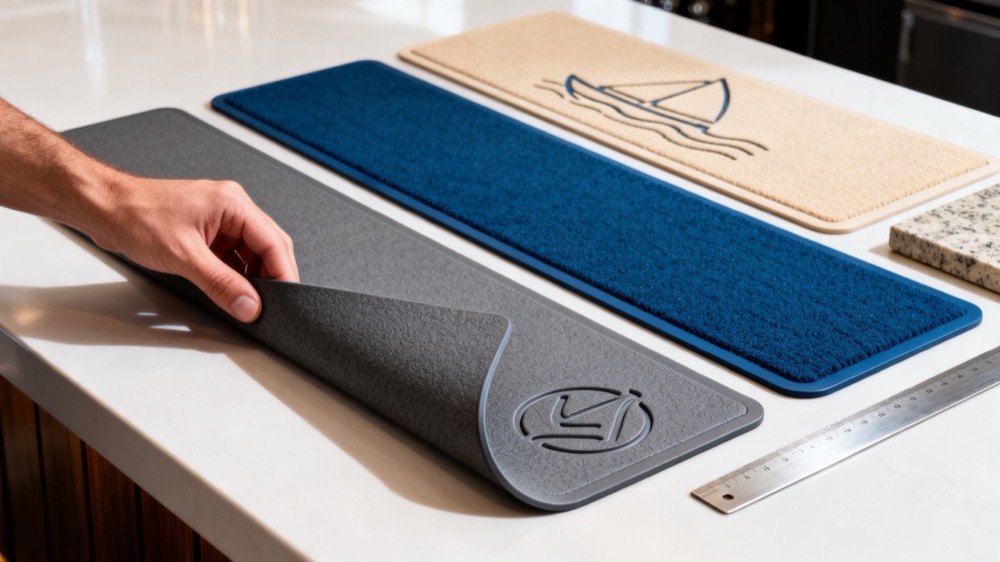
Custom bar mats for resorts can incorporate architectural outlines, local landscape motifs, or a distinctive venue emblem.
Keep these details subordinate to the main identity. A simplified coastal contour may work better than a detailed scenic illustration.
For group properties, maintain consistent logo placement while allowing approved local variations. This preserves family resemblance without making every destination feel interchangeable.
A detailed brief makes quotations easier to compare and reduces avoidable revisions.
Include the following information:
| Brief item | Information to provide |
|---|---|
| Deployment | Property names, outlets, and station locations |
| Dimensions | Available footprint and proposed mat size |
| Artwork | Vector files, color references, and orientation |
| Operating conditions | Indoor or outdoor use, countertop type, cleaning method |
| Quantities | Initial rollout, replacements, and property allocation |
| Documentation | Destination markets and required testing scope |
| Delivery | Required arrival date, packing, and shipping destination |
Ask suppliers to separate tooling, sampling, unit pricing, testing, packaging, and freight. A low unit price does not necessarily represent the lowest delivered project cost.
Also clarify ownership and retention of tooling, artwork revision rules, and the process for repeat orders.
A visual approval alone is insufficient. We recommend a short operational pilot before committing to a property-wide or multi-property order.
The following is a proposed evaluation method, not a universal testing standard.
Compare the sample with the approved drawing and color reference.
Inspect logo clarity, edge finishing, thickness consistency, and whether the mat lies flat. Photograph it in position with the actual glassware and countertop.
Place the sample at an agreed station during representative service periods.
Ask staff to record:
- Movement on the countertop when wet and dry.
- Stability of the glassware used at that outlet.
- Whether spills remain manageable.
- Interference with tools or service routines.
- Time and effort needed for cleaning.
A practical trial is more useful than asking whether staff simply "like" the mat.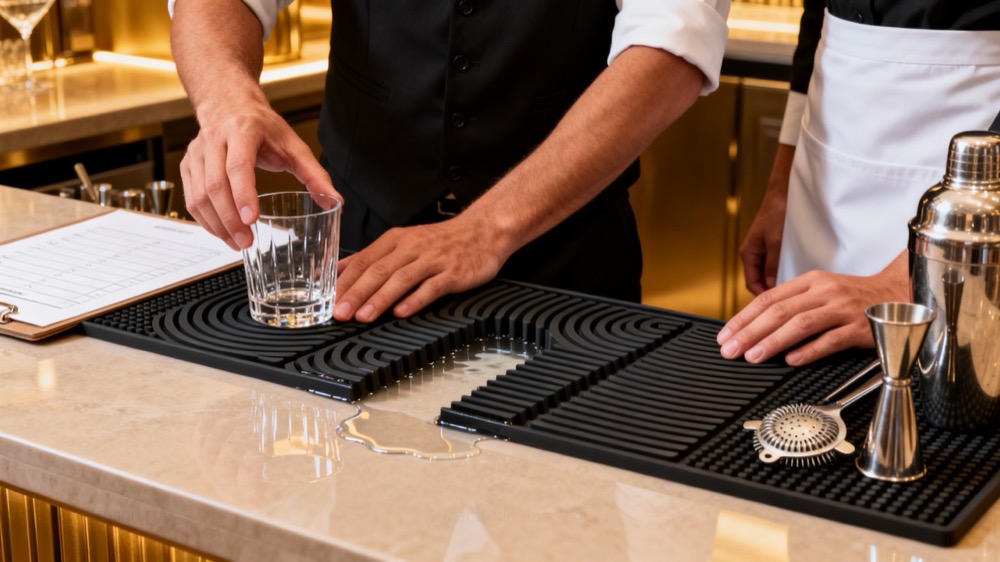
Follow the supplier's instructions and the property's approved hygiene procedure.
Check for visible changes in color, shape, surface condition, and residual odor. Record the cleaning products, dilution, temperature, and number of cycles used.
This creates a repeatable basis for approval rather than relying on memory.
Keep a signed sample and its specification record.
Use them to evaluate production deliveries and future reorders. Record agreed tolerances and inspection criteria in writing before production starts.
Hospitality buyers should distinguish chemical testing, legal obligations, and brand-production authorization. These are not interchangeable.
The EU RoHS Directive restricts certain hazardous substances in electrical and electronic equipment. An ordinary non-electrical bar mat does not become universally approved for hospitality use because its materials were tested against RoHS substance limits.
If a supplier provides such a report, review the tested sample, substances, methods, and results. Do not treat it as evidence of food-contact suitability.
California Proposition 65 concerns warnings for exposure to listed chemicals. It is not a general product-certification scheme.
For California-bound orders, ask for relevant documentation and obtain qualified advice where necessary. Whether a warning is required depends on the applicable exposure assessment, not simply the presence of a supplier's certificate.
Disney's Facility and Merchandise Authorization relates to authorized production involving Disney intellectual property. It does not establish that an unrelated hotel bar mat meets every safety requirement.
If licensed artwork is involved, confirm the authorization applicable to the facility, licensee or vendor, and project before production.
A bar mat can collect spills without making the service station hygienic by itself.
The FDA Food Code provides a useful reference: nonfood-contact equipment surfaces should be designed for easy cleaning and cleaned often enough to prevent soil accumulation. Local requirements and the actual use of the mat still govern the operating procedure.
For hotel teams, the practical implications are clear:
- Remove collected liquid and residue promptly.
- Clean beneath the mat as well as its upper surface.
- Follow validated washing and drying instructions.
- Replace mats that become damaged or difficult to clean.
- Do not place food directly on a mat without appropriate suitability documentation.
Do not assume that a chemical test report proves suitability for direct food contact or repeated dishwasher cycles.
Custom hotel bar mats should be evaluated as operating supplies with a branding function.
A useful internal calculation is:
Cost per service day = total allocated purchasing cost ÷ actual service days before replacement.
Include relevant tooling, freight, and replacement costs. Use observed service life rather than an unsupported durability promise.
For a pilot, track cleaning time, replacement frequency, staff feedback, and visual condition. These indicators help procurement teams compare options.
Brand recognition may be a project objective, but do not attribute higher beverage revenue to a mat without evidence. Operational improvements and commercial outcomes require separate measurement.
Yijia combines research and development, manufacturing, and sales of PVC bar mats and other soft PVC gifts.
Our company background includes 18 years of experience, a 3,000-square-meter factory, 10 automated production lines, and advanced dispensing equipment. We provide one-stop OEM/ODM customization for international customers.
Our stated cooperation experience includes Starbucks, Disney, McDonald's, Pop Mart, and Tencent. These relationships should not be interpreted as endorsements of every product or authorization to reproduce their trademarks.
For hospitality projects, the useful next step is to connect these manufacturing capabilities with a precise brief: your venue, artwork, operating requirements, documentation needs, and delivery schedule.
Request the current reports and authorizations relevant to your order rather than relying on a general credentials list.
The most effective custom bar mats for hotels and resorts fit both the brand and the station where they work.
Send Yijia your logo, proposed dimensions, outlet details, quantities, and destination market. Request a project-specific quotation, an artwork review, and a physical sample for operational approval before bulk production.
Measure the usable countertop and identify the glasses and tools that need space. Choose dimensions around the station layout rather than assuming a standard size will fit every outlet.
Yes, but a shared design system often works better than one identical product. Keep core branding consistent while adjusting dimensions and approved colors for individual venues.
Not automatically. Suitability depends on the finished product and washing conditions. Obtain written instructions and validate the proposed process before including dishwasher cleaning in staff procedures.
They may be suitable, but outdoor performance must be evaluated for the specific formulation and environment. Discuss sunlight, temperature, cleaning chemicals, and storage before approval.
Dimensions, material requirements, artwork complexity, tooling, order quantity, testing, packaging, and delivery all affect the quotation. Compare suppliers against the same specification.
Provide vector artwork, dimensions, color references, quantities, destination markets, intended use, and the required delivery date. Include cleaning requirements and any property-specific purchasing standards.
1. U.S. Food and Drug Administration — "Food Code 2022." Source for the model food-service hygiene framework; local adoption and requirements may differ. [fda]
2. U.S. Food and Drug Administration — "FDA Food Code 2022: Full Document," particularly Sections 4-202.16, 4-601.11, and 4-602.13 concerning nonfood-contact surface construction, cleanliness, and cleaning frequency. [fda]
3. European Commission, Directorate-General for Environment — "RoHS Directive." Source for the directive's electrical and electronic equipment scope and restricted-substance framework. [environment.ec.europa]
4. California Office of Environmental Health Hazard Assessment — "Business Resources: Proposition 65 Warnings." Source for exposure-based warning responsibilities and circumstances in which warnings are not required. [p65warnings.ca]
5. California Office of Environmental Health Hazard Assessment — "Frequently Asked Questions for Businesses." Additional guidance on determining warning requirements and consulting qualified professionals. [p65warnings.ca]
6. The Walt Disney Company — "Facility and Merchandise Authorization Application and Instructions." Source for the requirement to obtain applicable authorization before producing or handling Disney-branded products. [thewaltdisneycompany]
7. The Walt Disney Company — "International Labor Standards Program Manual." Source clarifying that FAMA authorization is specific to the relevant licensee or vendor and facility. [thewaltdisneycompany]


