
Views: 298 Author: Yijia Plastic Publish Time: 2026-11-05 Origin: Site
Content Menu
● PVC Bar Mat vs. Silicone Bar Mat: Quick Comparison
● What Constant Water and Ice Exposure Really Means
>> Water Resistance Is Only the Starting Point
>> Spill Containment Is Not the Same as Drainage
● Material Performance: PVC vs. Silicone Under Wet Conditions
>> Flexible PVC: Evaluate the Formulation, Not Just the Label
>> Silicone: A Strong Heat-Resistance Candidate, Not an Automatic Winner
>> Ice Exposure Does Not Automatically Require Silicone
● Wet Grip, Glass Stability, and Surface Design
>> "Non-Slip" Requires a Real Countertop Test
>> Raised Features Must Support Glassware Without Blocking Cleaning
● Cleaning and Hygiene: Neither Material Is Self-Cleaning
>> Separate Material Resistance From Hygienic Performance
>> Dishwasher-Safe Must Be a Finished-Product Claim
● A Practical Side-by-Side Trial Before Bulk Ordering
>> Step 1: Compare Equivalent Samples
>> Step 2: Measure Usable Spill Capacity
>> Step 3: Simulate Your Actual Cocktail Workflow
>> Step 4: Repeat Approved Cleaning Cycles
>> Step 5: Include Bartender Feedback
● Purchase Price vs. Total Operating Cost
>> Compare More Than the Unit Quote
>> Use a Simple Ownership Calculation
● Compliance Documents: What Buyers Should Actually Check
>> Material Names Do Not Establish Food-Contact Suitability
>> RoHS, Proposition 65, and Disney FAMA Have Different Roles
● Choosing a Custom PVC Bar Mat With Yijia
● Final Recommendation: Choose Around the Working Conditions
>> 1. Is PVC or Silicone Better for Constant Ice Melt?
>> 2. Does a Silicone Bar Mat Dry Faster?
>> 3. Can PVC Bar Mats Go in a Dishwasher?
>> 4. Are Silicone Bar Mats Automatically Food-Safe?
>> 5. Which Material Provides Better Wet Grip?
>> 6. When Should a Bar Mat Be Replaced?
Choosing a PVC bar mat vs. silicone bar mat for cocktail stations with constant water and ice exposure is not simply a question of which material handles moisture better. Both can work in wet environments. The more useful questions concern spill capacity, wet-counter stability, cleaning conditions, customization, and replacement cost.
From our manufacturing perspective at Yijia Plastic Products Co., Ltd., we recommend starting with the station's workflow rather than choosing a material by reputation. A well-designed PVC bar mat can suit a busy, brand-focused cocktail station. A silicone bar mat deserves closer consideration when verified heat resistance and demanding cleaning conditions drive the purchase.
The deciding factor is fit: the right formulation, surface design, and maintenance routine for your operation.

The table below provides a purchasing framework, not a guarantee for every product. Finished-mat performance depends on formulation, dimensions, construction, and testing.
| Comparison factor | PVC bar mat | Silicone bar mat |
|---|---|---|
| Water and ice exposure | Suitable formulations resist moisture | Silicone has strong water resistance |
| Spill management | Depends on rim height, usable volume, and surface layout | Depends on the same design factors |
| Heat resistance | Require a product-specific temperature limit | Generally offers a stronger heat-resistance margin |
| Wet-counter grip | Must be evaluated on the actual countertop | Must also be evaluated on the actual countertop |
| Cleaning | Follow approved detergent and temperature instructions | Heat tolerance does not automatically establish dishwasher suitability |
| Branding | Well suited to molded, multicolor custom designs | Customization is possible; confirm available processes |
| Purchase cost | Obtain a quote for the specified design and quantity | Compare equivalent specifications, not material names alone |
| Best purchasing approach | Validate the finished production sample | Validate the finished production sample |
Cocktail stations expose mats to more than clean water. Melted ice mixes with citrus juice, syrups, spirits, garnish fragments, and cleaning residues.
PVC is available in moisture-resistant formulations, while silicone technical literature documents strong resistance to water exposure. Neither fact establishes how a particular finished bar mat will perform after repeated service and cleaning.
A mat can resist water yet still overflow, slide, trap residue, or take too long to clean.
Our first purchasing question would therefore be: "What causes problems at this station today?" The answer may point toward deeper spill containment, easier cleaning, or a different footprint rather than a different polymer.
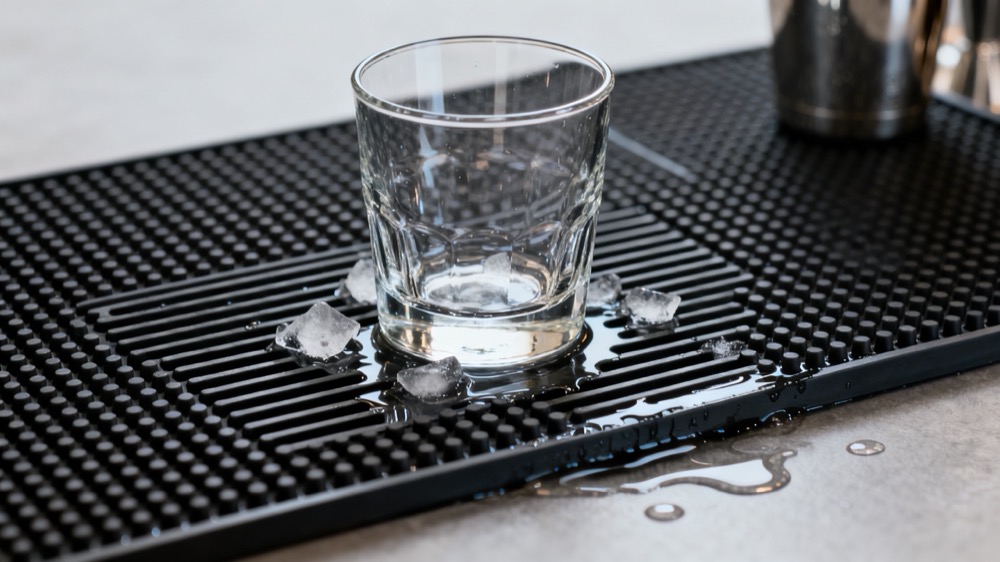
Most solid bar mats collect liquid between raised features. Unless they have an outlet, they do not continuously drain it away.
This distinction matters during peak service. Once collected liquid reaches the working surface, glass bases may sit in diluted drink residue.
Assess three separate characteristics:
- How much liquid the mat holds before overflowing.
- How high glassware sits above collected liquid.
- How easily staff can lift and empty the mat.
A taller perimeter alone does not prove greater usable capacity. Raised logos and closely packed studs also occupy space.
Flexible PVC uses a formulation selected to achieve the required softness and processing characteristics. Plasticizers, stabilizers, pigments, and other ingredients affect the finished product.
That makes broad statements such as "all PVC mats perform identically" unreliable.
For a custom PVC bar mat, request:
- The intended operating and cleaning temperature limits.
- Relevant restricted-substance documentation.
- Compatibility information for your cleaning products.
- A production-representative sample.
A soft initial feel is not enough. The sample should retain acceptable shape, surface condition, and usability after your actual cleaning routine.
Silicone rubber is recognized for heat and cold resistance. Manufacturer technical literature also describes strong performance during water immersion.
These properties make silicone worth evaluating when mats encounter hotter washing conditions or nearby hot equipment.
However, generic silicone temperature ratings should not become finished-product claims. Pigments, construction, decorative components, and processing can affect the mat's suitability.
Ask for the finished mat's documented limits. Do not assume that every silicone bar mat is suitable for boiling, commercial dishwashing, or unlimited chemical exposure.
A cocktail station with ice melt is different from prolonged subzero storage.
For ordinary wet service, containment, stability, and cleanability may matter more than extreme-temperature capability. If mats will be stored in a freezer, make that a separate specification.
A mat that grips dry stainless steel may behave differently on wet stone or a syrup-contaminated surface.
Material choice alone cannot establish slip resistance. Base texture, weight, flatness, countertop finish, and trapped liquid all influence movement.
Before ordering, test each sample:
1. On the actual dry countertop.
2. With water underneath.
3. Under a representative spill condition.
4. After the approved cleaning procedure.
Check movement when placing a shaker, lifting glassware, and reaching across the station. A simple stationary push test may miss problems that appear during service.
Closely packed studs can support smaller glass bases, but narrow gaps may be harder to inspect and clean.
Wider channels may improve access, yet their spacing must still support the glassware used at the station.
Include your smallest glass base, largest shaker, and common service vessels in sample evaluation. Review the branded logo area as carefully as the rest of the surface: decoration should not create unstable resting points or inaccessible pockets.
Water resistance does not prevent residue accumulation.
Food-service guidance emphasizes cleanable surfaces and the removal of soil. Where applicable, equipment and utensils also require appropriate sanitizing and air-drying procedures.
For bar mats, the practical implications are straightforward:
- Remove garnish fragments and other debris.
- Empty collected liquid before handling.
- Wash the channels, perimeter, and underside.
- Rinse and sanitize where required.
- Allow appropriate air drying before storage.
Follow local requirements, chemical labels, and the mat manufacturer's instructions. A bar mat's intended contact with food, glass rims, or utensils also affects the documentation and procedures needed.
Silicone's heat resistance can be useful, but it does not automatically establish dishwasher compatibility.
Commercial washing introduces temperature, detergent chemistry, mechanical action, and repeated cycles. PVC products likewise need clear cleaning limitations rather than assumptions.
Request a defined washing specification. "Easy to clean" is not sufficiently precise for procurement.
For either material, inspect for cracking, tackiness, distortion, damaged decoration, and residue that remains inaccessible after cleaning.
Instead of relying on unsupported lifespan promises, we recommend a controlled station trial. The following is a proposed purchasing method, not a published laboratory standard.
Use PVC and silicone samples with similar footprints and intended working capacity. Otherwise, a larger or deeper mat may appear superior for reasons unrelated to material.
Record dimensions, weight, surface layout, and supplier cleaning instructions.
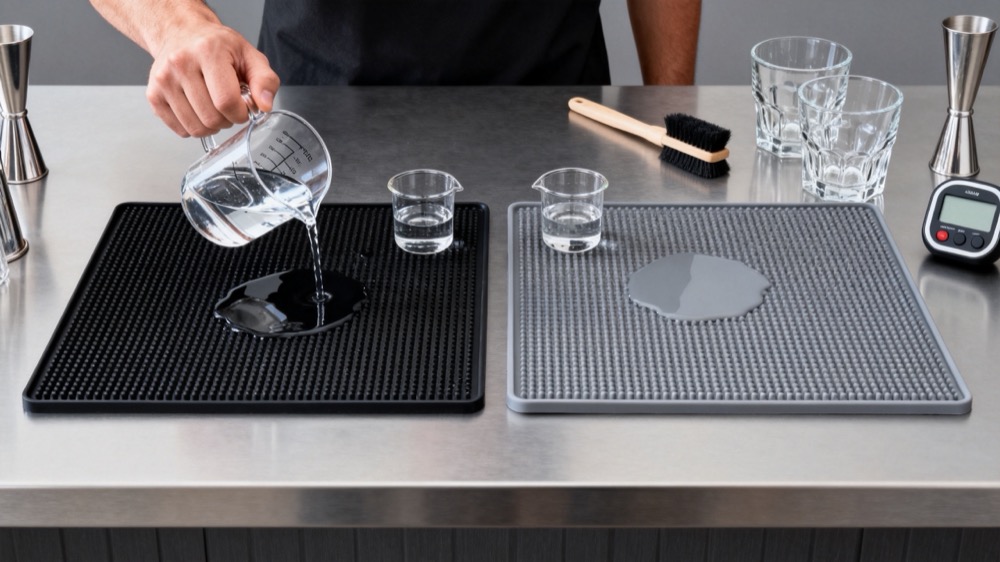
Place the mat level and add measured water until it reaches a predetermined working limit below the raised contact surface.
Record that volume separately from the volume at overflow.
The working-limit measurement is often more useful because it reflects when glass bases begin contacting collected liquid.
Use measured quantities of the beverages and ingredients normally encountered at the station.
Observe:
- Whether liquid spreads beyond the mat.
- Whether glassware remains stable.
- Whether the mat moves.
- Whether sticky residue is easily removed.
Use the same quantities and sequence for both samples.
Apply each supplier's approved cleaning method. Record cycle count, appearance changes, cleaning time, and dimensional changes.
Set acceptance criteria before testing. For example, specify that the mat must remain flat, retain readable branding, and show no visible surface damage.
Ask staff about lifting, emptying, glass placement, and cleaning access.
A mat that performs well in a static comparison may still be awkward during service. Operator feedback helps identify problems that product photographs cannot reveal.
A useful cost comparison includes:
- Tooling and artwork preparation.
- Unit price and order quantity.
- Freight and packaging.
- Cleaning labor.
- Spare-stock requirements.
- Replacement frequency.
Do not assume a fixed price premium or service-life advantage for either material without comparable quotations and operating evidence.
A lower-priced mat may offer better value when it meets the workflow requirements. A more expensive option may justify its price if verified performance reduces replacement or handling costs.
Compare total purchasing, cleaning, and replacement costs over the same operating period, then divide by the number of service days.
Use your own labor rates and trial results. This produces a more defensible decision than comparing unsupported claims such as "lasts twice as long."
Neither "PVC" nor "silicone" alone proves suitability for every food-contact application.
Define whether the mat will contact glass bases only, drink-contact rims, utensils, garnishes, or exposed food. Then request documentation relevant to the intended use and destination market.
Reports should identify the tested sample, material or product, test scope, and date.
RoHS primarily concerns restricted substances in electrical and electronic equipment. Testing a non-electrical mat against related substance limits does not establish food-contact suitability.
California Proposition 65 addresses warnings about relevant chemical exposures. It should not be presented as a universal product-safety certification.
Disney FAMA concerns facility and merchandise authorization within Disney's manufacturing framework, rather than blanket proof of a bar mat's material performance.
These distinctions help buyers interpret supplier credentials accurately.
Yijia Plastic Products Co., Ltd. brings 18 years of experience in the research, development, production, and sale of PVC soft-rubber gifts.
Our manufacturing setup includes a 3,000-square-meter factory, 10 automated production lines, and multiple dispensing machines. We provide one-stop OEM/ODM customization and have experience cooperating with Starbucks, Disney, McDonald's, Pop Mart, and Tencent.
For a cocktail-station project, we recommend reviewing the working design before finalizing the artwork:
- Counter dimensions and available footprint.
- Glassware and shaker sizes.
- Expected spill volume.
- Raised-logo placement.
- Channel accessibility.
- Cleaning chemicals and temperatures.
- Destination-market documentation.
Our reported RoHS-related, Proposition 65-related, and Disney FAMA credentials should be reviewed through the relevant supporting documents and their specific scope.
For a wet cocktail station prioritizing custom branding and a tailored footprint, a properly specified PVC bar mat is a practical option to evaluate.
For stations where verified heat resistance is a major requirement, silicone deserves particular attention.
Constant water and ice exposure alone does not establish a universal winner. Compare finished samples for containment, stability, cleaning, and operating cost.
Send Yijia your counter dimensions, artwork, target quantity, destination market, and cleaning conditions. Request a custom PVC bar mat proposal and production-representative sample before confirming your bulk order.
Both can suit wet service. Compare usable spill capacity, glass support, wet-counter movement, and cleaning performance. The better finished design may matter more than the material name.
Not necessarily. Water remains in channels and beneath the mat. Geometry, airflow, emptying method, and storage position affect drying, so compare actual samples.
Only when the supplier approves the finished product for the specified dishwasher conditions. Request temperature, detergent, and cycle guidance rather than assuming compatibility.
No. Suitability depends on the finished formulation, intended contact, and applicable requirements. Request relevant documentation for the product being purchased.
There is no reliable universal winner. Test both finished mats on your actual countertop, including conditions with water underneath.
Replace it when damage, persistent distortion, instability, or inaccessible residue prevents acceptable use and cleaning. Avoid relying on an unsupported calendar-based lifespan.
1. U.S. Food and Drug Administration. [Food Code 2022]. Basis for equipment cleanability, cleaning, sanitizing, and drying guidance; application depends on local adoption and intended use. [fda]
2. Shin-Etsu Silicone. [Characteristic Properties of Silicone Rubber Compounds]. Technical background on silicone's temperature resistance, water exposure, and chemical limitations; not a finished-bar-mat specification. [shinetsusilicone-global]
3. The Vinyl Institute. [PVC Uses in Everyday Life]. Industry background on PVC's versatility and moisture resistance; not independent comparative testing of bar mats. [vinylinfo]
4. The Vinyl Institute. [Understanding the Science Behind PVC Safety]. Background on formulation, additives, and end-use-specific evaluation. [vinylinfo]
5. European Commission. [Restriction of Hazardous Substances in Electrical and Electronic Equipment]. Source for the scope and purpose of RoHS. [environment.ec.europa]
6. California Office of Environmental Health Hazard Assessment. [About Proposition 65]. Source for exposure-warning requirements and the distinction from general product certification. [oehha.ca]


