
Views: 264 Author: Yijia Plastic Publish Time: 2026-10-17 Origin: Site
Content Menu
● PVC Heat Insulation Mat vs. Ceramic Coaster: Quick Comparison
● What Are You Actually Comparing?
>> PVC Heat Insulation Mats: Flexible, Customizable Table Protection
>> Ceramic Coasters: Glazed and Absorbent Designs Differ
● Heat Insulation: Protecting the Table Without Overpromising
>> Low Heat Transfer Is Not the Same as High Heat Resistance
>> Ceramic Still Requires a Complete-System Check
● Grip, Condensation, and Table Protection
>> PVC Coasters Can Collect Water Without Absorbing It
>> Ceramic Absorbency Depends on the Finish
● Cleaning and Hygiene During Restaurant Service
>> Cleaning Considerations for PVC Heat Insulation Mats
>> Cleaning Considerations for Ceramic Coasters
● Durability, Noise, and Guest Experience
● Custom Branding and Manufacturing Practicality
>> When Custom PVC Coasters Make Sense
>> When Ceramic Branding Works Better
● A Better Cost Comparison: Cost per Service Cycle
● A Practical Seven-Day Restaurant Trial
>> Days 1–2: Establish a Baseline
>> Days 3–5: Test Normal Service
● Compliance Documents: Ask What Each One Actually Demonstrates
>> RoHS Does Not Establish Food-Contact Safety
>> California Proposition 65 Is a Warning Framework
>> Disney FAMA Is a Facility Authorization
● Working With Yijia on Custom Restaurant Coasters
>> Is a PVC heat insulation mat better than a ceramic coaster for restaurants?
>> Can PVC coasters hold very hot cups?
>> Are ceramic coasters always absorbent?
>> Which coaster is easier to clean?
>> Can either coaster go in a commercial dishwasher?
>> Are PVC coasters suitable for direct food contact?
A PVC heat insulation mat is often the more practical choice for busy restaurant tables where impact resistance, quiet handling, and custom branding matter. A ceramic coaster can be the better fit when a refined appearance and a rigid serving surface take priority. However, comparing a PVC heat insulation mat vs. ceramic coaster requires more than choosing between flexible plastic and fired clay.
The real question is how each finished product performs with your drinks, furniture, cleaning routine, and service pace.
At Yijia Plastic Products Co., Ltd., our manufacturing perspective starts with fit: the right coaster should suit the restaurant's operating conditions, not simply look attractive in a sample photograph. Here is how we recommend evaluating both options before placing a bulk order.

This comparison concerns beverage coasters and small tabletop mats—not trivets for cookware.
| Buying consideration | PVC heat insulation mat | Ceramic coaster |
|---|---|---|
| Material structure | Flexible, formulation-dependent plastic | Rigid, fired ceramic body |
| Everyday handling | Cushions contact and avoids ceramic-style chipping | Can chip or fracture after impacts |
| Heat protection | Requires a verified temperature and exposure limit | Requires finished-product assessment; backing may limit performance |
| Condensation management | Usually nonabsorbent; may collect water in surface channels | Depends on glaze, porosity, and surface treatment |
| Grip | Texture and flexibility can help; test when wet | Often depends heavily on backing |
| Cleaning | Surface relief affects cleaning effort | Glaze, exposed edges, and backing affect cleaning |
| Branding | Molded shapes, raised details, and multiple colors | Printed, glazed, or decorated finishes |
| Restaurant atmosphere | Casual, promotional, family-friendly | Formal, minimalist, or craft-focused |
Neither category guarantees dishwasher compatibility, stain resistance, or protection against furniture damage. Those claims need evidence for the actual product.
A soft PVC coaster uses a flexible formulation that can be molded into different shapes and surface patterns. Plasticizers help make PVC flexible, while other formulation choices influence its finished properties.
For restaurant buyers, this creates useful design freedom: a coaster can combine a logo, a shallow condensation channel, and a textured underside.
However, "PVC heat insulation mat" is a product description, not a standardized heat-resistance rating. It does not establish a safe operating temperature.
"Ceramic coaster" also describes several different products.
A glazed coaster generally presents a smoother, less absorbent face. An unglazed, porous design may absorb condensation, but its stain behavior and drying requirements need evaluation. Porcelain is a ceramic subtype with relatively low porosity; it should not be treated as identical to every other ceramic body.
Backing matters, too. Cork, foam, or another underside material can change grip, cleaning compatibility, and heat performance.
A material can slow heat transfer yet still deform when exposed to excessive heat. This distinction is especially important when purchasing PVC heat insulation mats for restaurants.
Ask suppliers to identify:
- The maximum recommended contact temperature.
- Whether that limit covers brief or continuous exposure.
- The tested mat thickness and formulation.
- The contact duration and loading conditions.
- Any observed deformation, discoloration, or surface transfer.
Do not use the temperature of the drink as a substitute for measuring the cup's underside. Vessel construction and contact conditions influence what reaches the coaster.
A ceramic face does not automatically make the entire coaster suitable for very hot cookware. Adhesive, decoration, and backing can introduce separate limitations.
For either material, test the actual combination of vessel, coaster, contact time, and tabletop finish. A coaster that survives the test may still allow an unacceptable temperature rise at the furniture surface.
For skillets, oven dishes, and hot pots, specify a purpose-rated trivet rather than relying on a beverage coaster.
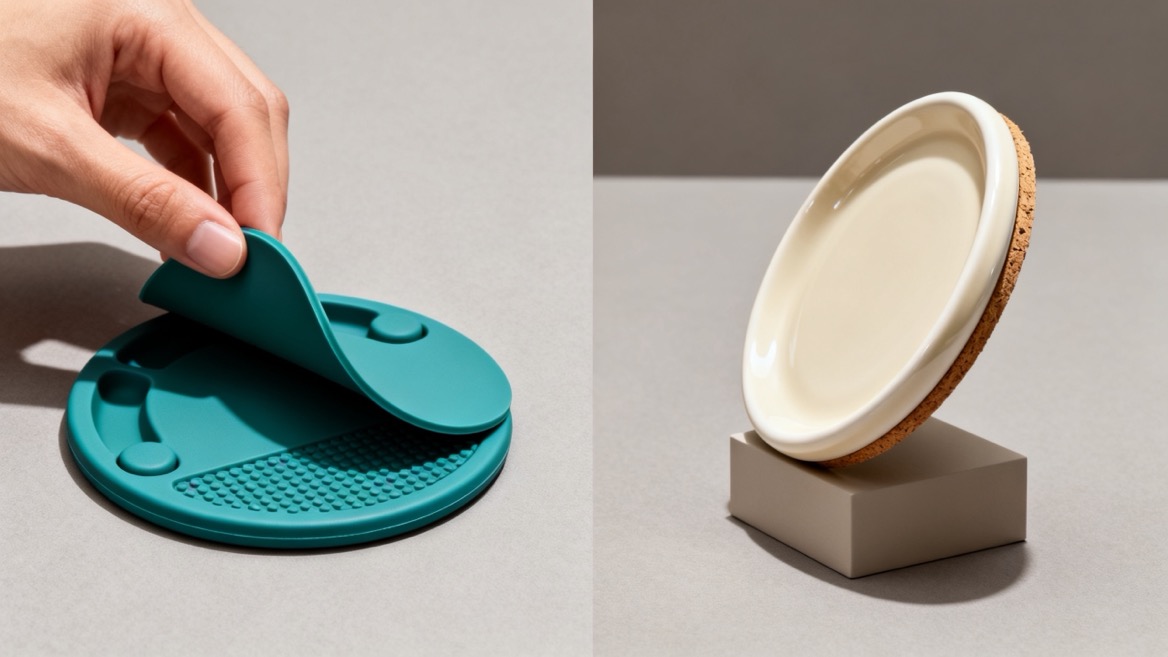
A nonabsorbent PVC surface can be useful for wiping away spills. However, it does not make condensation disappear.
Shallow channels or a modest perimeter lip may help retain droplets, but insufficient capacity can still allow overflow. Deep decorative grooves may also increase cleaning effort.
During sampling, place an iced drink on the coaster for a full service interval. Check for puddling, overflow, and water trapped underneath.
An absorbent ceramic coaster may manage droplets differently from a glazed one. The tradeoff is that absorbed coffee, wine, or colored beverages may leave marks.
Do not assume that "ceramic" means absorbent or that "glazed" means completely stain-proof. Request cleaning instructions and inspect samples after realistic spills.
A coaster has two important interfaces: cup-to-coaster and coaster-to-table.
Test both when dry and wet. Check whether the glass slides, whether the coaster sticks to its base, and whether the underside moves across the tabletop.
For delicate furniture, inspect for grit retention, backing wear, color transfer, and visible marks. A soft material or protective backing does not eliminate the need for compatibility testing.
The practical cleaning question is not simply, "Can staff wipe it?"
It is, "Can staff remove residue consistently, within the restaurant's normal turnaround time?"
The FDA Food Code provides a useful design principle for relevant nonfood-contact equipment surfaces: avoid unnecessary crevices and make cleaning straightforward. Its application depends on the item and local requirements; it is not a coaster certification.
Choose designs that balance visual detail with accessible surfaces.
Review:
- Groove depth and spacing.
- Compatibility with the intended detergent or sanitizer.
- Drying behavior after washing.
- Changes in flexibility, color, or surface feel.
- Whether stacking traps moisture.
Do not assume commercial dishwasher compatibility without product-specific instructions.
Inspect the complete coaster rather than only its top face.
Check glazed surfaces, exposed porous areas, and the backing. Establish a removal policy for chipped or damaged pieces, and verify whether the backing tolerates repeated washing.
For both materials, avoid unsupported "antibacterial" claims. A documented cleaning process is more useful than an unverified label.
Flexible PVC avoids the brittle fracture mode associated with ceramic. This makes it a sensible candidate for venues where coasters are frequently dropped or swept into collection bins.
It can also cushion contact between a cup and a hard tabletop. Still, assess noise with your actual glassware rather than promising a universal acoustic improvement.
Ceramic offers a different guest experience: weight, rigidity, and a finish that may coordinate with stoneware or porcelain table settings.
The distinction is operational:
- A family restaurant may prioritize impact tolerance.
- A cocktail lounge may prioritize presentation.
- A high-volume café may prioritize cleaning speed.
- A hotel dining room may prioritize consistency with existing tableware.
These are selection scenarios, not documented customer results.
PVC supports molded outlines, raised logos, recessed lettering, and multicolor designs. These options can help a restaurant extend its identity beyond menus and packaging.
From our manufacturing perspective, artwork should be reviewed alongside usability. Very fine lettering may lose clarity, while excessive relief can interfere with glass stability or cleaning.
Approve a physical sample that checks:
1. Logo legibility at normal viewing distance.
2. Stability beneath the smallest intended glass.
3. Color consistency under restaurant lighting.
4. Edge finish and underside flatness.
5. Cleaning access around decorative details.
Ceramic may better complement a restrained visual identity through printed artwork, glaze effects, or coordinated finishes.
Ask how decoration is applied and what cleaning conditions it supports. A decorative finish should be evaluated for wear rather than assumed to last indefinitely.
A lower unit price does not automatically produce a lower operating cost.
Use this purchasing model:
Cost per service cycle=(Landed purchase cost + cleaning labor + replacement expenditure)/Completed service cycles
Use a consistent accounting period and avoid counting replacement purchases twice.
Include freight, packaging, washing time, breakage, staining, missing pieces, and rejected items. For custom PVC, also ask whether tooling is a separate charge. For ceramic, review protective packaging and arrival-damage procedures.
The useful insight is that purchase price, handling cost, and usable life must be assessed together. Without restaurant-specific data, neither material can honestly claim a universal cost advantage.
Before a bulk purchase, run a small comparative trial. This is a screening method, not a laboratory certification.
Photograph and label each sample. Record dimensions, weight, surface condition, and backing construction.
Use the same glassware, tables, and beverages for both materials.
Rotate samples through comparable shifts. Record:
- Sliding and sticking incidents.
- Condensation overflow.
- Cleaning time and drying difficulty.
- Staining, deformation, chips, or backing separation.
- Staff feedback on stacking and collection.
Inspect samples under consistent lighting. Compare performance against requirements agreed before testing.
A busy café might assign greater importance to cleaning and impact tolerance. A premium lounge might emphasize appearance and glass stability.
Set rejection criteria in advance. Visible furniture damage, persistent residue, unacceptable instability, or structural failure should outweigh an attractive design.
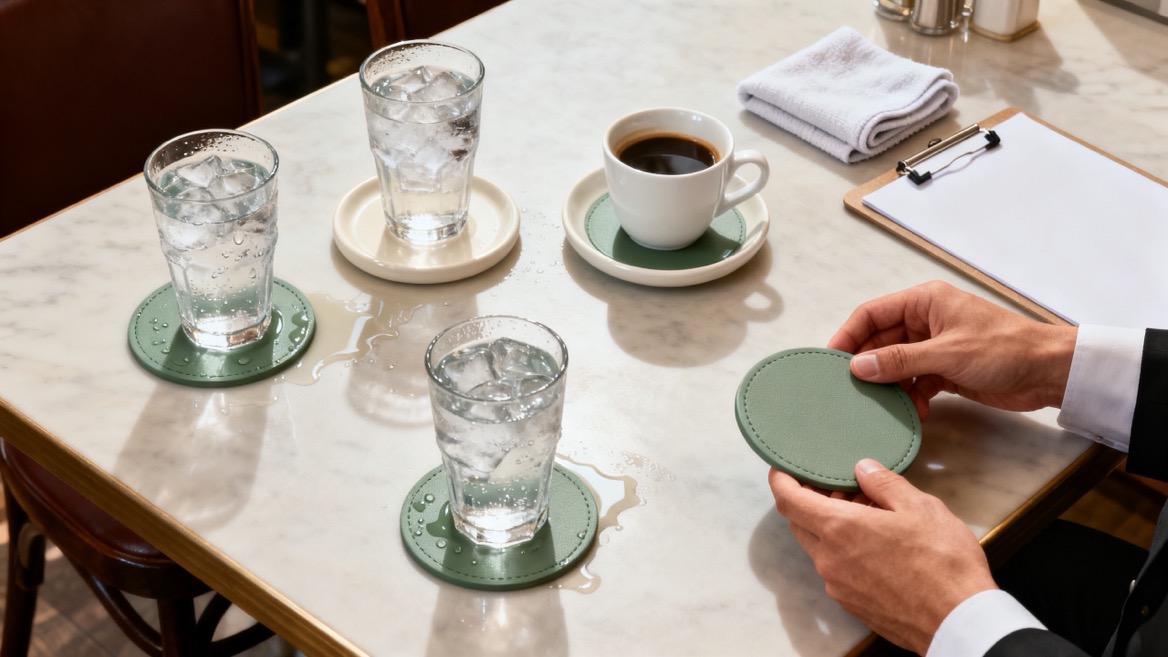
Restaurant buyers should distinguish chemical test reports, legal obligations, and manufacturing authorizations.
The EU RoHS Directive restricts specified substances in electrical and electronic equipment.
Testing a coaster against RoHS substance limits may provide chemical information, but an ordinary non-electrical coaster should not be presented as automatically falling within that directive's scope. Such testing also does not establish food-contact suitability.
Proposition 65 concerns exposure to listed chemicals. It is not a general product-safety certification.
Request documentation that identifies the sample, relevant substances, test scope, and any exposure assessment or warning determination. A broad "passed" statement needs explanation.
Disney FAMA concerns authorization for a facility to produce Disney-branded products under applicable arrangements. It does not certify a coaster's thermal performance or grant unrestricted permission to use Disney artwork.
Licensed designs require the appropriate rights and approvals.
Yijia Plastic Products Co., Ltd. brings 18 years of experience in developing, manufacturing, and selling PVC soft-rubber gifts, including PVC coasters.
Our company-provided manufacturing profile includes a 3,000-square-meter factory, 10 automated production lines, advanced dispensing equipment, and one-stop OEM/ODM services. Our stated cooperation experience includes Starbucks, Disney, McDonald's, Pop Mart, and Tencent; these names should not be interpreted as endorsements of every product.
We also report documentation relating to RoHS testing, California Proposition 65, and Disney FAMA. Buyers should review current records and their specific scope before relying on them.
For a targeted quotation, send your artwork, quantity, glass-base dimensions, table finish, beverage conditions, cleaning method, and destination market. Ask our team to propose a PVC coaster sample and a verification plan before confirming bulk production.
It can be better for impact-tolerant handling and molded branding. Ceramic may better suit presentation-led venues. Choose through finished-product testing.
Only within the finished product's verified conditions. Request temperature, duration, and tabletop-protection evidence rather than relying on a generic material claim.
No. Absorbency depends on the ceramic body, glaze, and treatment. Test the actual coaster with condensation and staining beverages.
A simple, accessible surface usually makes cleaning easier, but material alone does not decide the outcome. Decoration and backing also matter.
Only when the manufacturer confirms compatibility with the relevant washing conditions. Evaluate the complete construction, including adhesives and backing.
Do not assume so. If direct food contact is intended, request documentation applicable to the finished formulation, use conditions, and destination market.
- European Commission. "RoHS Directive." Official scope and substance-restriction guidance; supports the distinction between chemical testing and regulatory applicability. [environment.ec.europa]
- California Office of Environmental Health Hazard Assessment. "Frequently Asked Questions—Proposition 65." Explains exposure warnings and why they are not general safety certifications. [p65warnings.ca]
- California Office of Environmental Health Hazard Assessment. "Phthalates." Explains relevant chemical concerns and the use of certain phthalates in flexible plastics. [p65warnings.ca]
- The Walt Disney Company. "Facility and Merchandise Authorization Application." Defines facility authorization requirements for Disney-branded production. [thewaltdisneycompany]
- U.S. Food and Drug Administration. "FDA Food Code 2017," Sections 4-202.16 and related surface-design provisions. Supports the cleanability principles discussed; local adoption and applicable requirements must be checked separately. [fda]
- Daltile. "Ceramic vs. Porcelain Tile: What's the Difference?" Supports general ceramic-body and porosity distinctions—not coaster-specific performance ratings. [daltile]
- "Polyvinyl Chloride." Material overview supporting the distinction between rigid and flexible PVC and formulation-dependent properties; not used to assign a coaster temperature rating. [en.wikipedia]


