
Views: 258 Author: Yijia Plastic Publish Time: 2026-10-01 Origin: Site
Content Menu
● What "Glass Stability" Actually Means
● PVC Non-Slip Cup Mat vs. Standard Plastic Coaster: Key Differences
>> Where a PVC Non-Slip Cup Mat Has an Advantage
>> Where a Standard Plastic Coaster Can Win
● How Surface Design Affects Glass Stability
>> Top-Surface Grip and Raised Artwork
>> Underside Grip and Table Compatibility
>> Condensation Changes the Test
● Sliding and Tipping Are Different Risks
● A Practical Stability Test for Custom Coasters
● Specifying an OEM/ODM Coaster That Stays Put
>> Check Documentation Without Confusing Its Purpose
● Which Coaster Should You Choose?
>> Is a PVC non-slip cup mat always safer than a hard plastic coaster?
>> Can a glass slide even if the coaster does not move?
>> Does adding more grip prevent a tall glass from tipping?
>> What should I check when testing coasters for iced drinks?
>> Should the logo be raised in the center of a custom PVC coaster?
>> Does RoHS or Proposition 65 documentation prove a coaster is non-slip?
A PVC non-slip cup mat will usually keep a glass more stable than a smooth, standard plastic coaster—but only when its top grips the glass, its underside grips the table, and the mat stays flat. For a buyer choosing coasters for a café, promotional campaign, or retail range, the useful question is not simply "Which material is softer?" It is "Which finished design keeps this particular glass steady on this particular table, including when condensation appears?"
There is no reliable universal friction value for either product. Surface texture, formulation, moisture, glass shape, and tabletop finish can all change the result. This guide explains how to compare the two options, what can cause a supposedly non-slip mat to fail, and how to specify a custom coaster that performs consistently.
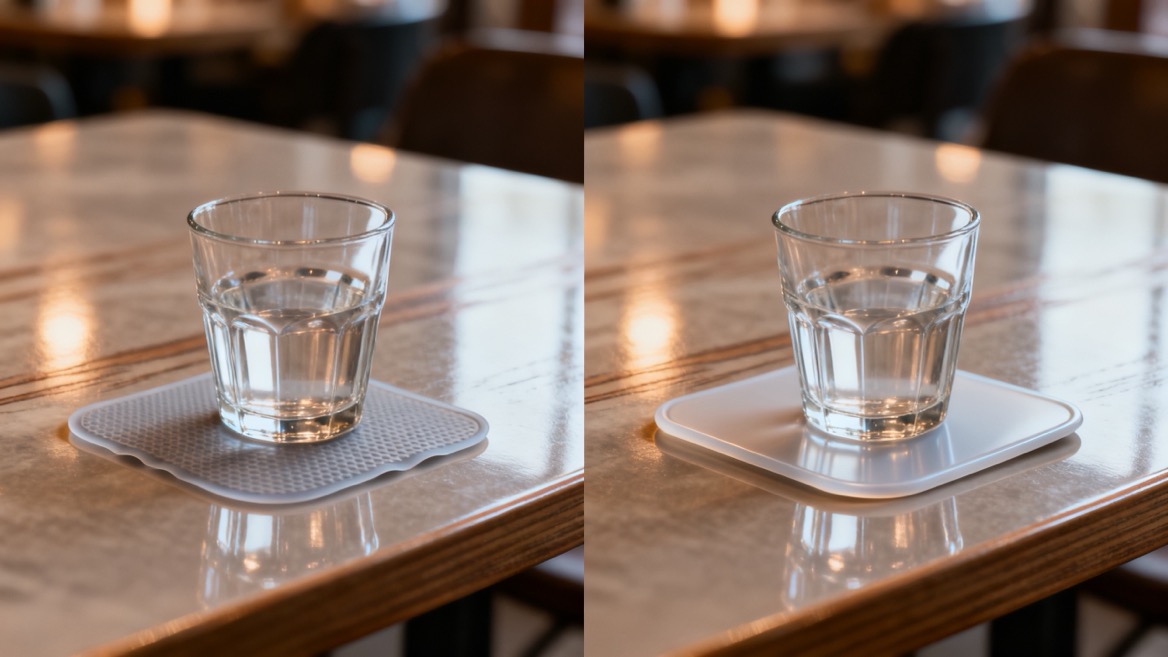
A glass and coaster form a small system with two contact points: glass to coaster, and coaster to tabletop. If either contact slips, the drink moves. A third failure mode is tipping: the glass may remain firmly attached to the coaster while the entire assembly tilts after a bump.
Consider someone reaching across a crowded café table. Their hand brushes a tall glass. Several things could happen:
- The glass slides across the coaster.
- The coaster slides across the table with the glass on top.
- One edge of the coaster lifts, allowing the glass to rock.
- The glass tips despite neither contact point sliding much.
That is why a coaster's "non-slip" label is not a complete performance claim. It may describe the underside while saying little about the drinking surface—or vice versa. A sound comparison examines sliding, rocking, and tipping separately.
Static friction describes resistance to the *start* of sliding. Once movement begins, resistance during continued sliding may differ. Friction also depends on the two surfaces in contact and the conditions under which they meet. In practical terms, a coaster that works well beneath a dry ceramic mug may behave differently beneath a cold, wet glass.
For this comparison, "PVC non-slip cup mat" means a flexible, intentionally grippy PVC design. "Standard plastic coaster" means a relatively rigid coaster with a conventional smooth or lightly textured surface. These are design categories, not guarantees: a textured rigid coaster can outperform a poorly designed PVC mat.
11111
The table describes likely design opportunities and risks, not measured results for every PVC or plastic coaster. The right choice depends on the sample in your hand.
Flexible PVC can make close contact with a tabletop and a glass base when both surfaces are reasonably clean and level. That can help resist an accidental sideways nudge. A textured underside may also help keep the mat from wandering as customers lift and replace drinks.
Its greatest advantage is design control. An OEM/ODM buyer can specify a gripping underside, a flatter center for the glass, and a perimeter that captures occasional droplets. The artwork does not have to occupy the functional contact zone.
But flexibility has limits. If a mat is too soft for its geometry, a narrow glass may feel less secure. A high decorative feature beneath the base can make the glass rock. A curled mat that touches the table only around part of its perimeter may also lose the benefit of its grippy material.
A rigid coaster can provide an exceptionally level platform. That matters for stemware, narrow-bottomed glasses, and any vessel that feels unsteady on a deeply embossed mat. Rigid construction can also support a clearly defined recess or raised boundary around the drink.
A standard plastic coaster becomes less convincing when both faces are smooth and the table is polished. The glass may slip on top, the coaster may slip underneath, or both may happen during one movement. Still, it would be wrong to assume that "rigid" means "slippery." Texture, feet, inserts, and the finish of the table can change its performance substantially.
The fairest conclusion: a well-designed PVC non-slip cup mat is generally the stronger starting point when preventing everyday sliding is the priority. A well-designed rigid plastic coaster may be preferable when a particularly flat, firm support is more important. Neither construction eliminates the need to test the finished product.
The glass should rest on a stable area, not on a logo peak or a few isolated points. Multicolor artwork can make a custom coaster memorable, but raised details directly under the glass can reduce even contact.
A useful design is a mostly level central support zone with decoration positioned outside the base-contact area. If artwork must cross the center, keep its relief consistent enough that the specified glass does not rock. Test the design with real drinkware rather than judging it only from a rendering.
A perimeter lip may help contain small amounts of condensation. It should not force a wide glass to balance on the lip, however. Check the largest and smallest intended glass bases before approving the tool design.
The underside matters just as much as the top. A mat can grip a glass well but travel across a glossy table with it. Conversely, a coaster can stay planted while the glass moves across its surface.
Ask suppliers to show the underside geometry in samples and drawings. Then test it on the surfaces that matter to your project: finished wood, glass, laminate, stone, or another specified material. The same pattern need not behave identically on all of them.
Flatness is part of the specification. If a mat rocks before a drink is placed on it, added grip will not solve the underlying problem. Look for edges that sit down evenly and a central area that does not dome or sag under the intended glass.
Cold drinks introduce a condition that dry showroom demonstrations often miss. Water may accumulate under the glass, reach the underside of the coaster, or collect around a raised rim. Its effect on friction is not reliably predictable from material names alone.
Instead of assuming that a textured surface remains grippy when wet, test it. Note whether droplets can leave the main contact area without creating an unstable ridge or a puddle under the base. Also check whether the glass lifts cleanly: a coaster that sticks to a wet glass and then drops unexpectedly creates a different usability problem.
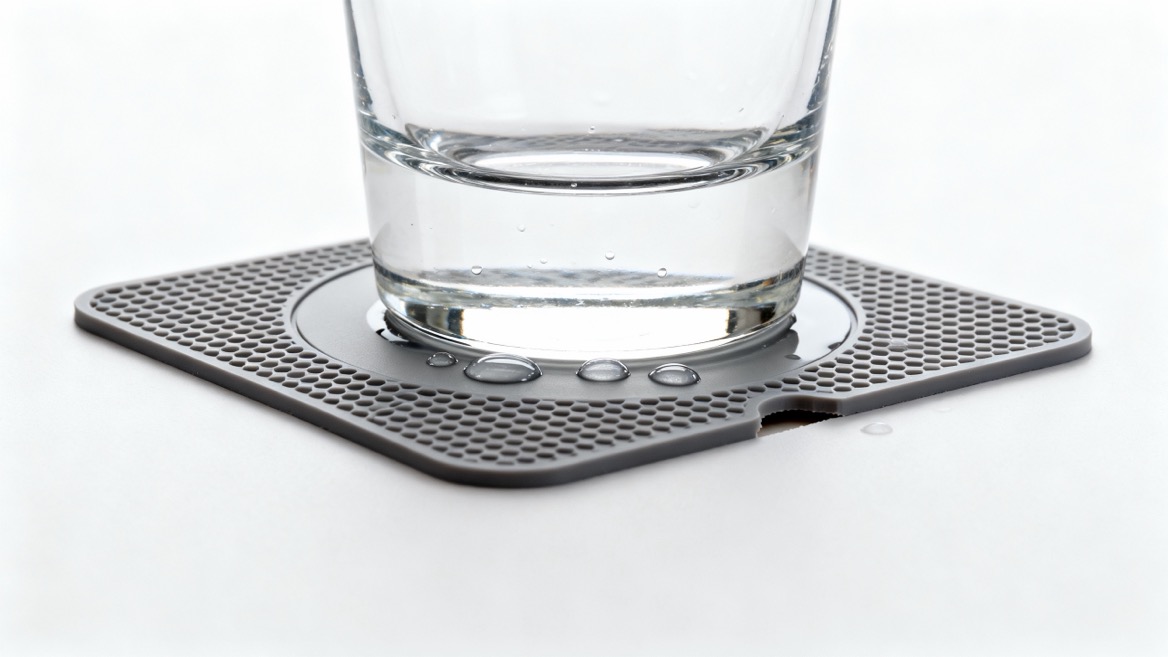
More grip is not always the whole answer. When a tall glass receives a sideways push, it might slide before it tips, or tip before it slides. The outcome depends in part on friction, the width of its support, and where the push is applied.
This distinction is useful when evaluating glass stability:
- If the glass slides on the coaster, review the top-surface contact.
- If the mat and glass move together, review the underside and tabletop pair.
- If the glass rocks or tips, review the support area, levelness, and glass geometry.
Imagine a tall, narrow glass on an aggressively grippy but uneven mat. Greater sliding resistance does not make the glass's base wider or the mat flatter. Correcting the contact geometry may do more for that glass than increasing grip further.
For purchasing decisions, define the glass types up front. A short water tumbler, a heavy mug, and a tall promotional drink cup do not present the same stability challenge. A design approved with one should not automatically be approved for all three.
A sample test does not need an invented "universal pass number" to be valuable. It needs matched conditions and recorded results so two designs can be compared fairly.
1. Choose representative drinkware. Include the narrowest and widest bases expected in use, plus at least one taller glass.
2. Choose representative tables. Use the actual surface finishes where the product will be placed, rather than a single convenient workbench.
3. Inspect each empty coaster. Record curling, uneven contact, prominent raised features, and whether it rocks when pressed lightly at the edges.
4. Run a dry trial. Place the same filled glass in the same position on each coaster. Apply a gentle, repeatable sideways force at the same height. Observe which contact moves first.
5. Run a condensation trial. Cool the glass until visible moisture appears, then repeat the comparison. Keep the fill level, waiting time, and table cleaning procedure consistent.
6. Check lift-off and reset. Lift the glass normally, replace it several times, and note whether the coaster sticks, shifts, or traps enough water to affect the next placement.
7. Document the outcome. Photograph the setup and record the glass, table, dry or wet condition, and failure mode for each sample.
For a more controlled development program, a force gauge can help compare the force required to initiate movement. Report which interface was tested—glass against coaster or coaster against table—along with the loading and surface conditions. Do not present a value measured on a thin plastic sheet as a verified result for a finished, embossed coaster.
This procedure is a proposed buyer evaluation, not published test data for either coaster type. Its purpose is to catch design problems before a large order, not to claim that every PVC mat beats every rigid plastic coaster.
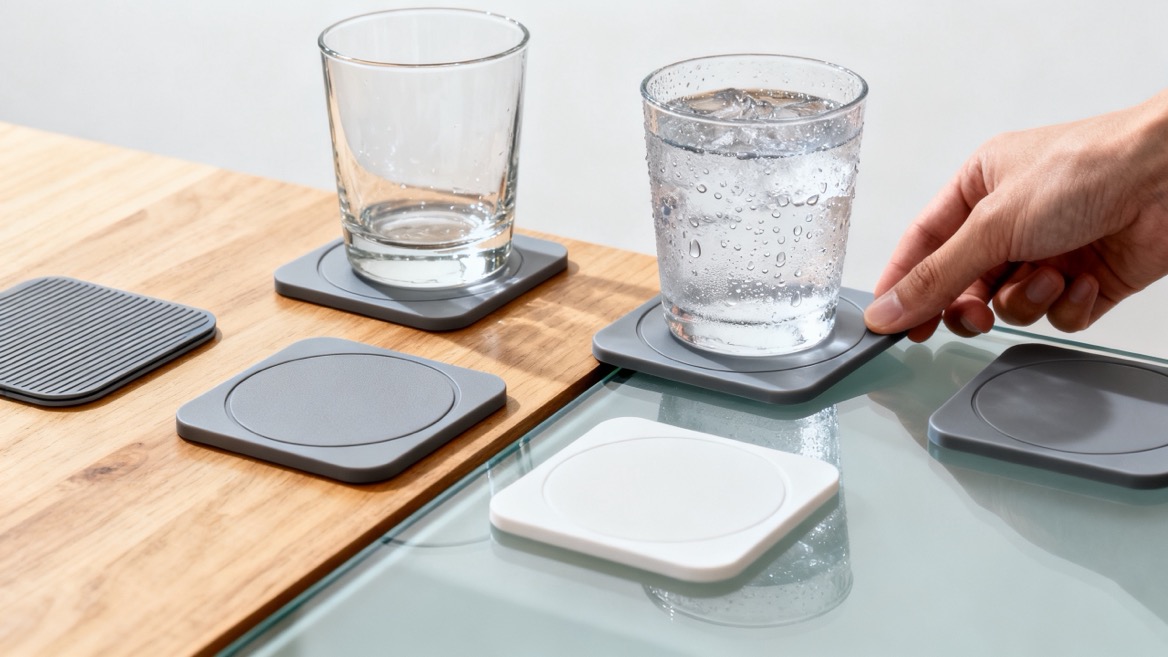
A purchasing brief focused only on color, diameter, and logo position leaves important performance questions unanswered. For a custom PVC cup mat, send the supplier a use-case brief as well as the artwork.
Include:
- The glass types and approximate base sizes the coaster must support.
- The tabletop finishes expected in use.
- Whether drinks are commonly served cold enough to create condensation.
- The preferred position and height of decorative relief.
- The need for a flat central support area and a stable underside.
- Your intended cleaning method and any appearance requirements after repeated use.
- The markets where the finished products will be sold and the supporting documents you require.
Ask for a pre-production sample in the proposed design, not just a stock coaster made from the same material. Changes in thickness, artwork, underside pattern, or shape may affect the result. Repeat the stability checks if those features change between the approved sample and production version.
Yijia Plastic Products Co., Ltd. describes itself as an integrated PVC soft-gift manufacturer with 18 years of experience, a 3,000-square-meter factory, 10 automated production lines, and dispensing equipment. It also reports one-stop OEM/ODM service and experience working with Starbucks, Disney, McDonald's, Pop Mart, and Tencent. These are company-provided details, not independently verified performance results for a particular cup mat.
That background makes a useful starting point for a custom-development discussion: provide the intended glass and table conditions, then ask how the proposed mold, relief, and underside design address them. The deciding evidence remains the finished sample and its documented test conditions, not the client list alone.
Yijia also reports EU RoHS, California Proposition 65, and Disney FAMA documentation. Buyers should request the current documents and verify their scope against the specific factory, materials, order, and destination market.
These items address different questions. EU RoHS concerns restricted substances in electrical and electronic equipment; a conventional non-electrical coaster should not be described as universally "RoHS-certified" merely because material testing exists. California Proposition 65 concerns exposures and potential warning obligations, not a blanket product certification. Disney FAMA is a facility and merchandise authorization relevant to Disney-branded work, not a measure of coaster grip.
None of these documents establishes that a mat is slip-resistant. Nor should a coaster be advertised as suitable for direct food contact without separate, use-specific substantiation. Keeping chemical documentation, brand authorization, and physical performance claims separate makes a purchasing specification clearer and more credible.
Choose a PVC non-slip cup mat when the primary goal is to reduce everyday sliding and you can approve a sample that grips on both sides, lies flat, and supports your intended glasses evenly. Its flexibility and custom surface design offer useful ways to address those needs.
Choose a standard plastic coaster when a firm, level platform is the priority, particularly if the rigid design includes effective contact features and passes the same wet and dry checks. Do not reject it simply because it lacks "non-slip" in its name.
For a branded program, decide by failure mode rather than appearance alone. A coaster that looks excellent in a product photograph may still slide on a restaurant's polished table. Conversely, an attractive soft PVC mat can underperform if raised artwork makes a tall glass rock.
Planning a custom coaster? Send Yijia Plastic Products Co., Ltd. your glass-base dimensions, tabletop types, artwork, and expected wet-use conditions. Request a pre-production OEM/ODM sample and compare its top grip, underside grip, flatness, and lift-off behavior before approving bulk production.
No. A well-designed PVC mat can reduce sliding, but a curled edge, uneven relief, or poor match with the tabletop can compromise stability. Compare finished samples under the same conditions rather than relying on the material name.
Yes. The underside may hold firmly while moisture or a smooth top surface allows the glass to move. Test glass-to-coaster grip separately from coaster-to-table grip.
Not necessarily. Grip addresses sliding; tipping also depends on the glass's support width, its balance, the height of the push, and whether the coaster provides a level base. A grippier surface cannot correct every geometry problem.
Repeat the comparison with visible condensation on the same glass. Look for movement at both interfaces, rocking, pooled water, and whether the coaster lifts with the glass.
Only if the intended glasses remain level on the finished sample. For stability-focused designs, a flat central support zone and decoration away from the main contact area are often easier to evaluate.
No. Those documents concern different compliance questions. Slip resistance requires a separate evaluation of the finished coaster with specified glasses, surfaces, and conditions.
1. Intertek, "[Coefficient of Friction ASTM D1894]" — distinguishes resistance at the start of sliding from resistance during movement. [intertek]
2. ZwickRoell, "[ASTM D1894 Coefficient of Friction of Plastic Films]" — explains how material pairing, roughness, lubricants, temperature, and humidity affect friction; its described method concerns films and sheets. [zwickroell]
3. Pennsylvania State University, "[Slipping vs. Tipping]" — explains why sliding and tipping are distinct failure modes. [mechanicsmap.psu]
4. Royal Academy of Engineering, "[Forces, Centre of Gravity, Reactions and Stability]" — discusses support width, center of gravity, and tipping. [raeng.org]
5. European Commission, "[RoHS Directive]" — defines the directive's electrical and electronic equipment scope. [environment.ec.europa]
6. California Office of Environmental Health Hazard Assessment, "[Chemical Exposure Warnings]" — explains the purpose of Proposition 65 warnings. [p65warnings.ca]
7. The Walt Disney Company, "[Facility and Merchandise Authorization Application Instructions]" — describes facility authorization for Disney-branded products. [thewaltdisneycompany]
8. U.S. Food and Drug Administration, "[Determining the Regulatory Status of Components of a Food Contact Material]" — explains why food-contact suitability depends on components and intended use. [fda]


