
Views: 210 Author: Yijia Plastic Publish Time: 2026-10-06 Origin: Site
Content Menu
● Vinyl vs. PVC Waterproof Mats
>> Are Vinyl and PVC Different Materials?
>> Define the Application Before Comparing
>> Commercial Dining Mat Comparison
● Performance in Commercial Dining Areas
>> Waterproofing and Spill Protection
>> Slip Resistance and Edge Stability
>> Heat, Stains, and Daily Wear
>> Branding and Customer Experience
>> Cost and Environmental Claims
● Procurement and Manufacturer Expertise
>> A Practical Sample-Testing Protocol
>> Illustrative Café Purchasing Scenario
>> Calculate Cost per Service Day
>> Understand Compliance Documentation
>> Yijia's Manufacturing Perspective
>> Which Mat Should You Choose?
>> Which Waterproof Mat Is Better for Restaurants?
>> Can PVC Mats Hold Hot Pans?
>> Are Waterproof Mats Automatically Non-Slip?
>> Can Vinyl or PVC Mats Go in a Dishwasher?
>> Does RoHS Testing Prove Food-Contact Safety?
>> What Should an OEM/ODM Inquiry Include?
Choosing between a vinyl waterproof mat and a PVC waterproof mat starts with a surprising fact: these names often describe products made from the same base polymer. For restaurants, cafés, hotel dining rooms, and branded beverage counters, the better choice depends on construction, surface design, cleaning compatibility, and intended placement—not simply the label.
From our manufacturing perspective at Yijia Plastic Products Co., Ltd., buyers should compare finished-product specifications rather than assume that "vinyl" and "PVC" represent two fundamentally different materials. A thin printed placemat and a molded soft PVC mat can serve very different purposes, even when both contain polyvinyl chloride.
This guide explains those differences and provides a practical framework for selecting commercial dining mats.

PVC stands for polyvinyl chloride. In everyday product descriptions, "vinyl" commonly refers to PVC-based materials, including flexible sheets, coverings, and mats.
PVC formulations can be rigid or flexible. Plasticizers help make the material flexible, while other additives influence processing and finished-product characteristics.
Consequently, "vinyl waterproof mat" does not identify one standardized construction. It might describe a flexible sheet, a layered placemat, or a floor mat with a PVC component. Likewise, "PVC waterproof mat" could describe a molded tabletop accessory or an open-grid drainage mat.
The essential question is: What exactly is being supplied?
Ask manufacturers to identify the base material, backing, layers, manufacturing method, dimensions, and intended application. Without that information, a material-name comparison can be misleading.
Commercial dining areas contain several distinct mat applications:
- Tabletop placemats that help protect surfaces from everyday spills.
- Countertop mats used beneath drinks or beverage-service equipment.
- Entrance mats intended to manage tracked-in dirt and moisture.
- Floor mats designed for wet workstations or standing areas.
These products are not interchangeable.
A custom soft PVC placemat should not automatically be treated as a floor-safety product. Similarly, a drainage floor mat is not designed to protect a dining table from spilled coffee.
For Yijia's soft PVC manufacturing background, tabletop mats, branded countertop accessories, and PVC coasters are the most directly relevant applications. Floor-mat purchasing requires additional application-specific assessment.
The table below compares two common constructions—not universally different polymers.
| Buying criterion | Sheet-style vinyl waterproof mat | Molded soft PVC waterproof mat |
|---|---|---|
| Material identity | Often PVC-based; verify all layers | Typically flexible PVC; verify formulation |
| Construction | Cut sheet or layered construction | Molded construction with specified geometry |
| Appearance | Suitable for flat graphics and broad printed designs | Suitable for molded shapes and raised branding |
| Spill management | A continuous surface can help contain small spills | Solid surfaces or recessed designs can help manage spills |
| Cleaning | Depends on coating, printing, backing, and seams | Depends on texture, recess depth, and formulation |
| Thickness | Product-specific; request measurements | Product-specific; request measurements |
| Heat performance | Requires stated limits and supporting evidence | Requires stated limits and supporting evidence |
| Floor suitability | Must be specifically designed and assessed | Must be specifically designed and assessed |
| Best purchasing approach | Verify the complete layered structure | Verify the molded design and finished compound |
Neither construction wins every category. Specification matters more than terminology.
A waterproof surface does not necessarily create a waterproof installation. Liquids can travel around edges, through openings, or beneath a mat.
For tabletop use, evaluate the complete design:
- Does the mat have a continuous surface?
- Can spills reach the table through decorative openings?
- Do raised borders help contain small spills?
- Can staff lift and clean underneath it easily?
- Does the underside remain damp after cleaning?
A perforated PVC mat may allow drainage, but it does not provide the same spill barrier as a solid placemat.
Our purchasing recommendation is to specify spill protection in practical terms: the expected liquid, exposure duration, cleaning process, and acceptable effect on the underlying surface.
Waterproof does not mean slip-resistant.
For floor applications, traction depends on the finished surface, contaminants, footwear, underlying flooring, mat movement, and maintenance. A material description alone cannot establish safe performance.
U.S. workplace requirements emphasize maintaining walking-working surfaces, addressing hazards, and keeping floors dry where feasible. Mats can contribute to a safety program, but they do not replace spill response or inspection.
For tabletop applications, the concern is different: a mat should remain stable while customers move glasses, plates, or cutlery.
Test samples on the actual table finish. Check movement, edge lifting, and whether the product lies flat after unpacking and repeated cleaning.
For dining operations, cleanability deserves as much attention as appearance.
A smooth surface may simplify wiping. Raised branding, deep grooves, or intricate recesses may require additional attention. Neither printed vinyl nor molded PVC is automatically the easier option.
Before approving a product, ask for cleaning instructions covering:
- Recommended detergent and dilution.
- Compatible sanitizers.
- Maximum cleaning temperature.
- Rinsing and drying requirements.
- Whether machine washing is permitted.
- Restrictions involving solvents or abrasive tools.
Run trials using the restaurant's actual products and procedures. Inspect for discoloration, tackiness, curling, surface damage, and persistent residue.
Avoid assuming that a waterproof mat is dishwasher-safe, antibacterial, or suitable for every commercial sanitizer.
Do not treat a vinyl or PVC placemat as a trivet unless the supplier explicitly supports that application.
Hot cookware, oven trays, and heated serving dishes require performance specifications beyond ordinary spill protection. Ask for a temperature limit, permitted contact duration, and relevant test evidence.
For staining, evaluate representative substances such as coffee, tea, sauces, and cooking oil. Define contact times and cleaning methods before comparing samples.
For wear, inspect the components that customers actually touch: printed graphics, raised lettering, edges, and the top surface. A thicker product is not automatically more durable if its formulation or design is unsuitable.
Sheet-style products can suit flat artwork, photographic graphics, or coordinated table settings. Molded soft PVC can support custom shapes and raised logo details.
However, branding should not interfere with service.
Keep plates and glasses stable. Position raised details away from critical contact areas. Consider whether staff can stack, store, and replace the mats efficiently.
For a café, a compact branded countertop mat may be more useful than a large placemat. For a themed restaurant, coordinated coasters and table accessories may create a consistent visual identity without covering the entire table.
Choose the format around the dining experience—not around the largest possible logo.
Compare lifecycle cost, not just unit price.
Include tooling, sampling, freight, cleaning labor, replacement frequency, and disposal. A low-priced mat may become expensive if its design slows cleaning or requires frequent replacement.
Environmental claims also require evidence. Neither "vinyl" nor "PVC" automatically proves recyclability, recycled content, or a lower environmental impact.
Ask suppliers to document the specific claim and confirm whether a suitable collection or recycling route exists in the destination market. Avoid unsupported terms such as "eco-friendly" or "fully sustainable."
We recommend a structured pilot before a full commercial order. This is a proposed procurement procedure, not a standardized certification test.
1. Define whether the product is for tables, counters, entrances, or floors.
2. Record dimensions, thickness, weight, and intended cleaning methods.
3. Place samples on the actual surface and inspect stability and edge behavior.
4. Apply representative food and beverage spills for agreed contact periods.
5. Clean samples using the restaurant's normal detergent and sanitizer.
6. Repeat use-and-clean cycles, documenting visible changes.
7. Approve an identified reference sample before production.
For floor mats, arrange appropriate application-specific traction assessment rather than relying on an informal tabletop trial.
This process turns subjective preferences into documented purchasing criteria. It also gives the manufacturer clearer feedback when modifying the design.
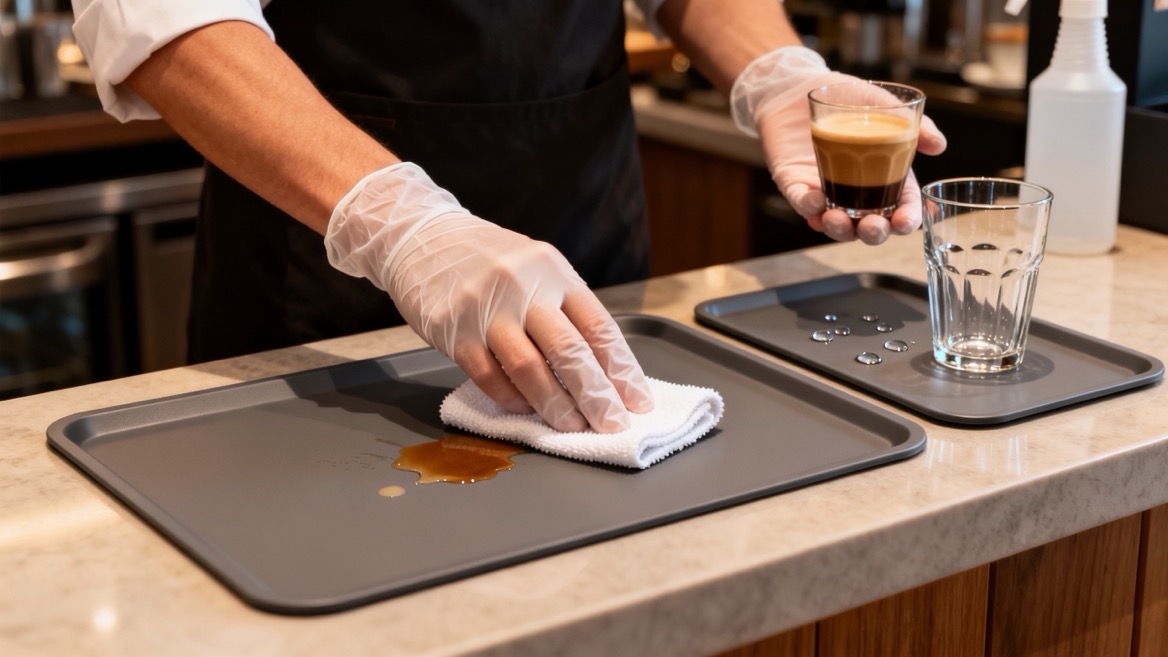
Consider a café choosing between a printed sheet-style mat and a molded PVC countertop mat. The priority is branded beverage service, not kitchen-floor drainage.
Both samples initially look suitable. During the pilot, staff evaluate wiping time, cup stability, staining, and whether water remains underneath.
Suppose the molded sample offers stronger visual branding but its deep recesses require extra cleaning. The buyer could request shallower detailing rather than reject molded PVC entirely.
Alternatively, if the printed sample's graphics deteriorate under the approved cleaner, the buyer could investigate a different print system or construction.
This is an illustrative scenario, not a documented customer case. Its lesson is that design revisions can matter more than choosing one material name over another.
A useful purchasing metric is:
Cost per service day=Purchase, allocated tooling, freight, maintenance, and disposal costs/Verified service days
For example, assume one mat costs $6 delivered and lasts 120 service days. Its purchase-only cost is $0.05 per day.
Another costs $9 delivered and lasts 240 service days. Its purchase-only cost is $0.0375 per day.
The second option is cheaper on that limited measure, despite its higher initial price. These are hypothetical figures, not market prices or predicted lifespans.
Add cleaning labor and other relevant costs before making a final decision. Most importantly, use pilot results rather than an unsupported supplier lifespan claim.
Compliance terminology should be precise.
RoHS restricts certain hazardous substances in electrical and electronic equipment. An ordinary non-electrical dining mat generally falls outside that equipment scope. Testing a mat against RoHS substance limits does not establish food-contact suitability.
California Proposition 65 concerns exposure to listed chemicals and associated warning obligations. It is not a universal product-safety certification.
Disney FAMA means Facility and Merchandise Authorization. It authorizes specified Disney-related production arrangements; it is not a general material-performance certificate or unrestricted permission to reproduce Disney artwork.
For any proposed food-contact application, request documentation specific to the intended use and destination market. A placemat beneath dishes and a surface intended for direct food contact require different purchasing considerations.
Yijia Plastic Products Co., Ltd. combines research and development, production, and sales of PVC coasters and other soft PVC gifts.
According to our supplied company profile, we have 18 years of experience, a 3,000-square-meter factory, 10 automated production lines, and advanced dispensing equipment. We provide one-stop OEM/ODM customization for global customers.
Our profile also reports cooperation experience involving Starbucks, Disney, McDonald's, Pop Mart, and Tencent. These statements describe company-provided background, not independent verification or authorization to reproduce customer trademarks.
For procurement, relevant documentation should accompany the proposed product: material specifications, applicable test reports, approved artwork, quality criteria, and any necessary authorization.
Choose a sheet-style vinyl product when the approved sample meets your requirements for flat graphics, dimensions, cleaning, and table protection.
Choose a molded PVC product when custom shapes or raised branding provide useful value and the finished design passes your operational tests.
For wet or greasy floor areas, prioritize a purpose-designed mat with suitable drainage, traction, chemical compatibility, and maintenance requirements. Depending on the application, alternatives such as nitrile rubber may also merit evaluation.
For branded tabletop accessories, contact Yijia with your dimensions, artwork, placement, cleaning procedure, and destination market. Request an OEM/ODM sample and relevant documentation before committing to production.
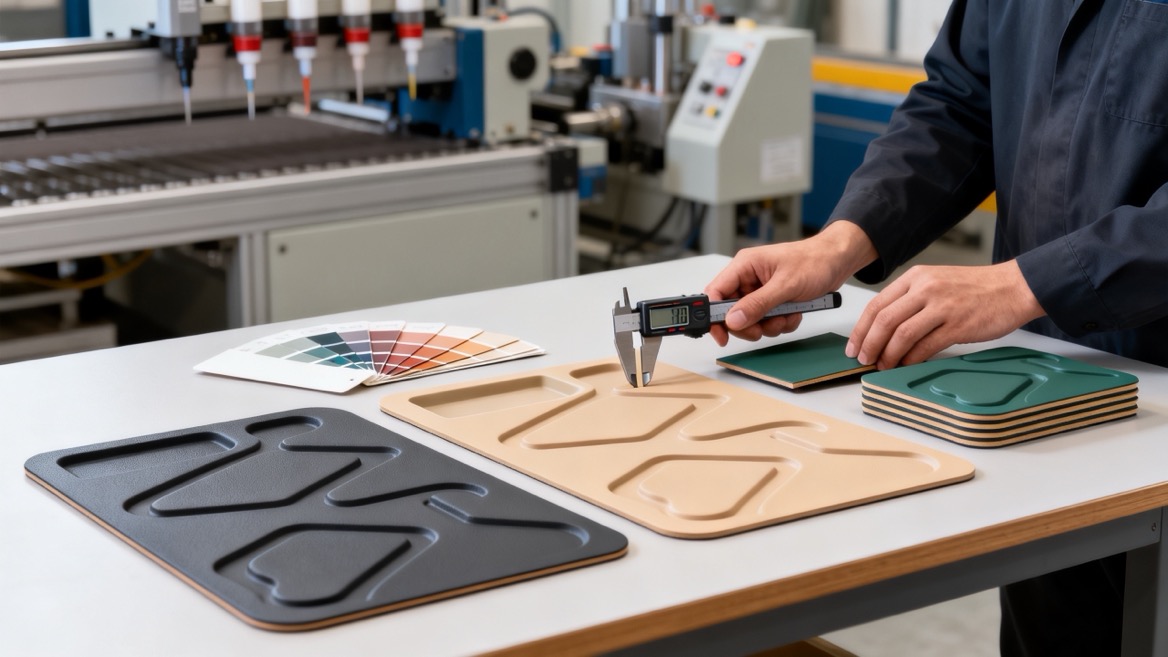
In many mat descriptions, vinyl refers to PVC-based material. Confirm the complete construction because coatings, backing, additives, and manufacturing methods can differ.
Neither name guarantees better performance. Select according to placement, spill protection, cleaning compatibility, stability, branding needs, and verified sample results.
Do not assume so. Use them for hot cookware only when the supplier provides appropriate temperature and contact-duration specifications supported by evidence.
No. Waterproofing concerns liquid penetration. Slip resistance depends on the finished product and actual use conditions, especially for floor applications.
Only if the manufacturer explicitly permits it. Dishwasher heat, detergents, and drying conditions must be compatible with the complete product.
No. RoHS substance testing does not establish compliance for food-contact use. Request application-specific documentation for the destination market.
Provide dimensions, quantity, artwork, colors, intended placement, cleaning procedures, destination market, packaging requirements, and any required testing.
- The Vinyl Institute. [*Hot Topics: Vinyl Materials and Additives*]. Industry information supporting the discussion of flexible vinyl and plasticizers. [vinylinfo]
- Occupational Safety and Health Administration. [*29 CFR 1910.22—General Requirements*]. Primary regulatory source for walking-working surface maintenance, drainage, inspection, and hazard correction. [osha]
- European Commission. [*RoHS Directive*]. Official explanation of the directive's electrical and electronic equipment scope and restricted substances. [environment.ec.europa]
- California Office of Environmental Health Hazard Assessment. [*Frequently Asked Questions for Businesses*]. Official guidance on Proposition 65 exposure and warning obligations. [p65warnings.ca]
- The Walt Disney Company. [*Facility and Merchandise Authorization Application*]. Primary documentation explaining authorization for Disney-branded production. [thewaltdisneycompany]
- The Walt Disney Company. [*International Labor Standards Program Manual*]. Supporting explanation of FAMA's licensee/vendor-specific authorization scope. [thewaltdisneycompany]
- NoTrax. [*Food Service Matting*]. Manufacturer information illustrating drainage designs and nitrile-rubber options for food-service environments; not independent comparative evidence. [notrax.justrite]


