
Views: 263 Author: Yijia Plastic Publish Time: 2026-10-25 Origin: Site
Content Menu
● What Makes a Bar Mat Suitable for a Busy Restaurant?
● Best Bar Mat Materials: PVC vs. Rubber vs. Silicone
>> PVC Bar Mats for Customized Restaurant Branding
>> Rubber Bar Mats for Service-Focused Applications
>> Silicone Bar Mats for Documented Dishwasher Compatibility
● How to Choose the Right Bar Mat Size
>> Custom Sizes for Irregular Workstations
● Bar Mat Design Features That Matter During Service
>> Glass Support and Drainage Geometry
>> Edge Height and Spill Collection
● Custom Bar Mats: Balance Branding with Bartender Usability
● A Practical Sample Test Before Bulk Ordering
● Cleaning Commercial Bar Mats Without Guesswork
● Compliance Documents: Understand What They Actually Prove
● OEM/ODM Bar Mats from Yijia Plastic Products Co., Ltd.
>> What are the best bar mats for busy restaurant bars?
>> Are PVC bar mats suitable for restaurant use?
>> What size bar mat should a restaurant order?
>> Can commercial bar mats go in the dishwasher?
>> How often should restaurant bar mats be cleaned?
>> Can we add our restaurant logo to a PVC bar mat?
The best bar mats for busy restaurant bars combine stable glass support, manageable spill collection, easy cleaning, and a footprint that fits the workstation. Material matters, but so do drainage geometry, edge height, and the way bartenders actually move during service. A well-designed PVC bar mat can also turn essential equipment into a distinctive branded touchpoint.
At Yijia Plastic Products Co., Ltd., our perspective comes from developing and manufacturing customized PVC soft-plastic products. Our purchasing advice starts with one principle: function should lead the design.
This guide explains how to compare materials, select practical dimensions, evaluate custom artwork, and test samples before placing a restaurant or wholesale order.

A restaurant bar mat has several jobs. It collects small spills, separates glass bases from pooled liquid, and creates a defined drink-preparation or service area.
However, those benefits depend on the actual design. A visually attractive mat can still perform poorly if glasses rock on oversized projections or its underside slides across a wet counter.
When evaluating commercial bar mats, prioritize:
- Stable support for your smallest and largest glass bases.
- A footprint that stays clear of sinks, equipment, and counter edges.
- Accessible channels that staff can brush clean.
- A base that remains stable on your specific countertop.
- Written cleaning instructions for the supplied material.
- Branding that does not interrupt the working surface.
Countertop bar mats are different from floor mats. They are not substitutes for anti-fatigue flooring or a workplace slip-control program.
There is no universally superior material. The right choice depends on your cleaning process, customization needs, and the performance of the finished product.
| Material | Main purchasing advantage | What to verify | Suitable buying priority |
|---|---|---|---|
| Soft PVC | Flexible options for molded colors, shapes, and branding | Formulation, flatness, cleaning compatibility, and documentation | Customized restaurant and promotional bar mats |
| Rubber | Options for substantial, service-focused designs | Exact compound, odor, wet-counter stability, and care instructions | Buyers prioritizing practical workstation performance |
| Silicone | Products are available with explicit commercial-dishwasher compatibility | The specific product's temperature and chemical limits | Operations requiring documented machine-washing compatibility |
These are purchasing directions, not guarantees. Two mats sold under the same material name can differ considerably.
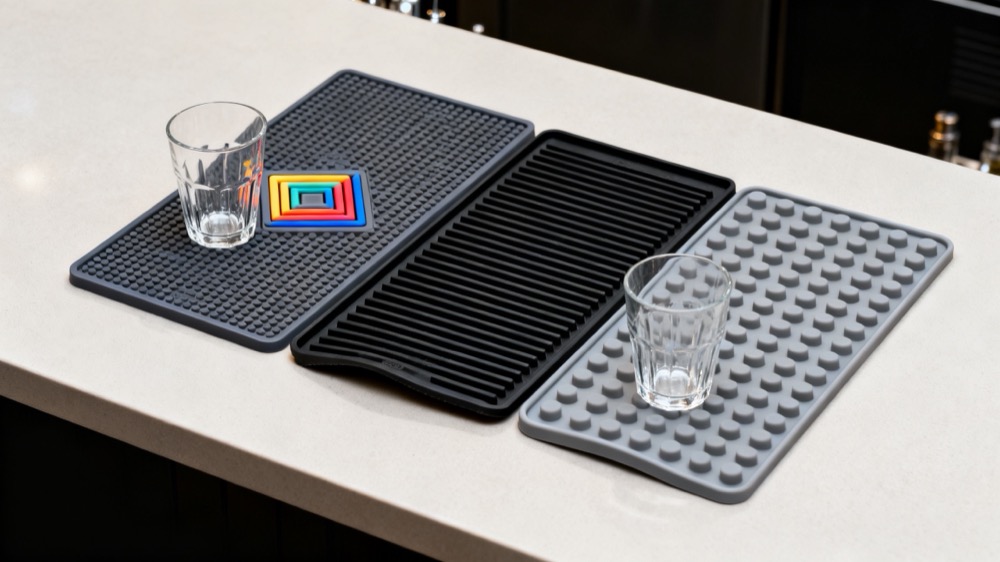
PVC deserves consideration when you want a custom shape, multiple molded colors, or an integrated logo.
For a restaurant group, that flexibility can support coordinated designs across cocktail bars, coffee stations, and promotional events. It also allows buyers to develop different layouts around the same brand identity.
Our manufacturing recommendation is to design the working surface before finalizing the artwork. Establish the glass-support area, drainage channels, and edge profile first. Then position the logo where it remains visible without creating an unstable landing zone.
Do not assume every PVC formulation tolerates the same heat or cleaning chemicals. Request instructions for the actual supplied product.
Rubber is worth comparing when the priority is a straightforward working mat rather than detailed multicolor artwork.
However, "rubber" is not a complete material specification. Ask the supplier to identify the compound and provide product-specific cleaning guidance.
Evaluate the sample with wet hands, representative glasses, and your countertop finish. Material descriptions cannot tell you whether a particular mat will slide, curl, or feel awkward during service.
Silicone is a useful option when machine washing is central to the operating routine.
For example, A Bar Above explicitly markets its silicone bar mats as compatible with home and commercial dishwashers. That supports the suitability of those specific products—not a blanket claim that every silicone mat is dishwasher-safe.
Ask any supplier to confirm the permitted wash temperature, detergent exposure, and drying conditions before purchase.
Start with the workstation rather than a catalog dimension.
Measure the usable counter area, identify where bartenders place glasses, and check how much room remains for tools and equipment. The largest mat that fits is not automatically the most practical.
A narrow rail mat suits a linear drink-handoff area or a slim section of counter.
An approximately 18 × 3-inch format is one commercially available example. Treat that as a starting point, then confirm the actual manufactured dimensions and available counter depth.
Check that the mat:
- Supports the full glass base.
- Remains entirely on the countertop.
- Does not obstruct service or equipment.
- Can be lifted without awkward bending.
A larger rectangular mat may suit a cocktail assembly station where several glasses and tools share one area.
A nominal 12 × 18-inch format is commercially available, but nominal and actual dimensions may differ. One supplier lists this size while specifying an actual footprint of 30 × 45 cm. Always approve production dimensions in one measurement system.
Also check whether the mat fits your sink and drying rack. Cleaning convenience should influence size selection.
Custom sizing is useful around unusual counter layouts, provided it does not create difficult cleaning or handling.
Use this sequence:
1. Measure the unobstructed work area.
2. Mark equipment clearances.
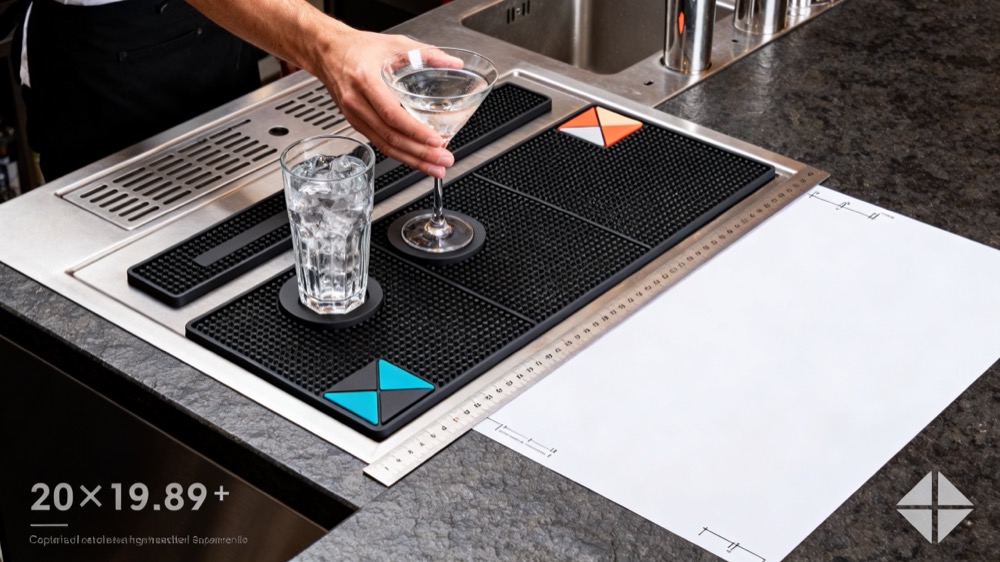
3. Make a full-size paper template.
4. Position representative glasses and tools.
5. Ask bartenders to simulate normal movements.
6. Confirm sink and storage compatibility.
A template can expose layout problems before tooling begins.
Raised ribs or projections create space beneath glass bases. However, an aggressive pattern can reduce usable support.
Test narrow highball glasses, stemware, heavy tumblers, and any unusually shaped vessels your restaurant uses. A mat that supports one glass well may feel unstable with another.
Look for support points that keep glasses level while leaving channels accessible for cleaning.
A raised perimeter can contain small spills, but edge height alone does not determine capacity. Internal projections occupy space, and liquid distribution changes with the design.
If spill capacity matters, request a measured test on a level surface. Do not accept an unsupported capacity estimate based only on outside dimensions.
The mat should also be comfortable to lift and empty before liquid approaches the rim.
"Non-slip" should be treated as a performance claim to test.
Evaluate the mat on your actual counter under dry and representative wet conditions. Check whether it shifts when staff place a glass down or lift one away.
Avoid interpreting countertop stability as evidence of floor-slip protection.
Deep lettering and narrow decorative channels may look impressive but require more brushing.
The FDA Food Code calls for relevant nonfood-contact equipment surfaces to allow easy cleaning and avoid unnecessary crevices. That makes cleanability a useful design benchmark, not merely an aesthetic preference.
Keep branding clear, but avoid turning the busiest working area into a dense relief pattern.
A successful branded bar mat should look intentional without demanding attention during every task.
For restaurant buyers, we recommend:
- One dominant logo rather than several competing messages.
- Strong contrast between the logo and background.
- Clear space around essential lettering.
- Artwork positioned away from critical glass-support areas.
- Color references approved through physical samples.
Confirm the viewing direction, too. Customer-facing branding and bartender-facing branding may require different orientations.
Only reproduce third-party logos when the buyer has the necessary permission. Experience supplying branded merchandise does not create permission to reuse another company's identity.
One useful way to reduce purchasing risk is to evaluate samples against a written scorecard rather than appearance alone.
The following is a proposed purchasing method, not a standardized laboratory test.
| Evaluation area | Suggested weighting | Practical check |
|---|---|---|
| Glass stability | 30% | Position and lift representative glassware |
| Cleanability | 25% | Remove typical beverage residue using approved methods |
| Countertop stability | 20% | Check movement on the intended counter |
| Fit and handling | 15% | Confirm placement, lifting, washing, and storage |
| Branding quality | 10% | Inspect color, lettering, and logo placement |
Score each category from one to five. Record the conditions so competing samples receive comparable treatment.
Reject a sample with an unacceptable functional problem even if its overall score looks attractive.
Keep the approved sample and written specification as production references. Record dimensions, artwork, color expectations, cleaning instructions, and agreed inspection criteria.
Cleaning frequency should reflect actual soil buildup. A quiet service period and a high-volume cocktail shift create different demands.
The FDA Food Code requires nonfood-contact equipment surfaces to be cleaned often enough to prevent soil accumulation. It does not assign every such surface a universal four-hour cleaning interval. Local requirements and the mat's actual use still matter.
A practical operating routine is to:
1. Remove glasses, tools, and loose debris.
2. Empty collected liquid carefully.
3. Wash using the supplier-approved detergent and method.
4. Brush between ribs and around lettering.
5. Rinse as instructed.
6. Clean the countertop beneath the mat.
7. Allow appropriate drying before storage or reuse.
If sanitizing is required for the application, follow the relevant product label, local requirements, and material-compatibility instructions.
Do not put a mat into a commercial dishwasher merely because it is flexible or described as durable. Obtain written approval for that product.
Request documents that identify the tested product, material, date, method, and results. A general factory claim is less useful than evidence connected to the supplied mat.
RoHS concerns restricted substances in electrical and electronic equipment. A RoHS-related material report should not be presented as restaurant food-contact approval for a nonelectrical bar mat.
Likewise, treat a Proposition 65 claim as something to investigate through its supporting documentation—not as a universal food-safety certificate. Determine the intended market, use conditions, and required evidence before placing an order.
If the mat will directly contact garnishes, food, or food-contact utensils, explain that intended use to the supplier. Do not infer suitability from color, softness, or a "premium" label.
Based on our company-provided information, Yijia brings 18 years of experience in developing, manufacturing, and supplying PVC soft-plastic gifts.
Our stated manufacturing resources include a 3,000-square-meter factory, 10 automated production lines, and advanced dispensing equipment. We offer OEM/ODM customization, from adapting supplied artwork to developing a new product concept.
Our company background also includes cooperation experience involving Starbucks, Disney, McDonald's, Pop Mart, and Tencent. These references describe company-reported experience, not endorsements of every product.
For procurement, ask us to provide the documentation relevant to your order, including the scope and validity of any applicable testing or authorization.
To request a focused proposal, send your counter dimensions, logo artwork, quantity, destination market, intended use, and cleaning method. Ask for a dimensioned drawing, material specification, sample, and applicable supporting documents before approving production.
The best option fits the workstation, supports the restaurant's glassware, remains stable on its counter, and works with its cleaning routine. Choose based on tested performance rather than material name alone.
They can be suitable when the finished product meets the intended operating and compliance requirements. Confirm material specifications, cleaning instructions, and any documentation needed for the destination market and application.
Measure the usable workstation first. Narrow rail mats suit slim service areas, while larger mats suit multi-glass preparation zones. Verify actual dimensions, sink fit, and equipment clearances.
Only when the supplier confirms compatibility for that specific product and washing process. Some silicone products carry explicit commercial-dishwasher claims, but material identity alone is insufficient.
Clean often enough to prevent residue accumulation, with additional cleaning whenever service conditions require it. Establish a written routine based on use, supplier instructions, and local requirements.
Yes. OEM/ODM customization can incorporate approved logos, colors, and dimensions. Review a physical sample to confirm readability, glass support, and cleanability before bulk production.
- FDA. [Food Code 2022]. See Sections 4-202.16, 4-601.11, and 4-602.13 for nonfood-contact surface design, cleanliness, and cleaning frequency. [fda]
- European Commission. [RoHS Directive]. Explains the directive's scope and restricted substances in electrical and electronic equipment. [environment.ec.europa]
- A Bar Above. [Silicone Bar Mat—Heavy-Duty, Gray]. Product-specific material, dimensions, and dishwasher claims; these should not be generalized to other products. [shop.abarabove]
- The Extra Ingredient. [A Bar Above Black Silicone Bar Rail Mat—18 × 3]. Commercial example of a narrow rail-mat format. [extraingredient]
- Yijia Plastic. [About Us]. Company-published background and compliance-related statements; buyers should verify order-specific supporting documents. [yijiabar]
- Yijia Plastic. [Custom PVC Bar Mats for Beverage Brands: A Practical Branding Solution]. Manufacturer perspective on customization and stated industry experience. [yijiabar]


