
Views: 219 Author: Yijia Plastic Publish Time: 2026-10-16 Origin: Site


Content Menu
● Coffee Machine Mat vs Bar Mat: The Main Differences
● What Is a Coffee Machine Mat?
>> Absorbent Coffee Mats vs Waterproof Coffee Mats
>> Can You Put a Mat Under an Espresso Machine?
>> How Does a Raised Bar Mat Handle Spills?
>> Why Custom PVC Bar Mats Suit Branded Service Areas
● Materials: PVC, Silicone, and Absorbent Constructions
>> PVC Bar Mats: Prioritize Formulation and Cleanability
>> Silicone Coffee Mats: Verify the Finished Product
>> Absorbent Mats: Consider Drying as Part of Maintenance
● Which Mat Does Your Café Need?
>> Small Café or Takeaway Coffee Counter
>> Busy Café With Multiple Beverage Stations
>> Branded Café Chain or Promotional Program
● A Practical Spill-Capacity Test Before Bulk Ordering
● Cleaning Coffee Machine Mats and Bar Mats Properly
>> A Practical Daily Cleaning Routine
>> Design Features That Make Cleaning Easier
● Compare Ownership Cost, Not Just Purchase Price
● Custom Café Mats From Yijia Plastic Products Co., Ltd.
● Choose Your Mat by Working Zone
>> Can a Bar Mat Replace a Coffee Machine Mat?
>> Is a PVC Bar Mat Suitable for a Café?
>> Which Mat Is Better for Milk and Syrup Spills?
>> Can Coffee Machine Mats Go in a Dishwasher?
>> Does a Bar Mat Eliminate the Need to Wipe the Counter?
>> What Should I Send a Custom Bar Mat Manufacturer?
A coffee machine mat protects the area around your brewing equipment. A bar mat manages drips where drinks are prepared and served. When comparing a coffee machine mat vs bar mat, the best choice depends on placement, spill volume, cleaning routines, and equipment requirements—not simply appearance.
For many cafés, the answer is both: a suitable protective mat near the coffee machine and a raised-pattern bar mat at the beverage preparation or pickup station. However, placing a soft mat directly beneath a commercial espresso machine requires checking the equipment manufacturer's installation instructions first.
At Yijia Plastic Products Co., Ltd., our manufacturing perspective starts with one question: what job must the mat perform? That question helps café owners avoid choosing an attractive accessory that creates unnecessary cleaning or stability problems.

The terms describe intended use rather than fixed material specifications. A coffee machine mat may be absorbent, waterproof, or textured. A bar mat typically uses raised ribs or studs to support drinkware above collected liquid.
Neither name alone guarantees heat resistance, dishwasher compatibility, or suitability for direct food contact.
| Comparison point | Coffee machine mat | Bar mat |
|---|---|---|
| Primary purpose | Protect the coffee equipment area | Manage beverage preparation and service drips |
| Typical placement | Beside equipment; underneath only when permitted | Under cups, pitchers, and drink assembly areas |
| Common construction | Flat, absorbent, or waterproof surface | Raised studs or ribs with recessed channels |
| Spill handling | Absorbs or contains liquid, depending on design | Collects liquid between raised features |
| Equipment support | Requires verified load-bearing suitability | Not normally intended as a heavy-machine foundation |
| Cleaning priority | Remove moisture and residue, including underneath | Clean channels, raised details, and the underside |
| Branding opportunity | Available through suitable printing or molding | Well suited to molded logos and contrasting colors |
Choose by the actual construction and documented performance, not the product category alone.
A coffee machine mat is a countertop accessory designed for the brewing area. Its purpose may include catching splashes, collecting scattered grounds, or separating small accessories from the counter.
The category includes products with very different structures. An absorbent coffee mat and a waterproof silicone tray should not be evaluated as interchangeable products.
An absorbent coffee mat takes liquid into its surface or internal layers. This may suit occasional splashes, but absorbed milk and syrup still require effective cleaning and thorough drying.
A waterproof coffee mat keeps liquid on the surface. Depending on its edge design, it may contain small spills or allow them to escape.
For either type, ask:
- Can staff remove coffee oils and milk residue effectively?
- Does the mat dry completely between cleaning cycles?
- Can moisture collect beneath it?
- Is its cleaning method practical during daily service?
A surface that looks dry does not necessarily mean the underside is dry.
Not automatically.
Commercial espresso machines may require a flat, level counter, unobstructed ventilation, and access for drainage or utilities. A thick or compressible mat can change how the equipment sits.
Before installing a coffee machine mat under equipment, check the machine manual and obtain clarification from the equipment supplier when necessary. Verify loading, clearances, drainage access, and whether the mat interferes with the feet.
When compatibility is uncertain, place the mat beside the machine to support pitchers or accessories rather than beneath the machine itself.
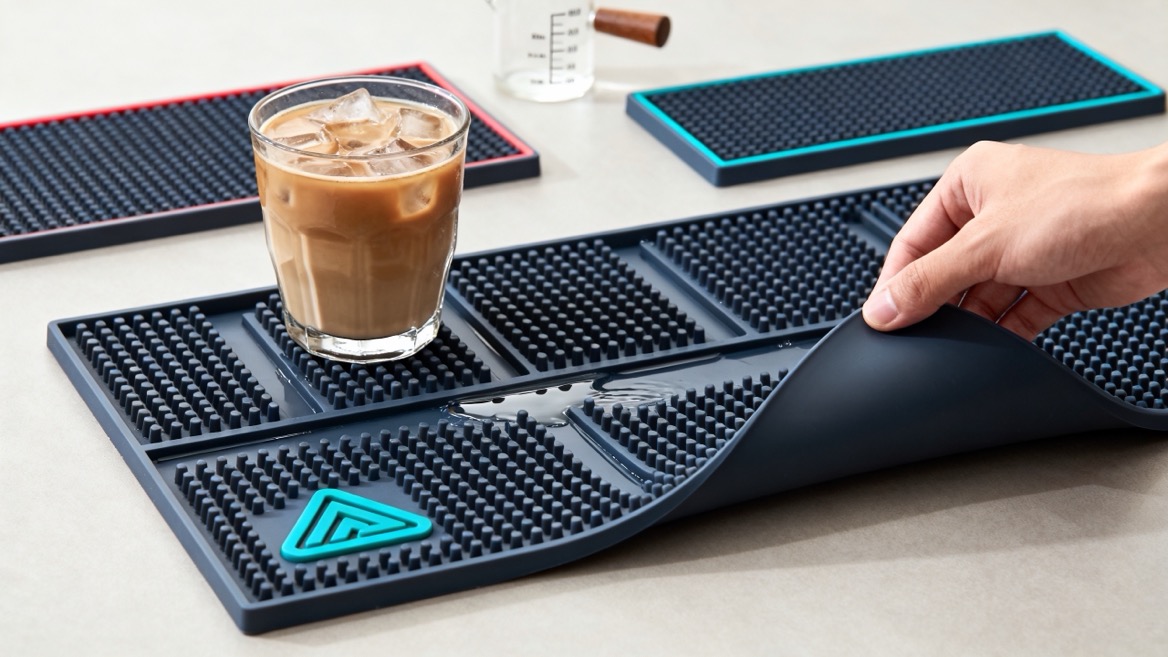
A bar mat is generally a flexible countertop mat with raised surface features. Cups, glasses, or pitchers sit on these features while small amounts of liquid collect in the spaces below.
In cafés, bar mats can serve several zones:
- Iced coffee and cold beverage preparation.
- Milk pitcher staging.
- Syrup and drink assembly stations.
- Beverage handoff counters.
- Temporary placement of rinsed drinkware.
A bar mat does not replace an espresso machine's drip tray, a plumbed drain, or a dedicated warewashing system.
Raised ribs or studs separate the base of drinkware from some collected liquid. This can help keep cup bottoms away from minor puddles while giving staff a defined working area.
However, the mat has limited capacity. Once liquid reaches its containment limit, overflow becomes possible.
From a product-design perspective, channel layout, edge height, and usable surface area matter together. Deep channels are not automatically better if they make residue difficult to remove.
A custom PVC bar mat can combine a practical service surface with molded branding. Contrasting colors and raised lettering make the logo part of the physical design.
For café groups, this creates an opportunity to standardize the appearance of beverage stations across locations.
The design still needs to support cleaning. Large, legible artwork is usually a more practical starting point than intricate lettering surrounded by narrow recesses.
Material selection should follow operating conditions. Avoid assuming that every silicone mat withstands the same temperature or that every PVC mat has identical flexibility.
Soft PVC offers flexibility and opportunities for molded shapes, colors, and logos. It can be a practical option for branded countertop service mats.
Buyers should request specifications for the finished product, including:
- Material composition and relevant substance testing.
- Intended operating conditions.
- Recommended detergents and cleaning methods.
- Dimensional tolerances.
- Intended contact use.
Do not place hot cookware or unusually hot accessories on a PVC bar mat unless its documented performance supports that application.
Silicone products are frequently marketed for heat-related applications, but the material name is not a complete performance specification.
Ask for the finished mat's temperature limits and cleaning instructions. Also check whether its thickness, surface texture, and flexibility suit the intended placement.
A heat-resistant material does not automatically make a mat suitable for supporting heavy equipment.
Absorbent constructions may suit a low-volume coffee corner with occasional water splashes. A busy commercial station handling milk, syrup, and repeated spills needs closer evaluation.
Consider how staff will wash, dry, and rotate the mats. If the available cleaning process cannot adequately remove residue, absorption becomes a maintenance disadvantage rather than a benefit.
The most useful purchasing approach is to divide the counter into working zones.
Start with the area where spills occur most often.
If splashes mainly land beside the brewer, a removable coffee station mat may be sufficient. If staff assemble iced drinks and stage pitchers in a separate area, a compact bar mat may offer better control there.
Avoid covering the whole counter unnecessarily. A smaller, correctly positioned mat is easier to remove and inspect.
Separate brewing protection from drink assembly.
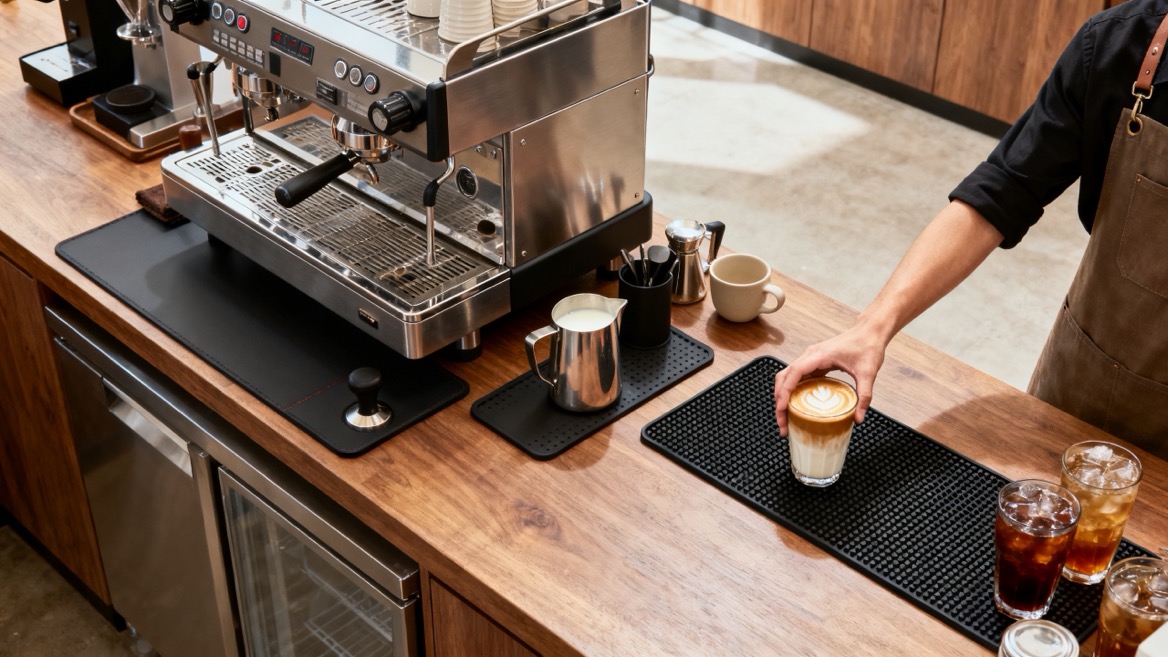
Keep the espresso machine installed according to its instructions. Use appropriately specified mats around accessory areas, then place raised bar mats where staff handle wet pitchers, cold drinks, and syrups.
This arrangement creates distinct work zones without relying on one oversized mat to solve every problem.
Prioritize repeatable specifications.
A custom logo bar mat should have agreed dimensions, colors, artwork placement, cleaning instructions, and acceptance criteria. These details make replacement orders easier to manage.
Brand visibility should support the working environment, not compete with it. Staff still need sufficient usable space for cups and pitchers.
A useful buying decision requires more than a photograph. We recommend a controlled sample evaluation before committing to a larger order.
This is a proposed purchasing procedure, not a standardized laboratory test.
1. Position the sample on a representative, level countertop.
2. Add measured amounts of clean water away from electrical equipment.
3. Record when water reaches the edge or begins to escape.
4. Place typical cups and pitchers on the mat.
5. Check whether their bases contact collected liquid.
6. Empty, wash, and dry the sample.
7. Inspect the underside and counter for trapped moisture.
Repeat the evaluation with the layouts your staff actually use. Drinkware displaces space, so an empty mat's capacity may not represent its working capacity.
Use the findings to define a practical emptying routine. Do not deliberately overflow a mat beside live equipment.
Cleaning performance depends on both product design and staff routines.
Food-service guidance distinguishes cleaning from sanitizing. Cleaning removes soil; sanitizing addresses microorganisms after appropriate cleaning. Applicable requirements depend on use and local rules.
For removable café mats:
1. Remove cups, pitchers, and loose debris.
2. Empty collected liquid before moving the mat through the workspace.
3. Wash using the supplier-approved detergent and method.
4. Brush accessible grooves and molded details.
5. Rinse as instructed.
6. Sanitize when required by the intended use and local procedures.
7. Dry thoroughly and clean the counter before replacement.
Inspect during service as well. A closing-time wash should not become an excuse to leave accumulated milk, syrup, or grounds throughout the day.
Do not assume dishwasher compatibility. Obtain written instructions covering temperature, chemicals, and washing method.
When reviewing samples, examine:
- Accessible channels rather than narrow, deep recesses.
- A removable shape staff can lift safely.
- An underside that is easy to inspect.
- Logo details that do not trap stubborn residue.
- Enough flexibility for handling without excessive distortion.
These features deserve attention alongside color and branding.
The cheapest mat is not necessarily the least expensive to operate.
Compare:
> Annual mat-related cost = purchase and replacement costs + cleaning labor + cleaning supplies.
Use your own operating figures. For illustration, if one design requires two additional minutes of cleaning each day over 300 operating days, that adds 10 labor hours annually.
That example is arithmetic, not an industry benchmark. It shows why cleaning time deserves a place in purchasing decisions.
Record cleaning effort during sample trials. For multiple locations, small daily differences can become meaningful across the estate.
Yijia Plastic Products Co., Ltd. combines research and development, manufacturing, and sales of PVC bar mats and other soft PVC gifts.
Our company background includes 18 years of experience, a 3,000-square-meter factory, 10 automated production lines, and advanced dispensing equipment. We provide one-stop OEM/ODM customization for international customers.
We also report cooperation experience involving Starbucks, Disney, McDonald's, Pop Mart, and Tencent. Such experience should not be interpreted as endorsement of every product or authorization to reproduce those brands.
For procurement, documentation matters more than a list of credentials. Our stated background includes EU RoHS-related and California Proposition 65-related documentation, plus Disney FAMA authorization.
These have different meanings. RoHS concerns restricted substances in electrical and electronic equipment; related testing is not universal proof of café-mat suitability. Proposition 65 concerns specified chemical exposures and warning obligations. Disney FAMA authorizes defined Disney-branded production; it is not a general food-contact approval.
Request current, product-relevant documents and confirm their scope before ordering.
Choose a coffee machine mat for appropriately specified brewing-area protection. Choose a bar mat for beverage assembly and service drips. Use both when separate zones need separate solutions.
For a custom PVC bar mat proposal, send Yijia your countertop dimensions, logo artwork, intended use, destination market, and estimated quantity. Request a sample, cleaning instructions, and relevant documentation before approving bulk production.
It can serve beside brewing equipment when its dimensions and spill-handling design suit the task. It should not automatically replace a mat intended for placement beneath equipment, where stability and installation requirements matter.
It can suit drink preparation and service areas when the finished product meets the intended operating and cleaning requirements. Confirm relevant documentation rather than assuming all PVC products perform identically.
A washable, non-absorbent design with accessible channels may be easier to inspect and empty. The deciding factor is whether staff can remove residue effectively using the approved cleaning process.
Only when the manufacturer explicitly permits it. Confirm acceptable temperatures, detergents, and cycle conditions for the specific finished product.
No. Liquid and debris can collect beneath or around it. Remove the mat regularly, inspect the underside, and clean the counter before replacing it.
Provide counter dimensions, intended placement, logo files, preferred colors, order quantity, destination market, and cleaning requirements. Include any anticipated heat exposure or direct food-contact use.
- [La Marzocco — Linea Operating Manual]. Basis for the discussion of level installation surfaces and unobstructed ventilation. [lamarzoccousa]
- [U.S. Food and Drug Administration — 2022 Food Code, Chapter 4]. Basis for cleaning non-food-contact surfaces and preventing accumulated soil; local adoption and requirements vary. [c-uphd]
- [International Association for Food Protection — "Cleaning: A Retail and Foodservice Perspective"]. Supporting discussion of cleanable equipment design and accessible surfaces. [foodprotection]
- [European Commission — Restriction of Hazardous Substances Directive]. Basis for explaining the directive's electrical and electronic equipment scope. [environment.ec.europa]
- [California OEHHA — About Proposition 65]. Basis for distinguishing chemical-exposure warning obligations from general product certification. [oehha.ca]
- [The Walt Disney Company — Facility and Merchandise Authorization Application and Instructions]. Basis for explaining facility authorization for Disney-branded production. [thewaltdisneycompany]


