
Views: 257 Author: Yijia Plastic Publish Time: 2026-09-09 Origin: Site
Content Menu
● Why Coffee Shops Use Custom PVC Bar Mats
● What Makes a Good Custom Bar Mat?
>> Material: Why PVC Is a Popular Choice
>> Surface Structure and Spill Control
● How to Design a Bar Mat That Supports Your Brand
>> Prioritize a Single Message
>> Use Raised Details Strategically
>> Match Color Expectations Early
● Buyer Checklist Before Requesting a Quote
● Compliance and Documentation for International Projects
● From Concept to Mass Production
>> Step 1: Define the Use Case
>> Step 2: Submit Artwork and Specifications
>> Step 3: Review the Production Proposal
>> Step 4: Approve a Physical Sample
>> Step 5: Confirm Inspection Standards
>> Step 6: Move to Mass Production
● Common Mistakes Coffee-Shop Buyers Should Avoid
>> Choosing Appearance Over Function
>> Using Artwork That Is Too Detailed
>> Treating Compliance as a Last-Minute Task
● Why Manufacturing Experience Matters
● Request a Custom PVC Bar Mat Proposal
● FAQ
>> What is the best size for a coffee-shop bar mat?
>> Can a custom PVC bar mat include a detailed logo?
>> Are custom bar mats suitable for hot coffee cups?
>> How should coffee-shop staff clean PVC bar mats?
>> What artwork format is best for a custom bar mat?
>> Do I need to order a sample before bulk production?
>> Can custom bar mats be used outside coffee shops?
>> What information should I provide for an accurate quotation?
A well-designed custom PVC bar mat does more than catch coffee drips. It helps coffee shops protect counters, organize high-contact work zones, improve the visual consistency of a service bar, and keep their brand visible at the exact moment customers receive their drinks.
For café owners, purchasing managers, roasters, beverage brands, and promotional-product buyers, the right custom bar mat is a practical operating tool and a long-lasting branded asset. The wrong one can create cleaning problems, poor logo visibility, weak grip, inconsistent color, or avoidable production delays.
At Yijia Plastic Products Co., Ltd., we have spent 18 years developing and manufacturing PVC soft-plastic promotional products, including custom PVC bar mats. From our 3,000-square-meter facility, 10 automated production lines, and advanced dispensing equipment, we support one-stop OEM and ODM projects for international buyers. Our experience working with brands such as Starbucks, Disney, McDonald's, Pop Mart, and Tencent has also taught us an important lesson: the best branded mat must perform reliably before it can communicate a brand effectively.
This guide explains how to choose custom bar mats for coffee shops, what specifications matter most, how to prepare artwork, and how buyers can reduce risk before mass production.

Coffee-shop counters face repeated exposure to water, milk, syrups, espresso residue, ice, and condensation. During a busy service period, small spills can spread quickly across the work surface, especially around espresso machines, cold-drink stations, pickup counters, and condiment areas.
A custom PVC bar mat creates a defined surface for cups, pitchers, shakers, tools, or bottled beverages. Its raised structure can help hold drips within the mat area and reduce direct contact between wet items and the countertop.
Commercial bar mats are commonly used to help protect surfaces, stabilize glasses and bottles, and simplify cleaning by catching spills in one controlled area.
For a coffee shop, the practical benefits usually include:
- Counter protection from water rings, syrup residue, coffee stains, and repeated abrasion.
- Better grip for cups, takeaway drink containers, pitchers, and bar tools.
- Faster cleanup because staff can remove, rinse, wipe, and return the mat.
- More organized work zones around espresso machines, handoff counters, and beverage-prep stations.
- Always-on branding through a visible logo, slogan, mascot, campaign graphic, or QR-code-ready layout.
- Improved presentation at cafés, pop-up stores, trade events, sampling counters, and retail activations.
A bar mat should not be treated as a generic giveaway. In a coffee-shop environment, it becomes part of the daily operating surface. That makes material selection, surface design, dimensions, and cleanability central purchasing decisions.
The most successful coffee shop bar mats combine function, durability, and brand visibility. Buyers should assess each of these areas before approving a design.
PVC soft rubber-style mats are widely used for branded merchandise and countertop accessories because they can support dimensional logos, bright colors, molded details, and flexible shapes.
For promotional and hospitality projects, PVC bar mats can offer several advantages:
- Flexible, soft-touch construction.
- Raised 2D or 3D logo areas.
- Good color separation for detailed brand artwork.
- Custom shapes beyond standard rectangles.
- Textured surfaces that can support grip.
- Easy-to-handle weight for events and temporary activations.
- Scalable manufacturing for repeat orders and regional campaigns.
Compared with a flat printed mat, a PVC bar mat can create a more tactile experience. Raised lettering, borders, grooves, icons, and color blocks give a customer something they can see and feel.
That said, buyers should avoid making broad assumptions about all PVC products. The composition, pigments, additives, finishing process, and intended market all matter. Ask your supplier for relevant testing documents and product-specific compliance information rather than relying on generic claims.
The surface pattern determines whether a mat only looks branded or also works efficiently in real service conditions.
Raised dots, ribs, channels, or honeycomb-style structures can help create separation between a wet cup base and the counter surface. A raised outer border can also help keep small spills inside the mat's usable area.
Practical mat features often include textured surfaces for grip and grooves or raised elements that catch liquid and make cleanup easier. Deep grooves and raised borders can further help contain splashes before they spread across a countertop.
For coffee shops, consider where the mat will be used:
| Application Area | Recommended Design Focus | Common Mat Features |
|---|---|---|
| Espresso station | Fast drainage and easy wiping | Raised ribs, open channels, medium-height border |
| Cold beverage station | Spill containment and stable cup placement | Deeper grooves, larger footprint, textured zones |
| Pickup counter | Strong logo visibility and neat presentation | Large central logo, clean border, flatter functional area |
| Condiment counter | Easy maintenance and clear organization | Rectangular shape, simple channels, stain-tolerant color |
| Pop-up event bar | Brand impact and portability | Custom shape, bold color matching, lightweight PVC |
| Retail display | Visual storytelling | Mascot shapes, embossed details, campaign slogans |
A highly decorative surface is not always the most practical. If grooves are too narrow, cleaning can take longer. If raised elements are too dense, cup bases may sit unevenly. The ideal structure depends on the workload of the specific station.
A common buyer mistake is selecting a size based only on available counter space. The better question is: What activity must the mat support?
For example, a small logo mat may work well beneath a register or a bottled-drink display. It may be too small for an espresso workstation where baristas place pitchers, tampers, cups, and cleaning cloths.
Before requesting a quotation, measure:
1. The actual usable counter width and depth.
2. The footprint of equipment that stays in place.
3. The normal placement zone for cups, pitchers, and tools.
4. Clearance needed for staff movement.
5. The size of the logo or message that must remain readable.
6. Whether the mat will be used individually or in a repeated modular layout.
Custom PVC bar mats are often produced in rectangular shapes, but custom outlines can be valuable when the brand has a recognizable visual identity. A coffee bean, cup silhouette, mascot, circular badge, or product-shaped mat can work well for product launches and retail promotions.
However, distinctive shapes should still be practical. Very narrow protrusions, extremely fine edges, or tiny isolated logo details may reduce visual clarity or complicate the production process. An experienced manufacturer should review these points during artwork development.
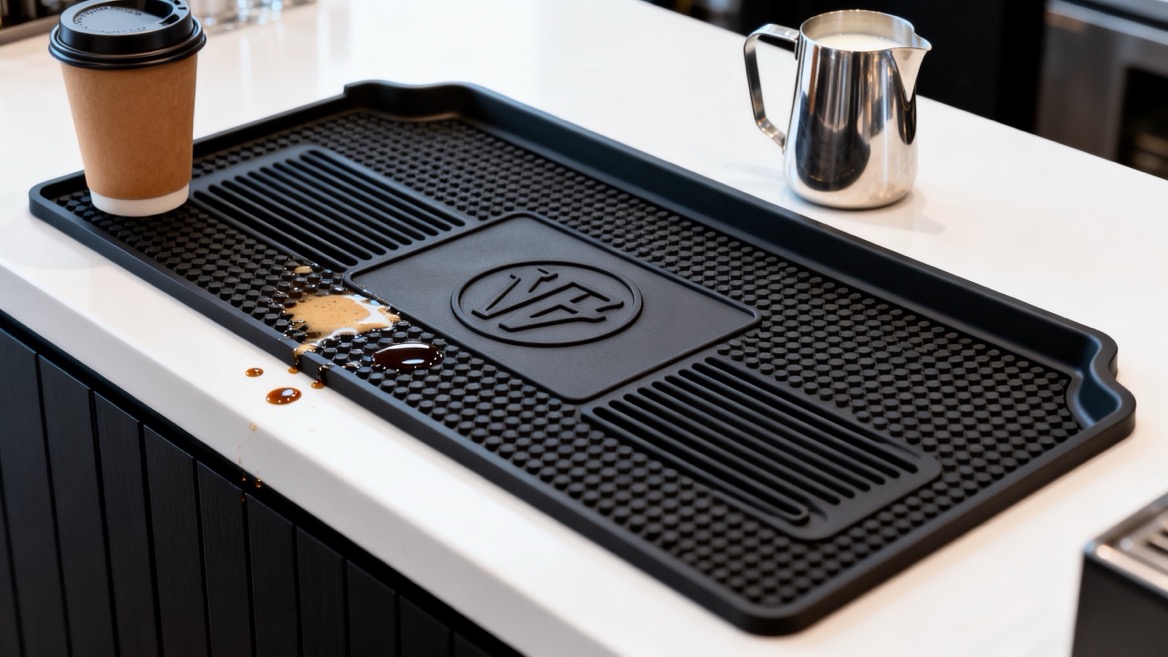
A custom bar mat is a small surface, so every design decision needs a purpose. The strongest designs are not necessarily the most complicated. They are the easiest to recognize at a glance.
Coffee shops often try to fit too much into one design: a logo, a product image, several slogans, social media handles, a QR code, multiple flavors, and an event message. This can make the final mat look crowded.
Instead, select one primary communication goal:
- Build logo recognition.
- Promote a seasonal beverage.
- Introduce a new coffee blend.
- Support a collaboration campaign.
- Encourage a loyalty-program action.
- Direct customers to a menu or campaign page.
- Reinforce a premium or playful brand identity.
For a permanent café installation, the main logo and signature color palette may be enough. For a limited campaign, a short callout such as "Try the New Cold Brew" can be more appropriate.
PVC dispensing technology can create layered color zones and dimensional effects. This makes it suitable for logos with outlines, icons, character artwork, and separate color areas.
Use raised details for:
- Brand names.
- Iconic symbols.
- Short slogans.
- Border lines.
- Product illustrations.
- Directional markers such as "Order Here" or "Pickup."
- Distinct zones for cups, pitchers, or bottles.
Avoid overly small text. What looks clear on a computer screen may become difficult to read after molding. The same principle applies to fine gradients, hairline strokes, and low-contrast colors.
A reliable workflow is to start with a simplified vector logo, create a production-ready color layout, and then approve a physical sample before bulk production.
Brand color consistency is particularly important for franchise groups, global beverage brands, and licensed merchandise programs. Buyers should supply official color references whenever possible.
For best results, provide:
- AI, PDF, EPS, or SVG vector artwork.
- Pantone references when available.
- Brand usage guidelines.
- Approved logo variations.
- Minimum-size requirements.
- Notes on whether colors must match a previous product or campaign.
- Placement requirements for trademarks or licensing marks.
Digital screen colors can differ from physical PVC colors. Lighting, material finish, color opacity, and raised edge shadows can all affect perception. A pre-production sample is the best way to confirm the final appearance.
A detailed inquiry saves time and improves quotation accuracy. It also allows the manufacturer to identify potential production risks before they become expensive changes.
Send the following information when requesting custom PVC bar mats:
| Information Needed | Why It Matters |
|---|---|
| Product dimensions | Determines material use, tooling, packing, and shipping volume |
| Shape | Affects mold design and manufacturing complexity |
| Thickness or height | Influences feel, rigidity, raised structure, and cost |
| Artwork file | Allows accurate logo and color evaluation |
| Pantone color references | Supports more consistent color matching |
| Quantity | Determines tooling allocation and unit pricing |
| Intended market | Helps identify relevant material and documentation needs |
| Intended use | Guides surface structure and durability recommendations |
| Packaging requirements | Important for retail, gifts, events, and e-commerce |
| Target delivery date | Helps plan sampling, approval, production, and shipment |
| Compliance needs | Should be confirmed before production begins |
Buyers should also ask whether the quote includes mold charges, sample charges, artwork support, packing, inspection standards, lead time, and shipping terms.
The lowest unit price is not always the lowest total cost. A supplier that catches artwork problems early, produces stable colors, maintains clear documentation, and provides reliable sampling can reduce the risk of rejected goods, delayed launches, or costly rework.
For brands selling across multiple markets, compliance documentation should be part of the sourcing process from the beginning, not an afterthought.
Yijia Plastic Products Co., Ltd. has EU RoHS, California Proposition 65, and Disney FAMA-related credentials for applicable customer and project requirements. Buyers should still verify the relevance of each document to the exact product, material formulation, production facility, and destination market.
California Proposition 65 is formally known as the Safe Drinking Water and Toxic Enforcement Act of 1986. It addresses exposure to chemicals known to the State of California to cause cancer, birth defects, or other reproductive harm.
For PVC soft-plastic products, responsible procurement may involve reviewing:
- Material declarations.
- Applicable test reports.
- Restricted-substance requirements.
- Market-specific labeling needs.
- Brand or retailer compliance manuals.
- Packaging-material requirements.
- Traceability and batch-control procedures.
This is especially important for licensed products, children's merchandise, large retail programs, and projects distributed in California or the European market.
A strong supplier relationship includes transparency. Ask direct questions, define your specifications in writing, and confirm that documentation applies to the finished product you are ordering.
Custom PVC bar mat production works best when buyers follow a structured approval process.
Start by identifying the location and purpose of the mat. Is it for a high-volume espresso bar, a display counter, a branded event, a gift-with-purchase campaign, or a retail package?
The answer influences size, texture, logo placement, thickness, packaging, and quantity.
Provide vector artwork, preferred dimensions, quantity, target colors, and intended market. If you have a reference product, send photos and measurements along with notes on what should be improved.
A professional manufacturer should review your artwork for fine lines, small text, thin walls, color boundaries, and areas where mold limitations may affect the final result.
This is the stage to confirm whether the logo will be raised, recessed, flat, or combined with a textured background.
Do not skip sampling for important brand programs. A sample allows you to evaluate:
- Color appearance.
- Logo readability.
- Surface grip.
- Flexibility.
- Raised-detail quality.
- Edge finishing.
- Odor and overall presentation.
- Fit on the intended counter.
- Packaging quality.
Define acceptable quality standards before bulk production. Confirm details such as color tolerance, logo placement, surface cleanliness, packing quantity, carton markings, and required documentation.
Once the sample and final specifications are approved, mass production can begin. Clear approval records reduce confusion when repeat orders are placed months later.
A mat may look impressive in a product photo but fail in a busy drink station. Always consider the amount of liquid, cleaning frequency, and type of items placed on it.
Tiny lettering and complicated multi-color illustrations may not translate well into molded PVC. Simplification often improves both brand visibility and production stability.
A highly textured mat can trap residue if it is not designed with cleaning in mind. Choose a surface pattern that staff can rinse or wipe quickly during normal operations.
For a logo-critical project, a physical sample is essential. It reveals color, size, feel, and workmanship issues that cannot be fully assessed from a digital proof.
A bar mat for internal café use may need only bulk packing. A mat sold as branded merchandise may need retail-ready packaging, barcode space, warning labels, instruction cards, or display hooks.
If the product is intended for specific retail channels or overseas markets, clarify testing and documentation needs before tooling and mass production begin.
For custom promotional products, the result depends on more than a logo file. It depends on material control, mold precision, dispensing quality, color management, production capacity, inspection procedures, and communication.
With 18 years of manufacturing experience, Yijia Plastic Products Co., Ltd. provides integrated support across product development, manufacturing, and sales. Our 3,000-square-meter production facility includes 10 automated production lines and advanced dispensing equipment, helping us support both standard custom bar mat programs and more complex OEM/ODM projects.
Our work with internationally recognized companies, including Starbucks, Disney, McDonald's, Pop Mart, and Tencent, has given us experience with brand-sensitive projects where visual consistency, product quality, confidentiality, and delivery coordination are essential.
For buyers, the value of an experienced supplier is not simply that they can produce a PVC mat. It is that they can help turn a branding idea into a product that is practical, repeatable, and suitable for the intended market.
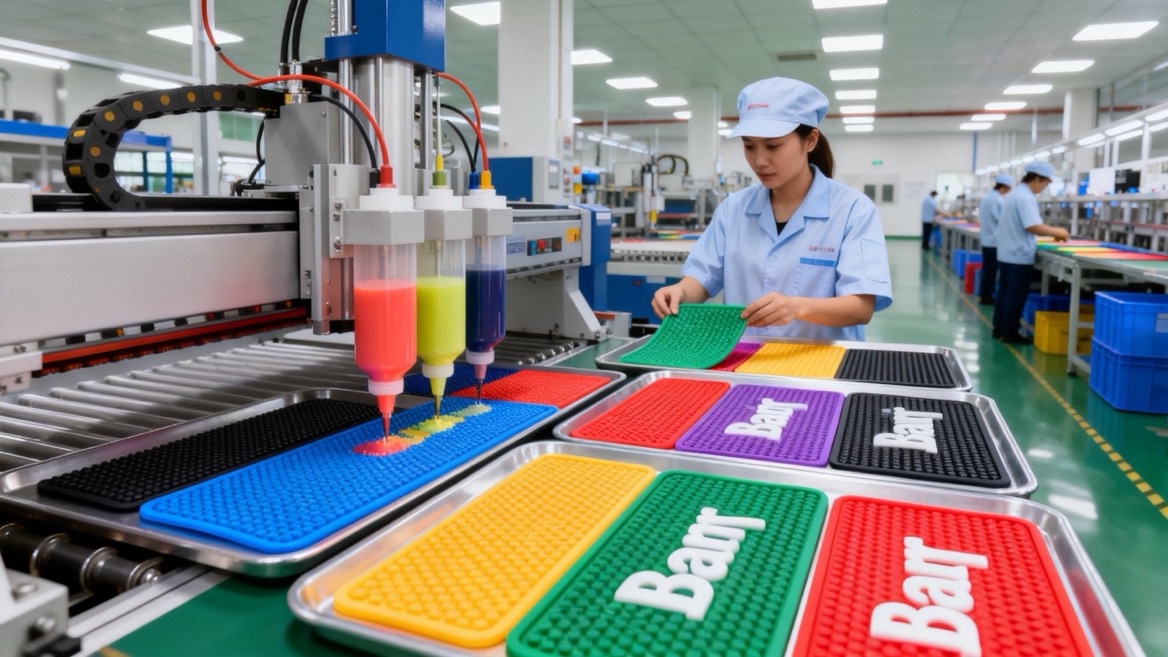
If you are sourcing custom bar mats for coffee shops, start with a clear brief: your logo, target size, estimated quantity, intended use, packaging needs, destination market, and required delivery date.
Yijia Plastic Products Co., Ltd. can help evaluate your design, recommend a practical PVC structure, prepare a sample, and support OEM or ODM production from concept through shipment.
Contact our team today to discuss your custom PVC bar mat project and receive a tailored quotation based on your specifications.
The best size depends on the workstation. Measure the actual drink-preparation or handoff area, then leave enough clearance for equipment and staff movement. A mat should cover the area where drips and cups are most likely to collect without crowding the counter.
Yes. PVC dispensing processes can support multi-color logos, raised lettering, icons, borders, and character designs. However, very small text and fine lines should be simplified to maintain clarity in the finished product.
A bar mat can help protect the counter from moisture and improve cup stability, but buyers should define the expected temperature exposure with the manufacturer. Product suitability should be evaluated based on the specific material formulation, design, and use environment.
In most daily-use settings, staff can remove loose debris, wipe the mat with mild detergent and warm water, rinse if appropriate, and allow it to dry before returning it to the counter. Regular cleaning helps prevent sticky residue from building up in textured areas.
Vector files such as AI, PDF, EPS, or SVG are preferred because they allow the manufacturer to review edges, color areas, text, and mold details accurately. Include Pantone colors and brand guidelines when available.
A sample is strongly recommended, especially for branded campaigns, licensed products, multi-color artwork, or large-volume orders. It helps confirm color, size, surface texture, logo quality, and overall usability before mass production.
Yes. They are also suitable for restaurants, bars, hotels, beverage promotions, trade shows, retail counters, tasting events, convenience stores, home coffee stations, and corporate gift programs.
Provide dimensions, shape, thickness, artwork, color references, quantity, packaging requirements, destination market, compliance needs, target delivery date, and intended use. The more complete the brief, the more accurate the quotation and production recommendation will be.
1. [California Office of Environmental Health Hazard Assessment — Proposition 65]
2. [A Bar Above — Bar Mats: How To Choose the Right One]
3. [Knot & Style — Drink Mats for Countertops: Bar and Coffee Station Guide]
4. [Beverage Craft — Why Custom Bar Mats Are a Must-Have for Bars, Pubs and Restaurants]


