
Views: 237 Author: Yijia Plastic Publish Time: 2026-10-21 Origin: Site


Content Menu
● 1. Match Custom Bar Mats to Restaurant Workflows
>> Measure the Usable Counter Space
● 2. Evaluate PVC Bar Mat Construction, Not Just Appearance
>> Specify Dimensions, Thickness, and Flatness
>> Test Grip on Your Actual Countertop
● 3. Put Cleanability Ahead of Decorative Complexity
>> Confirm Cleaning Compatibility Before Ordering
● 4. Design Branded Bar Mats for Real Viewing Conditions
>> Approve Physical Color Samples
● 5. Understand What Compliance Documents Actually Demonstrate
>> Ask for Product-Relevant Evidence
● 6. Run a Practical Sample Validation Trial
>> Use a Five-Step Approval Process
>> Turn Preferences into Acceptance Criteria
● 7. Compare Total Purchasing Cost, Not Unit Price Alone
>> Consider Cost per Accepted Unit
● 8. Assess Manufacturing Capability and Reorder Consistency
>> What Yijia Brings to the Discussion
● 9. Build a Complete Request for Quotation
● Start Your Custom Bar Mat Project with a Clear Brief
>> What Is the Best Size for Custom Restaurant Bar Mats?
>> Are Custom PVC Bar Mats Dishwasher-Safe?
>> Can Bar Mats Touch Food Directly?
>> What Is the Minimum Order Quantity?
>> Does Disney FAMA Prove a Bar Mat Is Food-Safe?
>> How Can Buyers Maintain Consistency Across Reorders?
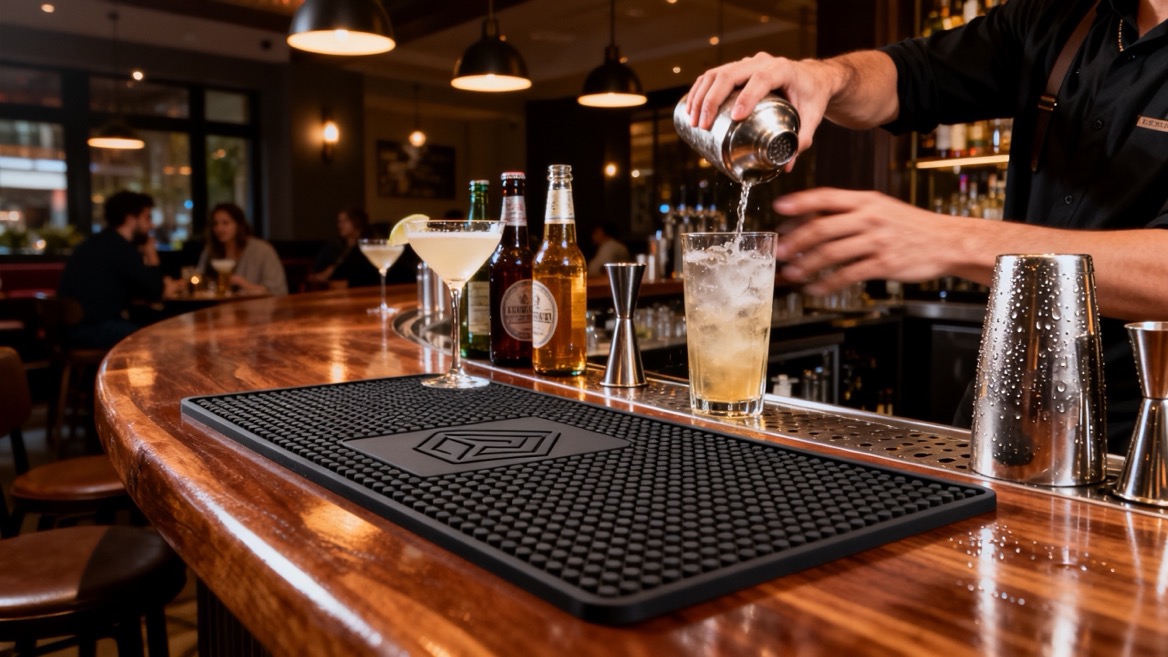
Custom bar mats for restaurants should do more than display a logo. They need to fit the workstation, support efficient service, withstand routine cleaning, and maintain a consistent appearance across repeat orders. For commercial buyers, the right specification connects brand presentation with everyday operating requirements.
At Yijia Plastic Products Co., Ltd., we approach this category from a manufacturing perspective, supported by 18 years of experience in PVC soft-rubber gifts. Our recommendation is straightforward: specification should come before decoration. Before approving artwork, define where the mat will sit, how staff will use it, and what evidence your purchasing team needs.
This guide explains how to evaluate custom PVC bar mats, compare suppliers, and build a purchasing brief that reduces avoidable uncertainty.

A cocktail preparation station, beer service counter, and customer-facing bar rail have different requirements. Ordering the same mat for every location may simplify purchasing but create problems during service.
Start by mapping the intended application.
| Application | Purchasing priority | What to check |
|---|---|---|
| Cocktail preparation | Stable working area and spill management | Footprint, surface texture, border design |
| Beer service | Practical placement beneath dispensing areas | Equipment clearance and cleaning access |
| Customer-facing counter | Visible, readable branding | Logo orientation and viewing distance |
| Glass staging | Appropriate support and spacing | Compatibility with actual glass bases |
| Multi-location rollout | Repeatable specifications | Approved samples and reorder controls |
Record the available length and width, not simply the counter's overall dimensions. Account for equipment feet, taps, sinks, cable openings, and edges.
A full-size paper template provides a useful first check. Place it on the counter and ask bartenders to simulate normal movements before committing to tooling.
Distinguish countertop bar mats from floor-standing anti-fatigue mats. They serve different purposes and should not share the same purchasing specification.
"Soft PVC" describes a material category, not a complete performance specification. Buyers still need to establish the formulation, dimensions, surface design, and intended cleaning conditions.
Request a dimensioned drawing covering:
- Overall length and width.
- Total thickness.
- Border height.
- Raised surface or nib geometry.
- Logo position.
- Agreed dimensional tolerances.
Do not assume that a heavier mat is automatically better. Instead, assess whether the finished product lies flat, fits the counter, and supports the intended workflow.
Inspect edges as carefully as the center. Curling, uneven borders, or inconsistent thickness can make a visually attractive sample unsuitable for the workstation.
Avoid accepting "non-slip" as an absolute performance promise. Request a sample and assess movement on the intended counter under representative dry and wet conditions.
Use your actual glassware during evaluation. Small cocktail stems, heavy beer glasses, and broad-based tumblers may interact differently with the same surface.
Your acceptance criteria should describe observable results rather than rely on vague terms such as "premium quality."
Restaurant equipment should support practical cleaning. The FDA Food Code's nonfood-contact equipment provisions emphasize suitable construction, accessible surfaces, and cleaning sufficient to prevent soil accumulation. Local requirements and the product's actual use remain important.
For custom restaurant bar mats, translate those principles into design questions:
- Can staff reach the spaces between raised details?
- Can sticky beverage residue be removed without excessive brushing?
- Can the mat be lifted and the counter underneath cleaned?
- Does the logo introduce narrow recesses that trap residue?
- Can staff inspect the surface easily after washing?
Request written care instructions for the proposed formulation. Ask specifically about detergent compatibility, maximum cleaning temperature, and any limitations on soaking or mechanical washing.
Do not describe a mat as dishwasher-safe unless that claim has been validated for the finished product and relevant wash conditions.
Likewise, avoid assuming a decorative countertop mat is suitable for direct contact with garnishes or ready-to-eat food. If direct food contact is intended, disclose it before material selection and obtain an appropriate assessment.
Custom logo bar mats combine an operating surface with a brand message. Neither function should undermine the other.
From a production perspective, we recommend simplifying artwork before increasing its complexity. Fine lettering, intricate gradients, and tiny details should be reviewed against the chosen manufacturing process.
Provide vector artwork where available, together with:
- Brand color references.
- Required logo proportions.
- Minimum clear space.
- Preferred logo orientation.
- Any restrictions on background colors.
Evaluate the design from the guest's viewing position and the bartender's working position. A logo that looks impressive on a screen may become difficult to read once glassware covers part of the surface.
Digital proofs help confirm layout, but screens are not reliable substitutes for physical color approval.
For multi-location buyers, identify an approved physical sample as the reference for subsequent orders. Also agree on how color differences will be assessed.
Request confirmation of whether each design element is molded into the mat or applied through another process. Construction affects which appearance and durability checks belong in the approval plan.
Commercial buyers should evaluate documentation by scope, not by the number of logos on a supplier presentation.
RoHS, California Proposition 65, and Disney FAMA address different subjects. They should not be presented as interchangeable product-safety certifications.
| Document or framework | What buyers should understand | Recommended purchasing check |
|---|---|---|
| RoHS-related report | RoHS primarily concerns electrical and electronic equipment | Review tested substances and sample identity; do not treat it as blanket approval for bar mats |
| Proposition 65 assessment | Warning obligations depend on relevant chemical exposure | Confirm the assessment basis for the intended product and use |
| Disney FAMA | Authorization relates to a facility and Disney-branded production | Verify applicable authorization and separate intellectual-property permissions |
| Relevant material testing | Results apply to identified samples and test conditions | Match reports to the proposed formulation and destination market |
A useful report identifies the laboratory, sample, test method, date, and results. Buyers should establish whether it represents the material and colors being ordered.
A generic report for an unrelated PVC item is not a complete substitute for product-relevant evidence.
For European orders, discuss applicable chemical restrictions, including relevant restrictions on phthalates in plasticized materials. The correct assessment depends on the product and intended use.
One of the most useful purchasing improvements is separating visual approval from operational approval.
A sample can look correct yet perform poorly in a busy service area. We recommend a documented trial before a substantial rollout.
1. Check the drawing: compare dimensions, thickness, borders, and logo placement with the agreed specification.
2. Check appearance: inspect color, lettering, surface consistency, and visible defects.
3. Simulate service: use the intended glassware and representative counter conditions.
4. Follow the cleaning routine: evaluate cleaning accessibility using supplier-approved methods.
5. Record the result: document observations, photographs, and any required changes.
This is a proposed buyer-validation process, not a substitute for laboratory testing or a published industry standard.
Replace "good grip" with an agreed evaluation method. Replace "easy to clean" with a defined cleaning procedure and an inspection for remaining residue.
Agree in advance on what happens when a sample fails. Options might include adjusting surface geometry, changing artwork, or reviewing the formulation.
A signed production sample helps connect purchasing expectations with factory inspection.
Wholesale custom bar mats should be compared on a like-for-like basis. A low quotation is difficult to interpret when tooling, packaging, freight, or testing responsibilities remain unclear.
Request an itemized quotation covering:
- Unit price at relevant quantities.
- Tooling and sample charges.
- Packaging specifications.
- Testing costs, where required.
- Shipping terms.
- Production lead time.
- Reorder conditions.
For an internal comparison, divide the relevant purchase and delivery costs by the number of units that meet your acceptance requirements.
This approach makes rejected goods and replacement handling visible without inventing a universal service-life figure.
Ask who owns the tooling, how long it will be retained, and whether future design changes require new tooling. Clarify these points before placing the first order.
Do not accept an unsupported claim that one mat will last a fixed number of years. Actual service conditions, cleaning practices, and material specifications matter.
A supplier's machinery list provides context, but buyers also need to understand how orders are controlled.
Ask how the manufacturer manages artwork approval, material identification, in-process checks, final inspection, and production changes.
For restaurant chains, repeatability matters as much as the first sample. Different locations should receive products made against the same approved specification unless a change is authorized.
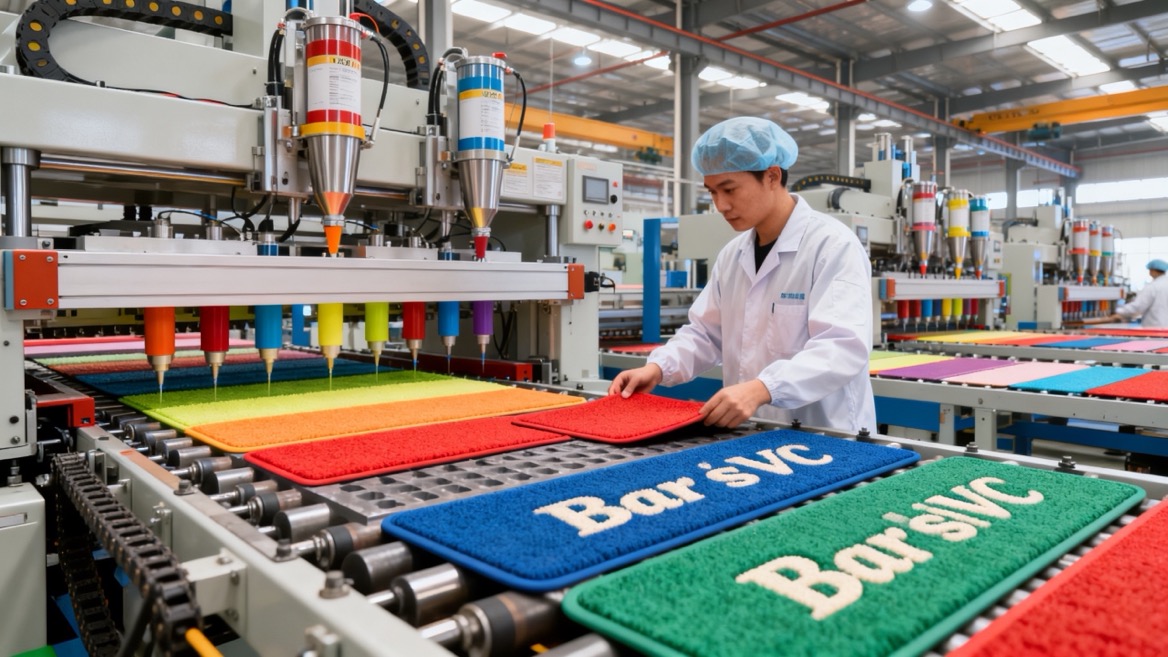
Yijia Plastic Products Co., Ltd. combines research and development, manufacturing, and sales of PVC soft-rubber gifts, including custom PVC bar mats.
Our company background includes:
- 18 years of industry experience.
- A 3,000-square-meter factory.
- 10 automated production lines.
- Multiple advanced dispensing machines.
- One-stop OEM and ODM customization.
We also report experience working with Starbucks, Disney, McDonald's, Pop Mart, and Tencent. These company-provided details describe our background; they should not be interpreted as endorsements of a particular bar mat.
Buyers are welcome to request relevant documentation, samples, and project-specific capability information.
A clear brief helps manufacturers quote the same requirement and reduces unnecessary clarification.
Include the following information in your inquiry:
| Brief item | Information to provide |
|---|---|
| Intended use | Preparation, service, display, or glass staging |
| Dimensions | Size, thickness, and available counter space |
| Branding | Vector artwork and color references |
| Quantity | Initial order and anticipated reorder quantities |
| Destination | Country or market of sale |
| Cleaning | Intended methods and operating conditions |
| Packaging | Individual packing, cartons, and labeling |
| Documentation | Required tests, reports, or assessments |
| Timing | Sample approval and required delivery dates |
If your design is still developing, identify which elements are fixed and which can change. That allows the manufacturer to suggest alternatives without weakening your essential requirements.
Send Yijia Plastic Products Co., Ltd. your logo, dimensions, quantity, destination market, and cleaning requirements. Request a project-specific quotation, sample plan, and documentation review before approving production.
For commercial buyers, a successful order starts with a mat that works at the counter—not simply one that looks good in a catalog.
There is no single best size. Measure the usable workstation, allow equipment clearance, and test a full-size template before approving a drawing.
Not automatically. Obtain written confirmation for the finished formulation and validate compatibility with the intended dishwasher temperature, chemicals, and cycle.
Do not assume so. If direct contact with garnishes or other food is intended, tell the manufacturer and request an appropriate material and compliance assessment.
Minimum quantities depend on dimensions, artwork, colors, tooling, and production arrangements. Request a project-specific quotation rather than relying on a general advertised figure.
No. FAMA concerns authorization for a facility to produce or handle Disney-branded products. It does not establish food-contact suitability.
Retain an approved sample, dimensioned drawing, artwork files, and agreed inspection criteria. Require notification before changes to materials, colors, tooling, or production specifications.
1. [U.S. Food and Drug Administration — Food Code 2022]. Background for equipment construction, nonfood-contact surfaces, and cleaning principles. This is a model code; buyers should check locally applicable requirements. [fda]
2. [European Commission — RoHS Directive]. Explains the directive's electrical and electronic equipment scope and restricted substances. [environment.ec.europa]
3. [California Proposition 65 Warnings — Frequently Asked Questions for Businesses]. Explains exposure-based warning responsibilities and the importance of appropriate assessment. [p65warnings.ca]
4. [The Walt Disney Company — Facility and Merchandise Authorization Application]. Explains facility authorization requirements for Disney-branded production and handling. [thewaltdisneycompany]
5. [SATRA Technology — Phthalates in Consumer Products]. Technical background on phthalate restrictions affecting plasticized materials and related supply-chain obligations. [satra]


