
Views: 263 Author: Yijia Plastic Publish Time: 2026-10-04 Origin: Site
Content Menu
● Why Custom Coffee Bar Mats Work
>> Branding at the point of service
>> Organization without unnecessary clutter
● How to Specify Custom PVC Mats
>> Measure the usable counter area
>> Turn requirements into a written brief
>> Design for recognition and cleaning
>> Understand the material's limits
>> Read compliance claims carefully
>> Test a sample before ordering
>> Make cleaning part of the design
>> Compare total cost, not price alone
>> Establish a repeat-order standard
>> What Yijia brings to customization
>> Start with a project-ready inquiry
>> What size should a custom coffee bar mat be?
>> Can I customize the logo, shape, and colors?
>> Are PVC coffee bar mats food-safe?
>> Can a coffee bar mat go in a dishwasher?
>> How long will a custom mat last?
>> What should I prepare for an OEM/ODM quotation?
Custom coffee bar mats give cafés a practical way to combine counter organization with visible branding. A well-designed mat creates a defined space for drink preparation or pickup, catches small spills within its surface profile, and places your logo where customers already look.
At Yijia Plastic Products Co., Ltd., we approach a branded mat as working equipment first and a promotional product second. The right design must fit your counter, support daily cleaning, and keep the café's identity readable during service. Attractive artwork alone is not enough.
This guide explains how to specify custom PVC coffee bar mats, evaluate samples, and plan an order without overlooking the operational details that matter after delivery.
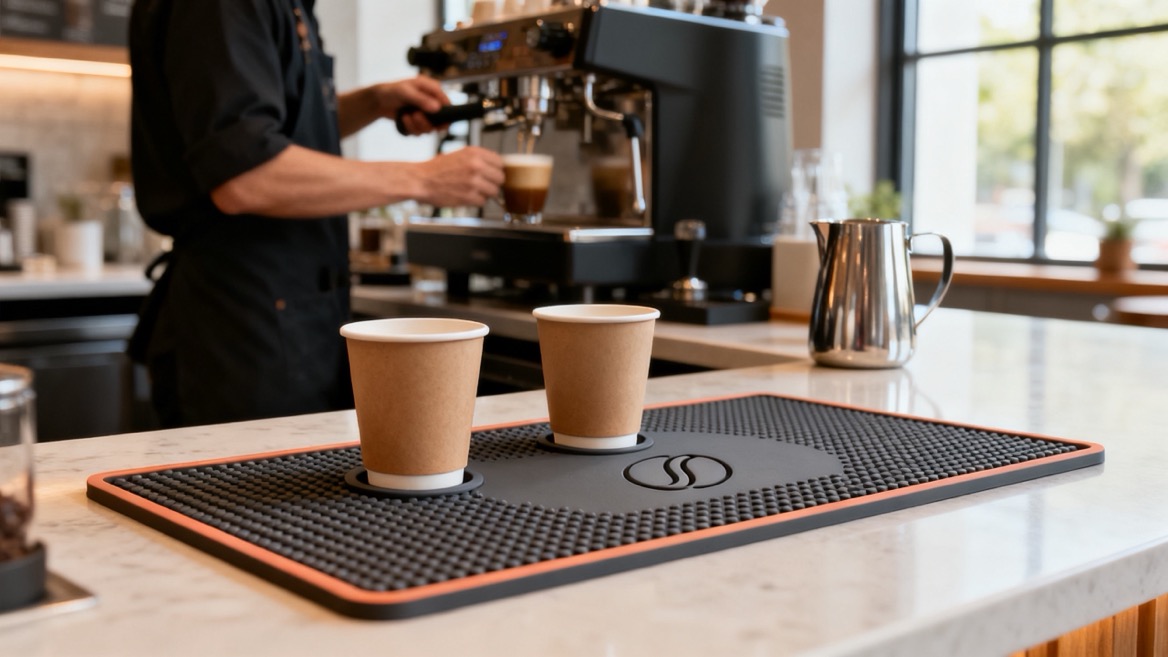
A coffee bar is a natural place to reinforce your visual identity. Customers watch drinks being prepared, collect takeaway orders, and photograph their purchases. A branded coffee counter mat can make that space look more intentional without adding another freestanding display.
Keep expectations realistic. A mat does not guarantee higher sales or social engagement. Its immediate value is a consistent, visible brand touchpoint that also serves a practical purpose.
For most cafés, one readable logo is more useful than several competing messages. A short tagline can work when it remains legible and does not interfere with the working surface.
A mat can mark a drink-finishing area, a pickup position, or a dedicated space for syrup bottles. That visual boundary helps explain how the counter should be used.
A raised surface can hold small spills beneath its contact points, depending on the design. However, a mat does not eliminate wiping, prevent every slip, or replace a proper spill-response procedure.
Choose the placement before choosing the artwork. A beautiful mat that blocks access to a machine or reduces usable workspace is the wrong specification.
Consider a café with a narrow takeaway counter. Its owner initially wants a large logo mat across the entire pickup area. During layout planning, the team finds that the proposed mat would overlap the payment terminal and leave insufficient room for drink carriers.
A smaller rectangular design keeps the logo visible while leaving a clear handover space. This is an illustrative planning example, not a documented customer case. The lesson is simple: fit the workflow first, then build the branding around it.
Record the available width and depth, but also identify the space staff need for pitchers, cups, cables, and cleaning access. Measure the actual installation point rather than relying on a general counter drawing.
Ask whether the mat will sit beneath equipment, beside it, or in a customer-facing pickup zone. These locations create different requirements for thickness, edge height, and visual orientation.
Leave enough clearance to lift the mat for cleaning. If equipment rests on it, confirm that the arrangement does not conflict with equipment instructions or service access.
A written specification makes quotations easier to compare and reduces misunderstandings during sampling.
| Specification | What to provide | What to verify |
|---|---|---|
| Placement | Preparation, pickup, or promotional counter | Available working space |
| Dimensions | Length, width, and proposed thickness | Fit and agreed tolerances |
| Artwork | Vector logo and preferred orientation | Legibility at actual size |
| Colors | Brand color references | Approved physical sample |
| Surface | Raised pattern, logo relief, and border | Cleaning access and cup stability |
| Market | Destination country and intended use | Relevant documentation |
| Order | Quantity, packaging, and delivery target | Written commercial terms |
Do not approve a design from a screen image alone. Digital artwork cannot show every detail of flexibility, surface feel, color, or edge finish.
For custom logo coffee bar mats, clarity should guide the artwork. Tiny lettering, thin outlines, and crowded patterns may look attractive in a digital mockup but become difficult to read in a working café.
Ask the manufacturer to identify production limits before finalizing fine details. Minimum line widths, relief depth, and color boundaries should be discussed against the proposed construction, not assumed.
From a manufacturing perspective, we recommend treating cleanability as a design requirement. Intricate recesses may create more work for staff. Keep decorative details away from areas where sticky residue is likely to collect.
Soft PVC is a possible choice for flexible, molded promotional mats. Suitability still depends on the formulation, construction, intended placement, and supporting test information.
Do not assume a standard PVC bar mat is suitable for direct food contact, dishwasher cleaning, or contact with very hot equipment. Ask for documented guidance covering the actual use you propose.
Likewise, avoid treating "non-slip" as an absolute promise. Evaluate movement on your own counter under relevant dry and wet conditions, and keep both the mat and counter clean.
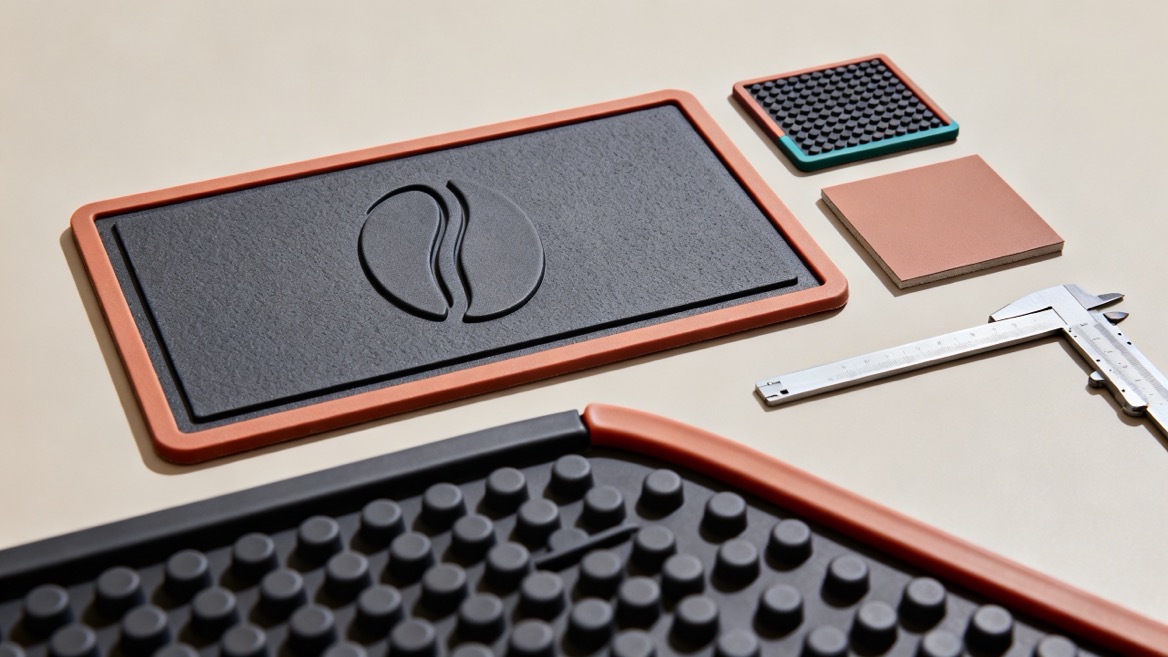
Buyers should request documents rather than rely on a list of certification names. Check the issuing organization, report date, sample description, tested substances, and connection to the product being ordered.
RoHS restricts specified hazardous substances in electrical and electronic equipment. A standalone coffee bar mat is not automatically within that scope. Testing against RoHS substance limits can provide supporting material information, but it does not establish food-contact suitability.
California Proposition 65 concerns exposures to listed chemicals and associated warning obligations. It is not a universal product safety certification. A chemical-content report alone may not answer whether a warning is required for the intended use.
Disney FAMA relates to facility and merchandise authorization for Disney-branded production. It is not a food-contact approval or unrestricted permission to reproduce Disney artwork. Brand licensing and applicable authorization must be handled separately.
A preproduction sample should answer practical questions, not simply confirm that the logo looks correct. Use the intended counter and representative cups where possible.
1. Check fit against the measured installation area.
2. Examine the logo, color boundaries, edges, and surface consistency.
3. Place representative cups on the mat and check for rocking or uneven support.
4. Observe movement during normal drink preparation and pickup.
5. Introduce a small, controlled spill and assess containment and cleanup.
6. Clean the sample using the proposed method and inspect it after drying.
7. Record the results and approve the final specification in writing.
Avoid hazardous heat tests or chemical experiments. Obtain manufacturer guidance first, and use qualified testing where safety or regulatory questions require it.
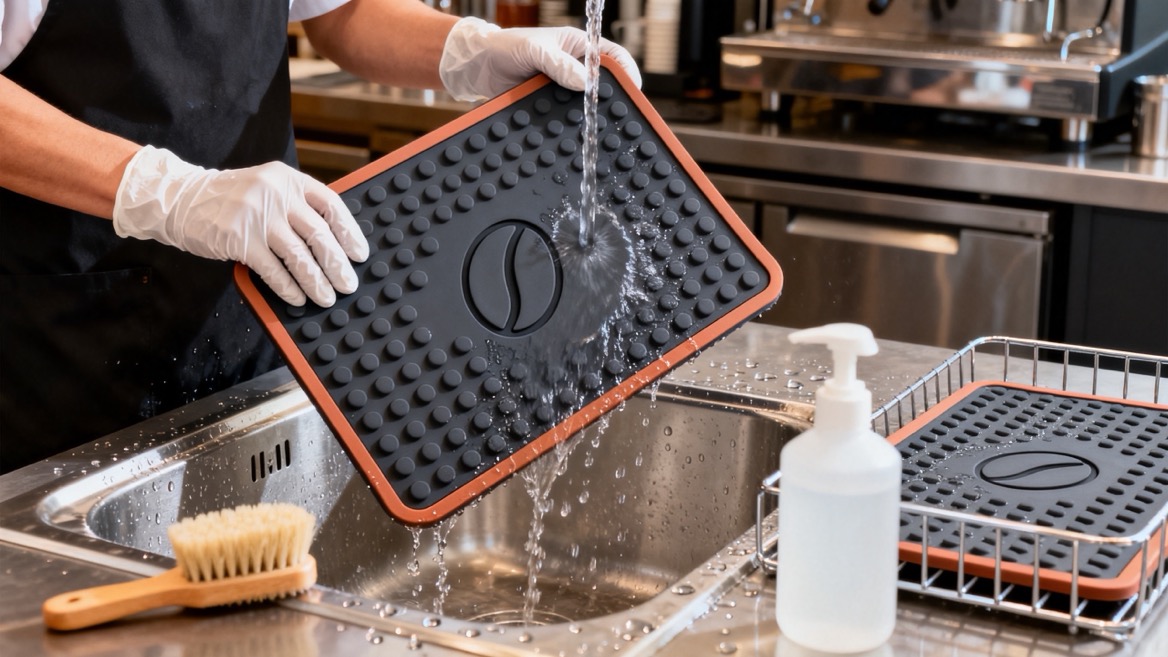
A coffee station encounters water, coffee residue, milk, and syrup. A mat that looks clean from above can still conceal residue underneath, so the cleaning procedure must address both surfaces and the counter.
Foodservice guidance emphasizes accessible, cleanable nonfood-contact surfaces and cleaning often enough to prevent residue accumulation. It does not make every bar mat appropriate for every foodservice application.
Use the following framework, adjusted to the manufacturer's instructions and your café's hygiene procedures:
- Remove cups and loose items before lifting the mat.
- Dispose of collected liquid without spreading it across clean areas.
- Wash with a compatible detergent and tools that reach the surface pattern.
- Rinse as instructed and apply any required sanitizing procedure separately.
- Clean the counter underneath and allow surfaces to dry before replacement.
- Inspect for damage, persistent residue, or other changes that warrant replacement.
Do not assume a quick rinse is sufficient after milk or syrup spills. Keep spares available if cleaning and drying would otherwise interrupt service.
A useful quotation separates tooling, samples, production, packaging, transport, and any agreed testing. Confirm minimum quantities, lead times, and repeat-order conditions instead of assuming that all suppliers offer the same terms.
The lowest unit price may not produce the lowest operating cost if the design requires excessive cleaning or does not fit the counter.
For illustration, if a mat costs $12 and remains usable for 240 operating days, its purchase cost is $0.05 per day. This hypothetical calculation excludes labor, freight, taxes, and replacement costs; it is not a Yijia quotation or a lifespan promise.
For multiple locations, keep one approved specification and physical reference sample. Record dimensions, artwork version, colors, surface design, packaging, and inspection criteria.
Ask how changes in materials, tooling, or production arrangements will be communicated. A repeat order should reference the approved specification rather than rely on "same as last time."
For a first rollout, consider testing the approved design at one location before distributing it across the network. Staff feedback can reveal handling problems that a purchasing team may not notice.
According to the company information provided, Yijia Plastic Products Co., Ltd. has 18 years of experience integrating research and development, production, and sales of PVC bar mats and other soft PVC gifts.
The company reports a 3,000-square-meter factory, 10 automated production lines, and multiple advanced dispensing machines. Its one-stop OEM/ODM offering supports buyers who have finished artwork as well as those developing a custom product concept.
Yijia also reports cooperation experience involving Starbucks, Disney, McDonald's, Pop Mart, and Tencent. These company-provided statements should not be interpreted as endorsements of a particular mat or permission to use those brands' intellectual property.
For procurement, request current documents supporting the stated RoHS-related testing, California Proposition 65 compliance work, and Disney FAMA authorization. Confirm their scope against your specific project.
Send Yijia your logo file, counter measurements, intended placement, destination market, estimated quantity, and required delivery date. Include cleaning expectations and any buyer-specific testing requirements.
Ask for a proposed specification, itemized quotation, sample plan, and relevant supporting documents. Approve the physical sample before authorizing production. That process gives your café a clearer route to a branded mat that works in daily service.
Choose the size from the usable counter area and the task it serves. Allow clearance for cups, equipment access, and cleaning. There is no single best size for every café.
Discuss these options with the manufacturer before finalizing artwork. Feasibility depends on tooling, design detail, construction, and order requirements. Use a physical sample to approve the result.
Do not assume they are suitable for direct food contact. Request documentation for the exact material and intended use. Supporting substance tests are not interchangeable with food-contact evidence.
Only use dishwasher cleaning when the manufacturer confirms compatibility with the relevant temperature, detergent, and cycle. Otherwise, follow the documented cleaning method for that product.
Lifespan depends on construction, use, cleaning, and exposure conditions. Avoid relying on an unsupported fixed lifespan. Inspect regularly and replace mats that no longer remain cleanable or perform as intended.
Provide artwork, dimensions, quantity, destination, delivery target, packaging preferences, and intended use. Request confirmation of tooling costs, sampling, production timing, and applicable testing before committing.
1. Yijia Plastic Products Co., Ltd. — Company information supplied for this article. Source of the stated 18-year experience, factory size, production equipment, OEM/ODM services, compliance credentials, and brand cooperation history. No company website, supporting certificates, original article, or customer reviews were supplied; these statements have not been independently verified.
2. U.S. Food and Drug Administration — [Food Code 2022]. See Sections 4-202.16, 4-601.11(C), and 4-602.13 for nonfood-contact surface design, cleanliness, and cleaning frequency. This is general foodservice guidance, not approval of a specific PVC mat. [fda]
3. European Commission — [RoHS Directive]. Explains the directive's scope for electrical and electronic equipment and its restrictions on ten hazardous substances. Supports the distinction between substance testing and food-contact suitability. [environment.ec.europa]
4. California Proposition 65 Warnings Website — [What Are Safe Harbor Numbers?]. Explains exposure levels used to determine whether a Proposition 65 warning is necessary. Supports the discussion of exposure-based obligations rather than blanket product certification. [p65warnings.ca]
5. The Walt Disney Company — [Facility and Merchandise Authorization Application]. Official application explaining facility-specific authorization for Disney-branded production. It does not verify Yijia's current authorization status. [thewaltdisneycompany]
6. Disney Impact — [Country-Specific Submission Requirements Supplement]. Explains FAMA submission requirements for facilities producing Disney-branded products in specified countries and regions. [impact.disney]


