
Views: 237 Author: Yijia Plastic Publish Time: 2026-10-14 Origin: Site
Content Menu
● Why Custom Coffee Bar Mats Matter for Café Brands
>> Bring Branding Into the Service Experience
>> Organize Small Spills Without Replacing Cleaning
● How to Specify Custom PVC Coffee Bar Mats
>> Choose Dimensions Around Real Tasks
>> Balance Surface Texture and Cleanability
>> Specify Material Performance, Not Just "Soft PVC"
● Designing Custom Logo Coffee Bar Mats That Stay Readable
>> Prioritize the Main Brand Elements
>> Approve Physical Colors and Orientation
● A Practical Pilot Test Before a Chain-Wide Rollout
>> Test Across Different Store Conditions
>> Turn Findings Into Approval Criteria
● Cleaning Custom Coffee Bar Mats in Daily Service
>> Create a Repeatable Cleaning Procedure
>> Define the Food-Contact Boundary
● Understanding Compliance Documentation Before Ordering
>> RoHS-Related Reports Need Context
>> Proposition 65 Is Not a Universal Product Certificate
>> Verify Authorization and Factory Documents Separately
● Working With Yijia Plastic Products Co., Ltd.
>> Use Manufacturing Experience to Improve the Specification
● Controlling Cost and Consistency Across Café Chains
>> Compare Quotations on the Same Basis
● Request a Custom Coffee Bar Mat Proposal
>> What size should a custom coffee bar mat be?
>> Can PVC coffee bar mats include custom logos and colors?
>> Are custom coffee bar mats dishwasher-safe?
>> Can food be placed directly on a coffee bar mat?
>> What determines minimum order quantities and lead times?
>> How can café chains maintain consistency between orders?
Custom coffee bar mats give coffee brands and café chains a practical way to bring their identity into everyday service. Positioned at beverage preparation stations or pickup counters, a well-designed mat can help contain small spills, support organized drink placement, and display a recognizable logo without adding another freestanding sign.
At Yijia Plastic Products Co., Ltd., our manufacturing perspective is straightforward: function should lead the design. An attractive mat has limited value if it obstructs the counter, traps difficult-to-remove residue, or creates extra work for baristas.
This guide explains how to specify custom PVC coffee bar mats, evaluate samples, manage compliance documentation, and develop a consistent rollout across multiple cafés.

A coffee counter is both a working surface and a customer touchpoint. Staff need room to prepare drinks, while customers need a clear place to collect them.
Custom logo coffee bar mats can contribute to both purposes when their dimensions, surface design, and placement match the operation.
A branded mat places your visual identity where drinks are prepared or handed over. Unlike decorative signage, it also has an operational role.
Useful applications include:
- Permanent logo mats at pickup counters.
- Coffee roaster branding at wholesale partner cafés.
- Seasonal designs for limited-time beverages.
- Coordinated counter accessories for franchise locations.
- Branded stations at exhibitions and product launches.
Visibility alone does not prove increased sales. Treat the mat as a supporting brand asset, not as a guaranteed revenue generator.
Raised surfaces and recessed areas can help keep cup bases above small amounts of collected liquid. Performance depends on the actual geometry, spill volume, and counter conditions.
A mat does not remove liquid from the workstation. Staff must empty it, clean it, and maintain the counter underneath.
The most useful design balances spill management with easy access for cleaning.
Start with the workstation rather than a standard catalog size. Two cafés using the same brand identity may still have different counter layouts.
Measure the available space and observe how staff move through it before approving a design.
Identify whether the mat will support drink preparation, customer pickup, or a branded display.
| Location | Main priority | Design consideration |
|---|---|---|
| Espresso preparation area | Clear working space | Avoid blocking equipment controls |
| Customer pickup counter | Stable cup placement | Test commonly used cup bases |
| Syrup station | Residue removal | Choose accessible surface channels |
| Wholesale partner café | Brand recognition | Fit different counter layouts |
| Promotional display | Visual presentation | Keep the logo readable at viewing distance |
Avoid placing mats over drainage openings, ventilation areas, or equipment access points. A larger mat is not automatically more useful.
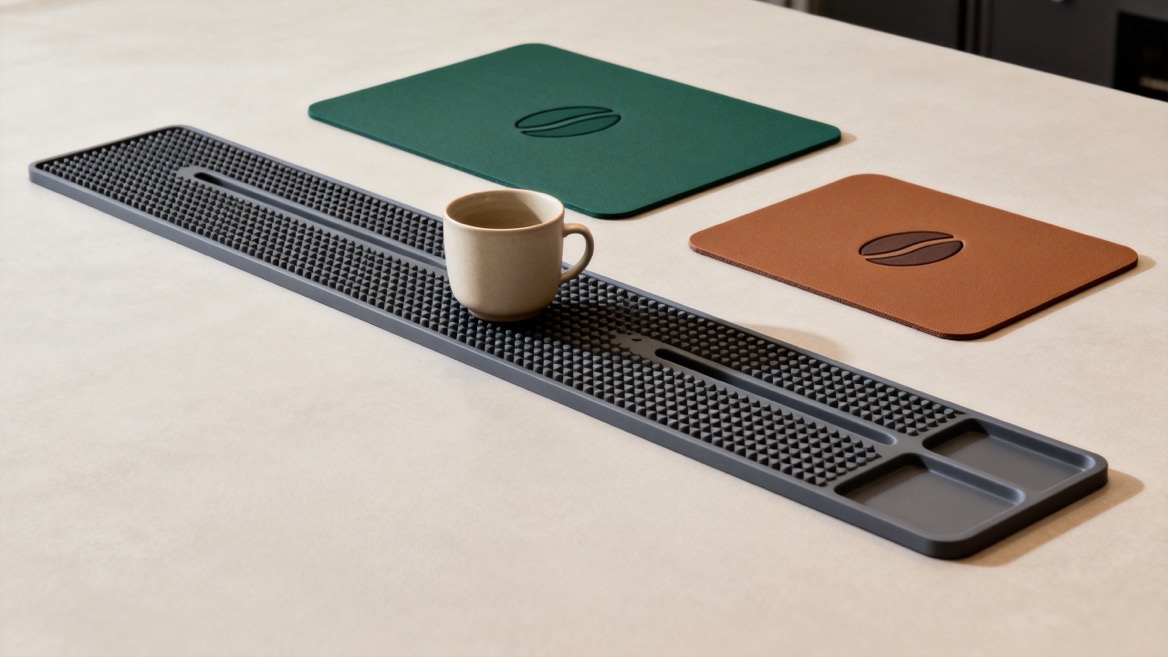
Closely spaced projections may look effective in artwork but can be harder to inspect and clean. Deep recesses can also retain residue if staff cannot reach them easily.
During development, evaluate:
- Space between raised features.
- Accessibility around the logo.
- Corner and edge geometry.
- Flatness on the intended counter.
- Cup stability during normal placement.
- The effort required to lift and empty the mat.
For café chains, cleaning practicality should be part of design approval, not an issue discovered after delivery.
PVC formulations and finished constructions can differ. The material name alone does not establish heat resistance, chemical compatibility, odor acceptability, or food-contact suitability.
Ask the manufacturer to confirm the intended conditions of use and supporting evidence.
Do not assume a coffee bar mat is dishwasher-safe or suitable beneath hot equipment. Those applications require specific validation.
A successful coffee bar mat does not need to reproduce every element of a brand campaign. Small text and complicated artwork can become difficult to interpret on a textured surface.
For most permanent café installations, begin with:
1. A clearly recognizable logo.
2. A controlled background color.
3. Strong visual contrast.
4. A short message only when necessary.
Request artwork review before tooling. Fine lines, tiny lettering, gradients, and closely spaced color areas may need adaptation for the selected manufacturing process.
The aim is recognizable branding, not an exact transfer of a crowded poster onto a working surface.
Screen previews are useful for layout decisions, but they should not replace physical sample approval.
Provide brand color references and evaluate the sample under typical store lighting. Record the approved color appearance alongside the production specification.
Also confirm orientation. A logo facing the customer may be upside down to the barista. That is acceptable when intentional, but frustrating when discovered during installation.
One of the most valuable purchasing steps is a controlled in-store trial. It reveals problems that artwork approval and factory inspection cannot fully predict.
The following framework is a recommended evaluation method, not a claim about a completed customer project.
Select pilot locations with different operating patterns. Include a busy store, a compact counter, and a location offering a broad beverage menu.
Use the same sample specification and feedback form at each location.
A two-week trial can provide an initial operational view, although durability assessment may require longer testing.
| Evaluation area | Suggested observation |
|---|---|
| Counter fit | Interference with equipment or staff movement |
| Cup stability | Movement during normal drink placement |
| Spill handling | Overflow and emptying frequency |
| Cleaning | Time and effort under the approved procedure |
| Appearance | Staining, deformation, or visible color changes |
| Staff acceptance | Repositioning, removal, or repeated complaints |
Record actual conditions rather than asking only whether staff "like" the mat.
Before testing, define what would trigger a redesign. Examples include persistent edge lifting, awkward cleaning, interference with pickup flow, or unstable placement of a commonly used cup.
Keep operational and appearance criteria separate.
A mat may look excellent but perform poorly. Equally, a functional design may need a larger logo or stronger contrast before it is suitable for customer-facing counters.
Coffee, milk, and flavored syrups create different cleaning challenges. A mat that appears clean from above may still have residue around its projections or underneath.
General food-service guidance emphasizes cleanable surfaces and cleaning frequencies that prevent soil accumulation. The exact procedure should follow local requirements, the café's hygiene program, and the manufacturer's validated instructions.
A practical workflow can include:
1. Remove the mat from the counter.
2. Empty collected liquid appropriately.
3. Wash using an approved cleaner compatible with the material.
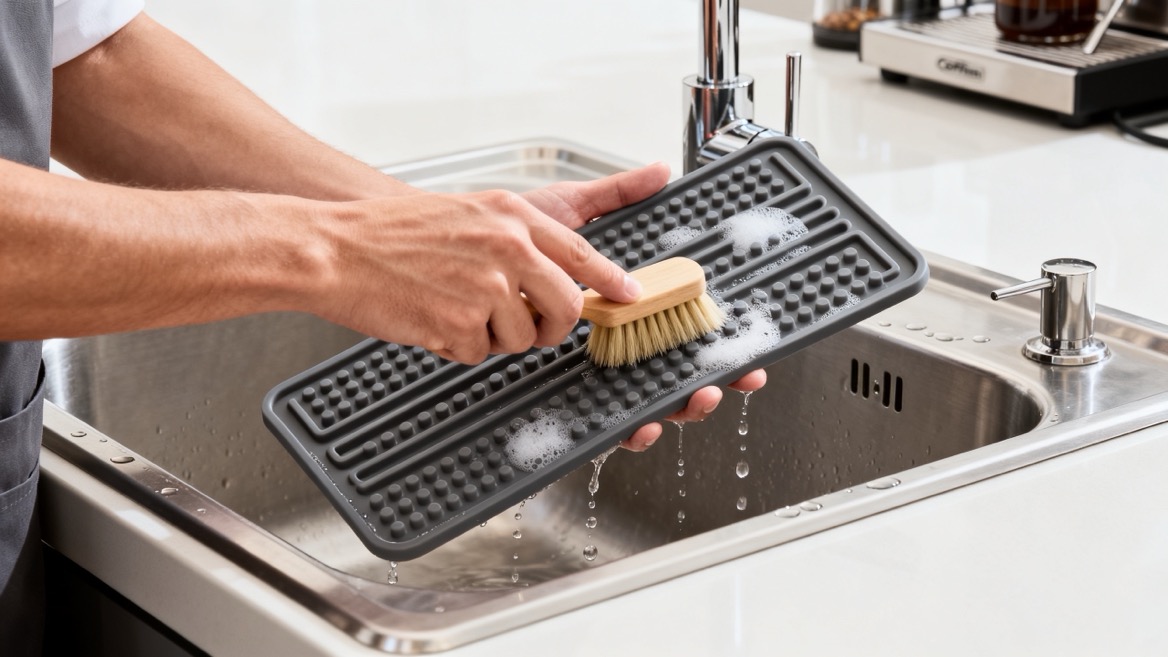
4. Brush accessible recesses when necessary.
5. Rinse according to the cleaning instructions.
6. Apply any required sanitizing step using validated directions.
7. Allow appropriate drying before reuse.
8. Clean the exposed counter before replacing the mat.
Do not approve a cleaning chemical based only on its effectiveness against residue. Confirm compatibility with the mat and follow the chemical label.
Avoid unverified claims that a PVC mat is antimicrobial, sterilizable, or resistant to every commercial cleaner.
A mat used beneath closed cups is different from a surface intended to contact food directly.
Do not place pastries, exposed ingredients, or food-contact utensil ends on the mat unless that use has been specifically assessed.
Food-contact suitability must match the finished product, intended application, and destination market. A general material description is not enough.
Procurement teams should distinguish between product testing, regulatory obligations, and manufacturing authorization. These documents answer different questions.
The EU RoHS Directive addresses hazardous substances in electrical and electronic equipment. A conventional non-electrical coffee bar mat does not automatically fall within that scope.
A report testing PVC material against RoHS substance limits may support a buyer's restricted-substance specification. It should not be presented as universal product approval or proof of food-contact suitability.
Review which material, color, and product version the report covers.
California Proposition 65 concerns exposure to listed chemicals and associated warning obligations.
A laboratory report can inform an assessment, but "Prop 65 certified" is not a sufficient explanation of compliance. Buyers should understand the tested substances, applicable exposure assessment, and any warning decision.
Requirements may differ by market and intended use. Obtain qualified regulatory guidance where necessary.
Brand-related manufacturing authorization is not the same as finished-product safety testing.
If Disney FAMA documentation is relevant to a project, confirm the facility, validity, and permitted scope. Do not treat it as permission to reproduce unrelated trademarks.
Every branded order should use artwork supplied or authorized by the rights holder.
Yijia combines research and development, manufacturing, and sales of PVC bar mats and other soft PVC promotional products.
According to the company background provided for this article, Yijia has:
- 18 years of industry experience.
- A 3,000-square-meter factory.
- 10 automated production lines.
- Multiple advanced dispensing machines.
- One-stop OEM/ODM customization services.
The company also reports cooperation experience involving Starbucks, Disney, McDonald's, Pop Mart, and Tencent.
These details describe the supplied company profile. Brand names should not be interpreted as endorsements, current contracts, or evidence of a specific coffee bar mat project.
OEM projects generally begin with an established customer design. ODM collaboration can include support in developing the product concept and configuration.
For either approach, agree on the deliverables before production:
- Approved artwork and dimensions.
- Material and color requirements.
- Physical sample approval.
- Applicable testing documentation.
- Packaging and labeling.
- Inspection criteria.
- Reorder identification.
Yijia's stated compliance credentials should be supported by current documents relevant to the proposed order. Buyers should review their scope rather than relying on a list of certification names.
The purchase price is only one part of the project cost. Tooling, samples, testing, packaging, freight, and replacement requirements also influence the final budget.
Send suppliers an identical specification.
Ask each quotation to identify tooling charges, unit price, minimum order quantity, sample conditions, packaging, delivery terms, and estimated production timing.
Avoid comparing a quote based on preliminary artwork with one based on an approved production sample. The underlying assumptions may be different.
Create a controlled specification with a revision number, approved sample reference, artwork file, color references, and inspection requirements.
Record any changes to material, tooling, dimensions, or packaging.
For chains, consistent reordering can be more valuable than repeatedly redesigning the product. Store teams should receive a mat that fits the established placement and cleaning procedure.
Send Yijia your logo artwork, intended counter dimensions, estimated quantity, destination markets, and preferred delivery date.
Include photographs of the installation area and explain whether the mat will be used for preparation, pickup, or promotion.
Request a proposal covering design feasibility, sampling, relevant documentation, packaging, and production planning. Approve the physical sample and operational trial before committing to a large rollout.
Choose the size after measuring the usable counter space and observing the task. Leave equipment access clear and test the layout with the cups and accessories used in the store.
Yes. The final result depends on artwork complexity and manufacturing feasibility. Approve a physical sample to confirm logo readability, color appearance, and surface details.
Do not assume so. Ask for written confirmation covering the finished product, dishwasher conditions, and validated cleaning limits. Otherwise, follow the approved manual-cleaning procedure.
Only when the finished product has been assessed for that intended food-contact use. A mat designed to support closed cups should not automatically be used for exposed food.
Design complexity, tooling, colors, packaging, testing, and production scheduling can affect both. Request project-specific figures rather than relying on general estimates.
Retain an approved reference sample and controlled specification. Use revision numbers and require written approval for changes that could affect appearance, performance, or compliance.
- [U.S. Food and Drug Administration — Food Code 2022]. Authoritative model guidance for retail food-service operations; supports the discussion of cleanability, hygiene procedures, and distinguishing intended uses. Local adoption and requirements may vary. [fda]
- [U.S. Food and Drug Administration — Supplement to the 2022 Food Code]. Additional guidance addressing cleaning, sanitizing, and disinfection considerations, including relevant chemical-use directions. [fda]
- [European Commission — RoHS Directive]. Official explanation of the directive's electrical and electronic equipment scope and restricted substances. Supports the distinction between material testing and regulatory applicability. [environment.ec.europa]
- [California Office of Environmental Health Hazard Assessment — Proposition 65 Business Resources]. Explains business responsibilities, exposure considerations, and circumstances in which warnings are not required. [p65warnings.ca]
- [California Office of Environmental Health Hazard Assessment — Proposition 65 Warnings]. Official overview of warning obligations and listed-chemical exposure. [p65warnings.ca]
- [PromoMatting — Custom Counter and Bar Mats]. Commercial industry reference illustrating molded PVC counter/bar mats and their combined functional and branding applications; not independent evidence of sales improvement. [promomatting]


