
Views: 289 Author: Yijia Plastic Publish Time: 2026-10-02 Origin: Site
Content Menu
● Why Beer Brands Choose Custom PVC Bar Mats
● Choose the Right Format for Your Bar
>> Plan the Logo Around Real Use
>> Match Relief and Color to the Artwork
● Prepare a Production-Ready Design Brief
>> Decide What Must Not Change
● Move From Artwork to Bulk Production
>> Use a Sample That Can Be Tested
● Plan Bulk Orders Without Guessing
>> A Practical Rollout Example
● Verify Documents for Each Market
● Work With a Manufacturer That Understands Brand Controls
● Start With Your Bar-Mat Brief
>> What file should I send for a custom beer bar mat?
>> Can one bar-mat design fit every taproom?
>> How do I judge a sample beyond its appearance?
>> What affects the price of a bulk order?
>> How early should I order for a beer launch?
>> Does a RoHS-related report mean every PVC bar mat is RoHS certified?
>> Can I request different packaging for distributors?
A custom PVC bar mat does two jobs at once: it gives bartenders a practical place to pour and sets a beer brand directly in the customer's line of sight. But a mat that looks striking in a design file can fail on a busy bar. Fine lettering may disappear under condensation. A crowded logo may interrupt drainage. And an attractive sample means little if the bulk order arrives with inconsistent colors or dimensions.
At Yijia Plastic Products Co., Ltd., we approach custom PVC bar mats for beer brands as working products, not just promotional gifts. Based on our 18 years of experience developing and manufacturing soft PVC products, this guide explains how to turn a logo into a production-ready bar mat, approve a useful sample, and order in bulk with fewer avoidable surprises.

A branded bar mat sits where beer is poured, served, and photographed. In a taproom, it can identify a flagship beer at the point of service. At a distributor event, it can help create a consistent presentation across multiple venues. For a brewery launching a new product, it can extend campaign artwork into an item that staff use every day.
The mat must still earn its place on the counter. A useful design should help contain small drips, offer a stable surface for routine service, and be straightforward to rinse and dry. Its performance depends on the finished design, the bar surface, and how staff use and maintain it.
Visibility alone is not enough. A beer brand should evaluate a proposed mat against three practical questions:
- Can customers recognize the brand from their side of the counter?
- Can staff pour and move glasses without the artwork getting in the way?
- Will the mat fit the intended bar space and cleaning routine?
Answer these questions before finalizing the artwork. They influence the shape, logo position, surface pattern, and quantity you order.
"Bar mat" can describe several formats. Choosing one by appearance alone often leads to an awkward fit in the venue.
| Format | Typical placement | Best use | Design priority |
|---|---|---|---|
| Bar runner | Along a counter or serving rail | Continuous brand visibility | Readable logo across a long, narrow area |
| Service mat | At a primary pouring station | Frequent handling and drips | Usable surface and practical drainage |
| Counter display mat | Near a tap feature or promotion | A focused product message | Clear campaign artwork |
These are planning categories, not fixed specifications. Measure the actual counter before choosing dimensions. Check the available depth, tap position, glassware storage, and whether an overhanging edge could obstruct service.
For a multi-location rollout, ask each venue for measurements rather than assuming every bar has the same layout. If one size cannot work across locations, two approved formats may be more useful than a single compromise.
A detailed beer label and an effective bar-mat logo are not always the same artwork. A label may contain fine illustration, small legal text, and several typefaces. On a mat, those details compete with raised features, wet glasses, and viewing distance.
Start with the element customers need to recognize: the brewery name, beer name, or primary symbol. Then decide what can be removed. Keep essential lettering large enough to remain legible in a physical sample, and avoid placing critical details where glasses will repeatedly cover them.
For a launch campaign, consider whether the mat needs to identify a single beer or represent the brewery for longer-term use. A product-specific mat can support a short promotion. A simpler brewery-led design may suit ongoing distribution across bars.
Raised logos can add a tactile feature, while recessed areas can help organize the surface visually. Neither choice automatically improves a design. What matters is whether the relief preserves the logo and leaves enough usable space around it.
Request a physical color check when brand colors are important. Screen displays, artwork files, and finished PVC can look different. Ask the manufacturer to show how the proposed colors appear on the selected material and how adjacent colors meet at the edges.
If your design uses tiny lettering, narrow outlines, or closely spaced color fields, flag them before tooling. Simplifying one detail during artwork review is usually easier than discovering the problem in a finished batch.
A strong brief helps a manufacturer quote the same product you intend to buy. It also gives your marketing, purchasing, and venue teams one specification to approve.
Include the following:
1. Artwork: Supply the highest-quality logo file available, with brand-color references and any rules for logo use.
2. Placement: State whether the mat will sit at a serving rail, pouring station, event bar, or retail display.
3. Size and shape: Provide target dimensions and photographs or measurements of the intended counter.
4. Design details: Mark essential text, preferred color areas, and features that may be simplified.
5. Order plan: Give the estimated quantity, destination markets, packaging needs, and required delivery date.
6. Approval process: Identify who will sign off on artwork, the physical sample, and the final order.
If the mat is part of a wider beer-brand promotion, explain what else it must match. Packaging, coasters, or other branded items may need a consistent visual treatment, even when they use different materials and production methods.
Before sampling, separate fixed requirements from preferences. A fixed requirement might be the approved logo proportions or an exact counter width. A preference might be a particular edge shape that can change if it makes the design harder to manufacture or clean.
This distinction gives the production team room to solve practical problems without compromising the brand. It also prevents late-stage revisions caused by stakeholders approving different versions of the same concept.
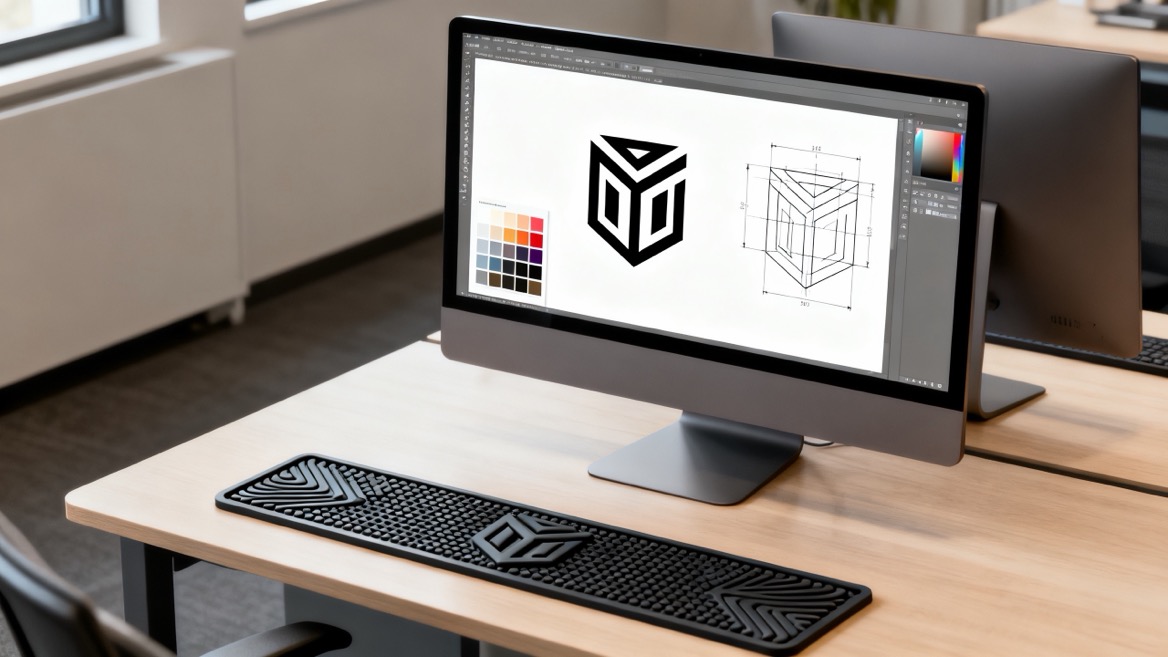
A dependable order follows clear approval points. At Yijia, our one-stop OEM/ODM service covers development, production, and sales support for custom soft PVC products. Our 3,000-square-meter factory has 10 automated production lines and multiple dispensing machines. For buyers, the important question is how that capability will be applied to their approved specification.
A typical project should move through these stages:
1. Review the brief. Confirm intended use, dimensions, artwork, quantity, and destination.
2. Assess manufacturability. Identify fine details, color boundaries, or relief features that may need adjustment.
3. Confirm the design. Approve a drawing that shows the planned layout and key dimensions.
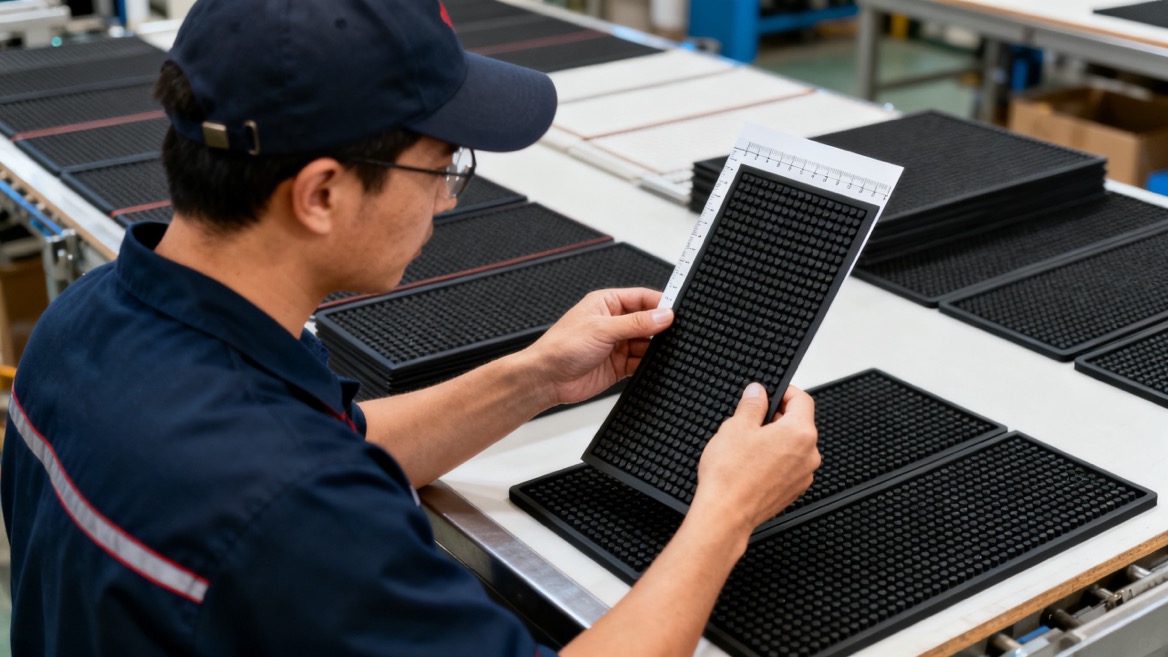
4. Produce a sample. Inspect an actual mat rather than relying only on a digital rendering.
5. Lock the specification. Record approved artwork, colors, dimensions, packaging, and any agreed tolerances.
6. Run and inspect production. Compare finished goods with the approved sample and order requirements.
7. Pack and ship. Check carton details and delivery documents against the purchase order.
The exact method, schedule, and approvals should be agreed for each project. Do not treat a preliminary rendering as approval for mass production.
The sample is where a promotional concept becomes a working bar accessory. Place it at the intended serving station if possible. View it from both the bartender's and customer's positions.
Check these points before approving it:
| Sample check | What to examine |
|---|---|
| Logo visibility | Is the name readable at normal viewing distance and under venue lighting? |
| Fit | Does the mat sit within the available counter space? |
| Surface use | Is there enough practical room for the intended glasses or tools? |
| Detail | Are small letters, outlines, and color boundaries clear? |
| Handling | Can staff lift, rinse, and reposition it conveniently? |
| Consistency | Do the sample’s dimensions and appearance match the signed-off drawing? |
Document every requested change. If the sample exposes a problem, ask for a revised approval version and confirm which sample will serve as the bulk-production reference.
The lowest unit price is not always the best purchasing decision. A design with extra detail may affect tooling or production. Custom packaging can affect handling and freight. Shipping a heavy order to multiple distributors may require a different plan from delivering it to one warehouse.
Request a quotation that separates the main cost drivers where applicable: tooling, sampling, unit production, packaging, and shipping. Ask whether a design revision changes the quotation. Confirm what quantity the price assumes and whether repeat orders can use an existing approved design.
Build the schedule backward from the date mats must be in venues, not the date your campaign starts. Allow time for artwork review, sampling, corrections, production, inspection, transit, and local distribution. Ask for a project-specific timeline; a generic lead time cannot account for every design or destination.
Suppose a brewery wants mats for a seasonal beer launch at 40 taprooms. Sending the same quantity to every site may waste stock if the bars have different layouts or serving volumes.
A better approach is to group venues by counter format, confirm the number of pouring stations at each site, and approve a sample for each mat size. The buyer can then assign quantities by venue and agree on carton labels that make distribution easier. This is an illustrative planning method, not a claim about a completed customer project.
For repeat campaigns, retain the approved artwork version and production specification. That record makes it easier to compare a reorder with the original and identify deliberate changes.
Beer brands often ask about material tests and factory authorizations. The right question is not simply, "Do you have certificates?" It is, "Which current documents apply to this mat, its materials, and its destination?"
Yijia reports experience with EU RoHS-related documentation, California Proposition 65 requirements, and Disney Facility and Merchandise Authorization (FAMA). These items serve different purposes and should not be presented as one universal product certification.
- EU RoHS: The directive primarily addresses restricted substances in electrical and electronic equipment. A conventional, non-electrical bar mat is not automatically within its scope. If a buyer requests RoHS-related substance testing, confirm what was tested and avoid implying that a test report changes the product's legal classification.
- California Proposition 65: This concerns potential exposure to listed chemicals and, where required, warnings. A test result alone does not establish that every product variant needs—or does not need—a warning. Buyers should assess the finished product and its intended California sales channel.
- Disney FAMA: This is a facility authorization process for work involving Disney intellectual property. It is not a general safety certificate for bar mats. A Disney-branded project needs the appropriate authorization and permissions for its specific work.
Ask for documents that identify the relevant product or material, test scope, issuing organization, and date. If a material or color formulation changes, confirm whether existing reports still cover the order. Do not publish a blanket "certified safe" claim when the supporting paperwork is narrower.
Custom merchandise carries more than a logo. It carries rules for artwork, approvals, confidentiality, and repeatability. Yijia has reported cooperation experience with Starbucks, Disney, McDonald's, Pop Mart, and Tencent. For a new beer-brand project, that background is relevant to managing branded work, but past cooperation does not replace approval of your own sample.
We recommend naming one decision-maker for each stage. Marketing can approve brand presentation. Venue staff can assess day-to-day use. Purchasing can confirm quantity, delivery, and the agreed specification. When these checks happen before bulk production, the final approval reflects how the mat will actually be used.
If your project involves licensed artwork or another company's marks, provide evidence that you have permission to use them. Ask how artwork files and approved samples will be controlled throughout production.
A successful custom mat begins with a clear description of where it will be used, what the customer should see, and what staff need from the surface. Send Yijia Plastic Products Co., Ltd. your logo artwork, target dimensions, estimated quantity, destination market, and required in-venue date. We can review the design with you, discuss a sample, and prepare a project-specific OEM/ODM quotation before you commit to bulk production.
Send the best available logo artwork, preferably an editable vector file, together with brand-color references and usage guidelines. If you only have a low-resolution image, tell the manufacturer before requesting a firm design approval. Artwork may need to be redrawn or simplified before sampling.
Not always. Serving rails, pouring areas, and counter depths vary. Measure representative sites and decide whether one size works in practice. For a larger rollout, approving two formats may give venues a better fit than forcing one design onto every counter.
Put it where staff will use it. Check logo visibility, available working space, fit, edges, handling, and cleaning. Compare its dimensions and colors with the approved drawing. Collect feedback from someone who works behind the bar before signing off.
Size, shape, design complexity, colors, tooling, quantity, packaging, and shipping can all affect a quote. Ask the supplier to state what the quoted price includes. Confirm whether changes after sample approval will alter cost or timing.
Start by sharing the in-venue deadline and delivery destinations. Then request a schedule covering design review, sampling, possible revisions, production, inspection, shipping, and distribution. Leave room for approval changes rather than treating the first proposed completion date as guaranteed.
No. EU RoHS primarily applies to electrical and electronic equipment. A report may provide useful information about substances tested in a material or product, but its scope must be read carefully. Ask to see the applicable report for the proposed order.
Yes. Include your packaging and carton-marking needs in the initial brief, especially if one order will be divided among venues or distributors. Confirm the approved packing method before production so the delivered cartons match your distribution plan.
- Company-provided information: Yijia Plastic Products Co., Ltd.'s experience, facility size, production equipment, OEM/ODM service, reported documentation, and brand-cooperation history were supplied in the project brief. These company claims should be checked against current records before publication.
- European Commission — RoHS Directive: Official explanation of the directive's electrical and electronic equipment scope and restricted substances. [View the RoHS Directive page]. [environment.ec.europa]
- California Office of Environmental Health Hazard Assessment — Frequently Asked Questions for Businesses: Official guidance on Proposition 65 exposure assessments, warning responsibilities, and product testing. [View the business FAQ]. [p65warnings.ca]
- The Walt Disney Company — Facility and Merchandise Authorization Application Instructions: Explains facility-specific authorization for producing or handling Disney-branded products. [View the FAMA instructions]. [thewaltdisneycompany]
- Yijia Plastic Products Co., Ltd. — Custom PVC Bar Mats: A Complete Guide for Bars, Breweries and Beverage Brands: Company-published background on its bar-mat services and production capabilities; used for context, not treated as the original article supplied for this assignment. [View the company guide]. [yijiabar]


