
Views: 257 Author: Yijia Plastic Publish Time: 2026-10-28 Origin: Site
Content Menu
● Why Restaurant Chains Need a Standardized Bar Mat Program
>> Design Around Workstations, Not Just Store Counts
● What Custom PVC Bar Mats Can—and Cannot—Do
>> Separate Branding From Performance Requirements
● How to Specify Custom PVC Bar Mats for Multiple Locations
>> Define Dimensions, Thickness, and Working Clearance
>> Make Logos Readable in Real Conditions
>> Specify Intended Use and Material Requirements
● Turn Compliance Claims Into Useful Purchasing Evidence
>> Understand the Scope of RoHS
>> Evaluate Proposition 65 Through Exposure
>> Treat Disney FAMA as Facility Authorization
● A Practical Pilot Before a Chain-Wide Rollout
>> Step 1: Select Representative Locations
>> Step 2: Define Acceptance Criteria Before Testing
>> Step 3: Record Results and Revise Once
● Build a Reorder System, Not Just a First Order
>> Control Changes Between Batches
● Calculate Rollout Quantities and Total Cost
>> An Illustrative Quantity Plan
● Plan Packaging and Distribution Early
● Establish Cleaning and Replacement Procedures
● Why Work With Yijia Plastic Products Co., Ltd.?
>> Start With a Project-Specific Brief
>> What is the best size for custom PVC bar mats?
>> Can every location use the same logo design?
>> Are PVC bar mats automatically food-safe?
>> Can custom PVC bar mats go in a commercial dishwasher?
>> How can a restaurant chain keep repeat orders consistent?
>> What are typical minimum order quantities and lead times?
Custom PVC bar mats for restaurant chains and multi-location businesses should do more than display a logo. They should fit the workstation, support practical cleaning routines, and deliver a consistent brand presentation across every location. For purchasing teams, the real challenge is not selecting one attractive mat. It is building a specification that remains reliable through new openings, replacement orders, and regional expansion.
At Yijia Plastic Products Co., Ltd., we approach customization from a manufacturing perspective: consistency starts before production. With 18 years of experience in PVC soft gifts, we bring research and development, manufacturing, and sales together to support one-stop OEM/ODM projects.
This guide explains how to specify, evaluate, and roll out branded PVC bar mats as a coordinated purchasing program rather than a series of disconnected orders.

A single restaurant can evaluate a bar mat at the counter. A multi-location business must also consider purchasing control, distribution, staff routines, and repeat-order accuracy.
Without a shared specification, individual locations may order different dimensions, colors, or logo versions. Even when each mat looks acceptable alone, the overall brand presentation becomes inconsistent.
A standardized program gives headquarters and franchise operators a common reference for:
- Approved artwork and brand colors.
- Dimensions for different workstation layouts.
- Material and performance requirements.
- Cleaning instructions and replacement criteria.
- Packaging, location codes, and reorder identification.
From our manufacturing perspective, the most useful starting point is a controlled product specification. A photograph communicates appearance, but it cannot define thickness, tolerances, material requirements, or acceptance criteria.
Restaurant groups often need more than one format. A cocktail preparation station, café pickup counter, and compact service bar may have different space constraints.
Create a small family of approved designs instead of forcing one size into every location. This preserves brand consistency while allowing operational differences.
A raised PVC bar mat can provide a textured working surface and space between raised features where incidental liquid may collect. Actual performance depends on its geometry, material formulation, dimensions, and operating conditions.
However, a mat does not remove spills, sanitize glassware, or replace counter cleaning.
Similarly, "non-slip" should be treated as a performance claim to verify, not an automatic property of every PVC product. Test the proposed mat on the actual counter surface under representative wet and dry conditions.
A strong logo does not compensate for poor workstation fit. Conversely, a practical mat may still fail brand approval if lettering is unclear or colors are inconsistent.
Evaluate these as separate requirements:
| Requirement | What to specify | What to check |
|---|---|---|
| Workstation fit | Length, width, thickness, placement | Interference with equipment or service |
| Branding | Artwork version, colors, logo position | Readability and sample approval |
| Liquid management | Raised pattern and recessed areas | Collection and emptying during use |
| Stability | Base design and intended counter surface | Movement during representative tasks |
| Maintenance | Cleaning method and drying procedure | Residue, deformation, and accessibility |
| Repeatability | Tolerances and retained sample | Differences between production batches |
A clear purchasing brief reduces interpretation during quotation, sampling, and production.
Measure usable counter space rather than relying on a standard product size.
Record clearance around taps, sinks, coffee equipment, payment terminals, and glass storage. Check whether staff move or lift the mat during service.
Thickness should be assessed alongside handling and edge profile. A thicker mat is not automatically a better mat, particularly where it creates an awkward transition or interferes with equipment.
Ask the manufacturer to propose dimensional tolerances and confirm them before approval.
Custom logo bar mats are often viewed at an angle, under variable lighting, and through glassware.
For molded designs, discuss:
- Minimum practical lettering and line widths.
- Separation between adjacent colors.
- Raised versus recessed artwork.
- Contrast between the logo and background.
- Placement away from frequently covered areas.
Use vector artwork where available. Specify a color reference, then approve a physical sample under agreed lighting. A screen image alone is not a reliable production acceptance standard.
"Soft PVC" does not fully describe a formulation.
Tell the supplier where the product will be sold, what it will contact, and which substances or performance characteristics require assessment.
Do not assume a counter mat is suitable for direct food contact, high-temperature equipment, or commercial dishwashing. Each proposed use needs appropriate supporting documentation or validation.
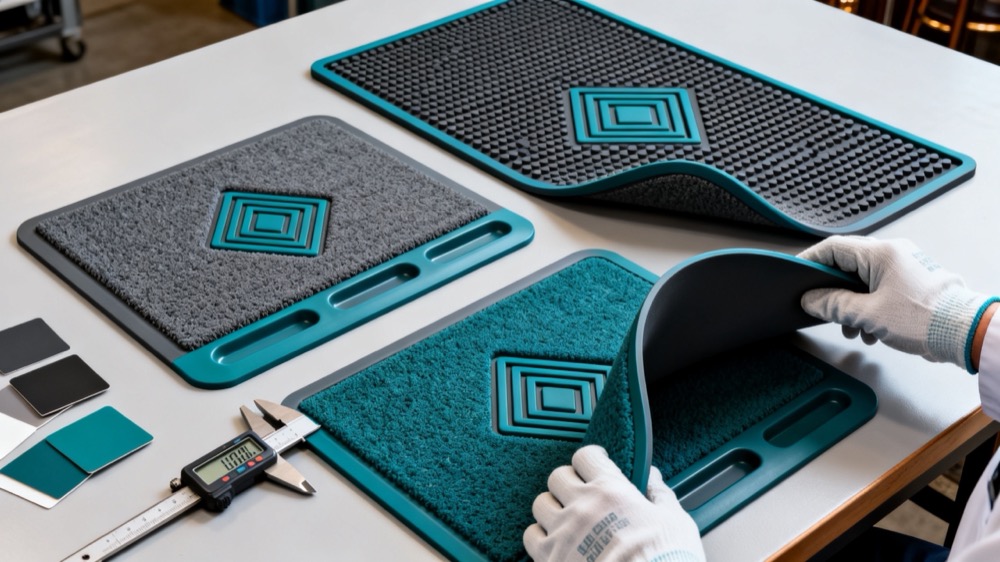
Compliance documentation is valuable only when it matches the product, material, market, and intended use.
Yijia's company background identifies EU RoHS-related documentation, California Proposition 65-related documentation, and Disney FAMA authorization. These should not be presented as interchangeable product-safety certifications.
The EU RoHS Directive restricts specified hazardous substances in electrical and electronic equipment.
An ordinary non-electrical PVC bar mat generally falls outside that product scope. A laboratory report assessing selected RoHS substances may provide material information, but it does not establish that the mat requires RoHS certification or is approved for food contact.
Request the report, identify the tested sample, and check which substances and limits were assessed.
California Proposition 65 concerns exposure to listed chemicals and associated warning obligations.
It is not a general government product-approval scheme. A laboratory report may support an assessment, but determining whether a warning is required depends on the applicable exposure and regulatory framework.
For California distribution, ask qualified advisers to review the relevant formulation, test evidence, intended use, and warning requirements.
Disney's Facility and Merchandise Authorization concerns authorization for a facility to produce or handle Disney-branded products within the applicable program.
It does not certify every product's chemical composition, food-contact suitability, or performance.
For licensed projects, verify the relevant authorization and artwork permissions separately from product testing.
One of the most useful safeguards is a structured pilot. It connects purchasing specifications with actual restaurant operations before a larger commitment.
Choose locations with different counter surfaces, service volumes, workstation layouts, and cleaning practices.
The objective is not simply to collect positive feedback. It is to identify where one specification may not work across the whole network.
Agree what constitutes an acceptable result.
Possible checks include:
- The mat stays within its designated footprint.
- Edges remain acceptably flat.
- Glassware remains stable during intended tasks.
- Raised details can be cleaned effectively.
- Approved cleaning methods do not cause unacceptable changes.
- Staff can remove, empty, clean, and dry the mat conveniently.
Document the test conditions. "Works well" is difficult to compare across locations.
Use a shared feedback sheet with photographs, product identification, cleaning details, and observed issues.
Separate design problems from local operating differences. If one location uses an unapproved chemical or places the mat beside excessive heat, that requires a different response from a repeatable manufacturing defect.
Approve the final specification only after reviewing the pilot findings.
Restaurant chains need continuity after the launch shipment.
We recommend assigning each approved design a unique item code linked to:
1. Artwork revision.
2. Dimensions and tolerances.
3. Material specification.
4. Color references.
5. Approved sample.
6. Packaging instructions.
7. Relevant testing records.
Retain a reference sample and agree how production will be compared with it.
A seemingly small change to color, formulation, tooling, or dimensions can affect appearance or performance.
Define which changes require notification and renewed approval. This is especially important when products are ordered by different regional teams or franchisees.
The goal is straightforward: a replacement order should reproduce an approved product, not restart an interpretation exercise.
Unit price is only one part of procurement.
Compare quotations using the same assumptions for tooling, samples, testing, packaging, freight, and delivery terms. Clarify tooling ownership, storage, and future modification charges.
Consider a hypothetical chain with 80 locations, each requiring three working mats and two replacement mats.
| Allocation | Calculation | Quantity |
|---|---|---|
| Working stock | 80 locations × 3 mats | 240 |
| Local replacement stock | 80 locations × 2 mats | 160 |
| Central reserve | Illustrative planning allowance | 40 |
| Total | Working stock plus reserves | 440 |
These figures are an example, not an industry benchmark. Set reserve quantities using replacement history, opening schedules, storage capacity, and replenishment lead time.
A useful comparison includes the full initial rollout cost divided by the number of locations equipped.
Track replacement costs separately once operating data becomes available. Avoid assuming a service life that has not been demonstrated under your cleaning and usage conditions.
Bulk custom bar mats can become difficult to distribute if cartons contain mixed designs without clear identification.
Specify item codes, quantities, destination information, and artwork versions on the relevant packaging.
Ask whether the supplier can support:
- Location-specific packing lists.
- Separate cartons for different formats.
- Regional warehouse deliveries.
- Installation or care instructions.
- Identification for future reorders.
Confirm these services during quotation rather than assuming they are included.
Packaging should also be evaluated for deformation risk during storage and transport. Inspect incoming products before distributing them across the network.
Cleaning instructions should reflect the validated material limitations and the establishment's hygiene requirements.
Ask the manufacturer to confirm compatible cleaning agents, temperatures, and methods. Do not describe a mat as dishwasher-safe without evidence for the intended cycle.
Restaurant teams should establish procedures for removing residue, cleaning beneath the mat, and drying it appropriately before reuse.
Inspect for persistent residue, cracking, deformation, damaged raised features, or unstable placement. Replace products when their condition no longer meets the approved operating standard.
A branded mat is a service accessory, not a substitute for the site's sanitation program.
Yijia combines 18 years of PVC soft-gift manufacturing experience with a 3,000-square-meter factory, 10 automated production lines, and multiple advanced dispensing machines.
Our integrated research, production, and sales capabilities support one-stop OEM/ODM customization.
According to our company background, our cooperation experience includes Starbucks, Disney, McDonald's, Pop Mart, and Tencent. These relationships should not be interpreted as proof that every named company purchased bar mats or endorses a particular product.
For restaurant groups, the relevant question is how manufacturing capability translates into the proposed project: workable artwork, approved samples, documented specifications, production control, and repeat-order continuity.
Send Yijia your logo files, workstation dimensions, location count, destination markets, intended use, and target delivery schedule.
Request a proposal covering design options, sample approval, relevant documentation, packaging, and replenishment planning. Build the order around an approved specification before committing to a chain-wide rollout.
The best size fits the intended workstation without obstructing equipment or service. Measure each workstation type and establish a limited range of approved formats.
Yes, provided the artwork is authorized and suitable for the chosen manufacturing process. Use one controlled artwork version and an approved physical sample.
No. Material type alone does not establish suitability for direct food contact. Define the intended contact conditions and request applicable supporting evidence.
Only when the manufacturer has validated compatibility with the intended temperatures, chemicals, and cycle. Otherwise, use the confirmed cleaning method.
Maintain item codes, controlled specifications, approved samples, and change-notification requirements. Compare subsequent production against the agreed acceptance criteria.
They depend on tooling, dimensions, colors, order volume, sampling, testing, and packaging. Request a project-specific quotation rather than relying on a general estimate.
- Company background supplied by Yijia Plastic Products Co., Ltd. for this article: manufacturing experience, factory area, equipment, service capabilities, documentation claims, and cooperation history. These details were not independently audited. The operational checklists and hypothetical rollout example are editorial recommendations, not reported customer results.
- European Commission. [RoHS Directive]. Official explanation of the directive's electrical and electronic equipment scope and restricted substances. [environment.ec.europa]
- California Office of Environmental Health Hazard Assessment. [Business Resources: Proposition 65 Warnings]. Explains business responsibilities, exposure assessment, and warning exemptions. [p65warnings.ca]
- California Department of Justice. [Proposition 65 Frequently Asked Questions]. Explains exposure-based warning decisions and obligations affecting out-of-state businesses. [oag.ca]
- The Walt Disney Company. [Facility and Merchandise Authorization Application and Instructions]. Describes facility authorization requirements for Disney-branded production. [thewaltdisneycompany]


