
Views: 289 Author: Yijia Plastic Publish Time: 2026-10-09 Origin: Site
Content Menu
● 1. Design Around Your Coffee Workflow
>> What a PVC Coffee Bar Mat Does
>> Separate Working Zones From Branding Zones
>> Make Your Logo Work in Molded PVC
>> Measure the Counter Before Selecting Dimensions
>> Compare Practical Starting Sizes
>> Specify More Than Length and Width
● 3. Evaluate Materials and Maintenance
>> Request a Defined PVC Specification
>> Understand What Compliance Documents Mean
>> Build Cleaning Into the Specification
● 4. Validate Samples Before Production
>> Turn Staff Feedback Into Changes
>> Approve a Clear Production Standard
● Work With Yijia on Your Brief
● FAQs
>> What Size PVC Mat Should a Coffee Shop Choose?
>> Can Custom PVC Coffee Mats Hold Spilled Drinks?
>> Can I Put Hot Coffee Equipment on the Mat?
>> Are PVC Bar Mats Dishwasher Safe?
>> Does RoHS Testing Mean the Mat Is Food Safe?
>> Can Yijia Customize the Shape and Logo?
Custom PVC mats for coffee shops should do more than display a logo. The right mat fits your counter, helps manage small beverage spills, supports an orderly preparation area, and reinforces your brand without getting in the barista's way.
At Yijia Plastic Products Co., Ltd., we approach customization from a manufacturing perspective: function comes before decoration. A visually impressive coffee counter mat offers limited value if it blocks equipment access, creates an awkward working edge, or takes too long to clean.
This guide explains how to specify custom PVC coffee bar mats, compare design options, evaluate materials, and approve a sample before committing to production.

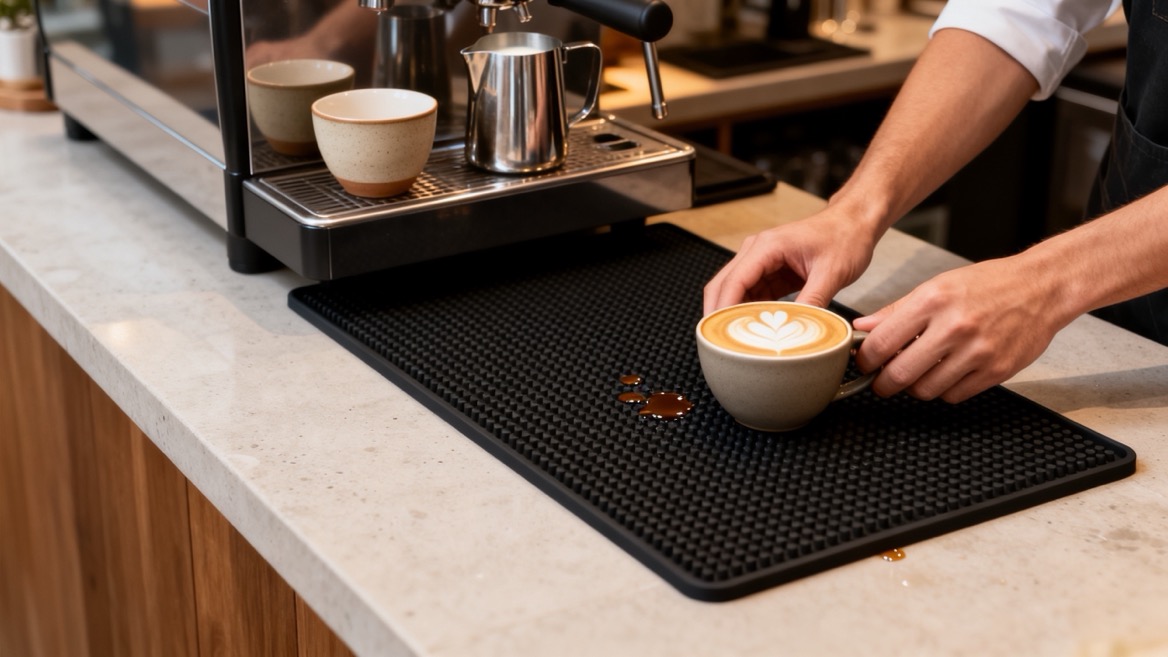
A molded PVC bar mat typically uses raised features and recessed channels to separate cup bases from small amounts of spilled liquid. Rather than absorbing spills like a textile, it provides a surface where liquid can collect until staff empty and clean it.
Its usefulness depends on its geometry, placement, and maintenance. A decorative flat counter mat and a raised drainage mat serve different purposes, even when both carry the same logo.
Start by identifying the main application:
- Beverage preparation beside the espresso machine.
- Cup staging before customer collection.
- Syrup and cold drink assembly.
- Branded presentation at the pickup counter.
- Promotional use at events or temporary coffee stations.
A countertop mat is not a floor safety mat, an equipment drip tray, or a substitute for regular cleaning.
My recommendation when reviewing a custom mat brief is to divide the surface into two zones: a working zone and a presentation zone.
Keep the working area practical. Cup bases should rest securely, and raised decorative elements should not make smaller vessels wobble.
Use a border or dedicated panel for the logo. This helps prevent detailed lettering from competing with the drainage pattern.
Before approving artwork, ask:
- Where will cups sit during a busy service period?
- Will staff lift the mat frequently to empty it?
- Could raised lettering interfere with cleaning?
- Will the logo remain visible when cups occupy the surface?
- Does the design face staff, customers, or both?
These questions are more useful than choosing colors before understanding the workstation.
Custom molded PVC mats allow raised lettering, contrasting colors, and shaped borders. However, a logo that looks sharp on a screen may need simplification for manufacturing.
Submit vector artwork when available. Identify brand colors using agreed color references, then approve the physical sample rather than relying on a digital rendering.
Contrast is usually more useful than complexity. Fine lettering, narrow gaps, and intricate outlines should be reviewed with the manufacturer before tooling.
For a coffee shop with a detailed illustrated logo, consider a simplified symbol on the mat and reserve the full artwork for packaging. This preserves brand recognition without overcrowding the usable surface.
Avoid ordering coffee shop counter mats from photographs alone. Measure the usable area and record nearby equipment, cables, counter edges, and staff movement.
For custom sizing, note:
1. Available counter width and depth.
2. Espresso machine and grinder footprints.
3. Access needed for trays, controls, and maintenance.
4. Typical cup and pitcher sizes.
5. Space needed to lift and remove the mat.
6. Any seams, slopes, or uneven counter surfaces.
Make a paper or cardboard template of the proposed footprint. Place it on the counter and run through a typical drink preparation sequence.
This inexpensive step can reveal awkward positioning before a mold is produced.
Supplier listings include formats such as 600 × 100 mm, 440 × 250 mm, and approximately 450 × 300 mm. These are examples of available dimensions, not universal recommendations for every café.
| Starting format | Possible application | What to check |
|---|---|---|
| 600 × 100 mm | Narrow service strip | Whether cup bases fit comfortably |
| 440 × 250 mm | Compact preparation area | Clearance around equipment and tools |
| Approximately 450 × 300 mm | Broader cup staging area | Counter depth and removal access |
| Custom dimensions | Unusual layouts or branded installations | Tooling requirements and sample fit |
The best size is the one that supports your workflow without covering access points or encouraging clutter.
For example, a narrow pickup counter may benefit from a long runner. A wider cold drink station may need a deeper mat to accommodate cups and syrup preparation.
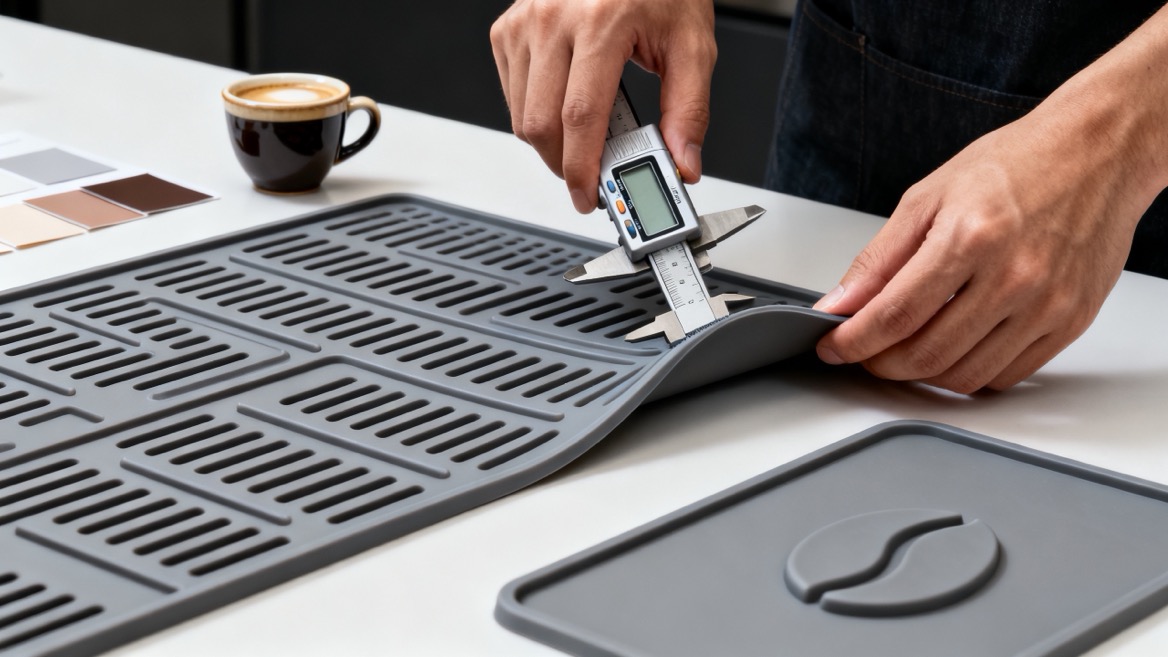
Overall dimensions are only part of the specification. Also discuss total thickness, base thickness, raised feature height, border shape, and dimensional tolerances.
A taller border may help retain small spills, but it can also become an inconvenient edge. Closely spaced raised features may support cup bases, yet make cleaning more demanding.
Do not assume a thicker mat is automatically better. Balance matters: support, flexibility, weight, cleaning access, and ease of handling should be evaluated together.
Ask the manufacturer to identify which dimensions are controlled tightly and which may vary within the agreed production tolerance.
"Soft PVC" describes a material category, not a complete performance specification. Buyers should request information relevant to the actual formulation and intended use.
Useful questions include:
- What material formulation will be used for this order?
- Is the sample representative of the production material?
- Which substances have been tested?
- What cleaning methods are recommended?
- What temperature limits apply?
- Does the documentation cover the finished product or only raw material?
Avoid unsupported descriptions such as "completely non-toxic," "food-grade," or "safe at any temperature."
A beverage counter application does not automatically establish suitability for direct contact with food. If that use is intended, request documentation for the relevant product and destination market.
Yijia reports EU RoHS-related compliance, California Proposition 65-related compliance, and Disney FAMA authorization. Buyers should review the actual documents, including their scope, dates, product identification, and applicable conditions.
These credentials are different, and they should not be presented as interchangeable product safety certifications.
RoHS principally restricts certain hazardous substances in electrical and electronic equipment. A RoHS-related test report for mat materials may provide useful substance information, but it does not establish food-contact suitability or automatically place an ordinary standalone mat within the directive's scope.
California Proposition 65 addresses exposure to listed chemicals and associated warning obligations. It is not a general government-issued product safety certification. Ask what testing or exposure assessment supports the proposed product's compliance approach.
Disney FAMA concerns authorization to use a specified facility for relevant Disney-branded production. It does not certify every product made there, nor does it authorize unrestricted use of Disney intellectual property.
A coffee mat should be easy to remove, inspect, and clean. Milk, syrup, and coffee residue can remain between raised features or underneath the mat if staff only wipe the visible surface.
Use the supplier's approved cleaning instructions as the starting point:
1. Remove cups and tools.
2. Empty collected liquid.
3. Wash the mat using the recommended cleaner and method.
4. Clean recessed areas with an appropriate non-abrasive tool.
5. Rinse and dry as instructed.
6. Clean the counter underneath before replacing the mat.
Cleaning frequency should reflect actual use and local requirements. The FDA Food Code provides a useful foodservice reference: nonfood-contact equipment surfaces should be cleaned often enough to prevent soil residue accumulation. Local adoption and requirements vary.
Do not assume dishwasher compatibility, sanitizer compatibility, or resistance to boiling water. Confirm each requirement before purchase.
Keep the mat away from direct heat sources unless its documented specification explicitly permits the intended exposure.
A physical sample should answer practical questions, not simply confirm the logo.
Place it on the intended counter and test representative cups, pitchers, and tools. Include the smallest cup base commonly used, since stability may differ between vessels.
A useful trial checks:
- Fit within the approved footprint.
- Cup stability across working areas.
- Movement on the actual counter surface.
- Small-spill collection and emptying.
- Access to equipment controls and trays.
- Ease of cleaning between raised features.
- Appearance after repeated cleaning.
Use small, controlled liquid quantities for spill checks. Record observations rather than making broad claims such as "spill-proof" or "completely non-slip."
Photograph the setup and note the test conditions. This gives the purchasing team and manufacturer a shared basis for revisions.
Ask baristas to describe specific problems rather than give a general rating.
"Looks good" is less useful than "the border catches the pitcher when I move it toward the pickup area."
Translate feedback into measurable revisions:
| Trial observation | Potential design response |
|---|---|
| Small cups wobble over lettering | Move the logo outside the working zone |
| Mat is awkward to lift | Adjust footprint, flexibility, or handling edge |
| Residue remains in narrow recesses | Review spacing and cleaning access |
| Equipment access is obstructed | Reduce dimensions or revise the shape |
| Logo is hidden during service | Relocate the branding panel |
These are illustrative design responses, not reported customer reviews. Validate any change with the revised sample.
Before bulk production, document the approved sample and commercial requirements.
Confirm artwork, dimensions, colors, material specification, packaging, inspection criteria, and acceptable tolerances. Clarify mold ownership, repeat-order arrangements, and how future changes will be managed.
Request separate confirmation of minimum order quantity, tooling cost, sample timing, production lead time, and shipping terms. These depend on the project and should not be assumed from another supplier's listing.
For multi-location cafés, pilot the design at one representative site before a wider rollout. A standard mat can still fail if different stores have different counter layouts.
According to the company information provided for this article, Yijia Plastic Products Co., Ltd. has 18 years of experience in developing, manufacturing, and selling PVC soft-plastic gifts, including PVC bar mats.
Its reported production resources include a 3,000-square-meter factory, 10 automated production lines, and multiple advanced dispensing machines. The company offers integrated OEM/ODM customization services.
Yijia also reports cooperation experience involving Starbucks, Disney, McDonald's, Pop Mart, and Tencent. Buyers should request relevant project evidence where available; these references should not be interpreted as endorsements or unrestricted permission to reproduce branded designs.
To start your custom PVC coffee mat project, send Yijia your counter measurements, logo artwork, target quantity, destination market, and intended application. Request a proposal covering dimensions, material documentation, sample development, and production terms before approving the order.
Measure the actual workstation first. Choose a footprint that accommodates your cups and tools while leaving equipment access clear. Use a paper template before requesting a custom sample.
Raised drainage designs can collect small spills between surface features. Capacity depends on the geometry and dimensions. They do not absorb liquid, and staff must empty and clean them.
Do not assume this is suitable. Ask for documented temperature limits and approval for the specific equipment. A countertop beverage mat should not automatically be treated as a trivet or machine support.
Only if the manufacturer confirms compatibility with your dishwasher conditions. Temperature, detergent, and washing cycles vary. Follow the product-specific care instructions instead of a generic PVC cleaning claim.
No. RoHS-related substance testing and food-contact suitability address different requirements. If direct food contact is intended, request the appropriate documentation for the finished product and destination market.
Yijia offers OEM/ODM customization according to the supplied company brief. Discuss dimensions, artwork, colors, molded features, packaging, and feasibility with the team before approving tooling.
- Company information: Yijia Plastic Products Co., Ltd. company brief supplied by the commissioning business. Source for experience, factory area, equipment, customization services, reported compliance credentials, and cooperation history. No public company page or supporting documents were supplied; these claims require company verification before publication.[Yijia Plastic Products Co., Ltd.]
- Product format examples: Best Name Badges, [Custom PVC Coffee Bar Mat for Counter, 17.7 × 11.8 Inches]. Commercial example supporting available mat dimensions.
- Additional size examples: Wellux, [PVC Custom Bar Mat]. Lists 600 × 100 × 10 mm and 440 × 250 × 8 mm formats and customization options.
- RoHS scope: European Commission, [RoHS Directive]. Official explanation of hazardous-substance restrictions for electrical and electronic equipment.
- California requirements: California Office of Environmental Health Hazard Assessment, [About Proposition 65]. Official explanation of chemical exposure and warning requirements.
- Disney authorization: The Walt Disney Company, [Facility and Merchandise Authorization Application] and [International Labor Standards Program Manual]. Official documents explaining facility authorization and its limitations.
- Cleaning guidance: U.S. Food and Drug Administration, [Food Code 2022] and [FDA Food Code Overview]. Model foodservice guidance, including cleaning of nonfood-contact equipment surfaces.


