
Views: 219 Author: Yijia Plastic Publish Time: 2026-10-23 Origin: Site
Content Menu
● Why Custom Bar Mats Matter for Restaurant Bar Branding
>> Bring Your Visual Identity to the Counter
>> Create Opportunities for Recognition
● How Custom PVC Bar Mats Connect Branding with Function
>> Support a More Organized Service Surface
● How to Design Custom Logo Bar Mats That Guests Notice
>> Establish a Clear Design Hierarchy
>> Choose Contrast for Real Lighting
>> Match Dimensions to the Service Area
● Match Restaurant Bar Mats to the Brand Experience
● A Practical Five-Step Custom Bar Mat Development Process
>> 1. Define One Primary Objective
>> 2. Document the Operating Conditions
>> 3. Approve Artwork and Construction Together
>> 5. Establish Repeat-Order Controls
● How to Measure Whether Branded Bar Mats Add Value
>> Separate Operational Results from Marketing Results
>> Use a Small Pilot Before a Large Rollout
>> Compare Cost per Usable Service Day
● Cleaning and Compliance: Protect the Brand Behind the Logo
>> Make Cleaning Part of the Specification
>> Request Evidence for the Intended Application
● Why Work with Yijia Plastic Products Co., Ltd.?
● Start Your Custom Bar Mat Project with a Clear Brief
>> How do custom bar mats improve restaurant branding?
>> What should appear on a custom logo bar mat?
>> Are PVC bar mats suitable for every restaurant bar?
>> Can custom bar mats be cleaned in a dishwasher?
>> How can a restaurant group maintain consistent designs?
>> Do branded bar mats guarantee higher sales?
Custom bar mats improve restaurant bar branding by putting your identity where drinks are prepared, presented, and enjoyed. A well-designed mat does more than display a logo. It connects your visual identity with a practical service tool, helping your counter look more coordinated while supporting everyday bar operations.
For restaurant owners, purchasing managers, and hospitality marketers, the opportunity is straightforward: turn a working surface into a recognizable brand touchpoint without adding clutter.
At Yijia Plastic Products Co., Ltd., we approach custom PVC bar mats from a manufacturing perspective. The strongest design is not necessarily the one with the largest logo. It is the one that balances visibility, cleanability, service requirements, and consistent reproduction.
This guide explains how to achieve that balance—and how to evaluate whether your branded bar mats deliver lasting value.
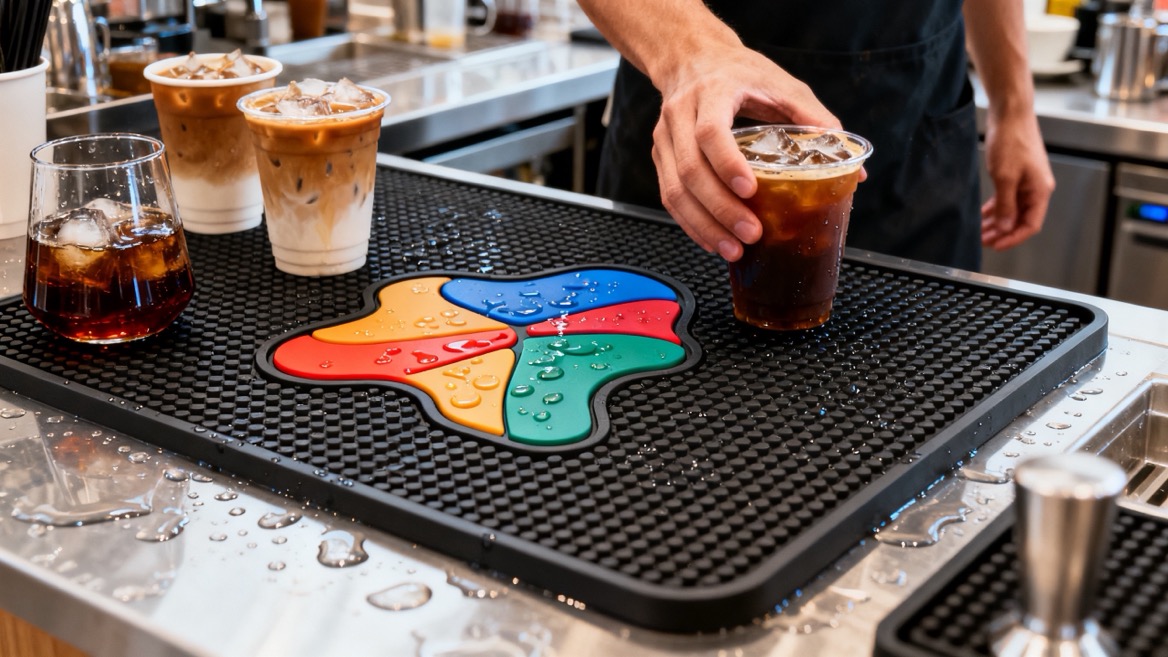
Restaurant branding extends beyond signage. Menus, uniforms, glassware, lighting, and service all contribute to the experience guests associate with your business.
A generic mat performs a task. A thoughtfully designed branded bar mat performs that task while reinforcing the surrounding identity.
Your bar may already feature distinctive colors and typography. Custom logo bar mats carry those elements into the service area, making the counter feel like part of the same environment.
For example, a neighborhood pub could use a dark background with a simple crest. A contemporary cocktail restaurant might choose restrained lettering and a contrasting border.
The goal is not maximum decoration. It is consistency between the mat and the restaurant around it.
A logo near a drink-presentation area gives guests another opportunity to notice your name.
However, visibility depends on placement. A mat hidden behind equipment contributes little to guest-facing branding. A logo covered by glasses throughout service has the same limitation.
Before approving artwork, consider what guests actually see from their seats—not just how the design looks on a screen.
Branding works best when the product earns its place in the operation.
A mat that looks attractive but creates cleaning difficulties or interferes with service can undermine the impression it was intended to create.
Raised features and recessed spaces can help separate glass bases from collected drips, depending on the mat's construction.
That makes surface geometry an important design decision. Decorative elements should not compromise glass stability or create unnecessarily difficult cleaning areas.
During sampling, test the mat with the glassware your team actually uses, including narrow cocktail stems and heavier beer glasses.
A suitably designed mat can collect incidental drips within its working area. It does not eliminate spills, replace counter cleaning, or guarantee that glasses will remain stationary.
Ask the supplier to explain the proposed surface pattern, edge design, and intended use. Evaluate grip on your actual countertop under representative conditions.
Treat "non-slip" as a performance claim to verify, not a promise to accept without testing.
A clean, coordinated service area can support the impression that your team pays attention to details.
The opposite is also true. A distorted logo, curled edge, or visibly dirty mat can detract from an otherwise polished bar.
For this reason, replacement planning and cleaning routines belong in the branding brief—not just the operations manual.
Effective custom bar mats begin with visual priorities. Trying to include your logo, slogan, website, social handles, and promotional message on one surface usually weakens the result.
Arrange the artwork in this order:
1. Restaurant name or primary logo.
2. Recognizable brand colors.
3. One optional supporting element.
4. Uncluttered space around the main identity.
If the logo contains fine lettering or intricate linework, ask whether it needs a simplified version for molded production.
Approve the physical sample rather than relying solely on a digital rendering.
Colors that look distinct on a bright monitor may appear much closer under warm or dim bar lighting.
Review samples at the installation location. Check whether the restaurant name remains readable when glasses cover part of the surface.
Also compare the sample with existing menus, signage, and uniforms. A technically attractive color combination may still feel disconnected from your restaurant.
Measure the available counter space before choosing dimensions.
Consider:
- The number and size of glasses used together.
- Clearance around taps, sinks, and equipment.
- Space needed for drink preparation.
- The guest's viewing angle.
- Whether the mat must be lifted frequently for cleaning.
A larger logo is not automatically more effective if the mat obstructs the bartender's workflow.
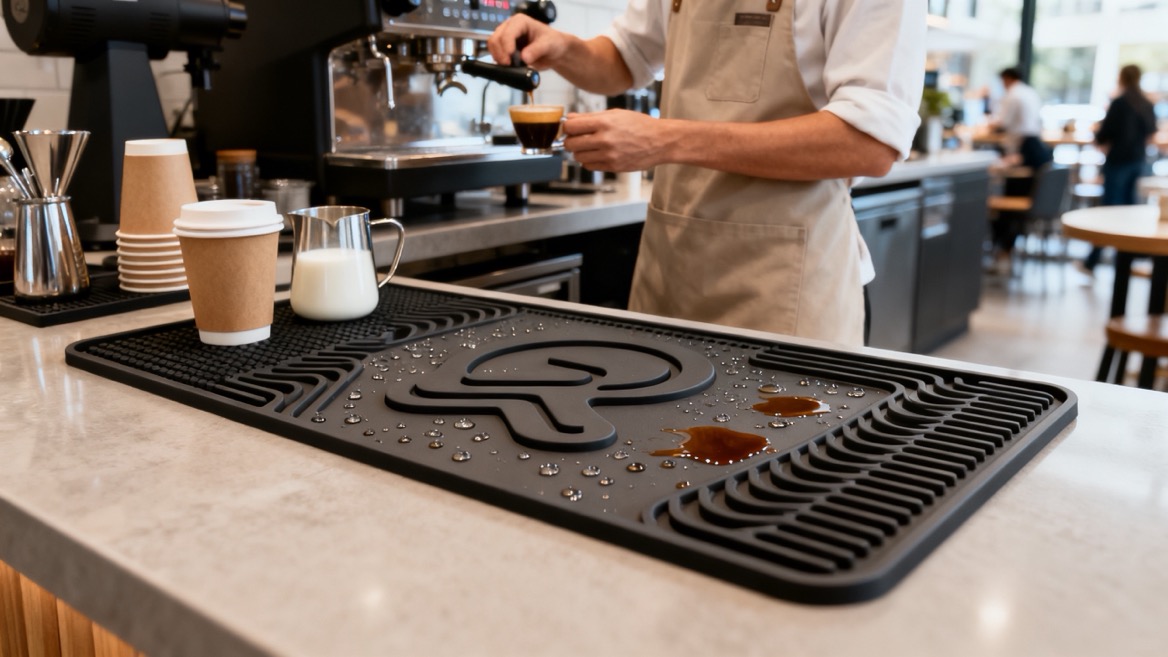
Different hospitality concepts need different treatments. The following examples are design scenarios, not documented customer results.
| Restaurant concept | Suggested design direction | Main evaluation priority |
|---|---|---|
| Neighborhood pub | Bold name, simple emblem, recognizable colors | Readability during busy service |
| Cocktail restaurant | Restrained palette and carefully spaced lettering | Visual fit with premium presentation |
| Family restaurant | Friendly graphics and clear branding | Cleaning practicality and broad appeal |
| Sports bar | High-contrast identity with minimal detail | Recognition in a visually busy environment |
| Multi-location group | Standardized artwork and approved color references | Consistency across repeat orders |
The useful question is not "Which design is most impressive?" It is "Which design belongs naturally in this restaurant?"
A structured approval process helps prevent attractive artwork from becoming an impractical finished product.
Decide whether the project primarily supports:
- Everyday restaurant identity.
- A new location opening.
- A seasonal drinks campaign.
- A beverage partnership.
- Standardization across multiple locations.
This choice determines what deserves space on the mat.
An evergreen design may suit daily use. A campaign-specific design may need a planned retirement date.
Provide the manufacturer with dimensions, countertop material, glassware types, cleaning methods, expected use, and destination market.
Include photographs of the installation area where possible.
These details help turn a vague request for "high quality" into a specification that can be reviewed.
Review the logo position alongside thickness, surface pattern, edge shape, and underside construction.
Ask the manufacturer to identify details that may not reproduce reliably.
A useful production proof should explain what the finished mat will be—not simply display a logo inside a rectangle.
Evaluate the sample for:
- Logo legibility under bar lighting.
- Stability with representative glassware.
- Fit within the intended working area.
- Ease of lifting, washing, and drying.
- Appearance after the proposed cleaning routine.
- Movement on the actual countertop.
Record observations so revisions have a clear purpose.
Retain an approved reference sample and confirm artwork revision, dimensions, color references, packaging, and inspection criteria.
For restaurant groups, label distribution cartons by location or design version.
These controls help prevent a successful first order from becoming an inconsistent rollout.
Custom bar mats should not come with unsupported promises of increased revenue.
Instead, evaluate results that your team can reasonably observe.
Operational measures might include cleaning time, replacement frequency, fit, and bartender feedback.
Marketing measures might include whether the logo remains visible during service or appears clearly in planned beverage photography.
Neither automatically proves that a mat caused additional sales.
Test the design at one service station or a small number of locations first.
Keep a short evaluation sheet covering visibility, cleaning, stability, and staff acceptance. Compare similar service periods and record other changes that could affect the results.
If your team is also introducing a new menu, promotion, or staffing model, avoid attributing every improvement to the mats.
Purchase price alone can obscure replacement and maintenance differences.
A useful internal measure is:
Cost per usable service day = total purchasing and replacement expenditure ÷ total usable mat-days.
Compare this alongside cleaning effort and appearance retention. A cheaper mat is not necessarily better value if it becomes unsuitable sooner.
A branded service accessory must fit the restaurant's hygiene procedures and procurement requirements.
Food-service guidance requires nonfood-contact equipment surfaces to be cleaned often enough to prevent soil accumulation.
For bar mats, establish a routine appropriate to actual use. Remove collected liquid and debris, clean the mat and the counter beneath it, and follow the manufacturer's validated care instructions.
Do not assume that every PVC mat is dishwasher-safe, compatible with every chemical, or suitable for high-temperature cleaning.
Ask what each test report covers: the material, finished product, tested substances, date, and applicable requirements.
Avoid treating a general compliance statement as proof of suitability for every use.
California Proposition 65 concerns warnings about relevant chemical exposures; it is not a universal product-safety certification. Likewise, Disney Facility and Merchandise Authorization concerns authorization for specified Disney-branded production, not blanket approval of all factory products.
Direct food contact, heat exposure, and other special applications require their own assessment.
Yijia Plastic Products Co., Ltd. combines research and development, production, and sales of PVC bar mats and other soft PVC promotional products.
According to our company-provided background, we offer:
- 18 years of manufacturing experience.
- A 3,000-square-meter factory.
- 10 automated production lines.
- Multiple advanced dispensing machines.
- One-stop OEM/ODM customization services.
Our reported cooperation experience includes Starbucks, Disney, McDonald's, Pop Mart, and Tencent. These names describe company-reported project experience; they should not be interpreted as endorsements of a particular bar mat.
Our company background also reports EU RoHS-related documentation, California Proposition 65-related documentation, and Disney FAMA authorization. Buyers should request current, applicable records and confirm their scope for the proposed order.
For your project, the priority is practical: translate brand artwork into a reproducible product, then verify the result through sampling and clear production requirements.
Send Yijia your logo file, preferred dimensions, estimated quantity, destination market, required delivery date, and photographs of the intended counter.
Include your cleaning procedure and any testing requirements. Request a quotation and physical sample based on those details.
That gives both teams a concrete starting point—and helps ensure your custom bar mats represent the restaurant as well in daily service as they do in the design presentation.
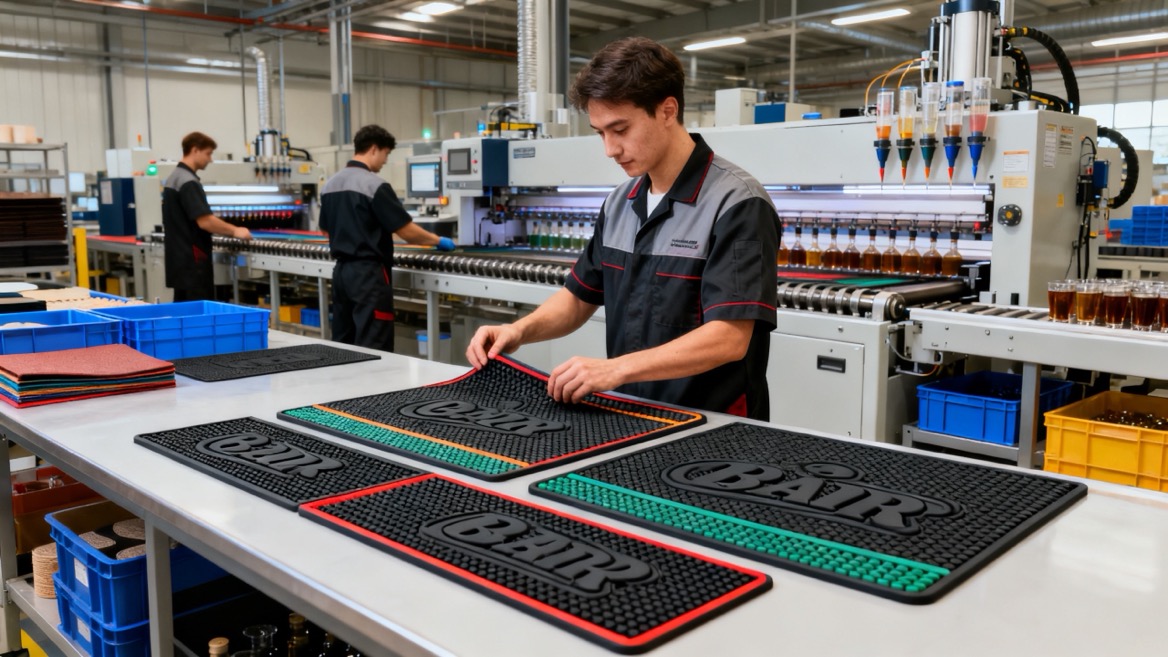
They extend your restaurant's visual identity into a working service area. Effective placement, readable artwork, and consistent colors help the mat complement menus, signage, and drink presentation.
Start with the restaurant name or primary logo. Add brand colors and, if necessary, one short supporting message. Leave enough space for recognition when glasses partly cover the surface.
Suitability depends on construction, operating conditions, cleaning methods, and applicable requirements. Test a physical sample in the intended environment rather than choosing by material name alone.
Only use a dishwasher when the manufacturer confirms compatibility with the relevant cycle, temperature, and chemicals. Otherwise, follow the approved care instructions.
Use controlled artwork, approved color references, written specifications, and a retained reference sample. Confirm the design version and inspection requirements for each repeat order.
No. They can support a coordinated brand presentation, but revenue depends on many factors. Evaluate visibility, staff feedback, maintenance, and replacement needs before making broader claims.
- ChowNow. "Restaurant Branding Strategies That Work." Background on visual identity, brand experience, and consistency across restaurant touchpoints. [get.chownow]
- U.S. Food and Drug Administration. "Food Code 2022," Sections 4-601.11 and 4-602.13. Guidance on cleanliness and cleaning frequency for nonfood-contact equipment surfaces. [fda]
- California Office of Environmental Health Hazard Assessment. "Frequently Asked Questions." Explanation of Proposition 65 warnings and their relationship to safety standards. [p65warnings.ca]
- California Office of Environmental Health Hazard Assessment. "Frequently Asked Questions for Businesses." Business responsibilities, exposure assessment, and warning determinations. [p65warnings.ca]
- The Walt Disney Company. "Facility and Merchandise Authorization Application and Instructions." Explanation of facility authorization for Disney-branded production. [thewaltdisneycompany]


