
Views: 243 Author: Yijia Plastic Publish Time: 2026-10-18 Origin: Site
Content Menu
● Why Coffee Shop Counters Deserve More Branding Attention
● How Custom PVC Mats Strengthen Coffee Shop Counter Branding
>> Create a Consistent Visual Identity
>> Give the Drink Handoff a Branded Setting
>> Support Seasonal Campaigns Without Changing the Counter
● Design Custom PVC Counter Mats Around Real Café Workflows
>> Choose Placement Before Size
>> Balance Logo Detail With Cleanability
>> Specify Function Instead of Relying on Product Labels
● A Practical Design Principle: Separate the Brand Zone From the Work Zone
● Cleaning and Material Safety Should Guide the Specification
>> Design for the Cleaning Routine
>> Distinguish Counter Use From Direct Food Contact
● Understand What Compliance Documents Actually Demonstrate
>> Disney FAMA
● From Concept to Production: A Better Custom Mat Brief
>> Provide These Details Before Sampling
● How to Measure Whether Branded Counter Mats Are Working
● Why Work With Yijia Plastic Products Co., Ltd.?
● Build a Counter Mat That Belongs in Your Café
>> 1. What size should a custom PVC coffee counter mat be?
>> 2. Can a custom PVC mat reproduce a detailed logo?
>> 3. Are PVC bar mats suitable for direct food contact?
>> 4. Can custom café mats go in a dishwasher?
>> 5. Do custom counter mats increase coffee shop sales?
>> 6. What affects the price of OEM PVC counter mats?
Custom PVC mats can turn an ordinary coffee counter into a recognizable brand touchpoint. Positioned at ordering, payment, or drink collection, they place your identity where customers interact with your business. The strongest designs combine a clear logo with practical features that suit everyday café service.
At Yijia Plastic Products Co., Ltd., our approach is to treat a branded counter mat as working equipment—not simply a promotional accessory. A successful mat should communicate your identity, fit the available space, and remain manageable for the team cleaning it.
This guide explains how custom PVC mats can support coffee shop counter branding, which specifications matter, and how to evaluate a design before ordering.

A café counter brings together several customer interactions: choosing drinks, paying, waiting, and collecting an order. It is therefore a useful place to connect your visual identity with the service experience.
A custom logo counter mat adds a branded surface without requiring permanent alterations to the counter. It can complement menu boards, cups, packaging, and staff uniforms.
However, visibility alone is not enough. A mat covered by cups or placed behind equipment contributes little to customer-facing branding.
From a manufacturing perspective, the first question should be: "Where will customers actually see this design?" Dimensions, artwork orientation, and placement should follow that answer.
A recognizable café identity depends on coordinated design choices. Your counter mat should use the same approved logo, colors, and typography as your other materials.
For an independent espresso bar, that might mean a restrained background with one contrasting logo. A playful takeaway brand might choose brighter colors and a distinctive outline.
Consistency does not mean placing every brand element on one surface. One clear mark usually creates a more focused design than a crowded combination of slogans, icons, and promotional messages.
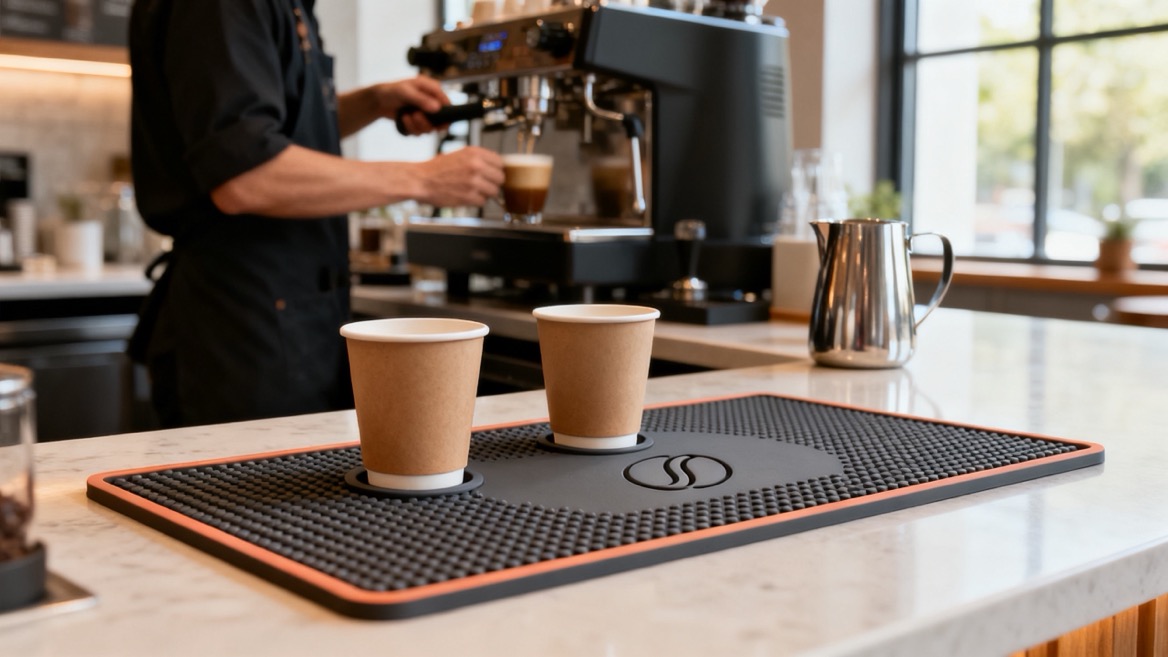
The collection point is where customers receive the finished product. A custom PVC bar mat can frame that interaction and visually distinguish it from the preparation area.
Keep the main logo outside the zone usually occupied by cups. Check its orientation from the customer's side, not just the barista's position.
This detail is easy to miss in a digital proof. A design can look correct on screen while appearing upside down or disappearing beneath takeaway drinks in actual use.
Custom café counter mats can introduce a seasonal color palette, anniversary identity, or limited-edition collaboration.
Keep the permanent brand recognizable while adding one campaign element. Otherwise, the mat may become unusable as soon as the promotion ends.
For smaller operators, a permanent logo mat paired with a replaceable nearby promotional sign may be more practical than producing a separate mat for every offer.
Measure the usable counter area rather than the entire countertop. Include space for payment terminals, collection trays, cup movement, and staff access.
| Counter location | Branding purpose | Design priority |
|---|---|---|
| Payment area | Reinforce identity during checkout | Compact footprint and visible logo |
| Drink collection point | Frame the customer handoff | Customer-facing artwork |
| Espresso workstation | Identify the preparation zone | Equipment clearance and cleanability |
| Retail display | Connect merchandise with the café brand | Uncluttered presentation |
| Event coffee station | Recreate a recognizable branded setup | Portable, practical dimensions |
Avoid assuming that a larger mat produces stronger branding. An oversized design can interfere with service or place important artwork outside the customer's view.
Soft PVC manufacturing can accommodate molded lettering, contrasting colors, and raised details. However, artwork must suit the production process and intended cleaning routine.
Fine lettering may need simplification. Deep recesses and tightly spaced details can make residue harder to remove.
Ask the manufacturer to review minimum line widths, letter spacing, relief depth, and color separation before approving tooling. The goal is not maximum detail; it is a recognizable design that remains practical in service.
Terms such as "non-slip," "heat-resistant," and "easy-clean" should lead to questions, not automatic assumptions.
Request evaluation against your intended counter surface, operating conditions, and cleaning method. Performance can vary with material formulation, construction, moisture, and contamination.
Likewise, raised channels may hold small drips, but a mat without a drainage outlet does not remove liquid. Staff still need to empty and clean it.
One useful approach is to divide the mat into two functional areas.
The work zone accommodates cups, small drips, and routine handling. The brand zone keeps the logo visible, preferably along a customer-facing edge.
This arrangement helps avoid a common design mistake: placing the main logo exactly where every drink will sit.
For a narrow coffee shop counter, consider a simple layout:
1. Measure the normal cup-placement area.
2. Reserve a visible strip outside that footprint.
3. Position the logo toward the customer.
4. Keep operational instructions separate from promotional artwork.
5. Test the arrangement using actual cups and service movements.
This is a design recommendation, not a guarantee of increased sales. Its value lies in making the branding visible without asking staff to work around it.
Coffee counters encounter milk, syrups, coffee grounds, and water. A branded mat must fit the establishment's hygiene procedures rather than complicate them.
The U.S. FDA Food Code provides a useful reference for cleanable equipment surfaces. Its provisions distinguish food-contact surfaces from nonfood-contact surfaces and emphasize construction that supports effective cleaning.
For a café mat, practical checks include:
- Can staff reach and clean recessed details?
- Does the mat lift easily for cleaning underneath?
- Does residue remain around the logo?
- Can the specified cleaning products damage the surface?
- Can the mat dry adequately before reuse?
Ask for written care instructions. Do not assume dishwasher suitability or resistance to boiling water.
A mat used beneath cups is not automatically suitable for direct contact with pastries, exposed ingredients, or food.
If direct food contact is intended, tell the manufacturer before sampling and request documentation relevant to the material, application, and destination market.
Similarly, do not position a PVC mat beneath hot equipment or heated metal components without confirming temperature limits. "Suitable for a coffee counter" is not a substitute for an application-specific specification.
Buyers should distinguish chemical testing, regulatory obligations, and manufacturing authorization.
The EU RoHS Directive restricts specified hazardous substances in electrical and electronic equipment. An ordinary nonelectrical counter mat does not become an electrical product because its material has undergone RoHS-related testing.
Such reports can provide information about tested substances, but they do not establish food-contact suitability or universal product safety.
California Proposition 65 addresses exposures to listed chemicals and associated warning obligations. It is not a general product-approval certification.
Request the relevant reports and an explanation of their scope. A chemical test result should not be presented as resolving every possible exposure or warning question.
Disney's Facility and Merchandise Authorization concerns authorization for facilities involved in Disney-branded production, subject to applicable conditions.
It is not a general product-safety certificate or permission for any buyer to reproduce Disney characters. Artwork rights and project authorization remain separate requirements.
A detailed brief helps the manufacturer quote accurately and reduces avoidable revisions.
- Finished dimensions and intended counter location.
- Quantity, destination market, and required delivery date.
- Vector artwork and brand color references.
- Intended thickness, border, and surface structure.
- Cleaning products and expected use conditions.
- Packaging requirements and store allocation.
- Required tests and documentation.
- Ownership or permission for all supplied artwork.
Color references should lead to a physical sample review. Screen appearance alone is not a reliable approval method.
Check the sample on the intended counter, under normal lighting, using actual cups and equipment.
Inspect logo legibility, edge finish, flatness, odor, and ease of cleaning. Test movement on the relevant surface under both dry conditions and foreseeable moisture.
Record the approved specifications and keep a reference sample. Repeat orders become easier to evaluate when both parties can compare production against an agreed physical standard.
Do not judge a custom mat only by whether it looks attractive in a product photograph. Evaluate both visibility and operational fit.
A simple pilot can compare a baseline period with a trial period while recording other changes, such as promotions, staffing, or opening hours.
| Evaluation area | Practical measure |
|---|---|
| Brand visibility | Is the logo visible during normal service? |
| Customer recognition | Can surveyed customers recall the identity? |
| Staff usability | Does the mat obstruct routine movements? |
| Cleaning workload | How long does cleaning take per shift? |
| Physical performance | Does it move, curl, stain, or retain residue? |
Treat results cautiously. A change in sales during the trial cannot automatically be attributed to the mat.
For procurement, compare tooling, samples, unit price, testing, freight, and replacements—not unit price alone.
Yijia combines research and development, production, and sales of PVC bar mats and other soft PVC promotional products.
According to the company information supplied for this article, Yijia has 18 years of experience, a 3,000-square-meter factory, 10 automated production lines, and multiple advanced dispensing machines. Its services cover one-stop OEM/ODM customization for international buyers.
The company also reports cooperation experience involving Starbucks, Disney, McDonald's, Pop Mart, and Tencent. These company-reported capabilities and relationships should be supported by appropriate records where disclosure is permitted; they do not imply endorsement of every product.
For buyers, the practical next step is to request project-specific evidence: relevant samples, current documentation, production specifications, and an agreed approval process.
Effective coffee shop counter branding combines visibility, consistent design, and operational practicality. A custom PVC mat should make your brand easier to recognize without creating unnecessary work for your team.
Send Yijia your counter dimensions, logo files, estimated quantity, destination market, and intended use. Request a tailored proposal covering artwork feasibility, material specifications, sample approval, documentation, and production scheduling before committing to a bulk order.

Measure the usable area and normal cup footprint first. Leave clearance for payment equipment, staff movement, and collection space. Choose dimensions that keep the branding visible without obstructing service.
Feasibility depends on the artwork and manufacturing tolerances. Fine text and intricate details may need adjustment. Approve a physical sample rather than relying only on a digital rendering.
Not automatically. Specify the intended contact conditions and request relevant documentation. A mat designed to support cups should not be assumed suitable for exposed food.
Only when the manufacturer confirms compatibility with the material and construction. Follow the supplied cleaning instructions and check compatibility with your detergents and temperatures.
They can support a coordinated brand presentation, but a sales increase is not guaranteed. Evaluate visibility, customer recognition, cleaning effort, and usability through a controlled pilot.
Dimensions, construction, color complexity, tooling, quantity, testing, packaging, and shipping all affect cost. Compare quotations against the same specification and approved sample requirements.
1. U.S. Food and Drug Administration — "FDA Food Code." Official overview of the model provisions for retail food safety; supports the discussion of cleaning, surface design, and application-specific requirements. [fda]
2. U.S. Food and Drug Administration — "FDA Food Code 2017," Chapter 4, including Sections 4-202.16 and related equipment-surface provisions. Supports the distinction between food-contact and nonfood-contact surfaces and the importance of accessible, cleanable construction. [fda]
3. European Commission — "Restriction of Hazardous Substances in Electrical and Electronic Equipment (RoHS)." Explains the directive's scope and restricted substances; supports the distinction between RoHS-related material testing and food-contact suitability. [environment.ec.europa]
4. California Office of Environmental Health Hazard Assessment — "Proposition 65." Explains the law's exposure-warning framework and listed-chemical requirements; supports the clarification that Proposition 65 is not a general product-approval certification. [oehha.ca]
5. The Walt Disney Company — "Facility and Merchandise Authorization Application." Explains facility authorization requirements for Disney-branded production; supports the distinction between FAMA authorization, product-safety certification, and intellectual-property permission. [thewaltdisneycompany]


