
Views: 268 Author: Yijia Plastic Publish Time: 2026-11-01 Origin: Site
Content Menu
● Why Custom Bar Mats Matter for Hotel Brand Identity
>> Connect Brand Recognition With Real Service Moments
>> Support an Experience-Led Hospitality Strategy
● Where Hotels Should Place Custom Bar Mats
>> Separate Guest-Facing and Working Areas
● How to Design Custom Hotel Bar Mats That Look Intentional
>> Build a Clear Visual Hierarchy
>> Match the Hotel's Personality
>> Approve Physical Samples, Not Just Digital Proofs
● Choosing PVC Bar Mats for Hotel Operations
>> Check Fit, Stability, and Liquid Management
>> Define the Intended Contact Conditions
● Turn Cleaning Into Part of the Brand Standard
>> Establish a Written Care Procedure
● A Practical Pilot: Test Before a Hotel-Wide Rollout
>> Run a Two-Week Operational Trial
>> Set Acceptance Criteria Before Testing
● Measure Value Without Inventing a Return on Investment
>> Use a Total-Cost Comparison
● What Hotel Buyers Should Verify About Supplier Credentials
>> Distinguish Chemical Testing From Broader Approval
>> Keep Brand Authorization Separate
● How Yijia Supports Custom Hotel Bar Mat Projects
● Start With a Brief That Connects Branding and Operations
>> How do custom bar mats strengthen hotel brand identity?
>> Should every hotel bar use the same mat design?
>> What should hotels check before ordering PVC bar mats?
>> Can custom PVC bar mats go in a commercial dishwasher?
>> Are custom bar mats suitable for direct food contact?
>> How many spare mats should a hotel order?
Custom bar mats help hotels strengthen brand identity by bringing their visual personality into everyday beverage service. A thoughtfully designed mat can connect a hotel's logo, signature colors, and bar concept at the exact moment guests order, receive, and photograph their drinks. For hotel owners and food-and-beverage managers, this makes custom bar mats more than counter accessories: they become practical, repeatable brand touchpoints.
At Yijia Plastic Products Co., Ltd., we approach this opportunity from a manufacturing perspective. With 18 years of experience producing PVC soft-plastic gifts, we believe the strongest design starts with a simple question: how should this product support both the hotel's identity and the bartender's work?
The answer requires more than adding a logo. It involves placement, material specifications, thoughtful artwork, cleaning requirements, and a consistent purchasing process.

A hotel communicates its identity through hundreds of small decisions. Lighting, uniforms, menus, glassware, and service language all contribute to the same impression. Bar accessories should reinforce that impression rather than interrupt it.
A generic supplier-branded mat may look out of place in a carefully designed cocktail lounge. A custom hotel bar mat can instead repeat the property's visual language in a useful location.
Guests encounter bar mats while watching cocktails being prepared, collecting drinks, or sitting at the counter. These moments give hotels an opportunity to make their identity visible without adding another advertising display.
However, visibility is not the same as proven commercial impact. A branded mat should be treated as one supporting element of the guest experience—not a guarantee of higher revenue or repeat bookings.
The goal is consistency: making a useful operational object feel unmistakably connected to the property.
The American Hotel & Lodging Association's 2025 industry reporting highlights growing interest in distinctive, experience-driven travel alongside pressure on hotel operating costs.
For hotel bars, the practical implication is to choose details that contribute to the atmosphere while serving a clear purpose. A well-specified mat can support that approach when its branding, placement, and maintenance requirements work together.
Start with the guest journey and the service workflow, not the number of logos you want to display.
| Hotel location | Branding opportunity | Recommended design direction |
|---|---|---|
| Lobby bar | Introduce the property's identity | Hotel logo with restrained brand colors |
| Rooftop lounge | Reinforce a distinctive venue concept | Venue name and a recognizable graphic |
| Poolside bar | Support a relaxed resort atmosphere | Clear, high-contrast artwork |
| Executive lounge | Maintain an understated presentation | Small emblem and minimal wording |
| Banquet bar | Connect temporary service to the hotel | Reusable hotel branding or approved event artwork |
A guest-facing serving mat prioritizes presentation and readability. A bartender's working mat must also fit preparation space, glassware movement, and cleaning routines.
One design may not suit both roles.
Before ordering, ask bartenders where liquids collect, where glasses are placed, and which counter areas must remain unobstructed. Do not extend mats into walkways or position them where raised edges interfere with service.
From our manufacturing perspective, the most useful artwork brief connects visual identity with physical production requirements.
A design that looks impressive on a screen still needs to remain readable when molded, viewed under bar lighting, and partially covered by glasses.
Give the design one main focal point. This will usually be the hotel name, bar name, or recognizable emblem.
Then add only the supporting details that serve a clear purpose:
- A short venue descriptor.
- A simple architectural motif.
- A signature brand color.
- An approved anniversary or event mark.
Avoid combining a large logo, slogan, website address, social handles, and decorative illustrations on one small surface. Every extra element competes for attention.
Different properties require different visual treatments.
A heritage hotel might choose a restrained crest and border. A contemporary lifestyle property could use geometric shapes and contrasting colors. A destination resort might reference local architecture or landscape through an original illustration.
These are design directions, not universal rules. The final choice should follow the hotel's existing identity guidelines.
For hotel groups, define which elements remain consistent across properties and which can change for individual bars.
For molded PVC bar mats, discuss minimum line widths, lettering size, color separation, relief height, and border construction with the manufacturer.
A physical sample should be checked:
1. Under the venue's actual lighting.
2. From the guest's normal viewing position.
3. With the hotel's glasses placed on it.
4. After the proposed cleaning process.
5. Against the approved color reference.
Photographs and digital proofs help with communication, but they should not replace approval of the finished sample.
Soft PVC allows manufacturers to create flexible mats with molded logos, raised details, and textured working surfaces. However, performance depends on the formulation and construction—not simply the material name.
Specify the properties your hotel needs, then evaluate samples against those requirements.
Useful purchasing questions include:
- Does the mat fit the counter without overhanging?
- Does the base remain stable on the actual surface?
- Do glasses sit securely on the raised pattern?
- Is collected liquid easy to empty?
- Are the edges flat and free from obvious distortion?
- Can staff clean the recesses effectively?
Raised structures may help keep glass bases above small amounts of collected liquid, but a mat does not drain itself unless its design includes an appropriate drainage arrangement.
Likewise, do not assume that a PVC mat is automatically slip-proof, heat-resistant, or dishwasher-safe.
A mat used beneath the exterior base of a glass is not necessarily suitable for direct contact with garnishes, ice, or drinking rims.
Tell the supplier exactly how the product will be used. Where food-contact requirements apply, request documentation appropriate to the intended use and destination market.
Avoid treating a general material test as approval for every hospitality application.
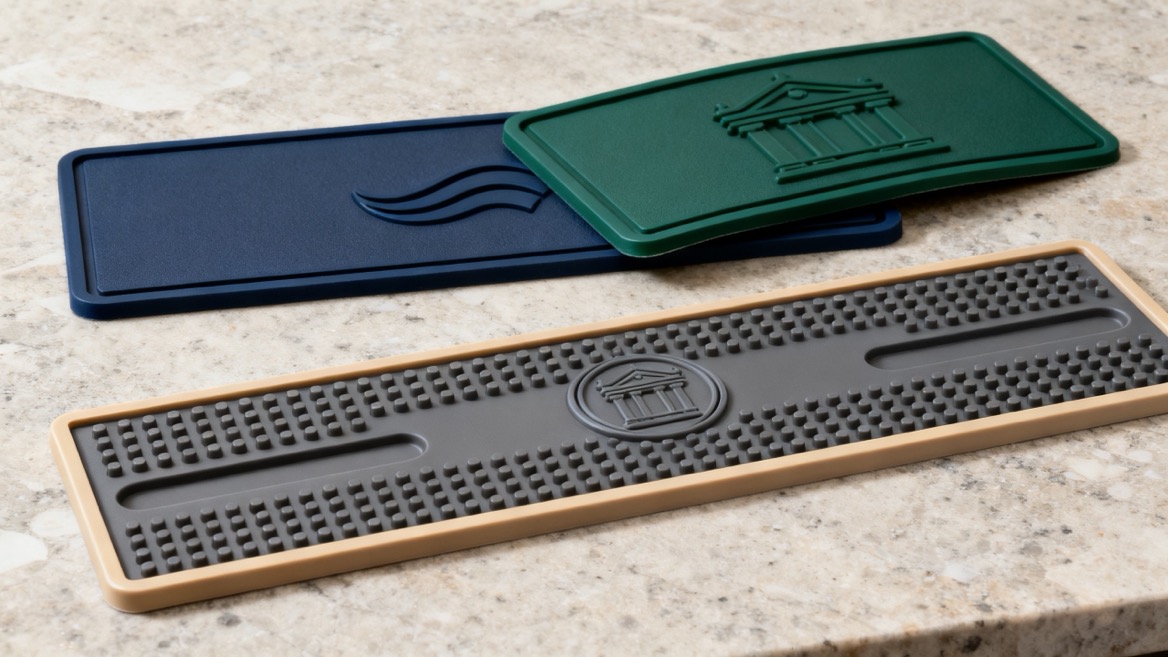
A beautifully branded mat undermines the intended impression if it retains sticky residue or develops damaged edges.
AHLA's hospitality reporting identifies cleanliness as a continuing guest priority. Cleaning should therefore be part of product selection, not an issue considered after delivery.
Create a procedure with the hotel's hygiene team and the supplier. It should define:
1. When mats are removed and emptied.
2. Which cleaning products are permitted.
3. How recesses and undersides are cleaned.
4. Whether sanitizing is required for the intended use.
5. How mats are dried and stored.
6. When worn or damaged units are replaced.
Follow chemical-label instructions, manufacturer compatibility guidance, and applicable local requirements.
The FDA Food Code distinguishes cleaning from sanitizing and sets different expectations for food-contact and non-food-contact surfaces. It is a model code; the hotel must check the requirements adopted in its jurisdiction.
Do not advertise antimicrobial performance or universal dishwasher compatibility without supporting evidence.
Rather than ordering for every venue immediately, introduce an approved sample batch in one representative bar.
The following is a proposed evaluation method, not a documented customer case study.
During the trial, ask the bar manager to record:
- Movement on the counter during service.
- Glass stability during normal use.
- Ease of emptying collected liquids.
- Time and effort required for cleaning.
- Changes in color, shape, or surface condition.
- Whether the branding remains visible in normal service photographs.
Include both busy and quieter shifts. A mat that looks attractive before opening may perform differently when staff are serving continuously.
Use a simple scorecard covering appearance, fit, stability, cleaning, and staff acceptance.
Identify non-negotiable failures separately. Persistent movement, difficult-to-remove residue, or unstable glass placement should trigger a design review rather than being averaged into an acceptable overall score.
This process turns subjective preferences into a clearer purchasing decision.
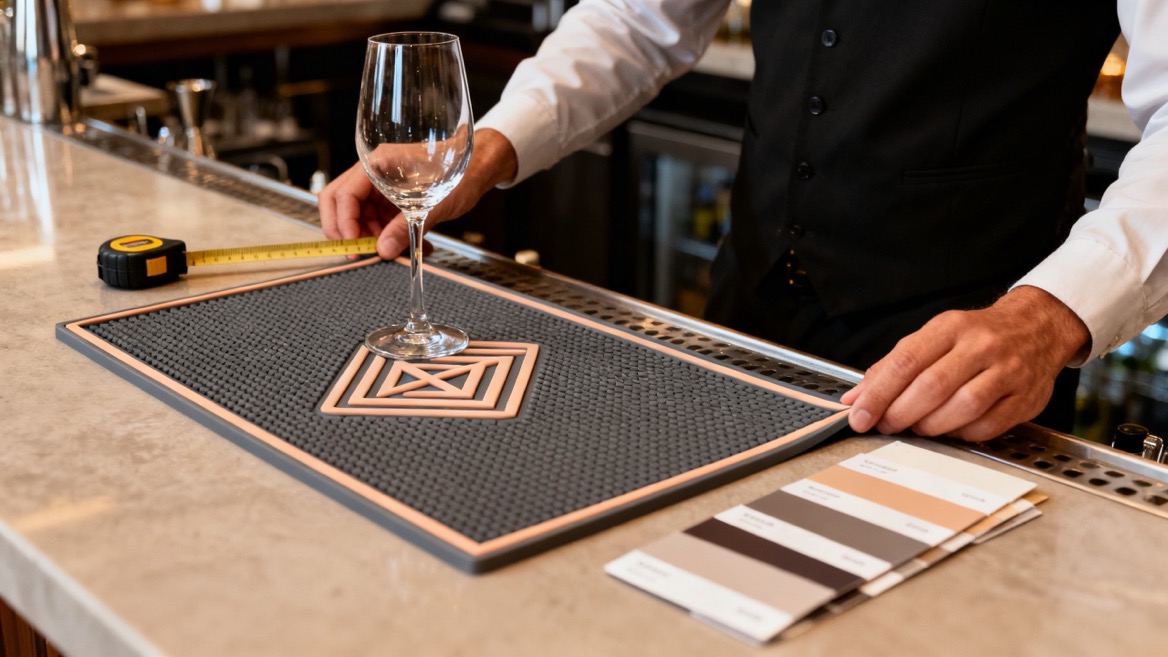
Hotels should evaluate custom bar mats as operational supplies with a branding role.
There is no defensible universal percentage showing how much a branded mat increases bookings or beverage sales. Instead, track outcomes the hotel can observe directly.
Compare suppliers using more than the unit price.
| Cost component | What to include |
|---|---|
| Development | Artwork support, tooling, and samples |
| Purchase | Unit price and minimum order quantity |
| Delivery | Freight, duties, and packaging |
| Operation | Cleaning effort and storage needs |
| Replacement | Wear, damage, and replenishment costs |
A useful internal measure is:
Cost per service day = total allocated cost ÷ actual days in service.
For example, a hypothetical mat costing $15 landed and remaining in service for 300 days has a purchase cost of $0.05 per service day. Cleaning and other operating costs would be additional.
This calculation supports procurement decisions; it does not measure brand recognition.
Documentation should answer a specific procurement question. Different credentials do not prove the same thing.
RoHS primarily concerns hazardous substances in electrical and electronic equipment. Testing a non-electrical PVC mat against RoHS substance limits should not be presented as universal hospitality or food-contact approval.
California Proposition 65 concerns exposure to listed chemicals and associated warning obligations. It is not a blanket product-safety certification.
For any report, request the tested product description, material identification, laboratory details, date, methods, and results. Confirm that the documentation is relevant to the product being purchased.
Ask suppliers to explain the scope of any Disney FAMA documentation they present. Do not treat it as independent evidence of bar-mat hygiene, food-contact suitability, or performance.
Likewise, previous work involving recognizable brands does not automatically authorize new use of their names, characters, or logos.
Hotels should provide artwork they own or are licensed to reproduce.
Yijia Plastic Products Co., Ltd. brings 18 years of experience in the research, development, production, and sales of PVC soft-plastic gifts.
Our company profile includes a 3,000-square-meter factory, 10 automated production lines, and multiple dispensing machines. We offer one-stop OEM/ODM customization for customers seeking products developed around their own artwork or design requirements.
Our stated cooperation experience includes Starbucks, Disney, McDonald's, Pop Mart, and Tencent. These company-supplied credentials describe our background; they should not be interpreted as endorsements of a particular hotel product.
For hotel procurement teams, the important next step is to review project-specific samples, specifications, documentation, production schedules, and reorder arrangements.
Before requesting a quotation, prepare:
- Hotel and bar artwork files.
- Required dimensions and quantities.
- Color references.
- Intended use and counter locations.
- Cleaning conditions.
- Destination markets.
- Required delivery date.
Contact Yijia Plastic Products Co., Ltd. with this brief to request a tailored quotation and discuss sampling. Approve the physical sample and agreed specifications before authorizing bulk production.
They repeat the hotel's visual identity during beverage service. Their contribution is strongest when the artwork matches the venue and the product remains clean, functional, and consistently presented.
Not necessarily. Keep core hotel branding consistent, but allow venue-specific colors or graphics where individual bars have distinct identities.
Check dimensions, construction, sample appearance, counter stability, cleaning compatibility, documentation, and intended contact conditions. Confirm production and delivery requirements in writing.
Only when the supplier confirms compatibility with the relevant temperatures, chemicals, and wash cycle. Otherwise, use the approved cleaning method.
Do not assume so. Suitability depends on the formulation, intended application, applicable rules, and supporting documentation.
Base the quantity on active service stations, cleaning rotation, replacement needs, and reorder lead time. Avoid applying an arbitrary spare-stock percentage to every property.
- American Hotel & Lodging Association. "2025 State of the Industry Report," February 6, 2025. Supports the discussion of experience-driven travel and hotel operating pressures. [ahla]
- American Hotel & Lodging Association. "New Report: Staffing Growth, Enhanced Services Remain Key to Hotel Success in 2025," March 31, 2025. Supports the discussion of cleanliness and guest expectations. [ahla]
- U.S. Food and Drug Administration. "Food Code 2022." Provides the model-code context for cleaning and sanitizing practices; local adoption and subsequent updates should be checked. [fda]
- European Commission, Directorate-General for Environment. "RoHS Directive." Explains the directive's electrical and electronic equipment scope and restricted substances. [environment.ec.europa]
- California Office of Environmental Health Hazard Assessment. "Frequently Asked Questions for Businesses." Explains Proposition 65 exposure assessment and warning responsibilities. [p65warnings.ca]


