
Views: 277 Author: Yijia Plastic Publish Time: 2026-09-30 Origin: Site
Content Menu
● Start With the Job Each Bar Mat Must Do
● Choose a Material for Your Workflow
● Match Drainage to Spill Volume
>> Look at the Surface From the Bartender's Side
>> Check the Base as Carefully as the Top
● Size Bar Mats Around Real Equipment
● Build Branding Into a Working Surface
>> Run the Same Test on Every Candidate
● Plan Cleaning Before You Buy
● Verify Claims Before Bulk Ordering
>> Know What Each Document Does—and Does Not Do
● Compare Quotes on Total Use Cost
>> Make the Purchase Specification Repeatable
● Choose for the Shift, Not the Photo
>> What type of bar mat works best beneath brewery taps?
>> Are PVC bar mats suitable for busy taprooms?
>> Should a bar mat replace a drip tray?
>> Can we put garnishes directly on a custom bar mat?
>> How many bar mats should a taproom order?
>> What should we send a manufacturer for an accurate quote?
In a busy brewery taproom, the right bar mats do more than catch drips. They help keep glasses steady, protect the counter, make cleanup manageable, and give staff a clearer place to work. Choosing a mat for a high-traffic bar means looking beyond its logo or color. You need to match its material, drainage design, size, cleaning requirements, and customization to the way each service station actually operates.
A narrow runner at the customer-facing rail faces different demands from a mat beneath the taps. A tasting-flight assembly area may need a broad, stable surface, while a crowded service well needs a compact mat that staff can lift and clean quickly. This guide explains how to make those choices—and how to test a sample before placing a bulk order.

Before comparing products, map the taproom into work zones. Watch a busy shift and note where beer lands, where glasses wait, and where staff need unobstructed access.
| Taproom zone | Main demand | Useful mat features |
|---|---|---|
| Beneath taps | Frequent splashes and overflow | Defined drainage channels and easy lifting |
| Service well | Repeated glass and tool movement | Stable base and manageable footprint |
| Customer-facing rail | Presentation and occasional drips | Legible branding and neat edges |
| Flight assembly area | Several small glasses at once | Adequate usable width and glass stability |
| Mobile event station | Fast setup and packing | Flexible construction and simple cleaning |
Keep countertop bar mats separate from floor mats. A countertop product may help contain drips at the pour point, but it is not a substitute for floor drainage, spill cleanup, slip-resistant footwear, or purpose-made floor matting. That distinction matters when assessing both safety and purchasing needs.
A practical starting point is to list the two or three problems each zone must solve. If a sample looks attractive but does not solve those problems during a rush, it is the wrong mat for that position.
Custom PVC bar mats are a strong option when a brewery wants molded shapes, colors, and raised logos in addition to spill control. Rubber and silicone products may suit other operating preferences. Material names alone, however, do not tell you whether a finished mat will remain stable on *your* counter or tolerate *your* cleaning routine.
| Material | Potential advantage | What to verify before ordering |
|---|---|---|
| Soft PVC | Detailed molded branding and flexible shapes | Surface grip, odor, cleanability, and approved formulation |
| Rubber | Resilient feel for repeated bar use | Weight, odor, cleaning compatibility, and logo detail |
| Silicone | Flexible handling and straightforward rinsing | Stability, desired appearance, and cleaning instructions |
Test the finished product, not just a material swatch. A mat's base texture, overall size, raised pattern, and weight can affect how it behaves. Ask the supplier for a production-representative sample with the intended logo method and surface design.
For high-volume taprooms, examine the trade-off between decoration and utility. Deep lettering can make a brand distinctive, but closely packed recesses may take longer to clean. A broad flat field can display artwork clearly, but it should not sacrifice the channels needed at a wet pour station. The best design gives both the logo and the liquid somewhere appropriate to go.
A bar mat does not make liquid disappear. It either holds drips temporarily, guides them away from the working surface, or makes a wet area easier to clean. Choose its surface pattern based on what staff actually pour and how often they can empty or wash it.
Raised studs can keep glass bases above minor drips. Channels can create paths for liquid, provided the layout does not direct it toward an exposed counter edge. A raised perimeter can help contain small spills, but it may become inconvenient if liquid is difficult to pour out during cleanup.
When reviewing a sample, ask:
- Can staff pick it up without spilling collected liquid?
- Are recesses wide enough to reach during cleaning?
- Does a glass sit steadily across the pattern?
- Does liquid gather near the main glass-placement area?
- Can the mat lie flat after washing and drying?
Do not assume the deepest pattern is the most effective. Drainage must fit the workflow. A tap station that is wiped and emptied often may benefit more from accessible channels than from an intricate pattern that traps residue.
Place the sample on the same counter material used in your taproom. Test it when the counter is clean and dry, then assess how it behaves under realistic service conditions. If it shifts, curls, or catches on tools, discuss a different base texture, footprint, or construction with the manufacturer.
Keep water from collecting beneath the mat. A tidy-looking top does not tell you whether the counter underneath needs attention.
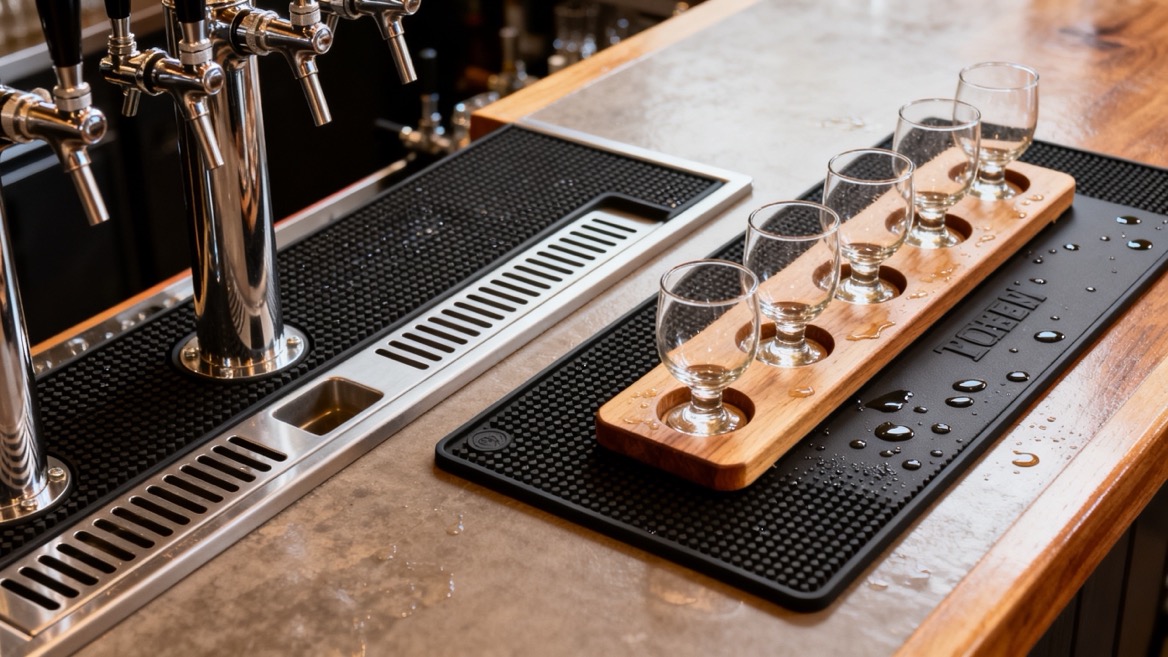
"Standard size" is useful for comparing quotes, not for designing a bar station. Measure the available space after accounting for tap towers, drip trays, payment terminals, speed rails, and staff movement.
Use a simple measurement plan:
1. Measure the clear counter area where the mat can sit without overhanging.
2. Mark fixed equipment and the space needed to clean around it.
3. Identify the working area where glasses are placed most often.
4. Check reach and removal. Staff should be able to lift the mat without moving the entire station.
5. Confirm the proposed dimensions on an artwork proof and physical sample.
At a customer-facing rail, a long brewery bar runner may give the brand more visibility. Behind the taps, a shorter mat that can be lifted and emptied easily may work better. For tasting flights, usable width can matter more than total length.
Ask for finished-product tolerances before approving a custom size. A drawing shows the intended dimensions; a sample shows whether the resulting mat fits the equipment and counter in practice.
A brewery logo is most useful when customers can recognize it and staff can work around it. Place the main mark where it will be visible during normal service—not permanently hidden beneath a tap tower or a row of glasses.
Prioritize legibility over detail. Small text, thin lines, and low-contrast color combinations may look good in a digital proof but become harder to read once molded, wet, or viewed across the bar. If your identity includes intricate artwork, ask for a sample of the smallest important elements.
For multi-location taprooms, agree on which parts of the design are fixed and which may change. The logo, primary colors, and core dimensions might remain consistent, while a location name or seasonal message changes by order. Documenting that distinction helps prevent unnecessary artwork revisions.
Before production, request approval views showing:
- Overall dimensions and logo placement.
- Colors and the expected appearance of raised or recessed areas.
- Surface pattern, edge design, and base texture.
- Packaging and identification for different locations or designs.
A branded mat should still pass the same stability, drainage, and cleaning checks as an unbranded one.
A catalog photo cannot show how a bar mat performs at 7 p.m. on a crowded Friday. A short, repeatable trial is more useful than a vague judgment that a sample "feels durable."
Place each candidate in the same station for a comparable service period. Tell staff what to observe, and avoid changing the cleaning routine for one sample but not another.
1. Record the starting condition: Does the mat lie flat? Are the edges secure? Is the logo readable?
2. Observe normal service: Note glass wobble, mat movement, pooling, and interference with tools.
3. Inspect after the rush: Photograph the top, underside, and surrounding counter.
4. Clean it as staff normally would: Record the time and effort required.
5. Repeat after drying: Check whether the mat returns to its original shape and position.
Use a simple scorecard with five categories: stability, spill handling, cleaning effort, appearance, and station fit. Give each a score from one to five and record brief comments. The numbers help compare samples; the comments explain *why* a mat passed or failed.
This is an operating trial, not a laboratory slip-resistance or product-safety test. If a supplier makes a quantified performance claim, ask for the relevant test method and results.
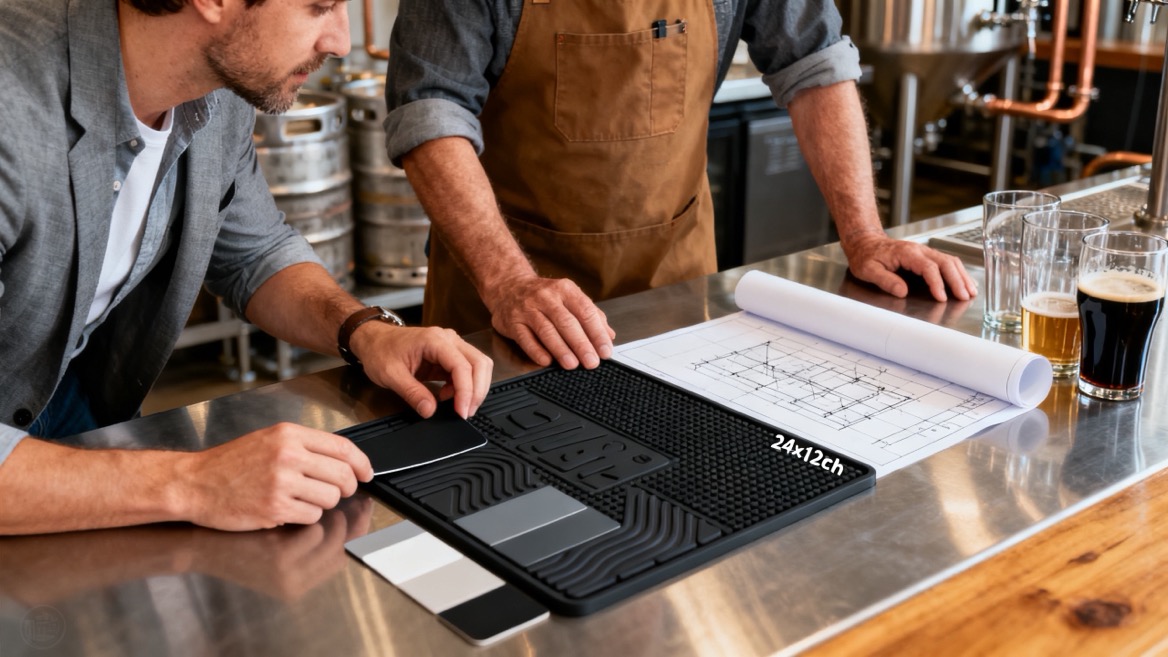
Even an attractive mat becomes a poor purchase if staff cannot clean it consistently. Beer, foam, and sticky drink residue can collect in patterns that look easy to wipe from a distance.
Set a routine that fits both the manufacturer's instructions and your local food-service requirements:
- During service, address spills promptly and empty a mat before liquid overflows.
- At scheduled breaks, inspect the counter beneath it as well as the visible top.
- After service, wash and rinse according to the product instructions, then allow the mat to dry fully.
- Inspect for curling, cracks, persistent odor, or residue that cannot be removed.
Clarify the mat's intended use. A bar mat that supports the outside of glassware should not automatically be treated as a surface approved for direct contact with food, garnishes, or drink ingredients. If direct food contact is planned, request documentation for that exact use and finished formulation.
Do not assume every mat is dishwasher-safe or compatible with every chemical cleaner. Get written care guidance for the supplied design, and train staff on the method the taproom will actually use.
For procurement teams, "compliant" is too broad a word. Ask which finished product, formulation, production batch, test method, and intended market a document covers. If a supplier changes colors or materials, ask whether the documentation still applies.
Yijia Plastic Products Co., Ltd. reports 18 years of experience in PVC soft-plastic products, a 3,000-square-meter factory, 10 automated production lines, and OEM/ODM capabilities. It also reports experience working with Starbucks, Disney, McDonald's, Pop Mart, and Tencent. These company-provided details may help a buyer frame due-diligence questions; they do not replace sample approval, order-specific records, or permission to use another company's name or artwork.
The EU RoHS Directive concerns hazardous substances in electrical and electronic equipment. A conventional, non-electrical bar mat should not be described as "RoHS certified" as though that phrase alone establishes its legal suitability for bar use. A material test report may still be useful to a buyer, but ask the supplier to identify exactly what was tested and why.
California Proposition 65 concerns exposure to listed chemicals and, where required, warnings. A generic "Prop 65 certificate" is not a substitute for assessing the relevant product and exposure. Ask for the supporting product information needed by the buyer or importer to make that assessment.
Disney Facility and Merchandise Authorization, or FAMA, relates to authorization for specified facilities and Disney-branded work. It is not a general safety certification for a bar mat, nor does it authorize unrelated buyers to reproduce Disney artwork. If licensed artwork is involved, verify the applicable permissions and facility authorization before production.
For any supplier, request current, order-relevant documents rather than relying on badges in a product listing.
The lowest unit price is not necessarily the lowest-cost choice for a busy taproom. Compare what is included in each quote and what happens after delivery.
Ask suppliers to state:
- Sample and tooling charges.
- Minimum order quantity for each size and design.
- Material, color, logo method, and packaging specifications.
- Production and shipping timelines.
- Accepted tolerances and inspection criteria.
- Procedures for defects, replacements, and repeat orders.
Then estimate how many mats each station needs, including a practical allowance for cleaning rotation and replacements. A mat that saves a small amount per unit but repeatedly moves, traps residue, or fits poorly may cost more staff time over its usable life.
Create one approved specification for each bar zone. Attach the final drawing, color references, signed-off sample, care instructions, and acceptance checklist to the purchase order. If you operate several taprooms, identify which details are shared and which vary by site.
This step is especially valuable for custom bar mats ordered across seasons or locations. It turns the first purchase into a standard that staff and suppliers can check, rather than a design that must be interpreted again every time.
The right mat fits its station, stays manageable through a rush, cleans without excessive effort, and presents your brewery clearly. Start with the work zone, compare production-representative samples, and approve documents for the intended product and market.
Planning custom PVC bar mats for one taproom or a multi-location rollout? Send Yijia Plastic Products Co., Ltd. your counter dimensions, station photos, artwork, target quantity, and destination market. Ask for a proposed design, relevant product documentation, and a sample to test during service before confirming the bulk order.
Choose a mat that fits the available space, keeps glasses stable, manages the volume of drips at that station, and can be lifted for cleaning. A sample trial is more reliable than choosing by surface pattern alone.
They can be, especially when a taproom needs custom shapes and molded branding. Check the finished mat's stability, cleanability, construction, and documentation before placing a volume order.
Not automatically. A drip tray and a countertop mat can serve different purposes. Review the tap station's layout and spill volume before deciding whether one, the other, or both belong there.
Do not assume so. Request documentation confirming that the finished product and its components are suitable for the intended direct food-contact use. Otherwise, keep food on an appropriate separate surface.
Count the stations that need mats, then account for cleaning rotation, replacement stock, and any planned events or additional locations. Base the final quantity on an approved sample and confirmed dimensions.
Provide dimensions, intended station, target quantity, artwork, colors, destination market, packaging needs, and the desired delivery window. Ask the manufacturer to identify any missing specifications before quoting.
- [Yijia Plastic Products Co., Ltd. — company-provided information]
- [A Bar Above — "Bar Mats: How To Choose The Right One"]: Practical considerations including fit, materials, cleaning, and durability. [abarabove]
- [U.S. Food and Drug Administration — *Food Code 2022*]: Model food-service guidance; local adoption and requirements should be checked separately. [fda]
- [U.S. Food and Drug Administration — "Determining the Regulatory Status of Components of a Food Contact Material"]: Basis for checking components against an intended food-contact use. [fda]
- [Occupational Safety and Health Administration — "Restaurant Safety: Slips, Trips and Falls"]: Guidance on prompt spill cleanup, drainage, floor conditions, and appropriate matting. [obis.osha]
- [European Commission — "RoHS Directive"]: Scope of EU restrictions for electrical and electronic equipment. [environment.ec.europa]
- [California OEHHA — "Frequently Asked Questions for Businesses"]: Proposition 65 exposure assessment and warning responsibilities. [p65warnings.ca]
- [The Walt Disney Company — "Facility and Merchandise Authorization Application Instructions"]: Facility-specific authorization requirements for Disney-branded production. [thewaltdisneycompany]


