
Views: 277 Author: Yijia Plastic Publish Time: 2026-10-07 Origin: Site
Content Menu
● Choosing Your Coffee Shop Mat
>> Measure the Real Working Area
>> Inspect the Surface Geometry
>> Use a Practical Sample Scorecard
>> Evaluate Cost Beyond Unit Price
● Cleaning and Custom Procurement
>> Establish a Cleaning Routine
>> Separate Chemical Claims From Suitability
>> Specify Branding Without Sacrificing Function
>> Build a Clear OEM/ODM Brief
>> What Is the Best Coffee Shop Mat?
>> Is PVC Suitable for Coffee Counters?
>> Can a Bar Mat Support Equipment?
>> How Often Should It Be Cleaned?
>> Are PVC Mats Dishwasher-Safe?
>> Which Documents Should Buyers Request?
Choosing the best bar mat for a coffee shop starts with your workflow—not your logo. A suitable coffee shop bar mat should help contain everyday drips, support stable drink preparation, protect the counter, and remain practical to clean between busy service periods.
At Yijia Plastic Products Co., Ltd., we approach custom PVC bar mat development from a manufacturer's perspective: first define where the mat will sit, what it will support, and how staff will clean it. Only then should you finalize the material, dimensions, surface pattern, and branding.
This guide explains how to compare materials, evaluate samples, and specify a custom bar mat that fits your café's actual operating conditions.
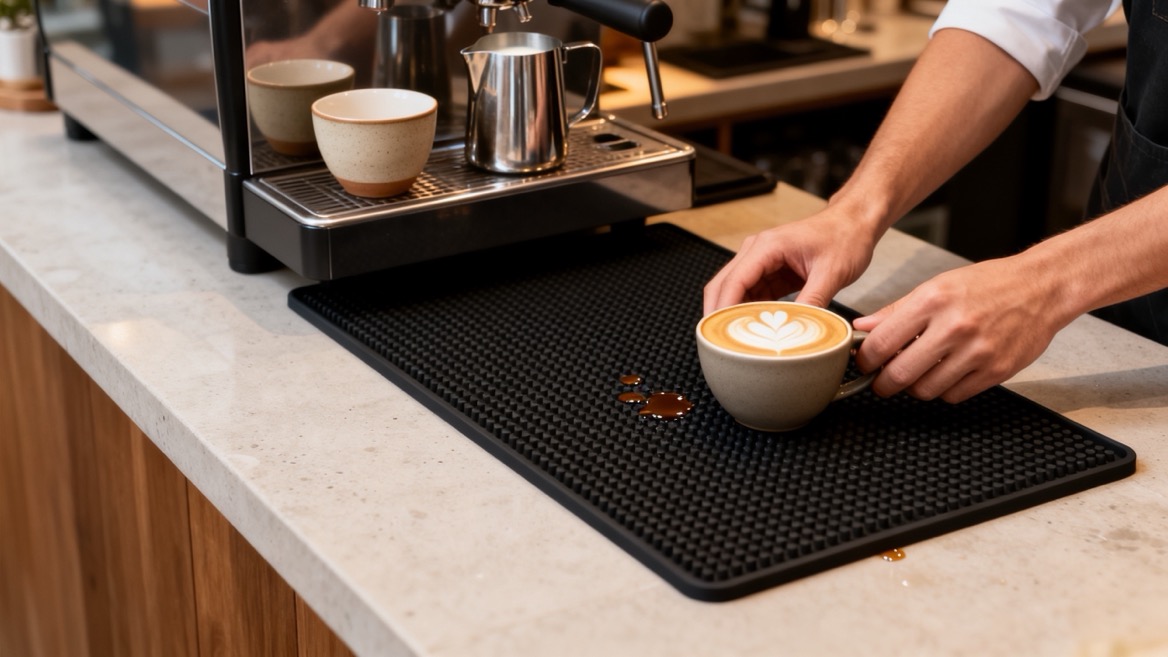
A coffee shop contains several work zones. One large mat rarely serves all of them equally well.
Before buying, identify the task you want to improve:
- Espresso preparation: Collect small drips around cups and tools without obstructing equipment.
- Milk preparation: Provide a manageable surface for pitchers and splashes.
- Beverage assembly: Support cups during syrup dispensing and drink finishing.
- Customer pickup: Create an orderly presentation area with visible branding.
- Cup drying: Keep eligible items elevated while allowing staff to inspect and clean underneath.
A countertop bar mat is different from a floor mat. It should not be presented as an anti-fatigue solution or a substitute for floor spill management.
Likewise, a bar mat is not automatically a tamping mat. Espresso tamping applies concentrated force, so that task may require a dedicated accessory designed for the pressure and portafilter geometry.
Material names alone do not establish performance. Formulation, thickness, geometry, and manufacturing quality all affect the finished product.
| Material | Potential advantage | What to verify | Suitable buying priority |
|---|---|---|---|
| Soft PVC | Flexible construction and molded branding options | Heat limits, cleaning compatibility, formulation, and odor | Customized countertop branding |
| Silicone | A possible option where higher temperature tolerance is required | Product-specific temperature rating and dishwasher instructions | Verified thermal performance |
| Rubber | A possible option for grip-focused applications | Compound, staining, odor, and cleaning requirements | Stable positioning |
| Absorbent fabric | Can take up small surface spills | Saturation, drying time, laundering, and stain removal | Light-duty coffee stations |
For a branded beverage counter, a custom PVC bar mat deserves consideration. However, it should not be selected for hot equipment placement without relevant supporting specifications.
Compatibility matters more than a broad "heat-resistant" claim. Ask what temperature was tested, for how long, and under what conditions.
Measure the usable counter space rather than the total countertop.
Account for machine feet, drains, knock boxes, pitcher rinsers, cables, and the path staff use to move cups.
A simple planning process works well:
1. Measure the available length and depth.
2. Mark nearby fixtures and cleaning access points.
3. Create a paper template of the proposed mat.
4. Rehearse normal drink preparation.
5. Confirm that staff can lift and remove the mat easily.
For example, a narrow mat beside a pitcher rinser may be more practical than a larger mat extending beneath equipment. This is a planning illustration, not a reported customer result.
The best coffee counter mat should fit the task without creating extra obstacles.
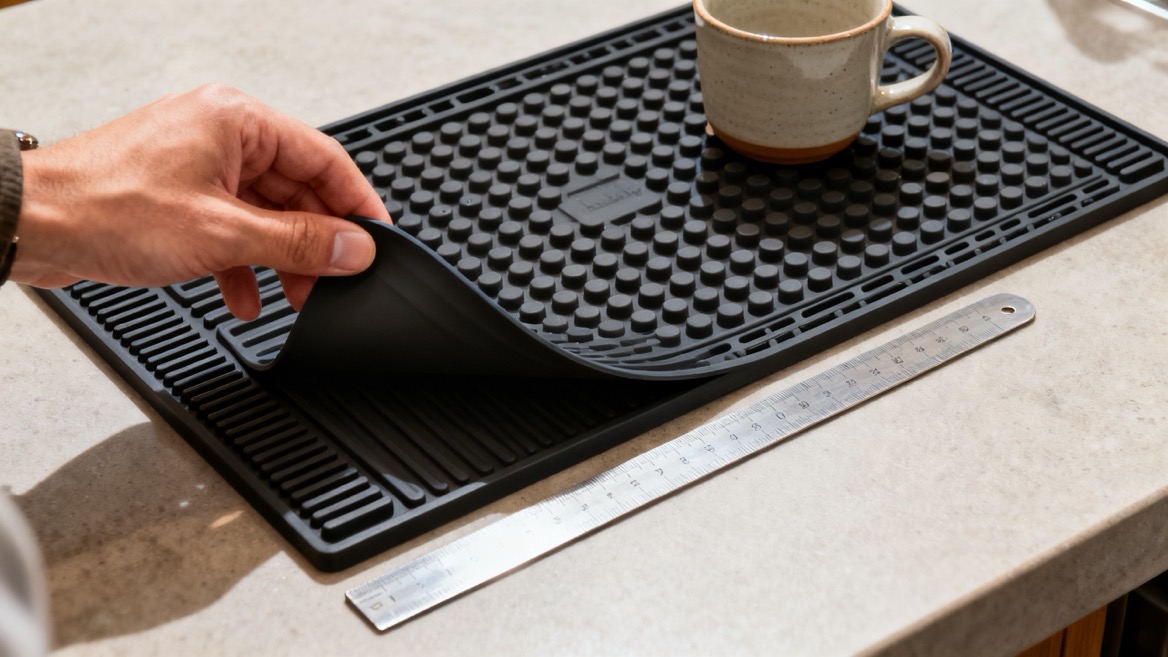
Raised ribs or nubs can separate cups from small amounts of collected liquid. However, the spaces between them must remain accessible for cleaning.
Inspect the following details:
- Whether cups stand securely on the raised pattern.
- Whether channels are accessible with the intended cleaning tools.
- Whether the perimeter contains small spills without becoming awkward.
- Whether corners lie flat.
- Whether decorative areas trap residue.
- Whether the mat can be lifted without spilling collected liquid.
Balance is essential. A visually elaborate surface is not necessarily the most practical surface for a busy café.
Also distinguish spill containment from drainage. Unless liquid has an outlet, it remains in the mat until staff remove it.
Product photographs cannot establish how a mat behaves on your counter. Request a production-representative sample before approving a bulk order.
Use the same workstation, cups, cleaning products, and procedures that your team normally uses.
| Test | Practical method | Approval question |
|---|---|---|
| Fit | Place the sample in its intended position | Does it obstruct equipment or movement? |
| Cup stability | Position the cups used during service | Do cups sit securely without rocking? |
| Surface grip | Check positioning during normal handling | Does the mat shift unexpectedly? |
| Spill handling | Introduce a measured amount of water | Can staff lift and empty it predictably? |
| Cleaning | Follow the proposed care procedure | Can residue be removed from all areas? |
| Appearance | Inspect after repeated approved cleaning | Are there visible changes in shape or color? |
| Branding | Review under actual counter lighting | Is the logo legible at its intended viewing distance? |
These checks are purchasing evaluations, not substitutes for laboratory testing.
Agree on acceptance criteria before testing. "Good quality" is too vague to guide a production decision.
A useful operational trial should include both busy and quiet periods. A single showroom demonstration may miss the cleaning burden created during repeated service.
Ask baristas to record specific observations:
- Where liquid accumulates.
- Whether frequently used cups remain stable.
- Whether staff move the mat aside.
- How easily the underside can be cleaned.
- Whether the design interferes with familiar movements.
- Whether the logo remains visible during normal use.
Feedback should describe a task, not just a preference. "The pitcher catches the raised border" is more useful than "I do not like the shape."
If genuine customer reviews become available, evaluate them the same way. Look for identifiable product versions, usage conditions, and specific observations rather than treating star ratings as technical evidence.
The cheapest quotation may not represent the lowest operating cost.
Compare purchase price alongside freight, tooling, cleaning labor, expected replacement needs, and the consequences of ordering the wrong dimensions.
A practical framework is:
Ownership cost = purchase cost + allocated tooling + delivery + cleaning labor + replacements.
For an illustrative comparison, imagine two samples with similar purchasing costs. One requires noticeably longer cleaning after every service period. That difference deserves attention even if the slower-cleaning option looks more impressive.
Do not assign either sample a lifespan without evidence. Use documented trial results and clearly stated assumptions when estimating replacement costs.
A waterproof material does not make a bar mat self-cleaning. Coffee residue, milk, syrup, and moisture can collect on the surface or beneath it.
The FDA Food Code distinguishes food-contact surfaces from nonfood-contact surfaces. For nonfood-contact equipment surfaces, cleaning frequency must prevent soil accumulation; a single universal hourly schedule does not apply to every surface.
Local requirements and the mat's actual use determine the appropriate procedure. If it contacts exposed food or food-contact portions of utensils, additional requirements may apply.
A practical routine should include:
1. Remove cups and tools.
2. Lift the mat and empty collected liquid.
3. Wash using a supplier-approved method.
4. Clean channels, corners, and the underside.
5. Rinse and apply any required, compatible sanitizing procedure.
6. Allow appropriate drying before returning the mat.
7. Clean and dry the counter underneath.
Instructions should identify compatible chemicals, water temperatures, and cleaning methods.
Do not assume that every PVC bar mat is dishwasher-safe. Machine temperature, detergents, and cycle conditions require product-specific confirmation.
Buyers should understand what each document actually demonstrates.
RoHS restricts certain hazardous substances in electrical and electronic equipment. A material test against RoHS substance limits may provide useful chemical information, but it does not automatically establish that a nonelectrical bar mat is approved for food contact.
California Proposition 65 addresses warnings about exposure to listed chemicals. It is not a universal product safety certification, and warning decisions depend on relevant exposure considerations.
Disney FAMA means Facility and Merchandise Authorization. It concerns authorization connected with Disney-branded production, not certification of a bar mat's thermal performance or food-contact suitability.
Evidence should match the intended application.
Request documents identifying the tested material or finished product, issuing organization, test date, methods, results, and limitations. Confirm that they apply to the formulation and production configuration you intend to purchase.
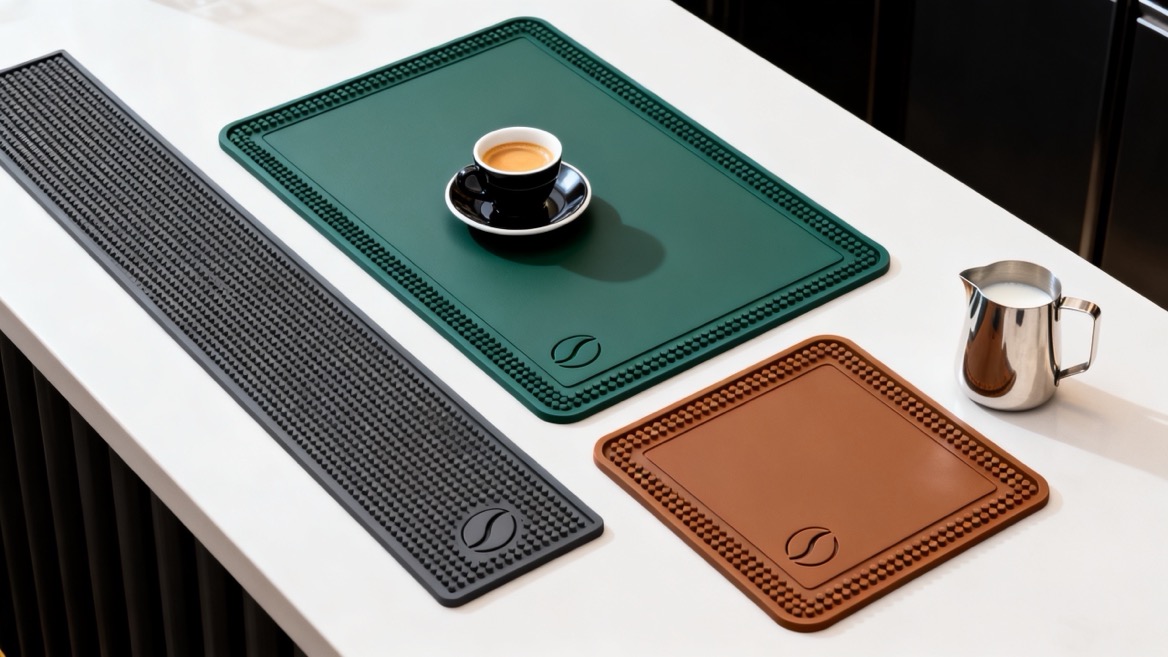
Custom coffee shop bar mats can support a recognizable counter presentation. Branding should nevertheless remain secondary to stable cup placement and accessible cleaning.
Your design brief should define:
- Finished dimensions and permitted tolerances.
- Base color and approved color references.
- Logo position and viewing orientation.
- Raised or recessed artwork.
- Border and surface pattern.
- Areas that must remain unobstructed.
- Packaging and labeling requirements.
Place prominent artwork where customers can see it, rather than beneath equipment or in a permanently occupied cup position.
Ask for a physical sample. Screen artwork cannot fully communicate texture, relief height, color appearance, or how the finished design interacts with cups.
For an existing design, an OEM brief should describe exactly what must be reproduced.
For a new concept, an ODM brief should explain the operating problem and allow the manufacturer to propose a workable configuration.
Include the intended market, countertop layout, expected use, cleaning procedure, order quantity, and any relevant testing requirements.
Also clarify commercial details before approval:
- Minimum order quantity.
- Sample and tooling charges.
- Tooling ownership and storage arrangements.
- Production timing.
- Inspection criteria.
- Freight assumptions.
- Defect handling and replacement terms.
A signed sample should become the agreed reference for production. Any subsequent material or design change should trigger a documented review.
Yijia Plastic Products Co., Ltd. brings 18 years of experience in the research, development, production, and sales of PVC bar mats and other soft PVC gifts.
Our manufacturing resources include a 3,000-square-meter factory, 10 automated production lines, and multiple advanced dispensing machines. We provide one-stop OEM/ODM customization for international buyers.
Our company background includes cooperation experience involving Starbucks, Disney, McDonald's, Pop Mart, and Tencent. Individual project scopes, disclosure permissions, and supporting records should be confirmed when relevant to procurement.
We also report documentation relating to EU RoHS, California Proposition 65, and Disney FAMA. Buyers should request current records and review their scope rather than assuming that every document covers every product.
Start with your counter dimensions, logo artwork, target quantity, destination market, and cleaning requirements. Ask Yijia for a proposed PVC bar mat specification, sample plan, relevant documentation, and quotation before committing to production.
The best option fits your workstation, supports stable cup placement, and can be cleaned using your approved routine. Compare samples against those requirements before prioritizing price or decoration.
PVC can be considered for customized countertop mats. Suitability depends on the formulation, design, cleaning requirements, temperature exposure, and intended contact conditions. Confirm these details for the specific product.
Only when the equipment manufacturer and mat specifications permit it. A mat must not obstruct ventilation, drainage, machine stability, or service access. Placement beside equipment may be more appropriate than underneath it.
Clean frequently enough to prevent residue accumulation, and respond promptly to contamination or spills. Build the schedule around actual use, applicable local requirements, and the supplier's care instructions.
Not automatically. Request written confirmation for the exact mat and dishwasher conditions. Without that confirmation, use an approved alternative cleaning method.
Yes, subject to the manufacturer's design capabilities and your rights to use the artwork. Confirm colors, dimensions, logo placement, surface relief, and packaging through sample approval.
Request applicable chemical test reports, care instructions, relevant contact-suitability documentation, and authorization records where needed. Check that each document matches the product, material, intended market, and claim being made.
1. FDA. [Food Code 2022 — Full Document]. See Sections 4-601.11 and 4-602.13 for nonfood-contact surface cleanliness and cleaning frequency. This is a model code; applicable local requirements should be checked. [fda]
2. European Commission. [RoHS Directive]. Explains the directive's electrical and electronic equipment scope and its restrictions on ten substances. Supports the distinction between chemical testing and application-specific product suitability. [environment.ec.europa]
3. California OEHHA. [Frequently Asked Questions — Proposition 65]. Explains the exposure-warning framework and clarifies that a warning does not necessarily mean a product violates safety or health standards. [p65warnings.ca]
4. California OEHHA. [Frequently Asked Questions for Businesses]. Explains businesses' responsibilities for determining warning requirements and distinguishes chemical presence from relevant exposure. [p65warnings.ca]
5. The Walt Disney Company. [Facility and Merchandise Authorization Application]. Defines FAMA and describes facility authorization requirements for Disney-branded production. [thewaltdisneycompany]
6. Disney Impact. [Country-Specific Submission Requirements Supplement]. Describes requirements for obtaining and maintaining facility authorization in specified countries and regions. [impact.disney]
7. Yijia Plastic Products Co., Ltd. Company information supplied for this article: manufacturing history, factory area, production lines, equipment, OEM/ODM services, reported compliance documentation, and cooperation experience. No company source page or supporting records were supplied, so no company hyperlink has been invented. These claims require internal verification before publication.[https://www.yijiabar.com/]


