
Views: 298 Author: Yijia Plastic Publish Time: 2026-11-12 Origin: Site


Content Menu
● PVC Bar Mat vs. Fabric Mat: The Main Differences
● How PVC Bar Mats and Fabric Mats Handle Liquid
>> PVC Bar Mats Contain Rather Than Absorb
>> Fabric Mats Absorb Liquid but Eventually Saturate
● Which Mat Better Reduces Liquid Accumulation?
>> For Busy Cocktail Stations: PVC Usually Fits the Workflow
>> For Light-Drip Service Areas: Fabric Can Be Appropriate
● Hygiene: Cleaning Access Matters More Than Material Claims
● A Practical Spill Test Before Bulk Purchasing
>> Test Under Comparable Conditions
>> Define Failure Before Testing
● Design Details That Influence Real-World Performance
>> Prong Spacing, Rim Shape, and Logo Placement
>> Backing and Counter Compatibility
● Compare Operating Cost, Not Only Purchase Price
● Custom PVC Bar Mats: A Manufacturer's Perspective
● Choose a Mat Around Your Actual Spill Pattern
>> Is a PVC bar mat better than a fabric mat for repeated spills?
>> Does a PVC bar mat absorb water?
>> Can fabric bar mats keep counters dry?
>> Are PVC bar mats dishwasher-safe?
>> How often should a bar mat be cleaned?
>> Can one mat type serve every part of a bar?
APVC bar matgenerally suits busy drink-preparation stations better than a fabric mat when the priority is controlling repeated spills and keeping glass bases above collected liquid. A fabric mat is useful for absorbing small drips, especially in lower-volume service areas. However, neither removes liquid automatically: PVC needs emptying, while fabric needs changing and laundering.
At Yijia Plastic Products Co., Ltd., our manufacturing perspective starts with one question: where will the spilled liquid go? That matters more than appearance alone. This guide compares PVC bar mats and fabric bar runners for countertop use behind the counter—not floor mats—and explains how to choose, test, and maintain each option.
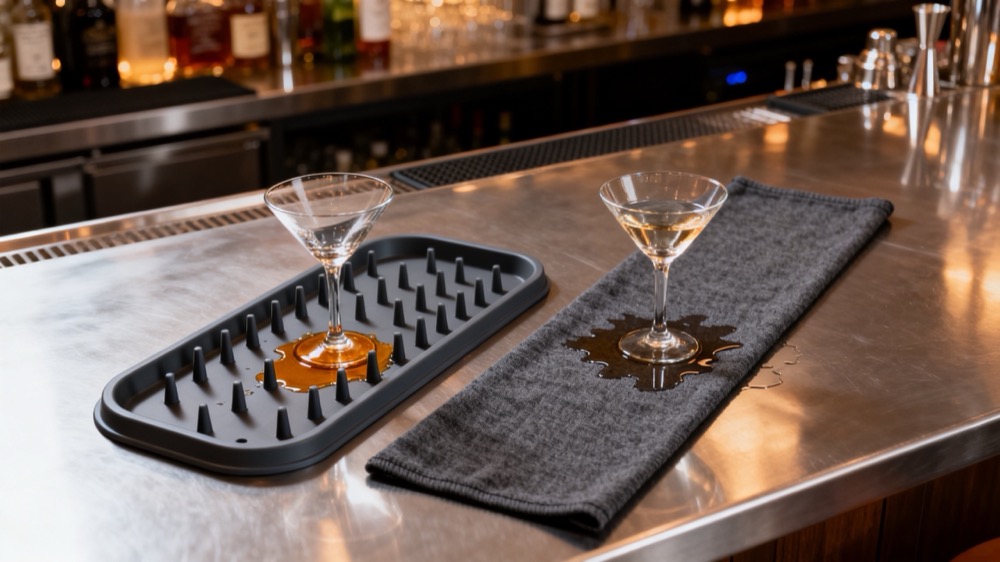
For this comparison, a PVC bar mat means a molded soft-PVC mat with raised prongs or ribs and a liquid-collection base. A fabric mat means an absorbent textile runner, often with a rubber backing. Construction varies, so buyers should compare actual samples rather than material names alone.
| Comparison point | PVC bar mat | Fabric mat |
|---|---|---|
| Liquid management | Collects spills between raised features | Absorbs liquid into textile fibers |
| Glass support | Raises glass bases above the collection base | Holds glasses against a comparatively flat textile surface |
| Capacity limit | Liquid reaches the rim or glass-support level | Fabric becomes saturated |
| Service reset | Empty, clean, rinse, and dry | Replace with a clean runner; launder the used one |
| Cleaning challenge | Residue around prongs and corners | Residue within fibers and backing interfaces |
| Branding | Molded colors and dimensional logos | Detailed printed graphics |
| Typical application | Cocktail preparation and frequent spills | Light condensation and presentation areas |
These are construction-based differences, not proof that every PVC mat outperforms every fabric runner.
A molded PVC bar mat manages spills through its shape. Liquid collects around the raised features while glassware rests above the base.
This distinction is important: a mat without a drain connection is a collection tray, not an active drainage system. Staff must empty it before liquid rises high enough to wet glass bases or overflow.
From a manufacturing standpoint, usable capacity depends on:
- Internal collection area.
- Rim height and lowest overflow point.
- Space occupied by prongs and decorative features.
- How level the counter is.
- Whether staff can lift the mat without spilling.
A thick-looking mat does not necessarily hold more usable liquid than a thinner, better-designed alternative.
Fabric bar runners take up drips within their textile surface. Commercial examples include knitted polyester tops with nitrile-rubber backing.
This can work well for occasional condensation or small serving spills. However, absorption does not remove water from the workstation; it temporarily stores it.
Once a runner becomes saturated, additional liquid may remain on top, spread toward its edges, or transfer to glass bases. Backing can help protect the counter, but its effectiveness depends on construction, condition, and whether liquid reaches underneath.
The practical question is not simply "Does it absorb?" It is "How long can it remain useful before replacement?"
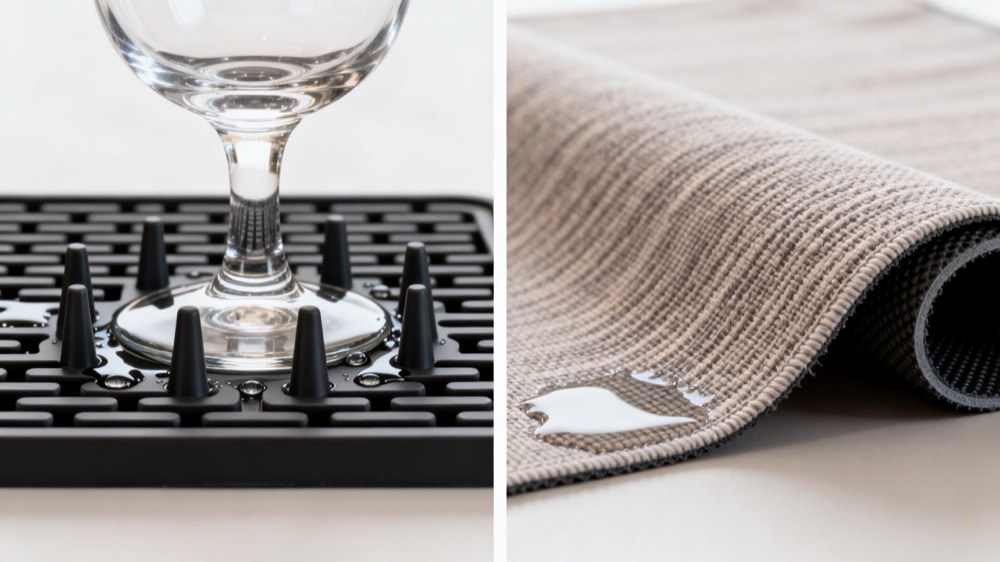
Where bartenders repeatedly handle shakers, wet tools, and dripping bottles, a raised PVC bar mat offers a useful combination: visible collection space and an emptying-based reset.
Its advantage is operational rather than automatic. Staff can inspect collected liquid and remove it without waiting for a saturated textile runner to be laundered.
However, narrow grooves, oversized logos, and difficult-to-reach corners can complicate cleaning. We would prioritize accessible geometry over decorative complexity in a high-spill work zone.
An absorbent fabric bar mat can suit a quieter serving point where presentation matters and spills are limited.
A venue with reliable laundry arrangements and enough replacement runners may find this practical. Conversely, a fabric mat becomes less convenient when staff leave it in place after saturation because no clean replacement is available.
A mixed approach often makes sense: use molded collection mats in preparation areas and fabric runners in lighter-duty presentation zones.
Neither material should be described as inherently antibacterial without relevant evidence. A nonabsorbent surface can still carry beverage residue, and an absorbent surface is not automatically unhygienic.
Use the product's validated care instructions and the venue's sanitation procedure:
1. Remove glassware and empty collected liquid safely.
2. Wash with a compatible detergent.
3. Brush between prongs, around logos, and along the rim.
4. Rinse thoroughly.
5. Sanitize where required, using a compatible product and its specified procedure.
6. Allow adequate draining or air-drying before reuse.
7. Clean and dry the counter underneath.
Do not assume all PVC bar mats tolerate commercial dishwashers, boiling water, or concentrated cleaning chemicals.
Remove saturated or visibly soiled runners promptly. Launder according to the manufacturer's instructions, dry as directed, and keep clean replacements protected from contamination.
Care requirements are product-specific. For example, one commercial knitted-polyester and nitrile-backed runner specifies washing below 30°C. That is not a universal temperature limit.
Also distinguish bar runners from wiping cloths. The FDA Food Code contains specific wiping-cloth requirements, but those provisions should not automatically be applied to every stationary textile mat. Local requirements and intended use matter.
A controlled sample comparison provides more useful purchasing evidence than unsupported claims about superior absorption or drainage.
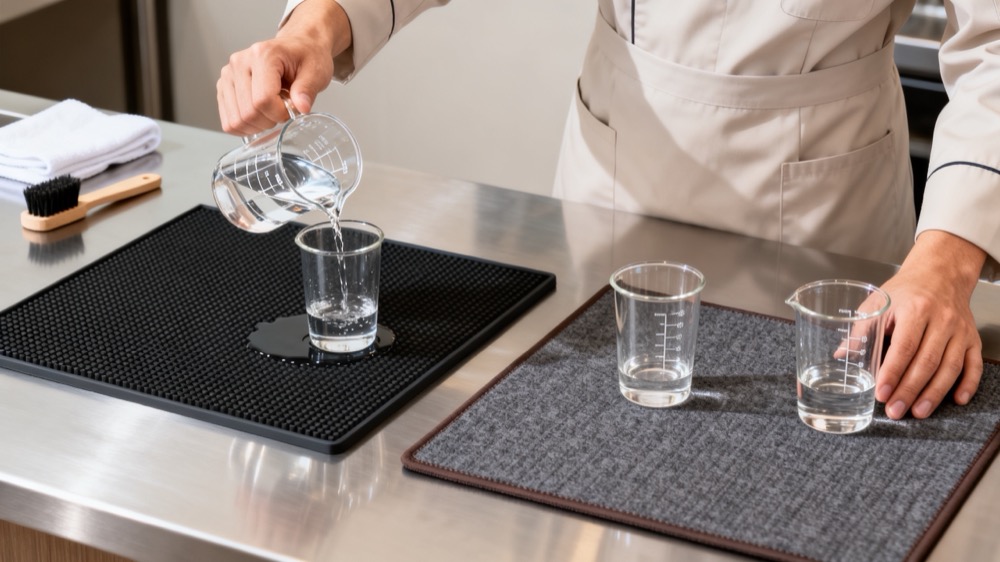
Use equal-sized samples, the same counter, and the same liquid temperature. Begin with clean, dry mats.
Then:
1. Add measured amounts of water at consistent intervals.
2. Record when glass bases first contact liquid.
3. Record when liquid reaches the counter or overflows.
4. Measure removal, cleaning, and drying time separately.
5. Repeat with representative drinks, including a sugary beverage.
6. Inspect the underside and counter after each trial.
Record both volume and time. A mat may contain more liquid yet take longer to clean.
Useful failure points include:
- Wet glass bases.
- Overflow beyond the mat.
- Liquid underneath the backing.
- Movement during normal handling.
- Residue remaining after the agreed cleaning process.
This is an operational screening method, not a microbiological safety test. Repeat it after several cleaning cycles to check for curling, cracking, backing separation, or other changes.
For custom PVC bar mats, spill management should guide the design.
Closely spaced prongs may create cleaning challenges. A large raised logo may displace collection space or affect how glassware sits. A low rim may overflow sooner than expected.
Ask your supplier to review:
- Collection space around the logo.
- Stable support for common glass sizes.
- Access for cleaning brushes.
- Corner and rim geometry.
- Safe lifting and emptying.
The best design balances branding, glass support, and cleaning access rather than maximizing any single feature.
A "non-slip" description does not guarantee stability on every surface. Test the mat on the actual countertop, both clean and under realistic damp conditions.
Inspect for movement, trapped moisture, surface marking, and edge lifting. Neither countertop mat should be treated as a substitute for managing spills on the floor.
There is no defensible universal lifespan or cost advantage for either category without product-specific testing.
A useful purchasing model is:
Total operating cost = purchase and replacement costs + cleaning labor + laundry expenses + spare inventory.
For PVC mats, record time spent emptying, brushing, rinsing, and drying. For fabric runners, include replacement frequency, laundering, and the number needed while others are being cleaned.
A lower purchase price may not produce lower operating cost. Equally, a premium molded mat may offer little benefit in a lightly used area.
Run the comparison over several representative shifts before committing to a venue-wide order.
Yijia Plastic Products Co., Ltd. combines research, development, production, and sales of PVC bar mats and other soft-PVC promotional products.
Our company-provided background includes 18 years of experience, a 3,000-square-meter factory, 10 automated production lines, advanced dispensing equipment, and one-stop OEM/ODM customization.
We also report project experience involving Starbucks, Disney, McDonald's, Pop Mart, and Tencent. Such experience is company background—not an endorsement of every product or permission to reproduce protected branding.
For procurement, documentation should match the product and intended market. RoHS-related reports, Proposition 65 assessments, and Disney FAMA documentation serve different purposes. They should not be presented as interchangeable food-contact approvals.
Request current documents with a clear product scope. Proposition 65 concerns chemical exposure and warning obligations; it is not a blanket product-safety certification.
For frequent spills behind the counter, prioritize accessible collection space, stable glass support, and straightforward cleaning. For light drips, consider absorbency alongside replacement and laundry arrangements.
Send Yijia your counter dimensions, typical drinks, cleaning procedure, artwork, and destination market. Request an OEM/ODM sample and relevant documentation, then validate spill performance before approving bulk production.
Usually, a raised PVC collection mat is more practical for repeated spills because staff can empty it. The advantage depends on usable capacity, cleaning access, and timely maintenance.
A conventional molded PVC bar mat contains water between its raised features rather than absorbing it like textile fibers. Collected liquid must be removed.
They can absorb small spills and may include protective backing. However, saturation, damaged backing, or liquid entering underneath can compromise that protection.
Not universally. Use a dishwasher only when the specific product's care instructions permit the machine, temperature, detergent, and cycle involved.
Base the schedule on use, visible soil, spill volume, manufacturer instructions, and applicable hygiene requirements. Empty or replace overloaded mats during service rather than waiting until closing.
It can, but zoning is often more practical. Heavy-spill preparation stations and lightly used presentation areas have different liquid-management and branding needs.
- U.S. Food and Drug Administration. *Food Code 2022*. Relevant provisions include wiping-cloth use, laundering, and equipment air-drying. The Code is a model for jurisdictional adoption; local requirements should be checked. [fda]
- Purple Mustard. *Premium Bar & Counter Mats—Product Details*. Commercial example documenting knitted-polyester construction, nitrile backing, absorbency, and product-specific washing instructions. [purplemustard]
- Lettosigns. *PVC Bar Runner | Custom Logo Spill Pad for Pubs and Bars*. Commercial example of raised-nub PVC construction and collection grooves. Its broader hygiene and cleaning claims are not treated here as universal material properties. [logomat-lettosigns]
- California Office of Environmental Health Hazard Assessment. *Frequently Asked Questions—Proposition 65 Warnings Website*. Explains exposure-based warning obligations and why a warning is not a product-safety determination. [p65warnings.ca]


