
Views: 236 Author: Yijia Plastic Publish Time: 2026-09-01 Origin: Site
Content Menu
● Quick Answer: PVC or Rubber for Busy Bar Spill Control?
● PVC Bar Mat vs. Rubber Bar Mat: Side-by-Side Comparison
● How Spill Containment Actually Works Behind a Bar
>> Why Raised Patterns Matter More Than a Flat Surface
● PVC Bar Mat Advantages for Customer-Facing Service Areas
>> 1. Better Branding Without Sacrificing Function
>> 2. Flexible OEM and ODM Customization
>> 3. Controlled Surface Engineering
● When a Rubber Bar Mat May Be the Better Choice
>> Heavy-Duty Grip in Utility Areas
>> Potential Limitations of Rubber Bar Mats
● Busy-Bar Test: What Happens During Peak Service?
>> A Practical Spill-Containment Scenario
● Cleaning, Hygiene, and Daily Maintenance
>> Recommended Daily Cleaning Routine
>> Design Advice for Easier Cleaning
● Choosing the Right Material by Application
● Expert Buying Checklist for Custom Bar Mats
● Which Bar Mat Contains Spills Better?
● Create Your Custom PVC Bar Mat
● FAQs
>> 1. Are PVC bar mats good for spill containment?
>> 2. Is rubber more slip-resistant than PVC?
>> 3. Can a PVC bar mat be customized with a logo?
>> 4. How should bar mats be cleaned?
>> 5. What size PVC bar mat is best for a cocktail station?
>> 6. Do PVC bar mats work for coffee shops as well as bars?
>> 7. What should buyers check before ordering custom bar mats?
When a bartender is making drinks continuously during a packed shift, spill containment is not a minor detail. It directly affects service speed, counter cleanliness, glass stability, staff safety, and brand presentation. The practical question is therefore not simply whether to use a bar mat, but whether a PVC bar mat or rubber bar mat offers the better balance of liquid control, durability, cleaning efficiency, and custom branding.
For many commercial bars, restaurants, cafés, hotels, event venues, and beverage brands, the answer depends on the working environment. A traditional rubber bar mat is often selected for its familiar heavy-duty grip. However, a well-designed soft PVC bar mat can provide more controlled spill channels, clearer branding, flexible custom shapes, and reliable performance in high-visibility service areas. Both materials can work well—but they do not solve exactly the same operational problem.

For most branded counter-service applications, a PVC bar mat is usually the stronger choice because it can combine raised spill-retention patterns, anti-slip zones, detailed logo reproduction, easy-rinse maintenance, and custom dimensions.
For extremely rough, non-branded, back-of-house applications where maximum material thickness and basic traction are the only priorities, a heavy rubber bar mat can remain a practical option.
The best choice should be based on:
How much liquid is spilled during peak service
Whether drinks are prepared or only served on the mat
How frequently the mat is washed
Whether the mat is customer-facing
Whether a logo or promotional message is needed
How much counter space is available
Whether the bar needs standard sizes or a custom layout
Commercial bar mats are commonly used to catch drips, protect countertops, help stabilize glassware, and simplify cleanup after service.
| Comparison Factor | PVC Bar Mat | Rubber Bar Mat |
|---|---|---|
| Spill containment | Strong when designed with raised borders, drainage channels, and recessed wells | Strong, particularly with deep molded nubs or grid patterns |
| Surface texture | Can be customized with dots, ribs, channels, logos, and different relief heights | Usually molded with standard nubs, grids, or honeycomb structures |
| Grip for glassware | Good when designed with anti-slip PVC textures | Often excellent because rubber naturally provides high friction |
| Branding quality | Excellent for 2D or 3D logos, color matching, and promotional graphics | More limited, especially for colorful or highly detailed logos |
| Custom shapes | Highly flexible for custom contours, sizes, and promotional designs | Possible, but tooling and design options may be more restrictive |
| Cleaning | Usually easy to rinse, wipe, or wash because of its smooth molded structure | Easy to rinse, but deep rubber texture can retain sticky residue if not cleaned thoroughly |
| Odor resistance | Depends on PVC formulation and cleaning routine; quality materials are important | Some rubber products may develop odors over time, especially in humid environments |
| Visual presentation | Strong choice for customer-facing bars and brand campaigns | Better suited to functional, utility-focused environments |
| Cost structure | Competitive for customized promotional and OEM projects | Often economical for standard, non-custom commercial mats |
| Long-term use | Performs well when material hardness, thickness, and structure are properly engineered | Known for heavy-duty traction and rugged use |
The material alone does not determine performance. Geometry matters just as much as material. A thin mat with shallow texture may fail to contain drips regardless of whether it is PVC or rubber. In contrast, a properly engineered PVC bar mat with raised edges and liquid channels can keep spills localized and make end-of-shift cleaning faster.
A bar mat does not absorb a large beverage spill like a towel. Instead, it is designed to hold liquid temporarily, separate glassware from pooled moisture, and prevent drips from spreading across the countertop or reaching the floor.
The most effective spill-containment design usually combines four features:
Raised perimeter edges to stop liquid from flowing off the mat immediately
Recessed collection zones to retain water, foam, condensation, syrup, and cocktail drips
Raised contact points that keep glass bases slightly above pooled liquid
Anti-slip backing or surface texture to reduce movement during busy service
This is why bar operators should avoid choosing a mat based only on material name. A “PVC bar mat” can be designed in many ways. So can a rubber bar mat. The relevant question is: How much liquid can the specific structure control before it overflows or becomes difficult to clean?
Bar-mat suppliers commonly position these products as tools for containing spills, protecting counters, reducing cleanup time, and lifting accumulated liquid for disposal.
A flat protective sheet may prevent scratches, but it has limited spill-management value. Once condensation or a drink spill lands on a flat mat, the liquid can spread quickly and leave glasses sitting in water.
A raised-dot, grid, ribbed, or channelled PVC bar mat creates small spaces below the glass. These spaces serve several practical purposes:
They retain liquid below the glass base
They improve airflow around wet glassware
They reduce direct contact between the counter and drink containers
They help bartenders identify and wipe concentrated spill areas
They create a more stable resting surface for glasses and tools
For a busy bar, this separation is valuable. A bartender can place a freshly rinsed shaker, glass, bottle, or jigger on the mat without immediately transferring water across the full countertop.
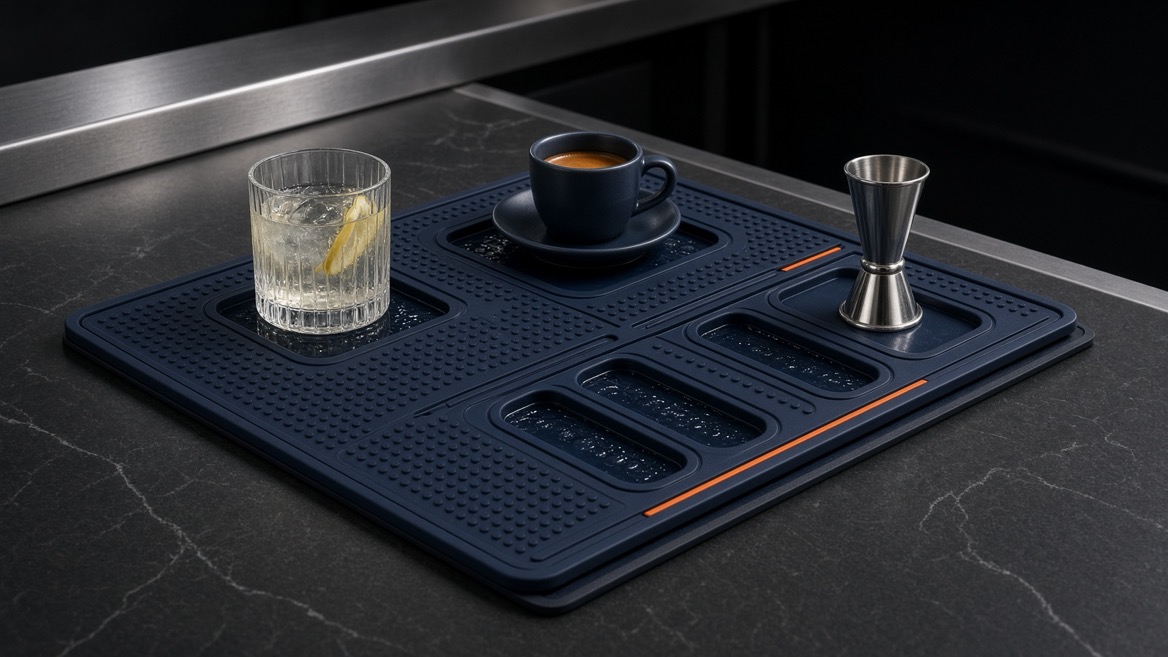
PVC bar mats are widely used for branded beverage promotions, hospitality counters, gift programs, retail displays, and restaurant service stations because they can be both functional and visually distinctive.
A custom PVC bar mat can include a raised or recessed logo while still preserving functional channels around the branded area. This makes it possible to turn a routine counter accessory into a consistent brand touchpoint.
For beverage brands, cafés, breweries, restaurants, and promotional campaigns, a mat can display:
A logo
A slogan
A product illustration
A mascot
A campaign message
A limited-edition visual identity
Brand colors matched to packaging or store design
This matters because a bar mat sits directly in the bartender’s workspace and often remains visible to customers. It can reinforce a brand at the exact moment a drink is being served.
For companies that need both spill containment and promotional value, PVC often offers more design freedom than a standard black rubber bar mat.
A custom PVC bar mat does not need to be rectangular. It can be produced in shapes that fit unusual counters, bottle displays, coffee stations, gaming promotions, themed events, and retail beverage zones.
Common customization options include:
Custom length and width
Round, oval, square, shield, bottle, or character-shaped designs
2D and 3D logo effects
Multi-color PVC dispensing
Raised lettering
Recessed liquid-retention areas
Different texture zones for bottles, glasses, or tools
Custom packaging for corporate gifts or retail sales
This flexibility is useful when a business wants a product that performs behind the bar but also supports a wider merchandising or promotional program.
With PVC dispensing and molding processes, manufacturers can engineer different heights across one mat. For example, the outer edge can be raised, while the center includes lower drainage pockets and the logo remains visible above the liquid-control area.
This is especially useful for a bar mat intended for:
Cocktail preparation stations
Coffee counters
Beer-tap zones
Hotel lounge bars
Festival beverage booths
Restaurant pass-through counters
Retail product displays
A good design should prevent the logo from becoming the lowest point where sticky liquid accumulates. Instead, the design should direct liquid away from the key visual area and into functional recessed zones.
Rubber bar mats remain popular for legitimate reasons. In high-abuse settings, thick rubber can provide excellent grip and withstand repeated handling.
Rubber tends to offer naturally high friction. This can make it useful in environments where glassware, metal bar tools, and wet containers are constantly moved across the surface.
A rubber bar mat can be a sensible choice for:
High-volume nightclubs
Back-bar washing areas
Utility counters
Dish stations
Brewery work zones
Non-customer-facing prep areas
Bars that prioritize standard replacement mats over custom branding
Commercial suppliers frequently describe rubber bar mats as durable, slip-resistant, and suitable for high-traffic areas where spills are common.
The strengths of rubber do not automatically make it the best material for every commercial buyer. Depending on formulation, thickness, and storage conditions, rubber may present several challenges:
Stronger material odor in some products
Less refined color reproduction for logos
Fewer options for intricate multi-color promotional graphics
Greater visual heaviness in premium or design-led venues
Textured pockets that require thorough cleaning
Potential degradation from harsh chemical exposure or prolonged sunlight
These concerns are not universal. Quality rubber mats can perform very well. However, for a brand-conscious venue, the decision should consider both operational function and visual experience.
To evaluate a PVC bar mat vs. rubber bar mat properly, imagine a Friday evening during peak service.
A bartender is preparing cocktails, pouring beer, handling condensation-heavy glasses, opening bottles, and moving tools rapidly. The mat is exposed to soda, citrus juice, syrup, alcohol, water, foam, and occasional broken garnish.
The best mat should do five things:
Keep liquid in a defined area rather than allowing it to travel toward the customer side or floor edge.
Maintain grip when glasses are placed quickly.
Stay in position when wiped, bumped, or exposed to moisture.
Allow rapid removal and cleaning between shifts.
Look professional even after repeated use.
Consider a 600 mm × 100 mm bar mat used beneath a line of prepared drinks. If several glasses develop condensation and one cocktail spills during service, a well-designed raised PVC mat can retain moisture inside its recessed sections while keeping glass bases elevated.
A rubber mat with deep nubs may provide similarly strong liquid retention and grip. However, if the area is visible to guests, the PVC version may offer a more polished branded presentation while still managing the spill.
The deciding factor is not whether PVC can contain spills. It can. The deciding factor is whether the PVC mat has adequate thickness, edge height, channel depth, anti-slip texture, and material quality for the venue’s service volume.
Spill containment only works if the mat is cleaned consistently. Sugar, dairy residue, fruit juice, beer foam, cocktail syrup, and sticky soft drinks can build up in recessed areas over time.
Food-service guidance emphasizes that mats and duckboards should be designed to be removable and easily cleanable.
Remove the PVC or rubber bar mat after the final service period.
Shake or rinse off loose debris, citrus pieces, paper fragments, and bottle-cap residue.
Wash the mat with warm water and an appropriate mild detergent.
Use a soft brush on raised patterns, drainage channels, and logo recesses.
Rinse thoroughly so detergent does not leave a slippery film.
Sanitize according to the venue’s approved cleaning procedures.
Air-dry fully before placing the mat back on the counter.
Regular cleaning is important for both PVC and rubber mats because residue can affect grip, appearance, and odor. Guidance for commercial rubber bar mats similarly recommends daily rinsing, regular sanitizing, drying, and periodic deep cleaning.
When ordering a custom bar mat, ask the manufacturer about:
Raised edge height
Drainage-pocket depth
Texture spacing
Whether the logo has hard-to-clean fine grooves
Material hardness
Resistance to common beverage stains
Recommended cleaning chemicals
Dishwasher suitability, if relevant
Packaging that prevents deformation during transit
A design that looks impressive but has extremely narrow channels may trap residue. In practice, a slightly simpler texture with wider cleaning access often delivers better long-term results.
| Application | Recommended Choice | Why |
|---|---|---|
| Premium cocktail bar | Custom PVC bar mat | Combines spill containment, refined appearance, and branding |
| Restaurant beverage station | PVC or rubber | Choose based on branding needs and expected spill volume |
| Nightclub service well | Heavy rubber or thick PVC design | Prioritize grip, depth, and durability |
| Coffee shop counter | Custom PVC bar mat | Supports logos, drip control, and cleaner visual presentation |
| Brewery promotional campaign | PVC bar mat | Strong for branded merchandise and point-of-pour visibility |
| Back-of-house wash zone | Rubber bar mat | Functional, rugged, and often economical |
| Hotel lobby bar | Premium PVC bar mat | Better integration with high-end brand presentation |
| Corporate gift program | PVC bar mat | Greater flexibility for custom color, shape, packaging, and logo detail |
Before approving a PVC bar mat or rubber bar mat, buyers should request a clear specification sheet and sample review.
Ask these questions:
What is the final mat thickness?
How high is the outer spill-containment border?
Are there dedicated drainage channels or recessed spill wells?
Does the mat include anti-slip backing?
What is the material formulation?
Can the manufacturer provide compliance documentation for the intended market?
How accurate are brand colors and logo details?
Can the mat withstand repeated rinsing and cleaning?
Will the mat lie flat after shipping and long-term use?
Is the supplier experienced with OEM and ODM brand projects?
Can the supplier provide pre-production samples before mass production?
What packaging is available for retail, gifting, or promotional distribution?
For global buyers, documentation and manufacturing controls should be considered alongside visual design. Certifications such as EU RoHS, California Proposition 65, and brand-factory authorization programs can be relevant when evaluating material compliance and supplier capability for international projects.
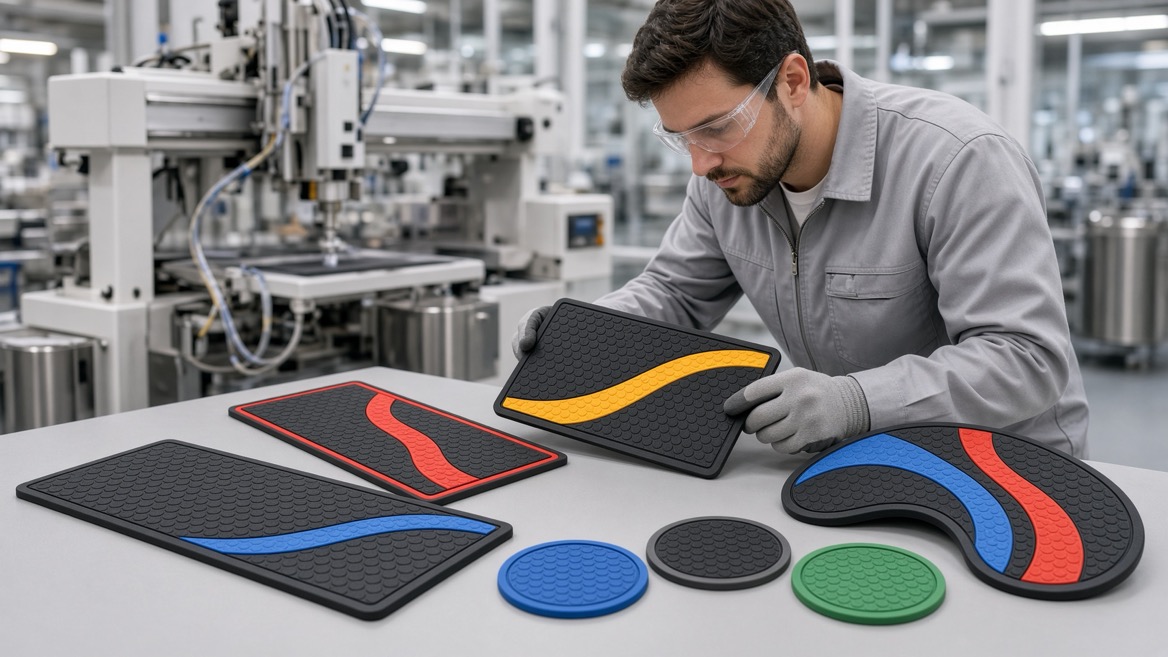
A rubber bar mat remains a reliable solution when a bar needs rugged grip, thick utility matting, and straightforward performance in demanding back-of-house conditions.
But for many modern commercial applications, a PVC bar mat provides the more versatile spill-containment solution. With the right raised structure, channel layout, thickness, and anti-slip design, it can control beverage drips effectively while offering better customization, more visible branding, and stronger suitability for customer-facing environments.
The best option for a busy bar is not simply “PVC” or “rubber.” It is a well-engineered mat designed around the actual workflow:
Where the bartender places glasses
Where condensation collects
How far liquid can travel
How often the mat is cleaned
Whether the mat is visible to customers
Whether it must carry a brand message
For brands that want functional bar protection and memorable visual impact in one product, a customized PVC bar mat is often the more strategic investment.
Yijia Plastic Products Co., Ltd. provides one-stop OEM and ODM customization for PVC bar mats and soft PVC promotional products. With 18 years of manufacturing experience, a 3,000-square-meter factory, 10 automated production lines, advanced PVC dispensing equipment, and experience supporting global brand projects, the team can help turn a spill-control requirement into a branded product solution.
Whether you need a custom PVC bar mat for a cocktail bar, coffee chain, restaurant, beverage promotion, retail campaign, corporate gift, or licensed merchandise program, start by sharing your logo, dimensions, target market, expected quantity, and preferred packaging. A suitable structure can then be developed around your spill-containment, anti-slip, cleaning, and branding requirements.
Yes. A PVC bar mat can provide effective spill containment when it includes raised borders, recessed liquid-collection areas, and a properly designed textured surface. The performance depends on the mat’s structure, thickness, edge height, and placement—not only on the PVC material itself.
Rubber often provides very strong natural friction, which is why it is widely used in high-traffic utility areas. However, a well-designed PVC bar mat with anti-slip texture and a stable backing can also provide reliable glassware stability for normal commercial bar service.
Yes. PVC bar mats are particularly suitable for custom logos, multi-color designs, raised lettering, 2D or 3D effects, special shapes, and branded packaging. This makes them a popular choice for beverage promotions, cafés, hotels, restaurants, and corporate gift programs.
Remove the mat regularly, rinse away debris, wash it with warm water and mild detergent, scrub textured areas when needed, rinse thoroughly, sanitize according to the venue’s procedures, and allow it to dry fully. Daily cleaning is especially important in high-volume beverage environments.
The best size depends on the available counter space and workflow. Common sizes include narrow runners for glass placement and larger rectangular mats for cocktail preparation. A custom size is often better when the mat must fit a specific service well, coffee counter, bottle display, or branded event station.
Yes. PVC bar mats can be used at espresso stations, milk-steaming areas, pickup counters, beverage displays, and café service zones. They can help contain water, coffee drips, milk residue, and condensation while also displaying a café logo or campaign artwork.
Buyers should confirm material quality, thickness, raised-edge design, drainage structure, anti-slip properties, logo accuracy, cleaning requirements, compliance documentation, sample approval process, lead time, and packaging options.
U.S. Food and Drug Administration. Food Code 2022.
TigerChef. Commercial Bar Mats and Bar Liners.
Rapids Wholesale. Rubber Bar Mats and Bar Spill Mats.
A Bar Above. Bar Mats: How To Choose the Right One.
Mats Inc. Bar Matting: Custom Floor, Counter and Bar Top Protection.
JIN SHEU Enterprise Co., Ltd. Custom Bar Mat and Promotional Products.
Wellux. Custom PVC Bar Mat.


