
Views: 282 Author: Yijia Plastic Publish Time: 2026-08-29 Origin: Site
Content Menu
● Quick Answer: PVC or Silicone for Commercial Bars?
>> Why PVC Bar Mats Work Well for Brand Programs
>> Why Silicone Feels More Premium
● PVC Bar Mat vs. Silicone Bar Mat: Detailed Performance Comparison
>> Heat Resistance and Temperature Exposure
>> Slip Resistance and Spill Management
>> Durability in High-Volume Service
>> Custom Logo and Visual Branding
>> Cleaning and Daily Maintenance
● Real-World Selection Guide by Venue
● Expert Buying Checklist for Custom Bar Mats
>> 1. What Is the Intended Operating Environment?
>> 2. Is the Design Built for Cleaning?
>> 3. Does the Supplier Control Color and Material Consistency?
>> 4. What Compliance Documents Are Available?
>> 5. Can the Factory Support Scale Without Sacrificing Detail?
● Why Manufacturing Method Matters
● Which Bar Mat Handles Commercial Volume Better?
● Build a Better Custom Bar Mat
● FAQ
>> 1. Are PVC bar mats suitable for commercial bars?
>> 2. Is silicone better than PVC for a bar mat?
>> 3. Can I add a custom logo to a PVC bar mat?
>> 4. Which bar mat is better for coffee shops?
>> 5. Are PVC bar mats easy to clean?
>> 6. Can PVC bar mats be used for food contact?
>> 7. What information should I provide for a custom bar mat quote?
When buyers compare a PVC bar mat vs. silicone bar mat, the real question is not simply which one feels better in the hand. For a high-volume commercial bar, café, restaurant, hotel, nightclub, or promotional campaign, the right material must balance spill control, durability, branding impact, cleaning speed, heat exposure, compliance requirements, and total purchasing cost.
From a manufacturer’s perspective, there is no universal winner. Silicone bar mats generally offer stronger heat resistance, flexibility, and premium tactile performance. PVC bar mats often provide better value for large-scale branded promotions, custom logo reproduction, and cost-sensitive commercial rollouts. The best choice depends on where the mat will be used, how often it will be cleaned, what it will contact, and how prominently your brand needs to appear.
At Yijia Plastic Products Co., Ltd., we have spent 18 years developing, manufacturing, and customizing PVC soft-rubber promotional products, including PVC bar mats. With a 3,000-square-meter facility, 10 automated production lines, advanced dispensing equipment, and experience serving global brand programs, we understand that a bar mat is not just an anti-slip accessory. It is a high-contact brand asset that works every day behind the counter.

For most high-volume commercial bar programs, the right answer is usually determined by operating conditions rather than material reputation.
| Decision Factor | PVC Bar Mat | Silicone Bar Mat | Better Choice |
|---|---|---|---|
| Initial cost | Usually lower | Usually higher | PVC |
| Custom logo color reproduction | Excellent | Excellent, but often higher cost | PVC |
| Heat resistance | Moderate | Very high | Silicone |
| Flexibility | Good | Excellent | Silicone |
| Grip on wet surfaces | Good with proper design | Excellent | Silicone |
| Promotional campaign use | Highly suitable | Suitable but less cost-efficient | PVC |
| Long-term premium placement | Suitable | Highly suitable | Silicone |
| Complex 3D logo details | Excellent with dispensing process | Good to excellent | PVC |
| Cleaning convenience | Easy for routine wiping | Easy; often handles repeated cleaning well | Silicone |
| Large-volume customization | Strong cost-performance | Possible, but typically more expensive | PVC |
| Coffee stations and hot drink areas | Limited by temperature exposure | Highly suitable | Silicone |
Choose PVC bar mats when you need scalable custom branding, strong visual impact, controlled purchasing costs, and dependable day-to-day bar protection.
Choose silicone bar mats when the location regularly involves hot cups, hot tools, stronger temperature variation, premium hospitality positioning, or repeated heavy cleaning.
A PVC bar mat is a molded or dispensed counter mat made from flexible polyvinyl chloride material. It is commonly used behind bars, on beverage counters, at coffee stations, in restaurants, at brand activations, and in retail display areas.
The raised surface pattern helps keep glasses, bottles, cocktail shakers, and tools slightly above standing liquid. This improves drainage, reduces countertop mess, and helps staff maintain a cleaner workstation during busy service periods.
PVC is widely used because it combines durability, design flexibility, chemical resistance, and cost efficiency. It can also be produced in a wide range of colors, dimensions, shapes, and logo styles. These strengths make custom PVC bar mats especially popular for beverage brands, breweries, cafés, restaurants, and promotional merchandise programs.
PVC is a plastic material rather than a rubber. Its practical characteristics include good durability, resistance to many oils and chemicals, and economic production at scale.
A commercial bar mat often has two jobs:
Protect the counter and organize the service area
Keep a brand visible at the exact moment a drink is served
PVC performs particularly well in the second role. With controlled dispensing, manufacturers can create raised logos, multiple color zones, outlined lettering, mascot designs, product silhouettes, and textured backgrounds. This makes PVC an effective material for brands that want their mat to function as both bar equipment and point-of-sale advertising.
For example, a coffee chain may need hundreds or thousands of bar mats featuring a recognizable cup icon, brand color palette, and a short campaign message. In that case, PVC can offer a practical balance of visual precision, production efficiency, and purchasing control.
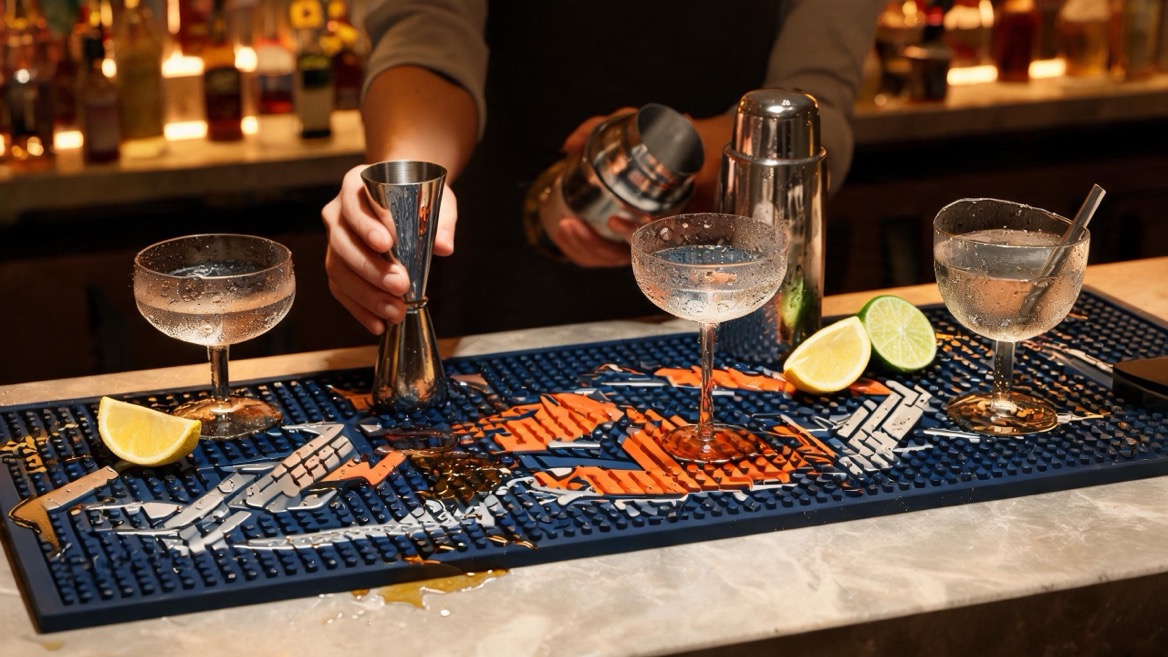
A silicone bar mat is typically made from cured silicone rubber. It is known for its flexibility, high-temperature stability, soft touch, and strong non-slip behavior.
Silicone is frequently selected for applications where hot mugs, hot beverage equipment, or high-temperature exposure are common. Compared with PVC, silicone remains more stable in demanding temperature conditions and generally provides a more premium, rubber-like tactile experience.
Silicone is also often positioned for food-contact applications, but buyers should not assume that every silicone product is suitable for direct food contact. The finished material, pigments, additives, curing system, and intended use must be reviewed against the applicable market requirements. In the United States, rubber articles intended for repeated food contact are addressed under FDA 21 CFR 177.2600.
Silicone bar mats are often favored by premium cocktail bars, specialty coffee counters, upscale hotels, and kitchens where the mat may contact hot serving items. Their appeal comes from several practical benefits:
Excellent heat resistance for hot mugs and hot tools
High flexibility, making the mat easy to lift, rinse, and reposition
Strong grip on many countertop surfaces
Soft, refined texture that supports premium presentation
Good resistance to repeated washing when the correct silicone grade is used
These benefits can make silicone worthwhile when performance demands are high and the purchasing decision prioritizes long-term use over the lowest initial cost.
This is one of the clearest differences between the two materials.
Silicone is better suited to locations where hot cups, hot milk pitchers, hot coffee tools, or temperature fluctuations are part of daily operations. It is commonly selected for coffee stations because its heat resistance helps it maintain performance in hotter working environments.
PVC is suitable for many bar and beverage applications, but it is not the preferred option for continuous direct contact with very hot items. Excessive heat may affect its flexibility, finish, and long-term appearance.
Best choice for hot drink stations: Silicone.
Best choice for standard cold beverage bars and promotional counter mats: PVC.
Both materials can provide effective anti-slip performance when the product is properly designed. In practice, the bar mat’s surface geometry matters as much as the base material.
A high-performing commercial mat should include:
Raised studs, ribs, or grid patterns
Channels that move liquid away from glasses and tools
A stable base that resists sliding
Adequate thickness for frequent handling
Rounded edges that reduce dirt accumulation
Easy-to-clean surface details
Silicone naturally has a high-friction, soft rubber feel. This can give it an advantage in wet and fast-paced work areas. PVC can still deliver reliable grip when the correct softness, thickness, underside texture, and surface pattern are engineered into the product.
The operational lesson is simple: do not choose a bar mat based only on a catalog photo. Request samples and test the actual design under wet, fast-service conditions.
High-volume bars expose mats to repeated impacts from glasses, bottles, shakers, ice scoops, cleaning cloths, and constant movement. Durability depends on more than material name. It also depends on compound formulation, wall thickness, curing or molding quality, design depth, and daily maintenance.
PVC offers strong practical durability and good resistance to many common substances, including oils, alcohols, fats, salts, and certain acids. It is especially effective for commercial programs that need consistent performance across many locations without overextending the budget.
Silicone generally offers stronger performance under heat, temperature cycling, and repeated flexing. It can be a better long-term option where mats are removed and washed frequently or placed near high-temperature beverage equipment.
For moderate-to-heavy cold beverage service, PVC is usually sufficient. For high-heat, premium, or intensive washing environments, silicone has the advantage.
For branded bar mats, appearance is not secondary. It is often the reason a buyer orders the product.
PVC has a major advantage in promotional customization because it supports bright color matching, raised 3D effects, complex outlines, small visual details, and eye-catching relief logos. Advanced dispensing techniques can create multi-color designs that remain visible across a busy service counter.
This makes custom PVC bar mats suitable for:
Beverage launches
Brewery promotions
Coffee chain campaigns
Restaurant table-service branding
Retail gift-with-purchase programs
Licensed merchandise collections
Corporate events and hospitality gifting
At Yijia, our experience with global brand projects has reinforced an important point: a logo must be engineered for production, not only designed for a screen. Fine lines, small text, color transitions, and raised details need to be adapted for real-world dispensing, mold release, cleaning, and daily wear.
Silicone can also be customized with logos and colors. However, when a project requires complicated multi-color 3D artwork at a large volume and controlled budget, PVC is often the more commercially efficient option.
A mat that traps liquid but cannot be cleaned quickly becomes a hygiene issue.
Both PVC and silicone bar mats should be cleaned regularly, especially in beverage environments where sugar syrup, fruit juice, beer residue, dairy products, and coffee oils can build up. The cleaning process should follow the product supplier’s instructions and the venue’s sanitation procedures.
For routine care:
Remove bottles, tools, and loose debris
Rinse the mat with warm water
Use mild detergent and a soft brush if residue remains
Pay attention to raised areas and drainage channels
Rinse thoroughly
Air-dry fully before placing it back on the counter
Inspect for cracking, lifting logos, warping, or permanent staining
Silicone is often preferred for frequent washing due to its flexibility and heat tolerance. PVC is also easy to wipe and rinse, but the buyer should avoid unnecessarily aggressive cleaners or heat exposure that could affect the product’s appearance over time.
Initial purchase price matters, especially for a chain rollout, distributor program, or national promotional event. PVC bar mats typically offer lower entry costs than silicone, particularly when the project requires custom colors, large quantities, and complex visual branding.
However, the lowest unit price is not always the lowest total cost.
A better purchasing calculation considers:
Total Value=(Useful Service Life×Brand Visibility×Operational Fit)/(Purchase Cost + Replacement Cost)
For an upscale café counter exposed to hot beverage service every day, silicone may justify its higher price because it can reduce replacement frequency and preserve a premium working environment.
| Commercial Environment | Recommended Material | Reason |
|---|---|---|
| Busy cocktail bar | PVC or silicone | PVC for branding value; silicone for maximum grip and durability |
| Coffee shop espresso station | Silicone | Better for frequent hot-cup exposure |
| Beer promotion or brewery event | PVC | Strong logo visibility and cost-effective campaign deployment |
| Hotel lounge | Silicone | Premium appearance and long-term performance |
| Restaurant beverage station | PVC | Practical, customizable, and efficient for broad rollout |
| Nightclub bottle-service counter | PVC | High brand impact, bold colors, and scalable customization |
| Premium spirits display | Silicone or PVC | Silicone for premium feel; PVC for detailed branded display |
| Licensed promotional merchandise | PVC | Excellent for colorful, character-driven, raised-logo designs |
Before approving production, commercial buyers should confirm more than the material. Ask the supplier these questions.
Clarify whether the mat will be used around:
Cold drinks
Hot beverages
Coffee machines
Alcohol and syrup spills
Outdoor events
Repeated dishwashing or rinsing
High-frequency bartender movement
The operating environment should drive the material recommendation.
A beautiful mat can fail in service if it contains very narrow channels, overly deep recesses, or fine logo lines that collect sticky residue.
Ask for a design that balances visual detail with cleanability and drainage.
For brand programs, color consistency matters across production batches. Request a pre-production sample and confirm the approved color reference before mass production.
This is especially important for multinational brands, franchise systems, and campaign materials that must look consistent across many locations.
Compliance requirements depend on the product’s intended use and destination market. Buyers should request relevant test reports or declarations for the exact finished product, rather than relying on general material claims.
Yijia Plastic Products Co., Ltd. holds EU RoHS, California Proposition 65, and Disney FAMA-related qualifications for applicable manufacturing programs. RoHS primarily concerns restrictions on certain hazardous substances in electrical and electronic equipment, while Proposition 65 relates to warnings for significant exposures to listed chemicals in California. These frameworks should not be treated as universal food-contact approvals for every bar mat application.
For direct food-contact use, request documentation specific to that use case and market.
A supplier should be able to demonstrate:
Stable production capacity
Automated or controlled production processes
Sample approval procedures
Quality inspection standards
Packaging options
Reliable lead-time planning
Experience with complex branded programs
For large promotional orders, production stability can matter as much as the material itself.
Two PVC bar mats may look similar online but perform very differently in a real bar. The difference often comes from the manufacturing process.
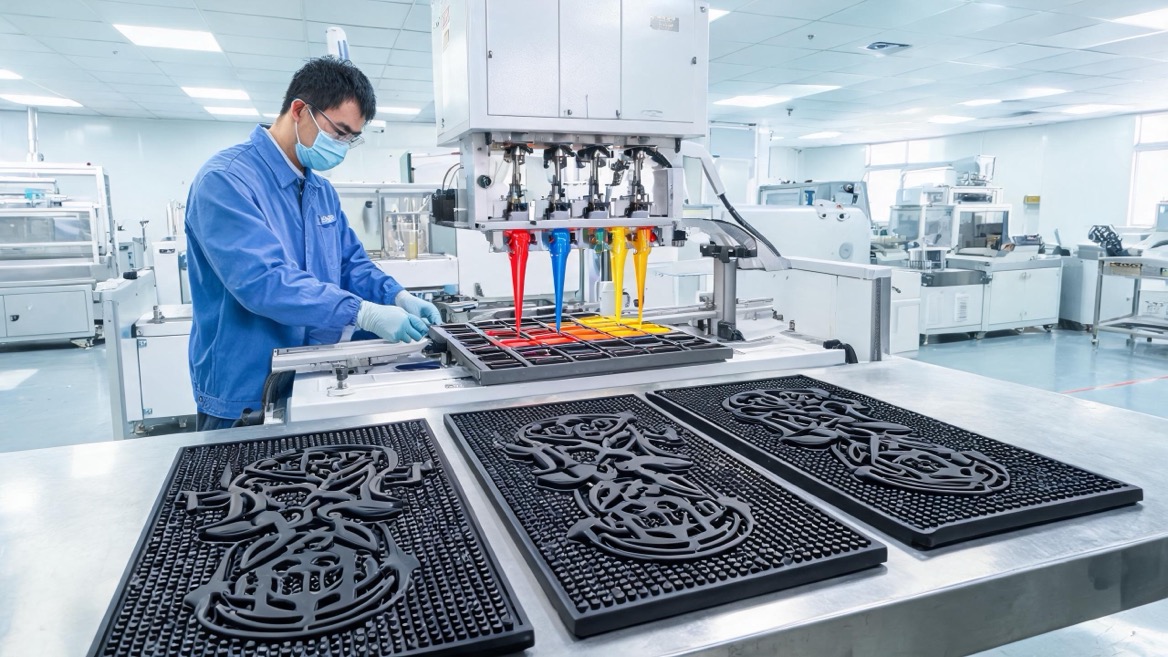
High-quality PVC dispensing requires controlled material flow, accurate color placement, adequate curing, and stable thickness. If these factors are not controlled, the mat may show uneven edges, weak logo adhesion, color bleeding, poor flatness, or inconsistent texture.
With 18 years of production experience, a 3,000-square-meter factory, 10 automated production lines, and advanced dispensing equipment, Yijia focuses on turning brand artwork into practical commercial products. Our team supports OEM and ODM projects from concept review through sampling, mass production, quality checks, and packaging.
For customers in beverage, retail, hospitality, entertainment, and promotional markets, this means the product can be developed around actual usage needs rather than selected from a generic template.
Silicone bar mats are the stronger technical choice for high-heat, premium, and repeatedly washed environments. They are especially suitable for espresso stations, upscale hospitality counters, and operations where flexibility and temperature resistance matter most.
PVC bar mats are the smarter commercial choice for many high-volume branded bar programs. They offer excellent custom logo potential, strong visual impact, reliable daily performance, and better cost control when ordering at scale.
The best decision is not “PVC versus silicone” in isolation. It is a decision about your service environment, branding requirements, cleaning process, intended lifespan, and purchasing plan.
If your business needs a colorful, durable, custom-shaped, logo-forward mat for a bar campaign, hospitality rollout, branded giveaway, or licensed merchandise program, PVC offers exceptional commercial value. If hot cups and premium long-term performance are the priority, silicone is worth considering.
A successful bar mat should protect the workspace, support faster service, and make the brand impossible to ignore. Whether you need a custom PVC bar mat for a global beverage campaign or an OEM solution for a high-volume hospitality program, Yijia Plastic Products Co., Ltd. can help evaluate your artwork, usage scenario, material requirements, and production plan.
Send us your logo, preferred size, estimated quantity, destination market, and intended application to receive a practical material recommendation and customized quotation.
Yes. PVC bar mats are widely suitable for commercial bars, restaurants, beverage counters, and promotional events. They provide spill control, raised surface support, brand visibility, and cost-effective customization. They are most appropriate for standard beverage service rather than continuous high-temperature exposure.
Silicone is better when heat resistance, flexibility, and premium tactile performance are the main priorities. PVC is often better when cost efficiency, detailed logo branding, multi-color customization, and high-volume promotional use are more important.
Yes. PVC bar mats can be customized with raised 3D logos, multiple colors, shaped outlines, slogans, character artwork, and textured backgrounds. This makes them highly suitable for beverage brands, cafés, breweries, restaurants, and promotional merchandise.
Silicone is generally the better choice for coffee stations that regularly handle hot cups, espresso tools, and hot beverage equipment. PVC can still work for cold beverage areas, branded display counters, or sections without substantial heat exposure.
Yes. PVC bar mats can usually be cleaned with warm water, mild detergent, and a soft brush or cloth. Regular cleaning is important to remove syrup, coffee residue, alcohol, and other sticky materials from raised details and drainage channels.
A bar mat’s suitability for direct food contact depends on its exact material formulation, pigments, additives, destination market, and intended use. Buyers should request documentation specifically covering the finished product and the intended food-contact application rather than relying on general material descriptions.
Provide your logo artwork, desired dimensions, shape, colors, estimated quantity, target delivery country, packaging needs, and usage environment. It is also helpful to state whether the mat will be used near hot drinks, cold beverages, outdoor areas, or food-contact surfaces.
Rubber-Cal. “PVC vs. Silicone.” Material comparison covering durability, flexibility, weather performance, and chemical resistance.
A Bar Above. “Bar Mats: How To Choose The Right One.” Overview of common bar mat materials and practical selection considerations.
ElastaPro. “FDA Food Grade Silicone: FDA 21 CFR 177.2600.” Information on silicone rubber articles intended for repeated food contact.
RugPadUSA. “PVC: What Is It, How Is It Made, and What Is It Used For?.” Overview of PVC material properties, including durability and resistance characteristics.
EUR-Lex. “Directive 2011/65/EU on the Restriction of Certain Hazardous Substances.” Official European Union legal text related to RoHS requirements.
UPMC HealthBeat. “Should I Worry About a Prop 65 Warning?.” Explanation of California Proposition 65 warning requirements and listed chemicals.
The Rubber Company. “Rubber & PVC Matting: A Buyer’s Guide.” Practical discussion of PVC matting durability, weathering behavior, and material characteristics.


