
Views: 217 Author: Yijia Plastic Publish Time: 2026-09-05 Origin: Site
Content Menu
● Quick Answer: Which Coffee Mat Is Better?
>> Why Cafés Choose PVC Coffee Mats
● What Is a Silicone Coffee Mat?
>> Why Cafés Choose Silicone Coffee Mats
● PVC Coffee Mat vs. Silicone Coffee Mat: Performance Comparison
>> Heat Resistance and Hot-Cup Exposure
>> Grip and Workflow Stability
>> Spill Control and Countertop Cleanliness
>> Durability in Daily Café Use
● Branding: Where PVC Has a Major Advantage
● Food Contact, Compliance, and Safer Procurement
● The Hidden Cost Factor: Total Cost of Ownership
● How to Choose the Right Coffee Mat
>> 3. Set the Cleaning Routine
>> 4. Specify the Design Details
● Recommended Choice by Café Scenario
>> Choose a PVC Coffee Mat When You Need:
>> Choose a Silicone Coffee Mat When You Need:
>> Choose a Hybrid Program When You Need:
● FAQ
>> 1. Is a PVC coffee mat suitable for a busy café?
>> 2. Can silicone coffee mats handle hot coffee cups?
>> 3. Are PVC coffee mats more affordable than silicone coffee mats?
>> 4. Which material is better for a custom café logo?
>> 5. Can a coffee mat be used for direct food contact?
>> 6. How often should café coffee mats be cleaned?
>> 7. What should I include in an OEM coffee mat inquiry?
For busy cafés, the choice between a PVC coffee mat and a silicone coffee mat affects more than countertop appearance. It influences spill control, barista workflow, cleaning time, beverage-station safety, replacement frequency, and the visibility of your brand during every customer interaction.
After working with custom soft-PVC promotional products and observing the practical needs of beverage brands, I believe there is no universal winner. PVC coffee mats are often the better commercial choice for branded, high-volume coffee counters with frequent replacement cycles, while silicone coffee mats are usually the stronger option for heat-intensive, long-life work areas where grip and temperature resistance matter most. The right answer depends on where the mat will be used, how often it will be washed, what it contacts, and whether it must function as a highly visible brand asset.

A silicone coffee mat is generally better for a permanent espresso workstation exposed to hot tools, repeated washing, and constant movement. A PVC coffee mat is often better for front-counter branding, beverage handoff zones, promotional campaigns, bar rails, drip areas, and custom designs that need bright color, raised logos, and controlled purchasing costs.
For high-frequency café operations, many operators benefit from using both materials strategically rather than selecting one material for every surface.
| Comparison Factor | PVC Coffee Mat | Silicone Coffee Mat | Better Choice |
|---|---|---|---|
| Upfront cost | Usually lower | Usually higher | PVC |
| Raised logo presentation | Excellent | Good to excellent | PVC |
| Color reproduction | Strong, especially for branded designs | Good, but can be more limited by process and finish | PVC |
| Heat resistance | Moderate; avoid direct extreme heat | High | Silicone |
| Flexibility | Flexible, but can become firmer in certain conditions | Highly flexible across a wider temperature range | Silicone |
| Countertop grip | Good when properly designed | Excellent | Silicone |
| Spill containment | Excellent with deep grid or well design | Good to excellent, depending on thickness and pattern | Depends on design |
| Daily wash durability | Good with correct cleaning practice | Very good | Silicone |
| Production flexibility | Excellent for custom shapes, logos, and multi-color effects | Good, often with higher tooling and material costs | PVC |
| Best for | Branded serving zones and promotional use | Heavy-duty preparation and heat-prone stations | Depends on zone |
The decision should begin with the operational role of the mat, not with material preference alone.
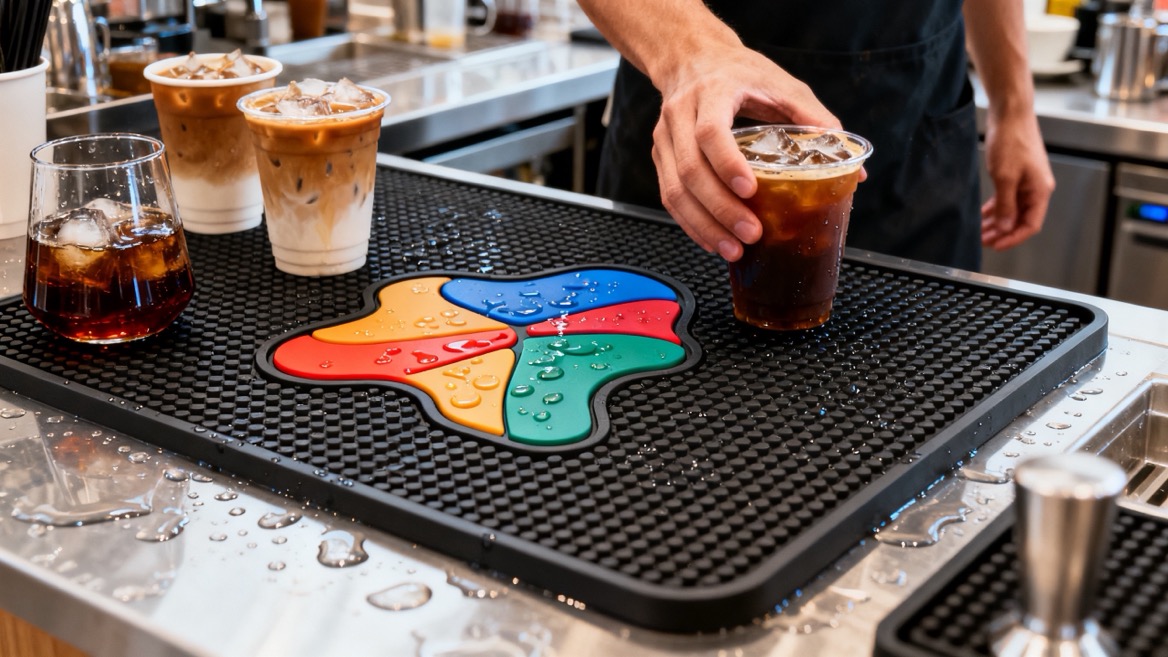
A PVC coffee mat is a flexible countertop mat made from polyvinyl chloride. In café settings, it is commonly used below cups, pitchers, syrup bottles, blenders, drink dispensers, and takeaway beverage stations. It can also be used as a branded bar mat, drip mat, service mat, counter mat, or promotional drink mat.
The most recognizable version has a raised grid, dot, rib, or honeycomb pattern. This textured surface helps hold liquid away from the base of cups and reduces visible mess during busy service periods.
PVC coffee mats are widely used because they offer a practical balance of durability, custom design freedom, liquid containment, and cost control. A skilled manufacturer can reproduce a logo in relief, add multiple colors, create custom outlines, and adjust the texture or edge profile for a specific coffee-service environment.
For cafés and beverage chains, a PVC coffee mat is not simply an accessory. It can work as a compact point-of-sale branding surface that appears repeatedly in customer photos, delivery-pickup moments, and counter interactions.
PVC is especially effective when the operation needs a mat that does more than protect a counter.
Common reasons include:
- High-visibility branding with raised logos, characters, icons, slogans, or product graphics.
- Custom shapes that match a cup silhouette, mascot, coffee bean, bottle, or campaign theme.
- Multi-color customization for brand recognition at a glance.
- Lower unit cost for chains, promotions, seasonal launches, and distributor orders.
- Good spill retention when the design includes deep channels or a raised rim.
- A substantial feel that helps the mat stay in place during ordinary drink service.
- Flexible OEM/ODM possibilities, including size, thickness, packaging, color matching, and logo treatment.
A custom PVC bar mat is particularly valuable when a café wants to transform a working surface into a branded experience. For example, a dark green mat with a raised white logo can make a takeaway counter feel more consistent with the rest of the store environment without redesigning the entire countertop.
A silicone coffee mat is made from silicone rubber, an elastomer known for flexibility, heat resistance, and strong anti-slip behavior. It is commonly used in espresso workstations, preparation counters, tamping areas, dishwashing-adjacent spaces, and locations where hot cups, pitchers, or tools may be placed.
Silicone has a soft, grippy feel. In a busy café, that property can help stabilize cups, milk pitchers, dosing tools, and small accessories. It is also better suited to temperature variation than standard PVC formulations.
However, not every silicone product should automatically be described as suitable for direct food contact. Material suitability depends on the formulation, intended use, applicable regulations, and compliance documentation. In the United States, substances intended to contact food are subject to regulatory requirements based on their specific use conditions.
Silicone becomes compelling when a café is trying to reduce operational risk in a demanding preparation environment.
Its key strengths include:
- High heat resistance for hot beverage-service areas.
- Strong slip resistance on smooth countertops.
- Excellent flexibility, even when bent, rolled, or washed frequently.
- Long-term resilience in demanding back-bar or espresso-bar conditions.
- Comfortable texture for stations where baristas repeatedly place tools and cups.
- Reliable performance in variable temperatures, including cooler preparation spaces.
A silicone coffee mat is often the practical choice for a permanent tool-rest zone beside an espresso machine. It can handle repetitive contact with warm metal pitchers or hot cups better than a typical PVC mat.
The best way to compare a PVC coffee mat and silicone coffee mat is to assess the actual pressures of café service: spills, heat, motion, speed, sanitation, branding, and cost.
Silicone is the stronger material when heat exposure is a routine part of the job. It is more stable around hot cups, steam-pitcher areas, heated accessories, and temperature fluctuations. PVC remains useful for ordinary beverage service, but it should not be selected for locations where direct high heat is expected.
This does not mean PVC is unsuitable for coffee shops. It means the placement matters.
Use PVC in areas such as:
- Cashier counters.
- Pickup shelves.
- Cold beverage assembly lines.
- Syrup and garnish stations.
- Branded display counters.
- Bar rails and customer-facing service areas.
Use silicone in areas such as:
- Espresso-machine side stations.
- Tamping areas.
- Milk-steaming zones.
- Hot-pitcher resting locations.
- Barista tool-rest spaces.
Practical rule: If the mat is expected to touch a hot metal component regularly, choose silicone. If it primarily manages drinks, condensation, branding, and routine spills, PVC can be the better-value option.
A high-frequency café can serve hundreds of drinks during peak periods. A mat that slides, curls, or feels unstable creates unnecessary friction in the workflow.
Silicone usually delivers a higher level of natural grip on smooth surfaces. This makes it well suited to fast-paced barista stations, particularly where employees repeatedly set down pitchers, scales, cups, or tools.
PVC can also offer reliable grip when the design is right. Thickness, underside texture, surface pattern, mat weight, and countertop condition all affect performance. A heavier PVC bar mat with a well-designed underside can remain stable in normal service settings.
The difference is that silicone tends to perform more consistently where traction is the primary concern. PVC provides better commercial flexibility where branding and cost must carry equal weight.
Both materials can manage spills effectively, but the mat geometry is often more important than the material alone.
A good coffee mat should include:
- Raised edges to contain liquid.
- Deep drainage channels or a textured grid.
- Sufficient thickness for the expected spill volume.
- A pattern that does not trap residue unnecessarily.
- An edge profile that is easy to wipe around.
PVC is often excellent for molded, three-dimensional spill-management designs. Raised logos, grid structures, and deep wells can be combined in a single custom piece. This makes PVC highly effective for drink handoff zones, where condensation, drips, foam overflow, and syrup residue are common.
Silicone can also provide effective containment, especially when designed with channels and raised borders. However, silicone mats are often selected primarily for grip and heat resistance rather than for highly detailed branded relief designs.
Both PVC and silicone can last well when matched to the correct application.
PVC performs strongly against general wear, beverage spills, and routine handling. It is particularly practical for programs where a business may refresh branding regularly or replace mats across multiple locations on a planned schedule.
Silicone is generally stronger for long-term use in physically demanding zones. Its flexibility and heat tolerance help it resist the fatigue associated with repeated bending, washing, and high-temperature exposure.
A material comparison should not rely on a simple "durable" or "not durable" label. Instead, ask:
1. Will staff place hot tools on the mat?
2. Will the mat be washed every day or several times each shift?
3. Does the station receive direct sunlight or outdoor exposure?
4. Is the mat moved, rolled, or stored frequently?
5. Is the mat a long-life operational tool or a short-to-medium-term promotional asset?
6. Does the logo need to stay visually prominent after repeated cleaning?
The answers determine which material offers the better total value.
For cafés, restaurants, beverage franchises, and licensed merchandise programs, branding can be as important as surface protection. This is where a custom PVC coffee mat often has a meaningful advantage.
PVC soft-rubber-style products can create a high-relief visual effect. Logos can be layered, outlined, color-separated, or shaped around a campaign concept. The result is tactile and highly recognizable.
This is especially useful for:
- New drink launches.
- Licensed character collaborations.
- Coffee-chain regional promotions.
- Gift-with-purchase campaigns.
- Coffee equipment partnerships.
- Festival and holiday collections.
- Branded barista stations.
- Retail merchandise bundles.
Yijia Plastic Products Co., Ltd. has 18 years of experience in research, production, and sales of PVC bar mats and related PVC soft-gift products. With a 3,000-square-meter factory, 10 automated production lines, and advanced dispensing equipment, the company supports one-stop OEM/ODM projects for global customers. Its experience serving major brands and programs associated with Starbucks, Disney, McDonald's, Pop Mart, and Tencent demonstrates the type of quality control, visual consistency, confidentiality, and production coordination required for large-scale branded customization.
For a café buyer, this manufacturing capability matters because a mat must look consistent across stores, campaigns, and reorder batches. A poorly controlled color match or shallow logo can weaken the brand effect even when the mat itself is functional.
Material selection should always be linked to the intended contact scenario.
A coffee mat designed only to support cups, glasses, and sealed beverage containers is different from a mat intended for direct contact with exposed food. Procurement teams should specify the use case clearly before finalizing a material, ink system, additive package, and testing plan.
For any product intended for food-contact use, buyers should request documentation relevant to the target market and intended conditions of use. In the United States, food-contact substances may require authorization for their intended use before marketing. Food-equipment standards also emphasize design principles such as non-toxic, non-absorbent surfaces and construction that supports effective cleaning.
For custom PVC coffee mats, buyers should ask suppliers about:
- The specific PVC formulation.
- Applicable restricted-substance testing.
- RoHS documentation where applicable.
- California Proposition 65 compliance approach.
- Intended-use limitations.
- Cleaning recommendations.
- Odor-control requirements.
- Colorant and additive controls.
- Batch consistency and traceability.
Yijia Plastic Products Co., Ltd. holds EU RoHS, California Proposition 65, and Disney FAMA-related qualifications, which can support procurement conversations for branded projects. However, buyers should still match each product's documentation to its own final market, intended use, and customer compliance requirements.
The cheapest mat is not always the lowest-cost choice over time. High-frequency café operations should calculate total cost of ownership rather than focusing only on unit price.
A useful comparison includes:
| Cost Element | PVC Coffee Mat | Silicone Coffee Mat |
|---|---|---|
| Initial purchase cost | Usually lower | Usually higher |
| Brand customization value | High | Moderate to high |
| Replacement flexibility | Strong for campaign-based programs | Better for long-term fixed installations |
| Heat-related replacement risk | Higher in hot zones | Lower in hot zones |
| Cleaning-related lifecycle | Good with proper handling | Often very good |
| Best purchasing model | Bulk promotional or multi-store rollout | Fewer, longer-life workstation placements |
For example, a 50-store café chain may use silicone mats at each espresso workstation but install custom PVC coffee mats at every order counter and pickup shelf. This creates a better balance between operational durability and customer-facing visual impact.
That hybrid approach can reduce unnecessary silicone spending while placing the more heat-tolerant material exactly where it delivers the most benefit.
Use this five-step selection process before requesting samples or quotations.
Identify where each mat will sit:
- Espresso machine.
- Cold drink station.
- Cashier counter.
- Pickup shelf.
- Syrup area.
- Wash station.
- Retail display.
- Outdoor service counter.
Do not use one material by default across all locations.
Choose the main problem the mat must solve:
- Hot-tool exposure.
- Cup slippage.
- Spill containment.
- Countertop protection.
- Brand presentation.
- Faster cleaning.
- Promotional visibility.
A mat designed for grip may not be the best mat for logo impact. A mat designed for visual branding may not be the right choice next to a hot steam wand.
Ask how the mat will be cleaned:
- Wiped between rushes.
- Washed once daily.
- Put through a commercial dishwasher.
- Sprayed with sanitizing solution.
- Scrubbed manually.
- Stored flat, hung, or rolled.
Commercial food-service equipment is typically evaluated with sanitation and cleanability in mind, so easy-to-clean shapes and materials should be prioritized during design.
For custom PVC coffee mats, define:
- Final length and width.
- Thickness.
- Raised rim height.
- Drainage pattern.
- Logo placement.
- Pantone color references.
- Matte, glossy, or mixed finish.
- Packaging format.
- Retail or bulk-carton requirements.
Before mass production, test samples in the actual café environment for at least several busy shifts. Check for movement, odor, staining, curling, logo legibility, water pooling, and cleaning performance.
This step is especially important when a mat will be used with high-acid drinks, flavored syrups, dairy products, cleaning agents, or high heat.
- High-impact custom branding at the counter.
- A raised 3D logo or multi-color design.
- A lower-cost solution for many locations.
- A promotional giveaway or seasonal campaign item.
- Strong spill containment for cold drinks and serving zones.
- Custom shapes, packaging, and fast visual differentiation.
- A practical branded mat for routine drink-service areas.
- Higher heat resistance near espresso equipment.
- Maximum countertop grip.
- A permanent mat for a high-use preparation station.
- Greater flexibility during frequent washing.
- Better performance in areas with hot tools or temperature variation.
- A premium utility-first mat with less emphasis on complex visual branding.
- Silicone mats at espresso and steaming stations.
- PVC coffee mats at cashier, pickup, and customer-facing counters.
- Branded PVC mats for events, product launches, and licensed campaigns.
- Different materials for different operational zones.
- Better lifecycle value across a multi-store café network.
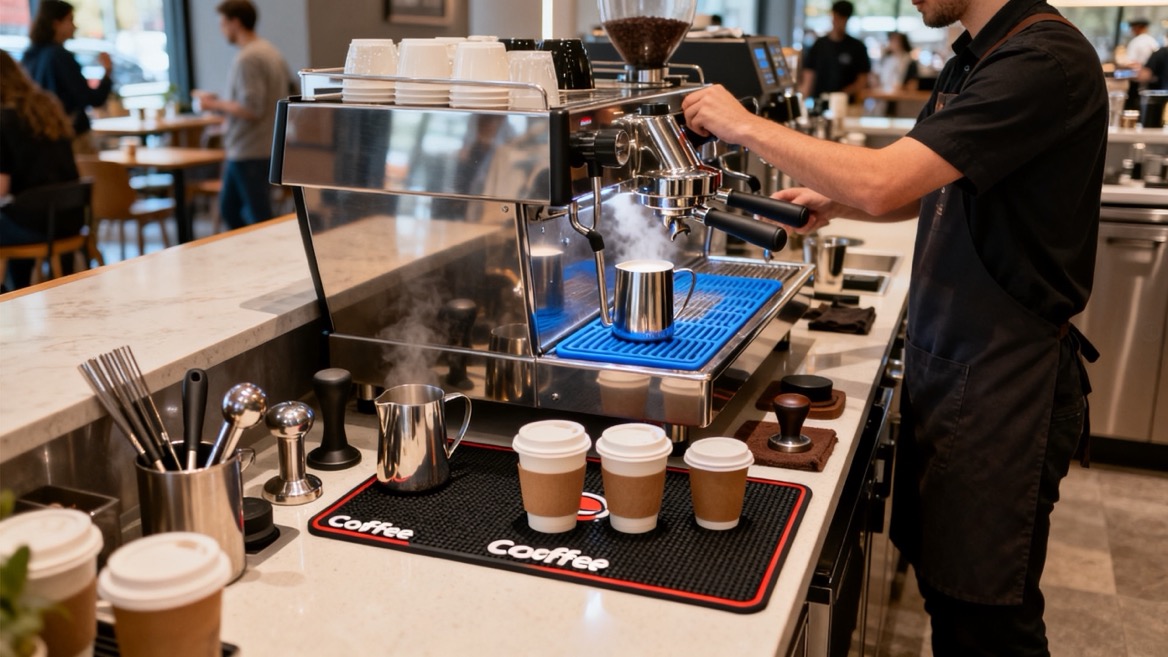
For high-frequency café operations, silicone coffee mats are better for hot, high-grip, permanent barista work zones, while PVC coffee mats are better for scalable branding, spill-management designs, and cost-efficient customer-facing applications.
The most effective decision is often not PVC versus silicone. It is PVC and silicone, each positioned where its material advantages are most valuable.
If your café, beverage brand, distributor, or promotional agency needs a custom PVC coffee mat with raised logos, detailed color matching, tailored spill channels, and OEM/ODM packaging support, contact Yijia Plastic Products Co., Ltd. to discuss your artwork, target market, compliance needs, sample plan, and production requirements. A well-designed mat can protect the counter, improve service presentation, and keep your brand visible throughout the busiest part of every day.
Yes. A PVC coffee mat can work very well in busy cafés when it is used in the right zone, such as a cashier counter, pickup station, cold beverage area, or branded service counter. Choose a design with stable dimensions, raised spill-control features, and a cleaning-friendly pattern.
Yes. Silicone is generally the better choice for regular exposure to hot cups, warm pitchers, and heat-prone preparation zones. It is particularly suitable beside espresso machines and milk-steaming stations.
In many custom projects, PVC coffee mats have a lower initial cost than silicone alternatives. This makes PVC attractive for large store rollouts, promotional campaigns, licensed merchandise, and branded counter programs. Final pricing depends on size, thickness, color count, tooling, packaging, and order volume.
PVC is often the better choice for a detailed raised logo, multi-color artwork, character design, or custom shape. The material supports strong visual depth and tactile brand recognition, making it effective for customer-facing coffee counters and promotional products.
Do not assume that every PVC or silicone mat is suitable for direct food contact. The supplier should confirm the exact formulation, intended use, target-market requirements, and supporting documentation. Buyers should clearly distinguish between a cup-support mat and a product intended to contact exposed food.
The cleaning schedule depends on traffic, beverage type, local operating procedures, and mat placement. In high-volume areas, wipe spills immediately and perform a thorough wash at least daily. Mats near milk, syrups, or food preparation may require more frequent cleaning.
Include the target size, thickness, intended application, logo artwork, color references, order quantity, desired packaging, target market, compliance requirements, and whether the mat must withstand hot tools or only routine drink service. A clear brief reduces sampling time and helps prevent material mismatch.
1. U.S. Food and Drug Administration. [Food Packaging and Other Substances That Come into Contact with Food]
2. U.S. Food and Drug Administration. [Guidance for Industry: Preparation of Premarket Submissions for Food Contact Substances]
3. NSF. [Food Equipment Standards]
4. American National Standards Institute. [NSF/ANSI 4-2025: Commercial Cooking Equipment]
5. All In One Merchandise. [PVC Bar Mats: Not Rubber, Not Yet Silicone]
6. Well Articrafts. [The Difference Between Silicone Bar Mat and PVC Bar Mat]


