
Views: 210 Author: Yijia Plastic Publish Time: 2026-09-29 Origin: Site
Content Menu
● Why Cold Drinks Create Problems
● Which Works Better at the Table?
● A Practical Restaurant Trial
● Custom Design That Serves a Purpose
>> Five Questions Worth Asking
● The Best Choice for Your Restaurant
>> Are a PVC cup mat and PVC coaster made from different materials?
>> Can a flat PVC coaster handle heavy condensation?
>> Is a larger cup mat always better at catching water?
>> Can staff put custom PVC coasters in a dishwasher?
>> Do restaurant PVC coasters need food-contact documentation?
>> Does a Proposition 65 report mean no warning is ever needed?
>> What should I send for an OEM or ODM quotation?
A cold drink can leave a surprising amount of water on a restaurant table. For operators comparing a PVC cup mat vs. PVC coaster, the better choice is not determined by the product name. It depends on the item's usable area, edge design, ease of cleaning, and the way staff serve the drink.
For most single glasses, a well-designed PVC coaster is the more practical choice. A larger PVC cup mat becomes more useful when the glass is wide, drinks arrive with frequent drips, or the service area needs room for more than one item. Neither will keep a table dry if water runs off its edge or collects beneath it.

In supplier catalogs, "PVC cup mat" and "PVC coaster" can describe similar flexible products. Neither name guarantees a particular size, thickness, or level of water containment. A buyer should compare drawings and samples rather than assume that a cup mat is always larger or that a coaster is always flat.
For this article, PVC coaster means an individual pad placed beneath one glass. PVC cup mat means a broader pad intended to protect a larger area around a cup or glass. These are purchasing descriptions, not separate material standards.
The distinction matters in restaurants because condensation does not always fall directly beneath the base. Guests move their drinks. Servers place glasses down at an angle. Water can travel along the outside of a tall glass and drip beyond a small coaster's edge.
| Buying factor | Individual PVC coaster | Larger PVC cup mat |
|---|---|---|
| Typical placement | One glass at one seat | A wider area around one drink or a small group of items |
| Table space | Takes up less room | Needs more clear space |
| Water control | Depends heavily on base coverage and rim design | Offers more area, but still needs suitable channels or containment |
| Guest handling | Easy to move with a glass | May stay on the table when the glass moves |
| Branding | Compact, visible beneath a drink | More artwork space, though a glass may obscure the center |
| Clearing | Easy to collect individually | Larger wet surface to handle and dry |
The decisive specification is usable wet area, not outside dimensions alone. A decorative border may make a product look generous while leaving too little space beneath the glass.
Condensation forms when a surface becomes colder than the dew point of the surrounding air. A chilled glass can therefore gather water on its exterior, especially in a humid dining room or outdoor seating area. A mat cannot prevent that process. Its job is to keep the resulting water away from the table and make cleanup manageable.
Restaurants also deal with water from other sources. Ice can melt near the rim. A server may overfill a drink. A guest may lift a glass before its droplets have drained. A good product brief should account for condensation and ordinary service drips, rather than treating every wet ring as the same problem.
This changes how samples should be judged. A coaster that looks attractive under a dry glass may allow droplets to run over its edge after twenty minutes. A broad mat may catch those droplets but leave a shallow pool touching the glass base. Both outcomes are visible during a realistic service trial.
Start with the largest glass base used for iced drinks, not the smallest. Check the area that actually supports the glass, excluding raised logos, deep grooves, or a decorative outer edge. The glass should sit securely while leaving a clear margin for water.
A wider margin gives drops more room to land. It does not guarantee containment, however. Water on a smooth surface can still reach an unprotected edge when a guest shifts the glass. For condensation-heavy service, ask for a sample with a shallow perimeter lip or a layout that directs water into a cleanable recess.
A textured underside may help a coaster or mat stay in place on a suitable tabletop. The top surface also matters: if a raised design supports only part of a glass base, the drink may wobble.
Test grip on your actual tables. A product that performs well on a dry laminate sample may behave differently on a wet stone, sealed wood, or textured outdoor table. Avoid promising "non-slip" performance across every surface without checking it under service conditions.
A mat that traps droplets also traps residue from milk, syrup, fruit juice, and handling. Shallow, accessible channels are generally easier for staff to inspect and wash than narrow decorative recesses. Raised artwork should not create pockets that remain wet after cleaning.
Request the supplier's cleaning instructions for the finished construction, including its colors and printed or molded details. Do not assume that flexible PVC can tolerate a restaurant dishwasher, a particular sanitizer, or high-temperature drying simply because another reusable product can.
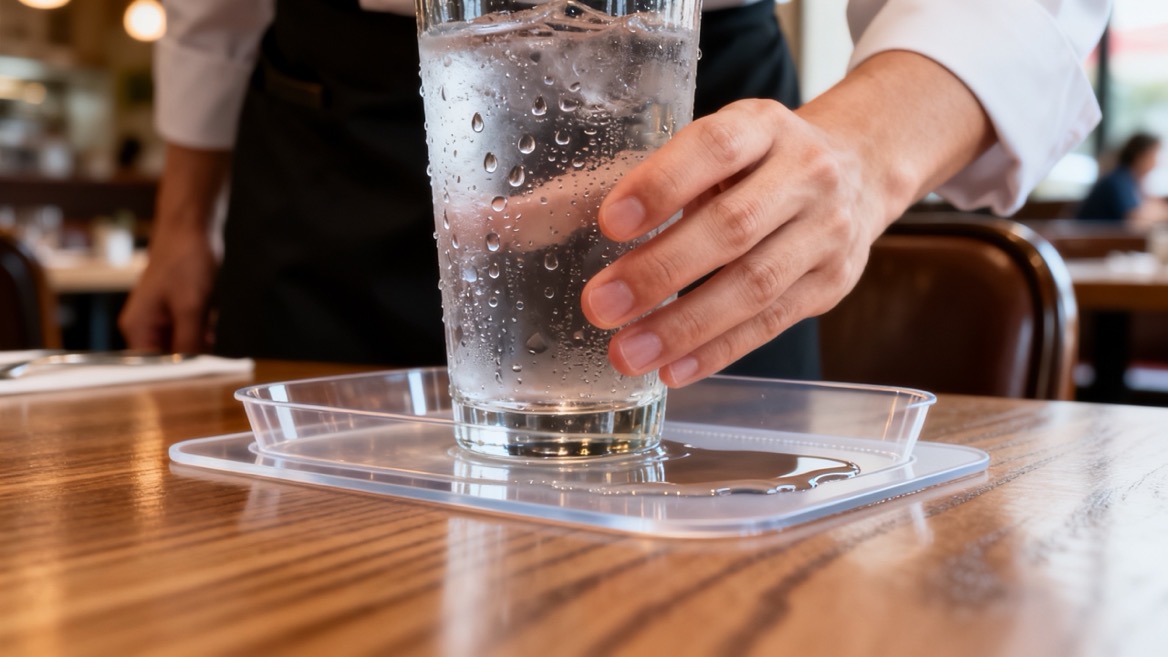
For a standard dine-in setting with one cold drink per guest, choose a PVC coaster first. It protects the area beneath the glass without crowding plates or cutlery. Staff can replace a wet coaster without moving other table items, and guests can recognize it as part of the drink service.
Specify more than a familiar coaster shape. A flat promotional design may be appropriate for a short coffee service but inadequate for a heavily sweating iced drink. Consider the glass footprint, a modest water-catching edge, a stable supporting surface, and a design staff can clean quickly.
A larger PVC cup mat is worth testing when drinks use unusually broad glassware, guests regularly receive a beverage with a small accompanying item, or tables have enough space for a wider protective area. Its extra coverage can catch drops that miss an individual coaster. The trade-off is more tabletop occupied and potentially more wet surface to clear.
There is no universal winner for outdoor dining. A broad mat may catch more drips, but limited table space and frequent clearing may favor compact coasters. The best choice comes from testing both in the same setting.
The answer changes behind the counter. Staff may place several wet glasses, pitchers, or tools on one surface. A small coaster under each item can slow service and leave gaps between them.
A purpose-designed PVC bar mat or larger draining mat is usually the more relevant comparison for that task. Raised supports and a recessed area can help organize drips, provided staff can empty and clean the mat. Do not use a guest-table cup mat as a substitute for a station mat without checking its capacity and workflow.
A sample comparison provides better evidence than a product photograph. Run the same short trial with both designs before approving a custom mold or bulk order. The following method is an operational checklist, not a published performance standard.
1. Choose representative glassware. Include the widest iced-drink base and the glass most likely to develop heavy condensation.
2. Use the real service location. Test on the actual table finish and, if relevant, at the outdoor seats or beverage station.
3. Observe a normal serving period. Place chilled drinks as staff usually would. Note where water collects after guests lift, rotate, and replace the glasses.
4. Record failures separately. Look for water beyond the edge, a wet tabletop underneath, a rocking glass, a sliding mat, and difficult-to-clean channels.
5. Repeat after cleaning. Check whether the product lies flat, remains presentable, and can be fully dried using the intended routine.
For a simple purchasing scorecard, rate each sample on containment, stability, cleaning effort, appearance, and staff handling. Have the people who clear tables participate; they will spot friction that an artwork review misses.
Avoid treating a single dry-table demonstration as proof. A product can look excellent at placement yet perform poorly after a glass has been lifted several times. If the restaurant has distinct drink formats, consider a compact coaster for ordinary service and a larger design for selected drinks instead of forcing one size across the menu.
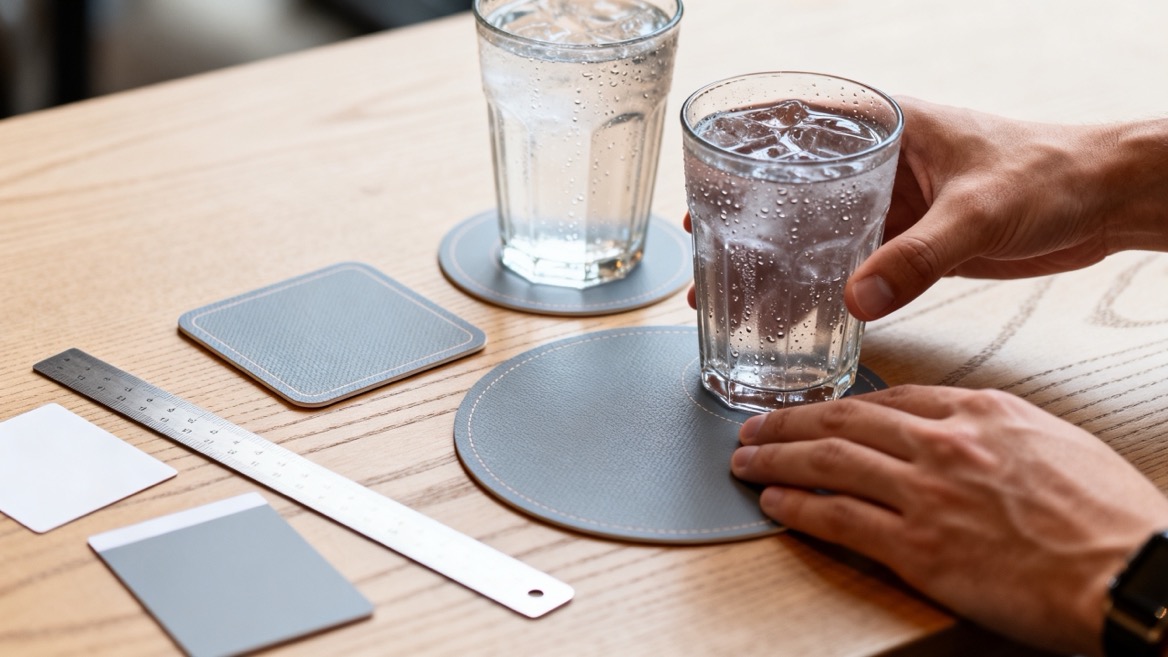
PVC lends itself to custom shapes, colors, and raised visual details. For restaurants, those options are useful only when they support the drink experience. A memorable logo will not compensate for water spilling onto a guest's sleeve or a glass that does not sit level.
Place the glass footprint before the artwork. Keep the main support area stable and reserve enough open space for drops. Put prominent raised branding where it will not tilt the glass or make cleaning unnecessarily slow. If a rim is requested, confirm that staff can reach and dry the area inside it.
A useful manufacturing brief should state:
- Glass-base dimensions and the intended number of drinks per mat.
- Table or counter material and whether it is normally dry or wet.
- Expected drink service, including iced beverages and any likely syrup spills.
- Desired outline, colors, logo position, and acceptable texture.
- Cleaning method, required documentation, target order quantity, and delivery market.
Ask the manufacturer to show the actual usable area on the drawing. For custom shapes, the narrowest part may determine whether the design works. An attractive novelty outline can leave less spill-catching space than a simpler round or square product.
A supplier's production capacity and brand experience can help a buyer shortlist manufacturers. They do not replace a product-specific sample, test report, or written specification.
Yijia Plastic Products Co., Ltd. states that it has 18 years of experience developing, producing, and selling PVC coasters and other soft-PVC gifts. The company also reports a 3,000-square-meter factory, 10 automated production lines, advanced dispensing equipment, one-stop OEM/ODM services, and cooperation experience with Starbucks, Disney, McDonald's, Pop Mart, and Tencent. These are company-provided details; buyers should request current documents and relevant project evidence before relying on them for procurement decisions.
Compliance language deserves particular care. EU RoHS primarily regulates electrical and electronic equipment; it should not automatically be presented as a mandatory approval for an ordinary non-electrical coaster. A material test against selected restricted substances may still be useful, but its scope should be described accurately.
Likewise, California Proposition 65 is not a general product certification. Its warning obligations depend on exposure to listed chemicals and the applicable circumstances. Disney FAMA is a facility authorization for specified Disney-branded production, not proof that every product from that facility meets every market's material requirements.
For a restaurant purchase, request documents tied to the proposed formulation and use. If the item is intended to contact food directly, ask for evidence appropriate to that intended food-contact use. A mat placed beneath a closed glass should not casually be advertised as "food-grade" without support for that claim.
1. What finished-product sample matches the proposed drawing, colors, and surface details?
2. Which test reports apply to that exact material formulation, and what do they test?
3. What cleaning process has been checked for the finished item?
4. How will the factory check dimensions, flatness, artwork, and edge quality during production?
5. Can the supplier confirm the quoted lead time, packaging method, and process for approving a pre-production sample?
These questions turn a design discussion into an operational one. They also make competing quotations easier to compare: two suppliers may quote a "PVC coaster" while offering different usable areas, inspection plans, and documentation.
Choose a PVC coaster for most single-drink table service, provided its usable area covers the glass securely and its edge handles the observed droplets. Choose a larger PVC cup mat when the service genuinely needs more coverage and the table has room for it. At a busy drink-preparation counter, evaluate a dedicated bar mat instead of either guest-table option.
The strongest purchase decision is a sample that stays stable, keeps water off the table, and fits the cleaning routine. Send Yijia Plastic Products Co., Ltd. your glass-base measurements, table material, drink menu, artwork, and destination market, then request comparable PVC coaster and PVC cup mat samples for a side-by-side service trial.
Not necessarily. The names usually describe how an item is positioned or used, rather than specifying a different material. Ask each supplier for the proposed construction and a drawing before comparing quotations.
It may protect the area directly beneath a glass, but a flat edge gives water less containment. Test it with your coldest drinks and widest glassware. If water regularly reaches the table, assess a wider design or a cleanable raised edge.
No. More area can help catch drops that fall away from the glass, but water may still run off a smooth edge or collect beneath the mat. Shape, surface design, placement, and staff handling all matter.
Do not assume so. Ask for care instructions and evidence relevant to the finished product and your wash process. Test cleaning and drying before writing the item into a restaurant operating routine.
That depends on their intended use and market. A coaster normally sits beneath a glass, but a product promoted or used for direct food contact needs its own assessment. Tell the supplier exactly how the item will be used and request supporting documents for any food-contact claim.
No. A test report provides information about the tested sample; it does not settle every possible exposure question. California warning decisions depend on the relevant listed chemicals, anticipated exposure, and applicable rules.
Provide glass dimensions, intended placement, target shape, artwork, colors, expected quantity, cleaning requirements, destination market, and any documentation your purchasing team requires. Request a drawing and physical sample before approving production.
- ASHRAE, *2016 ASHRAE Handbook—HVAC Systems and Equipment, Chapter 22: Humidifiers*. Explains surface temperature, dew point, and condensation. [Read the chapter]. [ashrae]
- U.S. Food and Drug Administration, *Food Packaging & Other Substances that Come in Contact with Food—Information for Consumers*. Describes food-contact substances and assessment of intended uses. [Read the FDA guidance]. [fda]
- U.S. Food and Drug Administration, *Food Code 2022*. Provides the model framework for food-service equipment and sanitation practices; it is not a coaster-specific cleaning certification. [Read the Food Code]. [fda]
- European Commission, *RoHS Directive*. Defines the directive's electrical and electronic equipment scope and restricted substances. [Read the directive overview]. [environment.ec.europa]
- California Office of Environmental Health Hazard Assessment, *Frequently Asked Questions for Businesses*. Explains Proposition 65 exposure-based warning responsibilities and product testing considerations. [Read the business FAQ]. [p65warnings.ca]
- The Walt Disney Company, *Facility and Merchandise Authorization Application Instructions*. Explains the facility-specific authorization required for Disney-branded production. [Read the FAMA instructions]. [thewaltdisneycompany]
- Lowe's, *Etokfoks PVC Bar Mat Product Description*. Illustrates a larger PVC mat with raised supports and a recessed area for drink-station drips; product-specific features should not be generalized to all PVC mats. [View the product description]. [lowes]


