
Views: 288 Author: Yijia Plastic Publish Time: 2026-10-15 Origin: Site
Content Menu
● PVC Heat-Insulating Coaster vs. Wooden Coaster: Quick Comparison
● What Premium Furniture Actually Needs Protection From
>> Heat Exposure at the Furniture Surface
>> Condensation, Spills, and Trapped Moisture
>> Scratches and Contact-Related Damage
● Which Coaster Provides Better Heat Insulation?
>> Wood Is a Genuine Insulating Material
>> PVC Performance Depends on the Finished Formulation
>> Thickness Can Matter More Than the Label
● PVC Coaster vs. Wooden Coaster for Condensation Protection
>> PVC Offers a Practical Nonabsorbent Surface
>> Wooden Coasters Need a Clear Moisture Strategy
● Scratch Protection and Slip Resistance
>> Flexible PVC Can Cushion Contact
>> Wooden Coasters Benefit From Carefully Selected Backing
● The Overlooked Issue: Furniture-Finish Compatibility
● A Practical Sample-Test Plan Before Bulk Ordering
>> Step 1: Define the Real Use Conditions
>> Step 2: Test on Representative Finish Samples
>> Step 3: Evaluate Hot and Cold Drinks Separately
>> Step 4: Check Repeated Contact and Cleaning
>> Step 5: Turn Results Into Purchase Requirements
● Cleaning, Durability, and Long-Term Ownership
>> PVC: Convenient Care With Defined Limits
>> Wood: Natural Character With More Care Variables
● Which Coaster Makes More Sense for Commercial Buyers?
>> Choose PVC for Design Flexibility and Practical Branding
>> Choose Wood for Natural Presentation
● Working With Yijia on Custom PVC Coasters
● Final Verdict: Which Better Protects Premium Furniture?
● FAQ
>> Is a PVC Heat-Insulating Coaster Better Than a Wooden Coaster?
>> Can PVC Coasters Damage Wooden Furniture?
>> Do Wooden Coasters Prevent Water Rings?
>> Can I Put a Very Hot Mug on a PVC Coaster?
>> What Should I Check Before Ordering Custom PVC Coasters?
A PVC heat-insulating coaster can be a practical choice for condensation control, easy cleaning, and customized designs. A wooden coaster offers natural character and potentially effective thermal insulation. However, when comparing a PVC heat-insulating coaster vs. wooden coaster, the better option depends on the coaster's construction, your furniture finish, and how you use it.
For premium furniture, compatibility matters more than the material name alone. A coaster should limit heat transfer, contain moisture, resist slipping, and avoid scratching or chemically affecting the surface beneath it.
At Yijia Plastic Products Co., Ltd., our approach to custom PVC coasters starts with these functional requirements—not simply the artwork. This guide explains where each material performs well, where caution is necessary, and what buyers should verify before ordering.

| Protection factor | PVC heat-insulating coaster | Wooden coaster |
|---|---|---|
| Heat protection | Depends on formulation, thickness, geometry, and tested temperature limits | Depends on wood species, thickness, moisture content, and construction |
| Condensation control | Generally nonabsorbent; a recessed surface can help contain droplets | Unsealed wood can absorb moisture; sealed wood may allow water to pool |
| Scratch protection | A clean, smooth, flexible underside can cushion contact | A hard underside requires careful sanding or suitable backing |
| Slip resistance | Textured, flexible designs can improve grip; testing is necessary | Smooth wood may slide unless fitted with suitable backing |
| Finish compatibility | Flexible PVC additives require particular attention | Sealants, adhesives, and backing materials also require checking |
| Cleaning | Often suitable for wiping or mild handwashing, subject to instructions | Usually requires wiping and prompt drying rather than soaking |
| Appearance | Strong fit for colorful branding, molded details, and custom shapes | Strong fit for natural grain and understated interiors |
| Best-fit application | Branded beverage service with verified surface compatibility | Natural styling with appropriate sealing and underside protection |
Neither category automatically wins every protection test. Compare finished products, not just raw materials.
A hot mug creates a temperature difference between the drinkware and the tabletop. A coaster adds a barrier, but its performance depends on more than whether it is plastic or wood.
The furniture finish matters too. A polished dining table, lacquered desk, and antique sideboard may respond differently to heat and prolonged contact.
A sensible buying question is: "What temperature reaches the furniture underneath this coaster during normal use?"
That is more useful than an unsupported "heatproof" claim.
Cold drinks introduce another risk: water.
A coaster can collect condensation while still allowing moisture to reach the table through overflowing edges, spills, or droplets already trapped underneath it.
The protective finish on wooden furniture provides some moisture resistance, but that does not make every finished surface waterproof. Remove wet coasters and dry the tabletop promptly.
Even a soft coaster can scratch a surface if grit becomes trapped underneath it. A wooden coaster can also damage furniture if its underside has rough grain, sharp edges, or exposed hardware.
Chemical contact is a separate concern. Additives in flexible plastics can migrate over time, while wooden coaster finishes and backing adhesives introduce their own compatibility questions.
Cleanliness, construction, and contact duration all matter.
Wood should not be dismissed as a decorative alternative with poor thermal performance.
Published research on selected plantation woods and tropical hardwoods reported thermal conductivity values ranging from 0.128 to 0.300 W/m·K. The results varied with density and moisture content.
Lower thermal conductivity generally means slower heat transfer under comparable conditions. These findings help explain why a suitably constructed wooden coaster can provide effective insulation.
However, the figures do not establish how every commercial wooden coaster performs.
General reference tables list PVC thermal conductivity around 0.19 W/m·K. That is a reference value, not a guaranteed specification for every flexible PVC coaster.
Plasticizers, fillers, thickness, molded features, and contact area can change the finished product's behavior.
The wood and PVC reference values also overlap. Therefore, it would be misleading to claim that PVC always insulates better than wood.
For a simple flat layer, thermal resistance increases with thickness and decreases with thermal conductivity:
R=t/k
Here, t represents thickness and k represents thermal conductivity.
This relationship explains why comparing a thick wooden coaster with a thin PVC coaster solely by material name is unreliable. Real beverage use also involves changing temperatures, cup geometry, and contact conditions.
Neither a standard PVC coaster nor a standard wooden coaster should be treated as a cookware trivet without specific validation.
A well-designed PVC coaster provides a generally nonabsorbent barrier beneath a cold drink.
For custom projects, consider:
- A recessed area for collecting droplets.
- A raised edge where suitable for the cup design.
- Enough surface area around the drinkware base.
- A stable underside that remains flat.
These features can improve moisture management. They cannot guarantee protection against every spill or prevent water already underneath the coaster from contacting furniture.
Unsealed wood may absorb moisture, while sealed wood relies on the integrity of its coating.
Absorption is not automatically a benefit. Repeated wetting and drying can affect wood dimensions, and retained moisture may create problems if the coaster remains on the table.
A sealed wooden coaster can be easier to wipe, but water may pool on its surface instead of being absorbed.
The useful distinction is not simply "waterproof versus absorbent." It is whether the finished coaster handles repeated condensation without leaking, deforming, or remaining wet underneath.
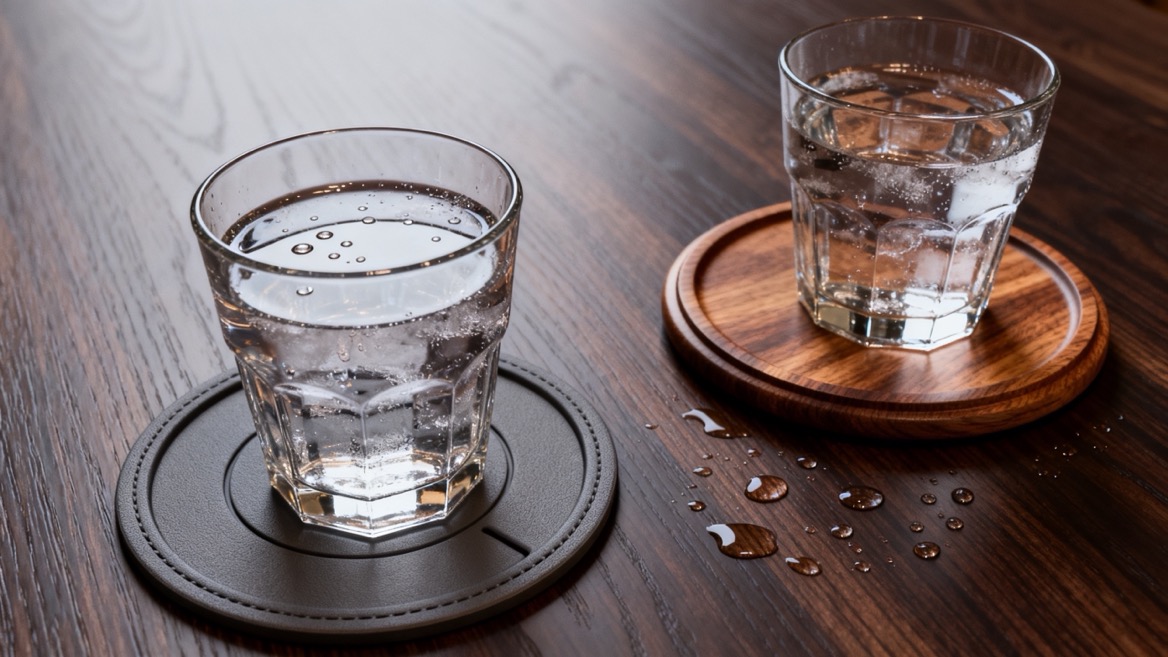
A clean, smooth PVC underside can provide cushioning between drinkware and furniture.
Textured designs may also improve grip, but "non-slip" should be treated as a testable performance claim. Results can change between glass, lacquer, stone, and other surfaces, especially when wet.
Avoid assuming that deep decorative texture always improves performance. An uneven base may reduce stability.
A wooden coaster can protect furniture effectively when its underside is smooth and appropriately finished.
Cork, felt, or another backing may help reduce hard contact, but the entire assembly requires inspection. Backing can collect debris, retain moisture, or separate if the adhesive fails.
Check:
1. Whether the coaster sits flat.
2. Whether its edges are smooth.
3. Whether the backing is securely attached.
4. Whether the backing and adhesive suit the intended furniture finish.
A protective accessory should not introduce a new source of damage.
For premium furniture, this is often the most important comparison.
Canadian conservation guidance warns that flexible PVC can contain plasticizers that migrate and stain materials in contact with it. This is particularly relevant to prolonged contact and sensitive surfaces.
That does not establish that every modern PVC coaster will damage furniture. It does establish that blanket claims such as "safe for all luxury furniture" require evidence.
For antique, historic, or unusually sensitive finishes, follow the furniture maker's or conservator's guidance rather than relying on a generic coaster recommendation.
Wooden coasters are not automatically risk-free either. Their coatings, dyes, adhesives, and backing materials must also be suitable for the surface.
From a product-development perspective, the right question is: "Has this complete coaster been evaluated against the intended finish?"
A purchasing specification becomes much stronger when it includes a repeatable evaluation method.
The following is a proposed screening process, not a standardized laboratory protocol or a claim about completed Yijia testing.
Record the intended drinkware, beverage temperatures, furniture finishes, cleaning methods, and typical contact duration.
A coaster for iced drinks in a café has different requirements from one for hot mugs on an executive desk.
Use spare panels or supplier-provided finish samples rather than valuable furniture.
Photograph and inspect each surface before testing. Check for existing haze, scratches, color variation, and tackiness.
For hot drinks, record the temperature beneath the coaster over a defined period.
For cold drinks, inspect condensation collection, overflow, underside moisture, and cup stability.
Use comparable drinkware and conditions for both coaster types.
Repeat wetting, drying, placement, and cleaning cycles. Inspect for:
- Surface marks or discoloration.
- Sticky residue or color transfer.
- Warping, curling, or cracking.
- Backing separation.
- Changes in grip or flatness.
Specify the approved material, thickness tolerance, underside construction, cleaning instructions, and tested use limits.
Keep an approved sample for comparison with production batches. Screening results support selection, but they do not replace specialist assessment for sensitive finishes.
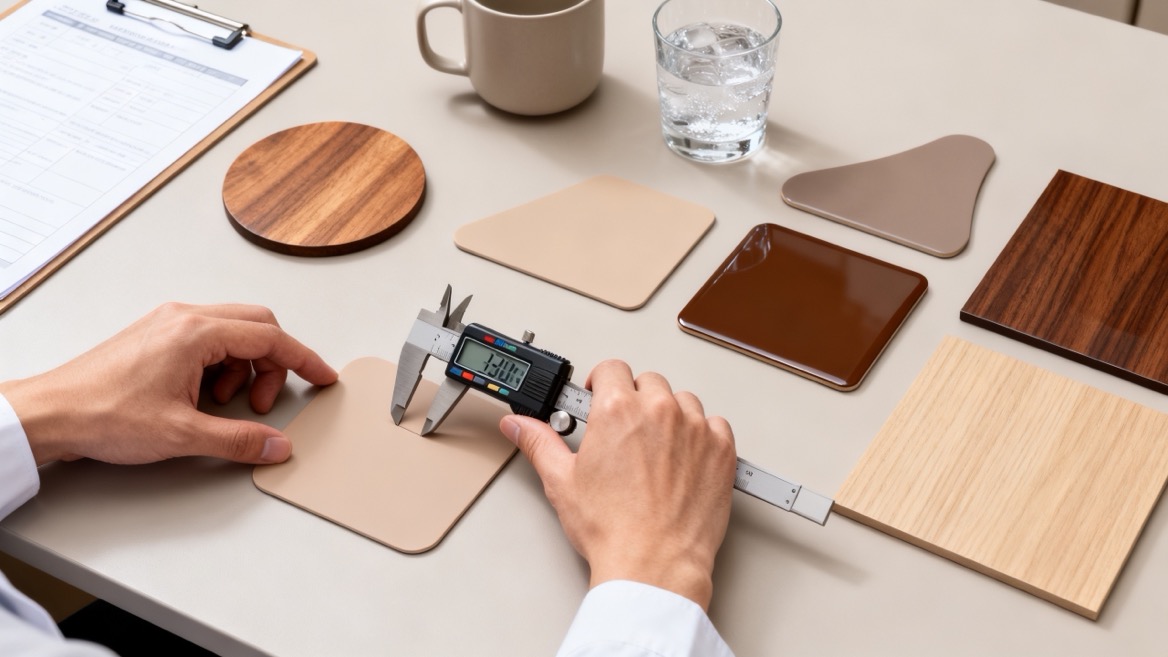
PVC coasters often suit wipe-clean beverage-service applications. Follow the manufacturer's instructions for detergents and washing.
Do not assume dishwasher compatibility. Heat, chemicals, and repeated mechanical stress can affect plastics and decorative features.
Remove the coaster when cleaning the furniture and allow both surfaces to dry before replacing it.
Wooden coasters generally benefit from prompt wiping and drying. Avoid soaking unless the manufacturer specifically permits it.
Over time, inspect the grain, coating, edges, and backing. A worn finish may change how the coaster handles moisture.
For both materials, replace damaged products before they compromise furniture protection. Durability should mean continued performance, not merely continued appearance.
PVC is a strong candidate when the project requires:
- Custom shapes and multicolor artwork.
- Molded logos or dimensional details.
- A generally nonabsorbent surface.
- Repeatable branded designs.
- Integrated collection features for condensation.
These advantages support promotional and hospitality applications, provided the product's thermal limits and finish compatibility are verified.
Wood makes sense when visible grain and a natural aesthetic are central to the experience.
It can complement boutique interiors, executive gifts, and restrained branding. However, species, sealing, engraving, backing, and maintenance requirements need to be specified.
Neither "natural" nor "plastic" alone establishes environmental superiority. A credible assessment would need sourcing, manufacturing, service-life, transport, and disposal information.
Yijia Plastic Products Co., Ltd. brings 18 years of experience in developing, manufacturing, and selling PVC soft-plastic gifts.
Our company information describes a 3,000-square-meter factory with 10 automated production lines and advanced dispensing equipment, supporting one-stop OEM/ODM customization.
We also report cooperation experience involving Starbucks, Disney, McDonald's, Pop Mart, and Tencent. These relationships should be presented within their documented scope, without implying endorsement of every product.
For buyer documentation, distinguish the following:
- RoHS concerns restrictions on hazardous substances in electrical and electronic equipment. A coaster material test against relevant substance limits is not automatically a certification that the coaster falls within that legislation.
- California Proposition 65 addresses exposure and warning obligations; it is not a general product-certification program.
- Disney FAMA is a facility and merchandise authorization, not a universal product-safety approval.
Buyers should request current, applicable documents and confirm which material, product, facility, and order they cover.
A PVC heat-insulating coaster is a practical candidate for moisture management, flexible construction, and branded customization. A wooden coaster is a credible choice for thermal insulation and natural presentation.
The better protector is the finished product that performs reliably on your specific furniture surface.
For a custom project, send Yijia your artwork, cup-base dimensions, intended furniture finish, destination market, and expected order quantity. Request samples and applicable documentation before approving bulk production.
Not in every application. PVC can offer convenient moisture management and customization, while wood can provide effective insulation. Compare thickness, construction, finish compatibility, and tested performance.
Potentially. Flexible PVC additives can migrate and affect contacting materials. Avoid unsupported universal-safety claims, particularly for sensitive finishes and prolonged contact.
They can help, but protection depends on sealing, moisture handling, and underside dryness. Remove wet coasters and wipe up spills promptly.
Only within the product's validated use limits. Ask for temperature and contact-duration information. Do not assume a beverage coaster is suitable for cookware.
Confirm dimensions, thickness, underside finish, material documentation, cleaning instructions, sample performance, and compatibility with the intended furniture surface.
1. Canadian Conservation Institute. "Care of Furniture Finishes." Guidance on protective coatings and furniture care. [Read the source]. [canada]
2. Canadian Conservation Institute. "Products Used in Preventive Conservation—Technical Bulletin 32." Discussion of flexible PVC, plasticizer migration, and contact-related staining. [Read the source]. [canada]
3. The Institute of Conservation. "Furniture." Guidance on moisture, environmental fluctuations, and furniture preservation. [Read the source]. [icon.org]
4. BioResources. "Thermal Conductivity of Plantation Wood Species and Selected Tropical Hardwoods from the Philippines." Research on wood conductivity, density, and moisture content. [Read the source]. [bioresources.cnr.ncsu]
5. Alfa Chemistry. "Plastic Thermal Conductivity Reference Table." General PVC conductivity reference; not a specification for Yijia products. [Read the source]. [alfa-chemistry]
6. Canadian Conservation Institute. "Care of Objects Made from Rubber and Plastic." Guidance on deterioration, heat, and material-care limitations. [Read the source]. [canada]
7. European Commission. "RoHS Directive." Official explanation of scope and restricted substances. [Read the source]. [environment.ec.europa]
8. California Office of Environmental Health Hazard Assessment. "Frequently Asked Questions for Businesses." Official explanation of Proposition 65 exposure and warning obligations. [Read the source]. [p65warnings.ca]
9. The Walt Disney Company. "Facility and Merchandise Authorization Application Instructions." Official explanation of FAMA requirements. [Read the source]. [thewaltdisneycompany]


