
Views: 255 Author: Yijia Plastic Publish Time: 2026-10-13 Origin: Site
Content Menu
● PVC Heat-Insulating Mat vs. Silicone Heat Mat: Quick Comparison
● What Is the Difference Between Soft PVC and Silicone?
>> Soft PVC: Flexible Thermoplastic for Custom Coasters
>> Silicone: Elastomer with a Wider Thermal Operating Range
● Heat Resistance and Heat Insulation Are Different
>> Why Thickness and Geometry Matter
>> Coffee Temperature Is Not Cup-Base Temperature
● Which Material Is Better for Hot Coffee Service?
>> Choose Silicone When Thermal Margin Comes First
>> Consider PVC for Validated Branded Cup Service
● Custom Branding: Evaluate Appearance and Function Together
● Cleaning, Grip, and Long-Term Appearance
>> Specify the Actual Cleaning Routine
>> Test Grip Under Real Conditions
● Compliance: What the Documents Actually Establish
>> RoHS and Proposition 65 Are Not Heat Ratings
>> Food-Contact Suitability Depends on Intended Use
>> Disney FAMA Has a Specific Purpose
● A Practical Sample-Testing Plan for Buyers
>> Step 1: Define the Service Scenario
>> Step 2: Measure the Contact Conditions
>> Step 3: Compare Equivalent Samples
>> Step 4: Repeat Use and Cleaning
>> Step 5: Preserve Production Traceability
● Two Procurement Scenarios That Clarify the Choice
>> Scenario One: Promotional Ceramic-Mug Coaster
>> Scenario Two: Reusable Café Service Mat
● Compare Lifecycle Cost, Not Just the Quotation
● Build Your Custom Coffee Coaster Around Real Service Conditions
>> Is Silicone Better Than PVC for Hot Coffee?
>> Can a PVC Coaster Hold a Freshly Filled Coffee Mug?
>> Does Silicone Automatically Protect Wooden Tables?
>> Are PVC and Silicone Coasters Dishwasher Safe?
>> Is RoHS Documentation Enough to Prove Food-Contact Safety?
>> What Should Buyers Send with a Custom Coaster Inquiry?
A PVC heat-insulating mat and a silicone heat mat can both provide a practical surface beneath a coffee cup, but they are not interchangeable. Silicone is generally the stronger choice when heat resistance is the priority. Soft PVC can be a useful option for colorful, custom-branded coasters, provided the finished product has been validated for its actual temperature exposure.
At Yijia Plastic Products Co., Ltd., our perspective starts with the application rather than the material name. A promotional coaster beneath a ceramic mug has different requirements from a mat supporting a hot metal coffee server.
The purchasing principle is simple: validation matters more than a generic "heat-resistant" label.

| Purchasing factor | PVC heat-insulating mat | Silicone heat mat |
|---|---|---|
| Heat resistance | Formulation-dependent; soft PVC needs careful application testing | Generally offers a wider heat-resistance margin |
| Best-fit application | Branded coasters for validated cup-contact conditions | Repeated hot-cup service and higher-temperature applications |
| Custom appearance | Suitable for colorful molded designs and raised lettering | Supports molded shapes, textures, and branding |
| Table protection | Depends on thickness, geometry, and exposure | Also depends on thickness, geometry, and exposure |
| Cleaning | Specify a validated washing method | Verify dishwasher suitability rather than assuming it |
| Compliance | Requires relevant product-specific documentation | Requires relevant product-specific documentation |
| Purchasing priority | Decorative value plus verified performance | Thermal margin plus verified performance |
Neither material automatically guarantees protection for every tabletop. A thin silicone mat can still transmit enough heat to affect a sensitive finish.
Soft PVC is polyvinyl chloride formulated with plasticizers and other additives to produce flexibility. Its properties depend on the complete formulation, including plasticizer content, stabilizers, pigments, and fillers.
This flexibility makes it useful for decorative products with raised logos, contrasting colors, and shaped edges.
However, flexibility does not establish thermal suitability. A supplier's processing temperature also does not establish the safe operating temperature of a finished coaster.
For example, Grafix Plastics states that its flexible PVC films begin softening around 60°C. That information is a useful caution, not a universal temperature rating for every molded PVC coaster.
Cured silicone rubber is an elastomer rather than a conventional thermoplastic. Suitable grades retain useful properties across a broad temperature range.
WACKER's silicone rubber guidance describes a broad operating range of approximately −50°C to +250°C, with performance depending on the grade and conditions.
These figures describe material capabilities, not automatic ratings for finished mats. Printing, bonded layers, pigments, and construction may impose additional limits.
For demanding hot coffee service, silicone therefore offers a stronger starting point—but the selected product still needs verification.
A material can resist heat without preventing heat from reaching the table.
Heat resistance concerns whether the mat remains functional during exposure. Heat insulation concerns how much heat passes through it.
Both affect purchasing decisions.
Table protection depends on:
- Material thermal conductivity.
- Mat thickness.
- Contact area beneath the cup.
- Ribs, recesses, or other structural features.
- Exposure duration.
- The tabletop material and finish.
WACKER reports typical thermal conductivity of approximately 0.2–0.3 W/(m·K) at 100°C for standard silicone rubber. Fillers can change this considerably.
Consequently, "silicone" alone is not an insulation specification. Buyers should compare finished designs, not just material names.
Raised ribs may reduce direct contact area, but they can also affect stability and cleaning. Any thermal benefit should be demonstrated rather than presumed.
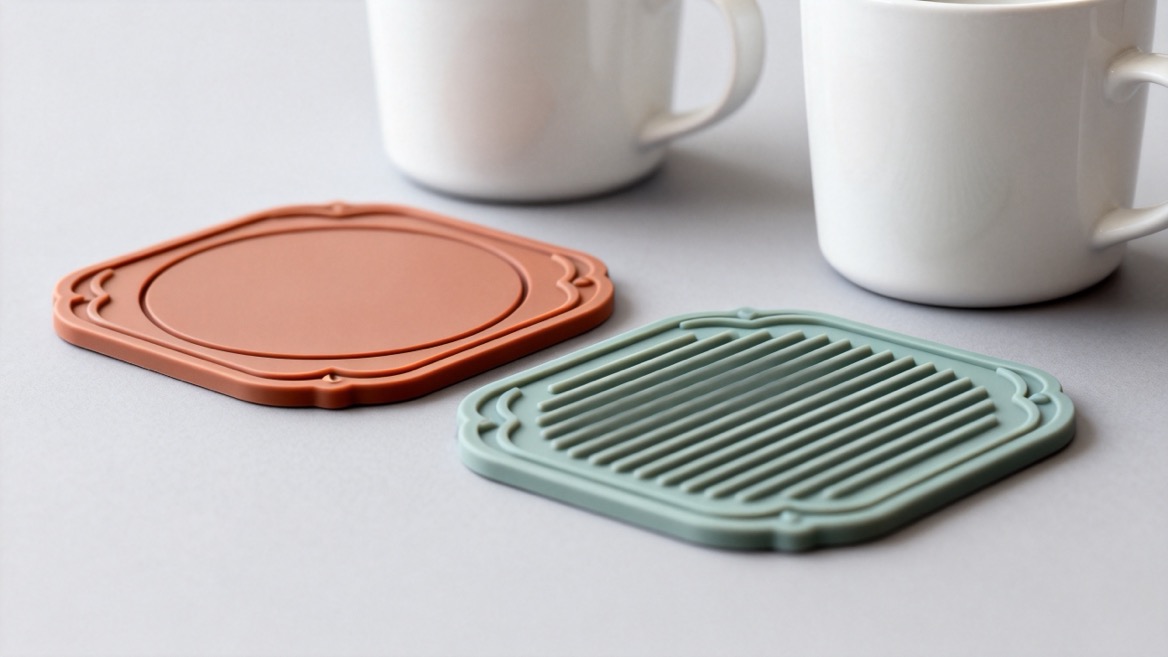
The coffee inside a cup does not directly establish the temperature touching the mat.
Cup construction, base geometry, wall thickness, fill volume, and elapsed time influence that interface. A ceramic mug with a foot ring behaves differently from a flat-bottomed metal vessel.
The relevant question is therefore:
> What temperature does this particular vessel create at the mat interface, and for how long?
That question is more useful than asking whether a coaster can "handle hot coffee."
A silicone heat mat is generally preferable when:
- Hot vessels repeatedly occupy the same position.
- Service conditions vary between locations.
- Staff may use different vessel types.
- The product must tolerate a demanding cleaning routine.
- Buyers need a wider margin against thermal deformation.
Metal servers, kettles, and other hotter vessels require their own validated use conditions. A silicone coffee coaster should not automatically be treated as a cookware trivet.
A PVC heat-insulating mat may suit projects emphasizing visual identity and custom molding, especially when the intended vessel and contact conditions are clearly defined.
Examples include:
- Promotional coffee coasters.
- Corporate gift sets.
- Branded café accessories.
- Collectible character designs.
- Hospitality welcome packs.
Approval should follow sample testing with the intended cup and surface.
Do not position an ordinary soft PVC coaster as suitable for unrestricted hot cookware, ovens, or direct flame.
Yijia's supplied company profile describes 18 years of experience in developing, manufacturing, and selling PVC soft gifts, including PVC coasters.
The profile also identifies a 3,000-square-meter factory, 10 automated production lines, advanced dispensing equipment, and one-stop OEM/ODM services.
For a custom coaster project, those capabilities should translate into practical design discussions:
- Can fine lettering remain legible?
- Will raised graphics interfere with cup stability?
- Are recesses easy to clean?
- Can production maintain consistent thickness?
- Does the packaging explain the intended use?
A visually impressive sample is not enough. It must work under the vessel it is designed to support.
Yijia also reports cooperation experience involving Starbucks, Disney, McDonald's, Pop Mart, and Tencent. Buyers should request relevant, shareable project evidence rather than interpret those names as endorsements of a new product.
Neither PVC nor silicone should receive an automatic dishwasher-safe claim.
Ask the manufacturer to validate:
1. Washing temperature.
2. Detergent type and concentration.
3. Exposure duration.
4. Drying method.
5. Number of repeated cycles.
A smooth design may simplify wiping. Deep grooves and raised lettering require additional inspection because they create more surfaces to clean.
For commercial service, assess cleanliness after coffee, milk, and syrup exposure—not just after washing an unused sample.
Surface texture can influence grip, but material identity does not guarantee slip resistance.
Test the mat on the intended countertop when dry and when lightly wet. Check whether it stays flat and whether the cup remains stable during normal placement.
Record changes after cleaning and thermal exposure, including:
- Curling or permanent indentation.
- Tackiness or surface residue.
- Color transfer.
- Logo damage.
- Noticeable odor changes.
These observations help compare samples. They do not replace chemical or regulatory testing.
Yijia's company brief reports documentation associated with EU RoHS and California Proposition 65.
Buyers should obtain the underlying reports and verify the tested product, formulation, date, substances, and scope.
A restricted-substance report does not prove that a coaster protects a table from heat.
Proposition 65 is an exposure-warning law, not a universal product certification. Whether a warning is required depends on relevant exposure considerations, not simply whether a product carries a "passed" statement.
A coaster beneath a closed-bottom cup serves a different function from a mat used to hold food directly.
For intended food-contact applications, review the regulatory status of the formulation and applicable conditions of use.
FDA guidance explains that food-contact compliance depends on the relevant substances, specifications, and use limitations. "Food-grade silicone" alone is not sufficient evidence for every finished article.
Disney FAMA means Facility and Merchandise Authorization. It concerns authorization to use a facility for relevant Disney-branded production.
It is not a general heat-resistance, food-contact, or product-safety certificate.
Keep manufacturing authorization, chemical documentation, and thermal performance evidence separate.
The following is a proposed procurement protocol, not a standardized certification test.
Document the vessel type, fill volume, starting beverage temperature, contact duration, tabletop finish, and cleaning routine.
Also identify foreseeable misuse, such as substituting a metal server for a ceramic mug.
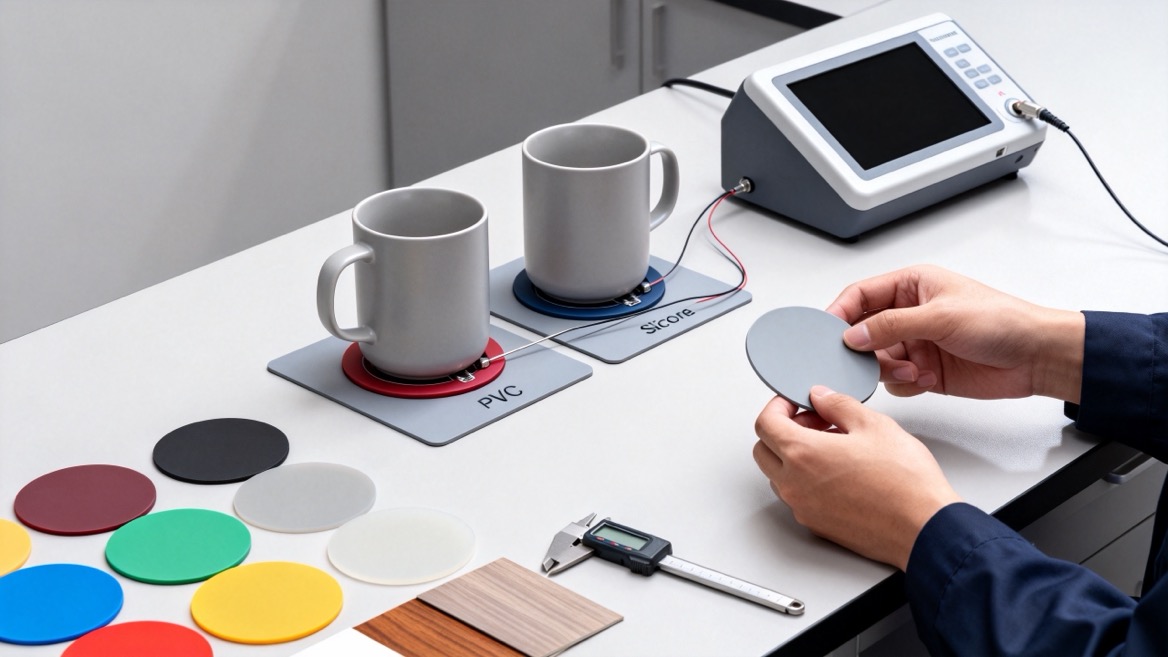
Use a suitable measurement method to record temperatures near the vessel–mat interface and beneath the mat.
Keep the setup consistent. Sensor placement can affect results, so obtain laboratory assistance when necessary.
Where possible, compare PVC and silicone samples with similar footprints and thicknesses.
Otherwise, distinguish material effects from design effects.
Use the same vessel, fill conditions, contact duration, and tabletop.
Inspect samples across repeated thermal and cleaning cycles. Evaluate flatness, indentation, grip, color, surface condition, and the tabletop.
Define acceptance criteria before testing. "Looks acceptable" is weaker than a documented requirement.
Record the approved formulation, dimensions, artwork, test conditions, and reference sample.
Ask suppliers to notify you before changing additives, pigments, printing systems, or manufacturing processes that could affect performance.
A brand wants a colorful, molded coaster for occasional office coffee use.
PVC deserves consideration when customization is central and testing confirms acceptable performance beneath the specified ceramic mug.
The procurement brief should clearly exclude hotter vessels and unvalidated washing methods.
A café group needs mats used repeatedly throughout the day with varied vessels and frequent cleaning.
Silicone is the more defensible starting point because of its broader thermal capability.
Nevertheless, the buyer should validate finished samples and specify cleaning conditions.
These are illustrative scenarios, not claims about completed customer projects.
A useful comparison includes:
- Tooling and development.
- Material and decoration.
- Packaging and freight.
- Inspection and testing.
- Cleaning requirements.
- Replacement frequency.
- Expected service life.
Avoid assuming that PVC is always cheaper or silicone always lasts longer.
Order quantity, design complexity, formulation, and actual use can change the result. Procurement decisions should reflect the cost of maintaining acceptable performance—not only the first purchase price.
Choose silicone when a wider thermal margin is the priority. Consider PVC when custom branding is central and the intended cup-contact conditions have been validated.
For a custom PVC coaster project, send Yijia Plastic Products Co., Ltd. your artwork, target dimensions, order quantity, and service requirements. Request a production-representative sample and relevant documentation before approving the order.
Generally, silicone is better when thermal resistance is the main priority. PVC may suit branded cup service when finished-product testing confirms that the intended contact conditions are acceptable.
Potentially, but the answer depends on the formulation, cup-base temperature, contact duration, and design. Test the actual mug and coaster combination before making that claim.
No. Protection depends on thickness, geometry, exposure duration, and the surface finish. Test representative tables and establish acceptable limits.
Not automatically. Validate the finished product under the proposed dishwasher temperature, detergent, cycle duration, and repeated-use conditions.
No. Restricted-substance documentation does not establish suitability for every food-contact application. Review the relevant formulation and intended-use requirements separately.
Provide artwork, dimensions, quantity, destination market, vessel type, temperature conditions, cleaning method, and documentation requirements. These details enable a more useful quotation and sample plan.
- WACKER Chemie AG, "Solid and Liquid Silicone Rubber—Material and Processing Guidelines." Manufacturer guidance supporting the silicone temperature-range discussion, thermal-conductivity figures, and formulation-dependent performance limitations. [wacker]
- Grafix Plastics, "What Is the Heat Resistance of Flexible PVC Film and Sheets?" Published October 3, 2023. Supports the flexible-film softening example; its figures are not presented as a universal rating for molded PVC coasters. [grafixplastics]
- U.S. Food and Drug Administration, "Determining the Regulatory Status of Components of a Food Contact Material." Explains component-level regulatory status, manufacturer responsibilities, specifications, and intended-use limitations. [fda]
- California Proposition 65 Warnings Website, "Frequently Asked Questions." Explains the exposure-warning framework and why Proposition 65 should not be represented as a universal product-safety certification. [p65warnings.ca]
- The Walt Disney Company, "Facility and Merchandise Authorization Application." Explains the facility authorization required before relevant Disney-branded products may be produced or handled. [thewaltdisneycompany]


