
Views: 215 Author: Yijia Plastic Publish Time: 2026-10-20 Origin: Site
Content Menu
● PVC Heat-Resistant Coaster vs. Silicone Coaster: Quick Comparison
>> Soft PVC: A Formulation-Dependent Material
>> Silicone: Greater Thermal Headroom
● Heat Resistance: Measure the Contact Conditions
>> Beverage Temperature Is Not Coaster Temperature
>> Separate Heat Survival From Table Protection
● Grip, Stability, and Spill Management
>> Non-Slip Performance Depends on Design
>> Water Resistance Does Not Mean Absorbency
● Branding and Customization for Commercial Buyers
>> Where Custom PVC Coasters Make Sense
>> Silicone Branding Also Requires Production Planning
● Cleaning, Odor, and Daily Maintenance
● Compliance Documents: What They Actually Demonstrate
>> RoHS Is Not a General Coaster Safety Certificate
>> Proposition 65 Is an Exposure-Based Requirement
>> Disney FAMA Is a Manufacturing Authorization
● A Practical Sample-Validation Protocol
>> Step 1: Define Realistic Exposure
>> Step 2: Compare Equivalent Designs
>> Step 3: Repeat Heat and Cleaning Cycles
>> Step 4: Record Specific Failure Modes
>> Step 5: Control Bulk Production
● Cost Comparison: Purchase Price Is Only One Variable
● How Yijia Can Support a Custom PVC Coaster Project
● Choose by Application, Then Verify the Product
>> Is a PVC Heat-Resistant Coaster Suitable for Hot Coffee?
>> Is Silicone Better for Repeated Heat Exposure?
>> Can Either Coaster Go in a Dishwasher?
>> Which Material Is Better for Promotional Branding?
>> Does a Coaster Need Food-Contact Testing?
>> Can a Silicone Coaster Hold a Hot Pan?
A PVC heat-resistant coaster can be a practical choice for branded coffee corners, while a silicone coaster generally offers greater heat tolerance for demanding hot beverage stations. The better option depends on actual cup-base temperatures, cleaning routines, design requirements, and purchasing costs—not simply the temperature printed in a product listing.
For procurement teams, my recommendation is straightforward: prioritize silicone when thermal margin is the deciding factor. Consider custom soft PVC coasters when distinctive branding and project economics matter, provided the finished product passes testing under your intended conditions.
This guide compares both materials from a manufacturing and purchasing perspective, explaining where each performs well and what buyers should verify before placing an order.

| Purchasing factor | Soft PVC coaster | Silicone coaster |
|---|---|---|
| Heat tolerance | Formulation-specific; require finished-product validation | Generally greater heat tolerance; verify the actual grade |
| Branding options | Suitable for molded colors, raised logos, and custom shapes | Supports molded shapes, textures, and branding |
| Surface protection | Depends on thickness, backing, and contact conditions | Also depends on thickness, backing, and contact conditions |
| Grip | Influenced by texture, hardness, moisture, and countertop | Influenced by the same factors; not automatically slip-proof |
| Spill handling | Nonabsorbent designs need suitable channels or edges | Nonabsorbent designs also need drainage or containment |
| Cleaning | Confirm detergent and temperature compatibility | Potentially suited to hotter cleaning, subject to validation |
| Cost | Can be attractive for promotional projects; compare quotations | Compare equivalent specifications rather than material labels |
| Best starting point | Branded mug stations with verified operating conditions | Stations prioritizing thermal tolerance |
Neither material wins every category. A well-specified coaster is more useful than a poorly designed product made from a nominally superior material.
Flexible PVC combines PVC resin with plasticizers and other additives. Manufacturers adjust the formulation to achieve particular flexibility, hardness, color, and performance characteristics.
This explains why "PVC heat-resistant coaster" is not a universal temperature classification. Two visually similar coasters can behave differently because their compounds, thicknesses, and decorative layers differ.
From a buyer's perspective, the key question is not "Is PVC heat resistant?" It is "What conditions has this specific finished coaster been tested to withstand?"
Silicone rubber is a cured elastomer with generally strong resistance to heat and temperature-related aging.
WACKER's technical literature describes broad operating ranges for silicone rubber, including approximately −50°C to +250°C across relevant material families. That is background information about silicone technology, not a guaranteed rating for every retail silicone coaster.
Pigments, formulation, curing, printing, and construction still matter. Request product-specific evidence instead of applying a raw-material temperature range to a finished accessory.
The temperature inside a cup does not directly establish the temperature where its base touches the coaster.
Cup construction changes heat transfer. A thick ceramic mug, a double-wall vessel, and a thin metal cup can create different contact conditions. Contact area and dwell time also influence the result.
For a hot beverage station, record:
- Cup material and base dimensions.
- Maximum measured cup-base temperature.
- Typical and longest placement times.
- Frequency of replacement with another hot cup.
- Countertop material and finish.
- Whether hot servers or other equipment could be placed on the coaster.
This creates a usable specification rather than a vague request for "high-temperature resistance."
A coaster can remain intact while the surface underneath becomes too warm for a sensitive finish.
Heat resistance describes whether the coaster tolerates exposure. Thermal protection describes how effectively the complete arrangement limits heat reaching the countertop.
Therefore, test both the coaster and the protected surface. Look for deformation, discoloration, tackiness, surface marks, and unacceptable temperature rise beneath the sample.
Neither a thin silicone coaster nor a thin PVC coaster should automatically be treated as a trivet.
Material choice contributes to grip, but it does not determine the result alone.
A heavily textured top may support one mug securely while allowing another to rock. A smooth underside may behave differently on dry stone, wet laminate, or a polished tray.
Evaluate both interfaces:
1. Cup against coaster.
2. Coaster against countertop.
Test with the lightest and heaviest vessels in normal service. Repeat under dry and lightly wet conditions.
A stable contact platform is usually more valuable than decorative relief directly beneath the cup base.
Neither PVC nor silicone should be selected on the assumption that it absorbs spills.
For stations serving both hot and iced drinks, liquid-management geometry deserves attention:
- A shallow rim can contain small spills.
- Channels can move liquid away from the cup's contact area.
- Open patterns may allow liquid to reach the countertop.
- Deep recesses may increase cleaning effort.
Match the design to the actual beverage menu. A coaster intended for occasional tea service may need different features from one repeatedly exposed to iced coffee condensation and milk splashes.
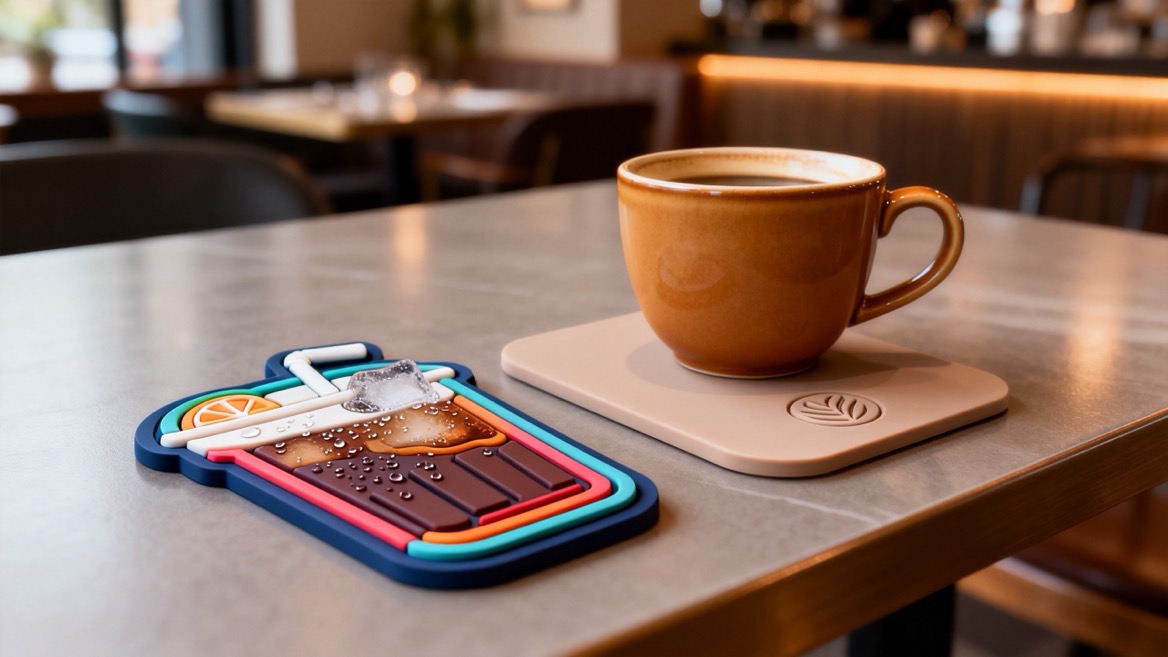
Soft PVC is a useful option for character shapes, contrasting molded colors, raised lettering, and dimensional brand elements.
For promotional programs, the coaster can function as both a practical accessory and a recognizable branded object.
However, visual complexity should not compromise usability. Keep the main cup-contact area stable, and avoid placing tall decorative elements where they interfere with common mug sizes.
My preferred design principle is simple: let the perimeter carry much of the personality while the center supports the drink.
Silicone coasters can incorporate molded logos, embossed or debossed details, textures, and custom shapes.
Neither material guarantees accurate color reproduction or fine-detail consistency. Buyers should approve physical samples showing:
- Logo legibility.
- Color appearance under agreed lighting.
- Edge quality and thickness.
- Cup fit and stability.
- Branding durability after cleaning.
Specify which details are molded and which are printed. Printed decorations may have different durability limits from the underlying material.
A coaster for a commercial beverage station must fit the operator's cleaning routine.
Silicone's greater thermal tolerance can make it a stronger candidate where hotter cleaning is required. Nevertheless, "silicone" alone does not establish dishwasher compatibility.
For either material, confirm the permitted:
- Cleaning temperature.
- Detergent and sanitizer.
- Contact time.
- Scrubbing method.
- Drying and storage conditions.
Test the complete product, including printing and backing. Examine whether cleaning changes color, dimensions, grip, odor, or surface feel.
Do not accept "odorless" as a substitute for chemical assessment. Equally, do not treat odor alone as proof of a particular chemical hazard. Investigate persistent or unusual smells through appropriate supplier review and testing.
The EU RoHS Directive restricts certain hazardous substances in electrical and electronic equipment.
An ordinary non-electrical coaster generally falls outside that scope. Buyers may request testing against RoHS substance limits as a purchasing requirement, but such testing does not establish heat resistance, food-contact suitability, or universal product safety.
Review the report's sample description, tested components, methods, and results.
California Proposition 65 concerns warnings about exposure to listed chemicals. It is not a general product certification scheme.
A statement such as "Proposition 65 compliant" needs supporting context: which substances were assessed, what exposure assumptions were used, and whether a warning is required.
A chemical screening report and a complete exposure assessment are not necessarily the same thing.
Disney's Facility and Merchandise Authorization concerns authorization to produce or handle Disney-branded products at a facility under the relevant arrangements.
It does not certify coaster heat resistance or authorize unrelated buyers to reproduce Disney artwork.
Keep facility authorization, chemical documentation, product performance, and intellectual-property permission separate.
The following is a proposed purchasing workflow, not a published laboratory standard or a claim about completed Yijia testing.
Measure representative cup-base temperatures during service. Establish normal conditions and a credible worst-case condition before requesting samples.
Keep dimensions, thickness, contact area, and decoration reasonably comparable. Otherwise, you may be comparing geometry rather than PVC against silicone.
For an initial internal screen, buyers could agree on 50 placement-and-cleaning cycles, followed by a longer site trial.
This is a proposed screening quantity, not an industry benchmark. Cycle count, duration, and acceptance criteria should reflect the intended service.
Inspect for:
- Curling, cracking, or permanent deformation.
- Color transfer or countertop marking.
- Increased tackiness or persistent odor.
- Logo deterioration.
- Reduced grip or unstable cup placement.
Retain an approved reference sample. Record formulation identification, dimensions, hardness where relevant, colors, and decoration method.
Require review before material or process substitutions. A successful prototype does not automatically establish consistent bulk performance.
Avoid assuming that PVC is always cheaper or that silicone always delivers better lifetime value.
Request quotations using the same dimensions, artwork, quantity, packaging, and delivery terms. Identify tooling and testing charges separately.
A practical comparison is:
Total operating cost = delivered purchasing cost + cleaning labor + replacement cost + verified damage-related costs.
For example, a lower-priced coaster may lose its advantage if its detailed surface takes substantially longer to clean. Conversely, a validated PVC design may be entirely appropriate for a low-intensity branded mug station.
Use a short operational trial to identify these differences before committing to a large rollout.
According to the company information supplied for this article, Yijia Plastic Products Co., Ltd. combines research, development, production, and sales of soft PVC gifts, including custom PVC coasters.
Its stated capabilities include:
- 18 years of experience.
- A 3,000-square-meter factory.
- 10 automated production lines.
- Multiple advanced dispensing machines.
- One-stop OEM/ODM customization.
Yijia also reports cooperation experience involving Starbucks, Disney, McDonald's, Pop Mart, and Tencent. These statements should not be interpreted as current endorsements or permission to reproduce their trademarks.
For procurement, the most useful next step is a project-specific discussion connecting artwork, construction, performance requirements, and relevant documentation. Historical company credentials cannot replace approval of the actual coaster being ordered.
For heat-focused stations, start with silicone. For distinctive branded mug stations, consider a validated PVC design.
Send Yijia your artwork, vessel dimensions, measured contact conditions, cleaning method, destination market, and order quantity. Request a custom PVC coaster proposal, representative samples, and relevant documentation before approving production.
It can be, provided the finished coaster is validated for the intended cup-base temperature, contact duration, and countertop. Do not infer suitability from the beverage name or a generic material description.
Silicone generally offers greater thermal headroom. However, buyers should still verify the finished coaster's grade, construction, decoration, and performance under repeated use.
Only when the supplier supports that use for the complete product. Temperature resistance alone does not establish resistance to detergent, spray pressure, repeated cycles, or decoration damage.
Both support customization. PVC deserves consideration for dimensional, multicolor promotional designs. Silicone remains a strong option when thermal tolerance carries greater weight. Approve a physical sample before selecting either.
Requirements depend on the intended use and destination market. Supporting a closed cup differs from direct contact with food or beverages. Define foreseeable use and obtain advice appropriate to that application.
Not automatically. A drink coaster may be too thin or otherwise unsuitable for cookware. Use a product specifically designed and validated as a trivet.
1. WACKER Chemie AG. [Solid and Liquid Silicone Rubber: Material and Processing Guidelines]. Technical background on silicone properties and operating-temperature ranges; these are not universal finished-coaster ratings. [wacker]
2. Teknor Apex. [Flexible PVC Compounds]. Background on flexible PVC composition and formulation-dependent properties. [teknorapex]
3. European Commission. [RoHS Directive]. Official explanation of hazardous-substance restrictions and the directive's electrical and electronic equipment scope. [environment.ec.europa]
4. California Office of Environmental Health Hazard Assessment. [Business Resources: Proposition 65 Warnings]. Official guidance on business responsibilities, exposure assessment, warnings, and exemptions. [p65warnings.ca]
5. The Walt Disney Company. [Facility and Merchandise Authorization Application and Instructions]. Explanation of facility authorization for Disney-branded production. [thewaltdisneycompany]


