
Views: 264 Author: Yijia Plastic Publish Time: 2026-10-24 Origin: Site
Content Menu
● PVC Soft Rubber Mat vs. EVA Mat: Quick Comparison
● What Are PVC Soft Rubber Mats and EVA Mats?
>> PVC Soft Rubber Mats: Flexible Plastic, Not Conventional Rubber
>> EVA Mats: Lightweight Foam With Useful Cushioning
● Spill Management and Wet-Counter Performance
>> PVC Bar Mats Can Be Designed Around Liquid Collection
>> EVA Water Resistance Does Not Equal Spill Containment
>> Test Grip on the Actual Countertop
● Cleaning and Hygiene: Evaluate the Finished Surface
>> Cleaning a PVC Soft Rubber Bar Mat
>> Cleaning an EVA Countertop Mat
● Durability, Temperature, and Chemical Compatibility
>> Compare Specific Grades, Not Generic Material Claims
>> Watch for Different Failure Modes
● Custom Branding and Beverage-Service Design
>> Where Custom PVC Bar Mats Have an Advantage
>> Where EVA Branding Makes Sense
● Compliance Documents: What Buyers Should Actually Request
● A Practical Five-Day PVC vs. EVA Sample Trial
>> Day 1: Establish the Baseline
>> Day 2: Reproduce Typical Spills
>> Day 3: Repeat the Cleaning Routine
>> Day 4: Check Loading and Wet Grip
>> Day 5: Inspect Both Mat and Countertop
● Purchase Price vs. Cost per Service Day
● Choosing a Manufacturing Partner
>> Is PVC or EVA better for a busy cocktail bar?
>> Can an EVA mat absorb beverage spills?
>> Are PVC bar mats dishwasher-safe?
>> Is EVA always more environmentally friendly than PVC?
>> Can either mat contact food directly?
>> What should I approve before bulk production?
For most busy beverage stations, a PVC soft rubber mat is the stronger starting point when spill containment, molded branding, and a stable working surface matter most. An EVA mat is worth considering when lightweight cushioning and portability take priority. The right choice depends on the finished design—not simply the material name.
At Yijia Plastic Products Co., Ltd., our focus is custom PVC manufacturing, so we approach this comparison from a manufacturer's perspective. However, recommending PVC for every application would overlook EVA's practical advantages. A cocktail service station, a café display counter, and a temporary sampling booth have different requirements.
This guide compares PVC soft rubber mats and EVA mats for commercial beverage countertops, including cleaning, durability, customization, purchasing costs, and sample evaluation.

The comparison below assumes a molded, non-foamed flexible PVC bar mat and a typical closed-cell EVA foam mat. Specialized formulations and constructions can change the outcome.
| Purchasing factor | PVC soft rubber mat | EVA foam mat |
|---|---|---|
| Core structure | Flexible, generally solid PVC compound | Lightweight, cellular EVA foam |
| Typical advantage | Molded spill-management features and branding | Cushioning and low weight |
| Liquid management | Can incorporate raised borders, ribs, or collection wells | Flat sheets generally need additional shaping for containment |
| Countertop stability | Greater mass can help, but underside design matters | Lightweight construction makes wet-surface testing important |
| Glass cushioning | Depends on compound hardness and surface geometry | Foam structure provides cushioning |
| Cleaning | Accessible molded surfaces can simplify washing | Surface skin, cut edges, texture, and printing require evaluation |
| Customization | Suitable for integrated raised or recessed logos | Suitable for cutting, printing, and selected embossing processes |
| Main buying risk | Assuming every PVC formulation performs identically | Assuming all closed-cell foam constructions perform identically |
Neither material automatically delivers slip resistance, food-contact suitability, dishwasher compatibility, or a guaranteed service life.
"Soft rubber" is a commercial description commonly used for flexible PVC promotional products. Technically, PVC is a plastic. Plasticizers help make the material flexible, and the complete formulation influences softness, processing, and performance.
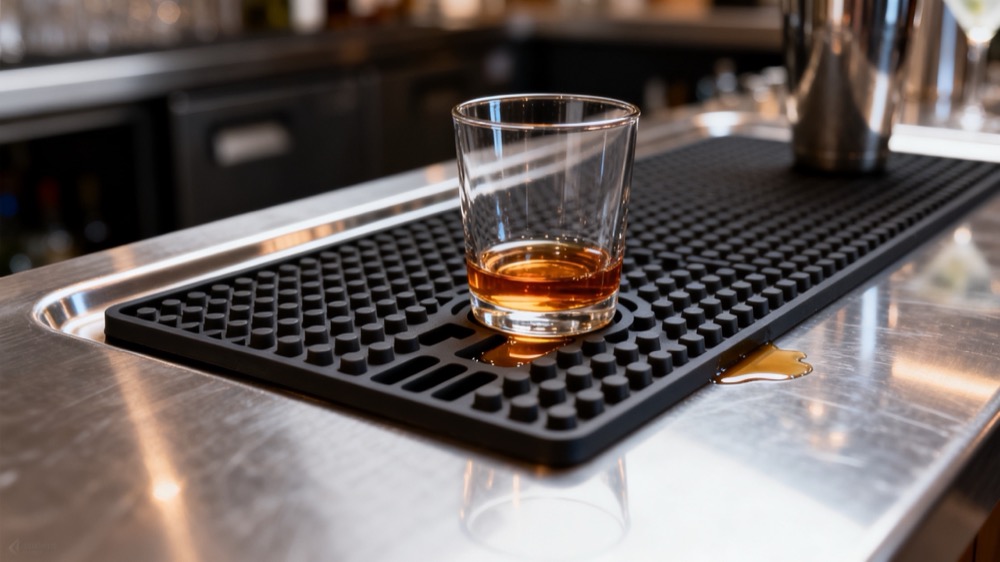
For a commercial PVC bar mat, material selection works together with geometry. Raised studs can support glassware above collected liquid, while an outer border can help contain small spills.
A dense mat with poor drainage geometry may still perform badly. Likewise, an attractive logo cannot compensate for unstable glass-support points.
EVA stands for ethylene-vinyl acetate. Many EVA mats use closed-cell foam, whose separated cells support lightweight cushioning and resistance to water uptake.
Closed-cell construction should not be confused with a guarantee that every finished mat is easy to clean. Cut edges, embossed channels, printed layers, adhesives, and surface damage can affect maintenance.
For beverage businesses, EVA is most compelling when the mat must be easy to transport or provide padding without adding much weight.
At cocktail stations and beverage pickup points, the practical question is not simply, "Does this material resist water?"
It is, "Where does the spilled liquid go?"
A molded PVC mat can incorporate:
- Raised supports that separate glass bases from collected liquid.
- A perimeter lip that helps limit spill spread.
- Collection spaces between ribs or studs.
- A footprint matched to the service area.
These features must remain accessible for cleaning. Narrow decorative channels may hold residue, while an excessively high border can interfere with moving glassware.
A useful design balances collection capacity, stable support, and easy emptying.
A flat EVA sheet may resist water absorption while allowing spilled drinks to run directly onto the countertop.
This does not make EVA unsuitable. It means water resistance and spill containment are different purchasing criteria.
For a dry display area, a flat EVA mat may be sufficient. For repeated cocktail spills, ask whether the proposed design actually captures liquid and whether staff can lift it without spilling the contents.
Neither PVC nor EVA should be described as universally non-slip.
Performance changes with the underside texture, countertop finish, detergent residue, moisture, and loading. A mat that grips dry stainless steel may behave differently on wet polished stone.
Test samples on the surface used in your business, including realistic wet conditions.
Commercial beverage countertops encounter sugar, milk, coffee, fruit pulp, and cleaning chemicals. A mat needs a repeatable cleaning process—not just a wipe-clean claim.
FDA guidance for relevant non-food-contact equipment surfaces emphasizes durability, nonabsorbency, and cleanability. Those principles provide a useful purchasing framework, although applicable requirements depend on the operation and jurisdiction.
For an approved formulation and design, a practical routine is:
1. Remove glassware and empty collected liquid.
2. Wash with the supplier-approved detergent and water conditions.
3. Brush accessible channels where residue collects.
4. Rinse and apply the site's required sanitizing procedure.
5. Allow the mat and countertop underneath to dry.
Do not assume every PVC mat tolerates commercial dishwashers, concentrated sanitizer, or prolonged soaking.
Evaluate whether the EVA mat has an intact surface skin, exposed cut edges, printed decoration, or bonded layers.
Inspect samples after repeated cleaning for:
- Persistent stains or odors.
- Surface damage.
- Edge lifting.
- Print deterioration.
- Changes in shape or cushioning.
Water-resistant foam is not automatically stain-proof or hygienically maintenance-free. Similarly, PVC should not be described as antibacterial without appropriate supporting evidence.
A useful technical example comes from Zotefoams' Evazote VA35 product information sheet. This particular closed-cell ethylene copolymer foam has a nominal density of 35 kg/m³ and a recommended maximum operating temperature of 70°C.
The important detail is the qualification behind the temperature figure: the manufacturer defines it using a specified shrinkage test and exposure period.
That number is not a universal EVA temperature limit, a dishwasher approval, or proof of suitability beneath hot equipment.
Apply the same discipline to PVC. Ask for specifications covering the actual formulation rather than borrowing performance claims from another PVC product.
With EVA foam, check for residual indentation, damaged edges, or changes beneath repeatedly loaded glassware. Performance depends on density, grade, thickness, and loading.
With PVC, inspect for curling, surface changes, discoloration, or compatibility problems with the countertop and cleaning chemicals.
For either material:
- Avoid placing hot appliances on an unapproved mat.
- Test the cleaners actually used on site.
- Inspect the countertop beneath the sample.
- Obtain written care instructions.
No supplier should promise a fixed replacement interval without knowing the operating conditions.
Molded PVC is well suited to combining functional features with raised or recessed brand elements.
For beverage brands, this allows the logo, border, and working surface to form one coordinated design. However, decoration should not compromise glass stability or create inaccessible residue traps.
Useful customization decisions include:
- Overall dimensions and corner shape.
- Border height and collection layout.
- Logo placement outside critical glass-support areas.
- Compound hardness.
- Brand colors and packaging requirements.
The best custom PVC bar mat is not necessarily the most visually complicated one. It is the one staff can use and clean consistently.
EVA can be practical for lightweight promotional mats, transportable displays, and cushioning applications.
Die-cut shapes and printed graphics may meet a campaign brief without requiring the same construction as a molded bar-service mat.
Compare finished samples. Printing durability, appearance, and cleaning compatibility depend on the decoration system—not merely on whether the base material is PVC or EVA.
Material names and familiar compliance labels do not replace product-specific documentation.
RoHS concerns restricted substances in electrical and electronic equipment. A report testing a mat against selected RoHS substance limits can provide information, but it does not establish food-contact suitability.
California Proposition 65 concerns exposures to listed chemicals and associated warning obligations. It is not a general product-safety certification.
Disney FAMA means Facility and Merchandise Authorization. It relates to authorized facilities and Disney-branded production; it is not a food-safety or universal quality certificate.
Before ordering, request:
- Reports identifying the tested material or finished product.
- Relevant test methods, dates, and substance lists.
- Documentation matching the intended sales market.
- Confirmation of the intended use, including any direct food contact.
- Current authorization where licensed branding is involved.
An upright glass resting on a mat and exposed food touching that mat are different use scenarios.
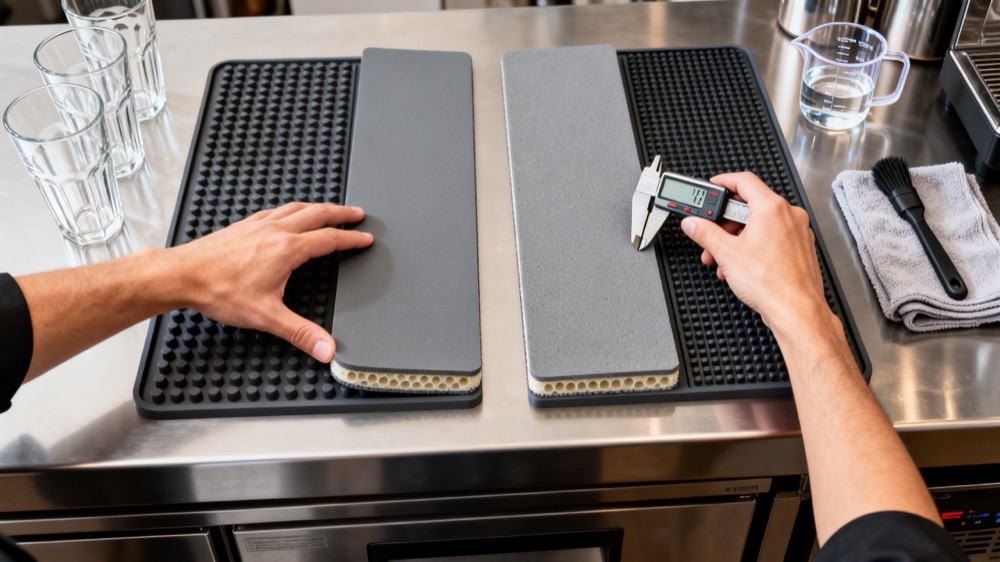
Instead of relying only on catalog descriptions, run a small operational comparison.
This is a proposed purchasing protocol, not a published laboratory standard or a claim about completed testing.
Record dimensions, thickness, weight, appearance, countertop fit, and glass stability. Photograph both samples under the same conditions.
Use measured quantities of the beverages served at your site. Compare liquid spread, containment, emptying, and visible residue.
Keep spill volume and exposure time consistent.
Use your normal approved detergent and sanitizer procedure. Record cleaning time and inspect difficult-to-reach areas.
Place representative glassware on the mats for a defined period. Check movement during ordinary service and inspect for lasting impressions or deformation afterward.
Do not treat this as a certified slip-resistance test.
Compare staining, odors, shape, print condition, and the surface beneath each mat.
A simple scorecard can weight spill control, cleaning time, stability, branding, and cost according to your priorities. Set the weights before reviewing results to reduce preference-driven scoring.
A lower unit price does not necessarily mean a lower operating cost.
Compare:
> Cost per service day = purchase, freight, cleaning labor, and replacement costs ÷ usable service days.
For a short promotional event, lightweight EVA may offer a practical logistical advantage. For a permanent wet-service station, a well-designed PVC mat may justify its price through useful spill-management features.
Neither outcome should be assumed without quotations and sample testing.
For customized orders, also compare tooling charges, minimum order quantities, packaging, approval stages, and replacement-order consistency.
Based on the company information supplied for this article, Yijia Plastic Products Co., Ltd. brings 18 years of experience in PVC soft gifts, including PVC bar mats.
Its stated capabilities include a 3,000-square-meter factory, 10 automated production lines, advanced dispensing equipment, and integrated research, production, sales, and OEM/ODM customization.
The company also reports cooperation experience involving Starbucks, Disney, McDonald's, Pop Mart, and Tencent, alongside RoHS-related documentation, Proposition 65-related compliance documentation, and Disney FAMA authorization.
Buyers should verify the current scope of relevant documents and brand-related project permissions. These credentials provide context; they do not substitute for approving the exact mat being purchased.
For a targeted quotation, send Yijia your countertop dimensions, beverage-service conditions, artwork, order quantity, destination market, and cleaning requirements. Request a proposed design, relevant documentation, and a physical sample before confirming production.
A molded PVC mat is usually the stronger starting point when liquid collection and integrated branding are priorities. Confirm the choice through cleaning, stability, and wet-counter testing.
Closed-cell EVA is generally selected for low water uptake, not absorbency. A flat sheet should not be expected to soak up spilled drinks or function as a collection tray.
Not automatically. Dishwasher suitability depends on the complete formulation, construction, decoration, temperature, and wash chemicals. Obtain written approval for the intended washing cycle.
No universal comparison is justified from the material name alone. Weight, service life, additives, production, transport, and available end-of-life routes all affect the assessment.
Only where the finished product has appropriate supporting documentation for the intended food-contact conditions and destination market. General chemical testing alone is insufficient.
Approve dimensions, hardness or density, colors, logo geometry, spill-management features, cleaning instructions, packaging, and applicable documentation. Keep a signed reference sample for production comparison.
1. European Council of Vinyl Manufacturers, "Plasticisers." Explains the role of plasticizers in flexible PVC. [Read the material overview]. [pvc]
2. Zotefoams, "Evazote®." Manufacturer overview of closed-cell foam grades and technical documentation. [View the product information]. [zotefoams]
3. Zotefoams, "EVAZOTE® VA35, Product Information Sheet A039," May 2026. Source for the grade-specific density, temperature recommendation, and testing qualifications discussed above. [Read the technical sheet]. [zotefoams]
4. U.S. Food and Drug Administration, "Interstate Carriers and Support Facilities—Guidelines," Section 2.2. Source for relevant non-food-contact surface cleanability principles. [Read the guidance]. [fda]
5. California Office of Environmental Health Hazard Assessment, "Proposition 65." Official explanation of the law's chemical-exposure and warning framework. [Read the overview]. [oehha.ca]
6. The Walt Disney Company, "Facility and Merchandise Authorization Application." Explains facility authorization for Disney-related production. [Read the application document]. [thewaltdisneycompany]
7. WARCO, "Rubber & the Standard Compliances." Industry overview distinguishing RoHS, REACH, and Proposition 65. [Read the compliance overview]. [warco]


