
Views: 288 Author: Yijia Plastic Publish Time: 2026-10-22 Origin: Site
Content Menu
● What "Better Grip" Means for a Wet Bar Mat
>> Glass-to-Mat Grip: Keeping Drinks Stable
>> Mat-to-Counter Grip: Preventing the Whole Mat from Moving
● PVC Soft Rubber Mat vs. Silicone Mat: Practical Comparison
● Why Water Can Change Bar Mat Grip
>> Drainage Geometry Matters Alongside Material
>> Water, Beer, and Syrup Are Different Test Conditions
● When a PVC Soft Rubber Bar Mat Makes Sense
>> Branding Should Not Compromise the Service Surface
>> Compare Complete Quotations, Not Material Prices
● When a Silicone Mat Deserves Consideration
>> Ask for Product-Specific Heat and Cleaning Limits
● A Practical Wet-Grip Test Before Bulk Ordering
>> Step 1: Match the Samples and Test Surfaces
>> Step 2: Separate Upper-Surface and Underside Testing
>> Step 3: Introduce Controlled Contamination
>> Step 4: Repeat After Cleaning
● Three Design Details Buyers Commonly Overlook
>> 1. Effective Glass-Support Area
>> 3. Cleanability Around Branding
● Compliance Documents: What They Actually Establish
● Working with Yijia on a Custom Bar Mat
>> Is Silicone Always Grippier Than PVC When Wet?
>> Can a PVC Bar Mat Work on Stainless Steel?
>> Does a Heavier Bar Mat Automatically Have Better Grip?
>> Can Both Materials Be Cleaned in a Dishwasher?
>> Does a RoHS Report Prove That a Bar Mat Is Food-Safe?
>> What Should I Request Before Placing an OEM Order?
A PVC soft rubber mat vs. silicone mat comparison has no honest universal winner: wet-bar grip depends on the finished mat's formulation, surface geometry, drainage, and contact with the countertop—not simply its material name. For branded beverage-service stations, a well-designed PVC bar mat is a practical option. Silicone deserves consideration when heat exposure is a major purchasing requirement.
At Yijia Plastic Products Co., Ltd., our manufacturing perspective starts with the application rather than a material preference. A mat must stabilize glassware, manage spills, remain flat, and withstand the customer's cleaning routine. The most useful question is therefore: Which finished design maintains reliable grip in your actual bar conditions?
This guide explains what buyers should compare, where material claims need qualification, and how to evaluate samples before committing to an OEM or ODM order.

A non-slip bar mat has two separate contact interfaces. Both matter, but they require different design decisions.
The upper surface supports glasses, bottles, and tools. Its performance depends on:
- The shape, spacing, and flexibility of raised features.
- The size and shape of the glass base.
- Whether spilled liquid drains below the contact points.
- The amount of syrup, detergent, or other residue present.
Tall, narrow glasses also introduce a tipping problem. A surface that resists sliding can still provide uneven support if its raised pattern is poorly matched to the glass base.
The underside contacts stainless steel, stone, laminate, or another countertop material.
A mat may hold a glass securely while sliding as a complete unit. Alternatively, its base may stay stationary while glassware moves across a wet upper surface.
For this reason, evaluate both interfaces separately. A single "anti-slip" description does not establish how either one performs.
"Soft rubber PVC" is a commercial description for flexible PVC. It should not be confused with silicone rubber; the materials belong to different polymer families.
The following comparison is a purchasing framework, not a set of measured results for Yijia products.
| Comparison factor | PVC soft rubber bar mat | Silicone bar mat | Purchasing implication |
|---|---|---|---|
| Wet grip | Depends on compound, texture, liquid, and counter | Also depends on compound, texture, liquid, and counter | Test finished samples rather than assuming a winner |
| Spill management | Can incorporate raised features and recessed collection areas | Can incorporate similar drainage geometry | Compare actual usable capacity and glass support |
| Heat exposure | Require product-specific temperature limits | Often considered for heat-oriented applications, but limits remain grade-specific | Request a documented operating range |
| Branding | Suitable for molded logos, color zones, and relief details | Can also support molded branding | Compare artwork samples and quotations |
| Cleaning compatibility | Depends on formulation and cleaning conditions | Depends on formulation and cleaning conditions | Validate the actual detergent and process |
| Purchasing cost | Depends on tooling, size, colors, and quantity | Depends on tooling, size, colors, and quantity | Compare equivalent specifications |
| Food-contact suitability | Requires evidence for the intended use | Also requires evidence for the intended use | Material names alone prove nothing |
Neither material should be described as "100% non-slip" under every condition. Such wording ignores contamination, wear, countertop differences, and cleaning practices.
Rubber-friction research shows that liquid can alter contact between an elastomer and a hard surface. Surface roughness, sliding speed, deformation, and lubrication interact; dry-hand tackiness is therefore not a reliable substitute for wet testing.
Research on rubber against wet road surfaces also describes a sealing effect, where trapped water changes the effective surface texture. This helps explain why liquid management matters, but road-test findings cannot be converted into performance percentages for bar mats.
Raised studs and channels can help separate glass bases from collected spills. However, more texture is not automatically better.
A useful design must balance:
- Enough contact area to support glassware.
- Spaces that allow liquid to collect below that contact area.
- Accessible channels for cleaning.
- Stable support for different glass-base diameters.
A dramatic-looking pattern may perform poorly if it creates rocking points or traps sticky residue.
A water-only demonstration does not represent a complete bar shift.
Beer, cocktail syrup, citrus residue, and detergent solutions create different operating conditions. Syrup can also leave a tacky deposit after drying, making a dirty mat feel grippy without demonstrating dependable performance.
The practical lesson is straightforward: include representative spills and cleaning residues in sample evaluation.
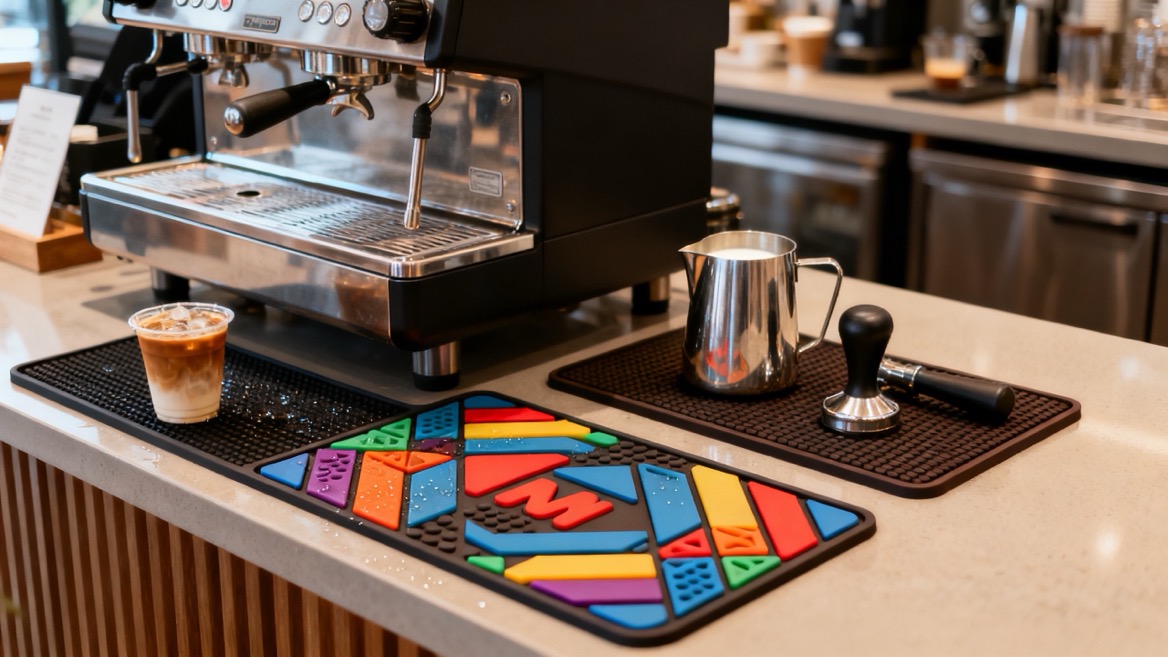
For buyers sourcing custom promotional bar mats, PVC deserves consideration when the project combines beverage service with visible branding.
Yijia's manufacturing focus includes PVC soft rubber gifts and custom PVC bar mats. From that production perspective, we recommend evaluating the logo and working surface together rather than treating artwork as a separate finishing step.
A large raised logo can change where glasses make contact. Deep decorative recesses can also make cleaning more demanding.
Before approving artwork, check:
1. Whether the central logo creates uneven support.
2. Whether small lettering produces difficult-to-clean gaps.
3. Whether color boundaries affect the intended surface geometry.
4. Whether the design accommodates the customer's common glass sizes.
For a brewery, beverage distributor, or hospitality promotion, the best branded mat is not simply the most visually elaborate. It is the one staff can use comfortably throughout service.
Avoid assuming that PVC is always cheaper.
Compare the same dimensions, weight, design complexity, packaging, order quantity, and inspection requirements. A lower quotation for a thinner or lighter mat is not an equivalent offer.
For procurement teams, the meaningful number is the cost of an acceptable finished product—not the lowest unit price on an unmatched specification.
Silicone should remain on the shortlist when a project involves significant heat exposure, such as proximity to hot beverage equipment.
However, heat capability and wet grip are separate characteristics. A supplier's temperature claim does not establish resistance to sliding on a wet stainless-steel counter.
Request written guidance covering:
- Maximum service temperature.
- Permitted exposure duration.
- Dishwasher compatibility, if claimed.
- Approved cleaning agents.
- Restrictions involving hot tools or equipment.
Chemical-compatibility guides emphasize that performance depends on exposure conditions, including temperature. Generic silicone or PVC compatibility charts can help screen materials, but they do not validate a finished mat's pigments, additives, construction, or cleaning life.
Choose silicone because its documented properties match the application—not because "silicone" sounds like a universal performance guarantee.
The following is a proposed comparative purchasing protocol. It is not a certified test standard, and it does not represent previously measured Yijia results.
Its purpose is to make supplier comparisons more repeatable.
Use samples with comparable dimensions, thickness, and intended function.
Test them on the actual countertop where possible. Otherwise, select representative surfaces such as stainless steel and the customer's specified stone or laminate.
Clean and dry each surface consistently before starting. Record the sample identification, countertop, temperature, and cleaning method.
For mat-to-counter testing, place a defined load on the mat and pull the mat horizontally using a force gauge.
For glass-to-mat testing, secure the mat and pull the same glass, containing the same quantity of water, across its surface.
Keep the pull direction, attachment height, and movement rate consistent. Record the peak force immediately before movement begins.
These are comparative measurements for a defined setup, not universal friction ratings.
Repeat the comparison under clearly documented conditions:
- Clean and dry.
- Water-wet.
- Wet with a representative beverage.
- Exposed to the intended cleaning solution.
Specify the liquid quantity and wetted area. Excess liquid should not be applied casually, because changing the liquid layer can change the comparison.
Repeat each condition several times and report the range as well as the average.
Run the same evaluation after a predefined series of cleaning cycles.
Inspect for curling, surface changes, discoloration, odor, and loss of flatness. Any proposed cycle count should be identified as a buyer's screening requirement—not proof of a particular service life.
A sample that performs consistently after cleaning provides more useful purchasing evidence than a single impressive demonstration.
Mat dimensions do not tell you how much of the surface supports a glass.
Compare the contact pattern using the actual glassware. A design suitable for broad beer glasses may not support small shot glasses equally well.
A curled edge reduces usable contact and can interfere with wiping or placing tools.
Inspect samples both after unpacking and after cleaning. Packaging and storage conditions should also be included in the approval discussion.
Detailed relief can create attractive branding while adding cleaning work.
Ask bar staff to wash a sample after a realistic spill. Their feedback can identify awkward recesses that a purchasing photograph will never reveal.
These checks connect product design with daily use rather than relying only on material descriptions.
Documentation should support a specific claim.
RoHS concerns restricted substances in electrical and electronic equipment. A report testing a bar mat against selected RoHS substance limits may provide useful information, but it does not establish wet grip or food-contact suitability.
California Proposition 65 addresses warnings about exposure to listed chemicals. It is not a universal product-safety certification.
Disney FAMA means Facility and Merchandise Authorization. It concerns authorization for facilities involved in Disney-branded production; it is not a friction-performance certificate or unrestricted permission to use Disney intellectual property.
If a mat is intended for direct food contact, request evidence appropriate to the destination market and intended conditions. Neither "PVC" nor "silicone" automatically establishes that suitability.
According to company-provided information, Yijia Plastic Products Co., Ltd. brings 18 years of experience in research, development, production, and sales of PVC soft rubber gifts.
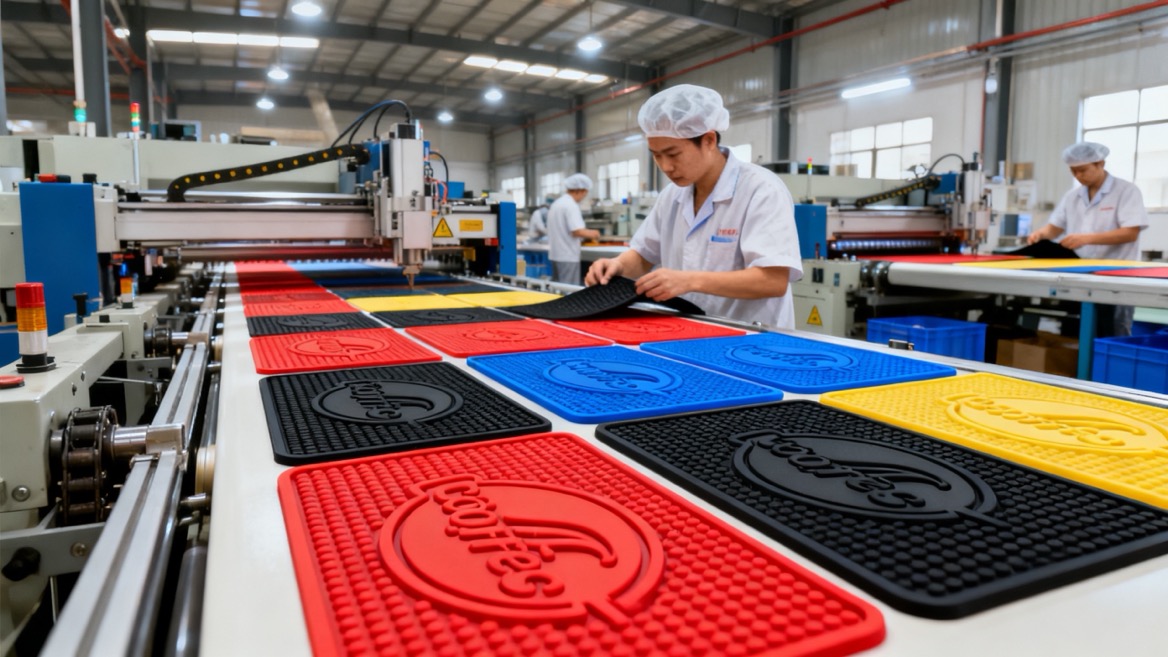
Our stated production resources include a 3,000-square-meter factory, 10 automated production lines, and multiple advanced dispensing machines, supporting one-stop OEM/ODM projects.
Company-provided background also lists experience on projects involving Starbucks, Disney, McDonald's, Pop Mart, and Tencent. These statements should be supported by authorized project records where disclosure is permitted; they should not imply current endorsement or unrestricted trademark rights.
For a productive quotation, send Yijia your countertop material, glassware sizes, spill conditions, cleaning process, dimensions, artwork, destination market, and order quantity. Request a production-representative sample and applicable documentation before bulk approval.
No. Neither material name establishes a universal ranking. Compare the finished compound, surface pattern, countertop contact, and contamination conditions.
It can be evaluated for that application, but performance should be confirmed on the intended surface. Test both a dry underside and conditions where liquid reaches beneath the mat.
No. Weight influences loading, but contact geometry, surface condition, and material behavior also matter. Compare complete designs rather than weight alone.
Do not assume so. Obtain product-specific instructions covering temperature, detergent, cycle duration, and drying conditions. Validate any dishwasher claim with representative samples.
No. Restricted-substance testing and food-contact assessment answer different questions. Request documentation matching the intended use and sales market.
Request a specification sheet, artwork proof, production-representative sample, cleaning guidance, relevant test reports, and written acceptance criteria for dimensions, appearance, flatness, and performance.
- Persson, B. N. J., et al. "Rubber friction on wet and dry road surfaces: The sealing effect." *Physical Review B*, 71, 035428 (2005). Scientific background on water, roughness, and rubber friction; not a PVC-versus-silicone bar-mat trial. [link.aps]
- Saint-Gobain. "Chemical Resistance Properties of Tubing." Compatibility guidance noting temperature-dependent limitations; used here for screening principles, not finished-mat performance claims. [biopharm.saint-gobain]
- European Commission. "Food Contact Materials." Framework requirements for materials intended to contact food in the European market. [food.ec.europa]
- California Office of Environmental Health Hazard Assessment. "Frequently Asked Questions for Businesses." Explanation of Proposition 65 warning obligations and exposure considerations. [p65warnings.ca]
- The Walt Disney Company. "Facility and Merchandise Authorization Application." Explanation of facility authorization for Disney-branded production. [thewaltdisneycompany]
- Z2Data. "Understanding REACH, RoHS, and Prop 65." Background on the differing scope of restricted-substance and exposure-warning requirements. [z2data]


