
Views: 264 Author: Yijia Plastic Publish Time: 2026-10-10 Origin: Site
Content Menu
● PVC Table Mat vs. Silicone Table Mat: Quick Comparison
● What Makes a Table Mat Handle Repeated Spills Well?
>> Liquid Resistance Is Only the First Requirement
>> Compare Finished Products, Not Just Material Labels
● How PVC Table Mats Handle Food and Beverage Spills
>> Where Soft PVC Makes Practical Sense
>> Where PVC Needs Closer Evaluation
● How Silicone Table Mats Handle Repeated Spills
>> Why Silicone Has an Advantage When Heat Dominates
>> Why Silicone Is Not Automatically Stain-Proof or Oil-Proof
● Coffee, Tomato Sauce, and Oil: Which Material Performs Better?
>> Coffee, Tea, and Sugary Beverages
>> Tomato Sauce, Curry, and Strongly Colored Foods
>> Cooking Oil and Greasy Dressings
● Surface Design Can Matter More Than Expected
>> Smooth Areas Make Cleaning More Predictable
>> Borders and Textures Create Trade-Offs
● A Practical Repeated-Spill Test Before Bulk Ordering
>> Step 1: Select Representative Samples and Residues
>> Step 2: Define Exposure and Cleaning Conditions
>> Step 3: Record More Than Appearance
● Compliance: What Buyers Should Actually Request
>> Spill Exposure and Food Contact Are Different Uses
>> RoHS, Proposition 65, and Disney FAMA Have Different Meanings
● Choosing a Custom Table Mat with Yijia
>> Is a Silicone Table Mat Always Better Than a PVC Table Mat?
>> Can I Put Either Table Mat in a Dishwasher?
>> Which Table Mat Resists Coffee Stains Better?
>> Can Food Be Served Directly on Either Material?
>> Are Silicone Table Mats Suitable Under Hot Pans?
>> What Should I Check Before Ordering Custom PVC Table Mats?
A PVC table mat and a silicone table mat can both protect a dining surface from everyday spills. However, repeated exposure to coffee, sauces, cooking oils, and cleaning changes the comparison. Silicone generally offers the stronger starting point when heat and frequent washing dominate. Soft PVC remains a practical option for custom-branded table mats used with ordinary beverage spills and controlled cleaning routines.
At Yijia Plastic Products Co., Ltd., our manufacturing perspective starts with one question: what will the mat actually experience every day? A promotional café mat, a family dining placemat, and a kitchen preparation mat have different requirements.
The most important distinction is repeatability: whether the finished mat remains easy to clean, flat, visually consistent, and suitable for its intended use after many spill-and-clean cycles.

This comparison concerns solid, flexible PVC mats and molded silicone mats—not woven placemats, absorbent fabric-backed products, or multilayer constructions.
| Selection factor | PVC table mat | Silicone table mat |
|---|---|---|
| Water and beverage spills | Practical wipe-clean option with an intact surface | Practical wipe-clean option with an intact surface |
| Repeated hot spills | Requires careful verification of the finished product's temperature limits | Generally the stronger starting point |
| Oily food spills | Formulation and cleaning method require evaluation | Not automatically oil-proof; grade and exposure matter |
| Staining | Depends on pigments, texture, coatings, and spill duration | Also depends on formulation, texture, and spill duration |
| Dishwasher cleaning | Do not assume compatibility | Possible for products specifically approved for it |
| Custom branding | Well suited to molded promotional designs | Also supports molded customization |
| Food-contact suitability | Requires applicable, product-specific evidence | Requires applicable, product-specific evidence |
| Best procurement approach | Validate the proposed construction against actual use | Validate the proposed construction against actual use |
Neither material wins every category. For repeated spills, surface design and cleaning instructions can matter as much as the material name.
A mat may repel water yet perform poorly after repeated cleaning. Food residue can collect around raised lettering, staining can affect appearance, and the underside can remain wet after wiping.
For buyers, spill performance should include:
- How quickly residue can be removed.
- Whether stains remain after cleaning.
- Whether the mat develops persistent odors.
- Whether edges curl or the surface becomes tacky.
- Whether cleaning damages decoration.
- Whether moisture collects underneath.
A clean-looking top surface does not guarantee a dry tabletop. Lift the mat after spills and inspect both contact surfaces.
"PVC" and "silicone" identify material families. They do not specify every ingredient, manufacturing condition, pigment, coating, or surface feature.
A smooth PVC table mat can be easier to wipe than a deeply textured silicone table mat. Conversely, a silicone mat designed for repeated hot washing may better suit demanding kitchen use than a decorative PVC product.
Our purchasing recommendation is to compare production-representative samples with equivalent dimensions, thicknesses, and intended applications.
Soft PVC is a useful choice when a buyer wants a flexible, customized mat for beverage service or promotional use.
For Yijia, this fits our manufacturing focus on PVC coasters and other soft PVC gifts. Molded shapes, coordinated colors, and integrated branding help turn a functional accessory into part of a recognizable product collection.
Potential applications include:
- Café beverage-service mats.
- Promotional dining accessories.
- Branded coaster-and-mat sets.
- Restaurant merchandise.
- Corporate gift collections.
These applications still require testing. A promotional mat used beneath cups should not automatically be marketed as a hot-pan protector or direct food-preparation surface.
Repeated hot liquid exposure and aggressive cleaning deserve particular attention.
Flexible PVC performance depends on its formulation and construction. Therefore, buyers should request a documented maximum service temperature rather than applying a generic temperature claim to every PVC mat.
Also distinguish between three exposures:
1. A brief splash of a hot beverage.
2. Prolonged contact with a heated container.
3. Direct contact with cookware fresh from a stove.
These are different demands. Passing one does not demonstrate suitability for the others.
Inspect test samples for curling, dimensional changes, surface tackiness, and changes in decorative details.
Silicone rubber is widely used in applications requiring thermal stability. Manufacturer guidance also describes resistance to boiling water and compatibility with certain aqueous cleaning solutions.
That makes silicone a stronger starting point for table mats expected to encounter repeated hot spills and more demanding washing.
However, a material's capabilities do not establish the limits of every finished product. Thickness, pigments, attachments, printing, and manufacturing quality can affect the usable product.
Ask for the mat's stated operating conditions and cleaning instructions. Do not treat "silicone" as permission to use the product in an oven, under a hot pan, or in a dishwasher.
Silicone should not be described as universally resistant to every food residue.
Technical guidance identifies swelling behavior with some oils, greases, and other nonpolar liquids. This does not mean a brief cooking-oil spill will necessarily damage a silicone placemat. It means exposure conditions and formulation matter.
Likewise, research on silicone food-contact articles shows why product-specific assessment remains important. Those findings cannot be converted into a blanket claim that all silicone mats are unsafe—or that every silicone mat is suitable for food contact.
Test the actual mat against the foods it will encounter.
For promptly cleaned beverage spills, either material may meet the requirement.
The more useful question is whether a dark drink leaves visible discoloration after repeated exposure. Light-colored products make this especially important.
Sugary drinks introduce another challenge: sticky residue around logos, borders, and textured areas. A simple wiping test may miss residue that requires scrubbing.
There is no reliable universal winner for stain resistance.
Colorants, oily ingredients, dwell time, and surface finish all influence the result. A mat cleaned immediately may behave differently from one left overnight.
For restaurant procurement, test the actual menu's most difficult residues rather than relying only on water or coffee.
For both materials, repeated oily exposure should be evaluated separately from water resistance.
Record whether the cleaned surface becomes slippery, changes texture, or retains an odor. Also inspect dimensions and edges.
Avoid the shortcut that "waterproof" means resistant to prolonged exposure to every oil-based food.
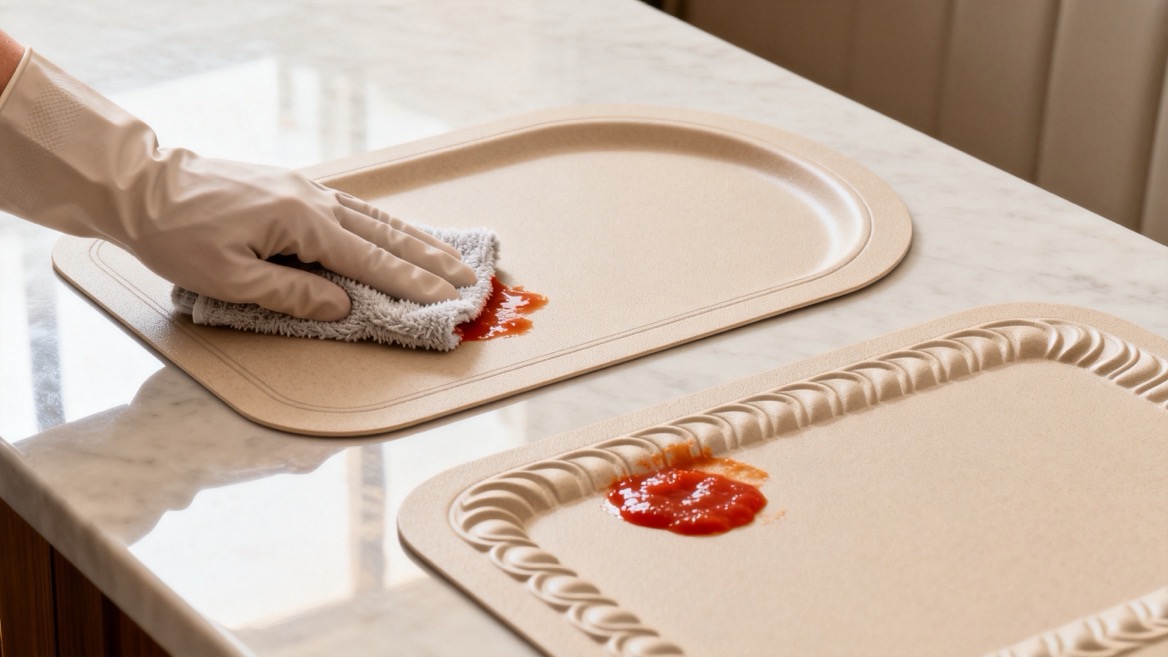
Deep recesses and closely spaced raised details create additional places for residue to collect.
For a custom PVC table mat, our design recommendation is to prioritize smooth spill-exposed areas and keep branding details accessible to a cloth or soft brush.
The same principle applies to silicone.
A visually impressive sample is not necessarily the easiest product to maintain during a busy service shift.
A raised border may help contain liquid, but it also adds an edge that needs cleaning. Texture may support handling or appearance, yet complicate residue removal.
Approve these features deliberately:
- Use shallow, accessible decorative details.
- Avoid unnecessary grooves in frequent spill zones.
- Evaluate underside cleaning.
- Check stability on the intended tabletop.
- Confirm that trapped moisture can be removed easily.
Neither material guarantees that a mat will remain stationary on every wet surface.
The following is a proposed buyer screening method, not a recognized certification procedure or a claim about Yijia's completed testing.
Obtain samples made with the proposed production formulation, colors, decoration, and thickness.
Choose residues that reflect actual use:
- Coffee or tea.
- A sugary beverage.
- Tomato sauce.
- Cooking oil or dressing.
- A strongly colored menu item.
Retain an unused sample for comparison.
Apply the same measured quantity to each sample. Use consistent spill temperatures, contact times, detergent concentrations, and cleaning tools.
For an initial screen, buyers might choose 10-minute and 60-minute contact periods, followed by 30 repeated cleaning cycles.
These are suggested comparison conditions—not industry benchmarks or proof of a particular service life.
Evaluate each sample for:
1. Visible staining under consistent lighting.
2. Cleaning time and effort.
3. Residual odor after drying.
4. Curling, swelling, or dimensional change.
5. Surface tackiness or loss of decorative detail.
6. Moisture or marks beneath the mat.
Set acceptance criteria before testing. For example, define whether any visible stain is unacceptable or whether a minor appearance change is tolerable.
Use laboratory assessment when needed for regulatory compliance, food contact, or safety claims.
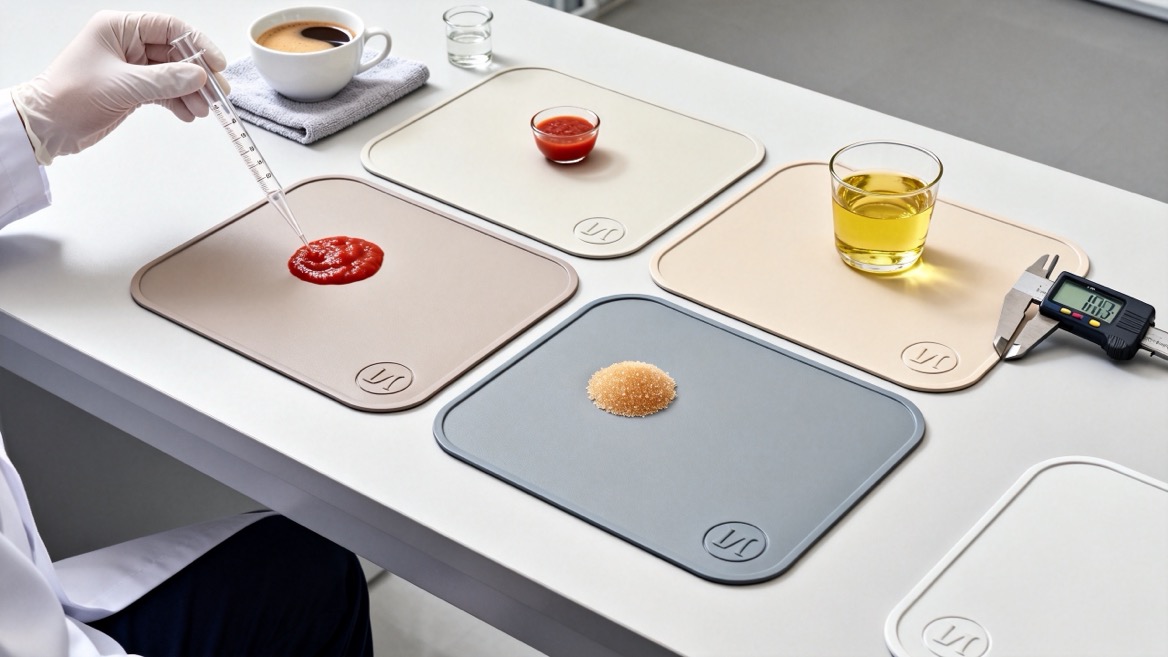
A mat beneath a cup is not necessarily intended for direct food contact. A mat used for serving food, kneading dough, or holding ingredients presents different requirements.
European food-contact rules require materials to avoid transferring constituents at harmful levels or causing unacceptable changes to food.
Plastic food-contact articles also have specific regulatory requirements. Silicone falls outside the scope of the specific EU plastics regulation, but that does not exempt it from the broader food-contact framework.
Define the intended use before requesting test documentation.
These credentials should not be presented as interchangeable food-safety certifications.
- RoHS concerns restricted substances in electrical and electronic equipment. A RoHS-related material report does not establish food-contact suitability.
- California Proposition 65 addresses listed-chemical exposures and warning obligations. It is not a general government product-certification scheme.
- Disney FAMA concerns authorization for specified facilities to produce Disney-branded products. It does not certify table-mat spill resistance or food-contact safety.
Match each document to the claim it supports, including the product identity, scope, date, and applicable conditions.
According to our company-provided background, Yijia Plastic Products Co., Ltd. has 18 years of experience integrating research, development, production, and sales of PVC coasters and other soft PVC gifts.
Our stated manufacturing resources include a 3,000-square-meter factory, 10 automated production lines, and advanced dispensing equipment. We provide one-stop OEM/ODM customization services.
Our company background also reports cooperation experience involving Starbucks, Disney, McDonald's, Pop Mart, and Tencent. Such experience should remain distinct from product-specific performance evidence or an implied endorsement.
For a custom PVC table mat project, we recommend discussing:
- Expected spills and cleaning frequency.
- Maximum exposure temperature.
- Dimensions, thickness, and surface details.
- Logo construction and color requirements.
- Destination-market documentation.
- Sample approval and production inspection criteria.
Choose silicone when heat tolerance and demanding cleaning are the dominant requirements. Consider PVC when customized branding and ordinary beverage-service use are central—then validate the finished design.
To start your project, send Yijia your artwork, dimensions, target market, order quantity, and expected spill conditions. Request a production-representative PVC sample and agree on acceptance criteria before bulk manufacturing.
No. Silicone is generally the stronger starting point for heat-intensive use. For ordinary beverage spills, a well-designed PVC mat may meet the requirement. Compare finished samples.
Only if the manufacturer expressly approves it. Material identity alone does not establish compatibility with dishwasher heat, detergent, and repeated cycles.
There is no universal winner. Test the proposed color and surface finish using realistic coffee exposure times and the recommended cleaning method.
Only when the finished product is intended and documented for that use. A generic material claim or unrelated compliance report is insufficient.
Some specifically designed products may be. A dining placemat should not automatically be treated as a trivet. Follow its documented temperature and use limits.
Check cleaning performance, staining, flatness, decoration durability, temperature limitations, and relevant compliance documentation. Approve production-representative samples rather than appearance-only prototypes.
1. European Commission — *Food Contact Materials: Legislation*. Supports the discussion of the general food-contact framework, migration requirements, and specific rules for plastic articles. [View the legislation overview]. [food.ec.europa]
2. WACKER — *Solid and Liquid Silicone Rubber: Material and Processing Guidelines*. Supports the discussion of silicone's thermal and chemical behavior, boiling-water resistance, formulation dependence, and oil-related swelling limitations. Material guidance is not a finished-mat performance guarantee. [Read the technical guide]. [wacker]
3. *Risk Assessment of Food Contact Materials II* — scientific article available through PubMed Central. Supports the distinction between general silicone properties and product-specific food-contact assessment. Its findings concern evaluated food-contact articles, not Yijia table mats. [Read the article]. [pmc.ncbi.nlm.nih]
4. European Commission — *RoHS Directive*. Explains the directive's electrical and electronic equipment scope and restricted-substance objectives. [View the official overview]. [environment.ec.europa]
5. California OEHHA — *Businesses and Proposition 65*. Explains exposure assessment, warning obligations, exemptions, and safe-harbor principles. [Read the business guidance]. [oehha.ca]
6. The Walt Disney Company — *Facility and Merchandise Authorization Application Instructions*. Explains facility authorization for Disney-branded production. [Read the application instructions]. [thewaltdisneycompany]


