
Views: 224 Author: Yijia Plastic Publish Time: 2026-10-03 Origin: Site
Content Menu
● PVC Waterproof Mat vs. Fabric Table Mat
>> What makes these table mats different?
>> Outdoor beverage service comparison
>> Waterproofing versus absorption
>> Cleaning and table turnover
>> Sunlight, heat, and appearance
>> A practical sample-testing protocol
>> Compare cost per usable service
>> Match the material to the venue
● Customization and Compliance
>> Design features worth specifying
>> What compliance documents actually mean
>> Yijia's manufacturing perspective
>> Make a responsible final choice
>> Is a PVC waterproof mat better than fabric for outdoor cafés?
>> Can fabric table mats be waterproof?
>> Does a PVC mat absorb condensation?
>> Can custom PVC mats be left outside permanently?
>> Are PVC beverage mats automatically food-safe?
>> Which mat is cheaper over time?
A PVC waterproof mat is generally the more practical choice for outdoor beverage service when frequent spills and quick table resets are the main concerns. A fabric table mat can be better when softness, absorbency, and an elegant presentation matter more than wipe-clean convenience.
At Yijia Plastic Products Co., Ltd., our manufacturing perspective starts with a practical question: what happens after a customer spills an iced coffee? Comparing a PVC waterproof mat vs. fabric table mat means looking beyond appearance to consider moisture, cleaning, stability, weather exposure, and replacement costs.
Drawing on our stated 18 years of experience in custom soft-PVC gifts, we recommend evaluating the finished product—not simply choosing a material name. This guide focuses on tabletop mats and coasters placed beneath beverages, rather than floor mats or products intended for direct food contact.
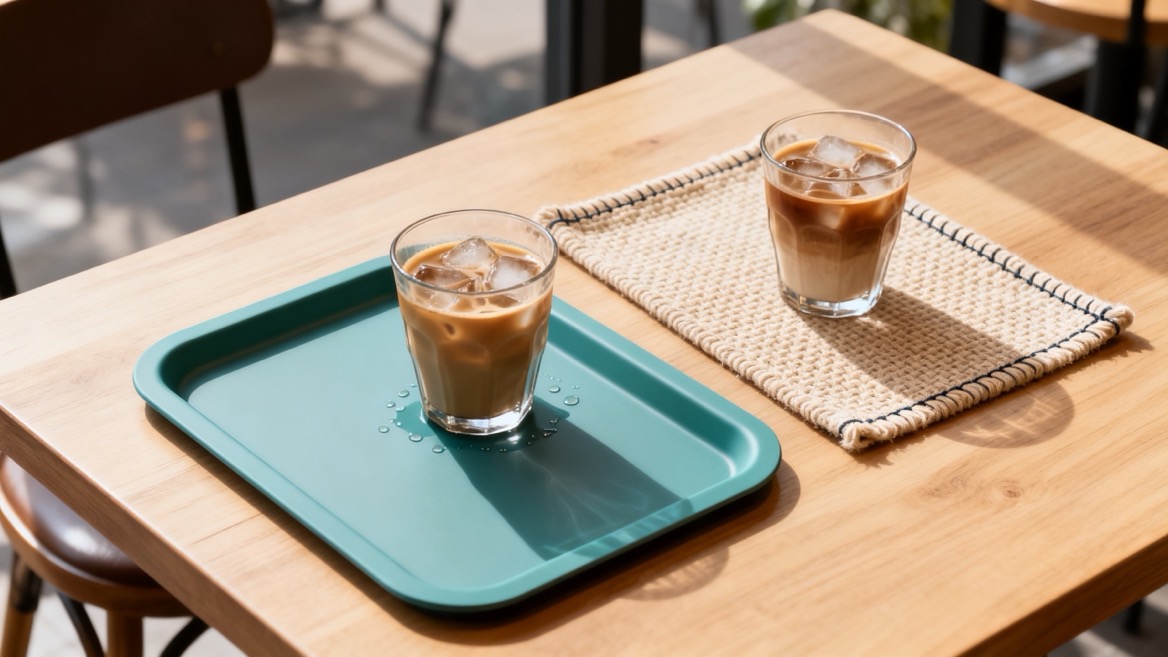
A PVC waterproof mat typically has a flexible, nonabsorbent body. Custom molding can add raised borders, recessed areas, textured backing, and dimensional branding. Water remains on its surface rather than soaking into the material.
A fabric table mat may use cotton, polyester, linen, blends, or coated textiles. These are not interchangeable. Cotton naturally absorbs moisture, while fiber selection, weave, backing, and finishing treatments change how a textile handles spills.
For a fair comparison, distinguish ordinary absorbent fabric from coated outdoor fabric. A water-repellent textile may resist an initial spill, but that does not automatically make its seams, backing, or entire construction waterproof.
| Buying criterion | PVC waterproof mat | Fabric table mat |
|---|---|---|
| Water handling | Keeps liquid on the surface; does not absorb condensation | Absorbency varies with fibers, weave, and finish |
| Between-customer cleaning | Often suitable for wiping or rinsing, subject to care instructions | May need laundering when wet, sticky, or visibly soiled |
| Condensation control | Needs surface texture or channels to manage accumulated water | Absorbent versions collect moisture until saturated |
| Appearance | Suitable for colorful, molded, dimensional branding | Offers softness, woven texture, and a linen-style presentation |
| Stability | Depends on backing, thickness, table finish, and moisture | Depends on backing, weight, construction, and moisture |
| Outdoor durability | Requires verified suitability for sunlight and temperature exposure | Requires verified colorfastness and outdoor fabric performance |
| Storage | Must be clean and dry before stacking | Must be thoroughly dry before folding or storing |
| Best-fit setting | Busy patios, promotional events, outdoor beverage counters | Covered terraces, styled dining, controlled table service |
The strongest advantage of PVC is operational convenience. The strongest advantage of fabric is its tactile presentation and, in absorbent constructions, its ability to collect condensation.
Neither material wins every category. A poorly designed PVC mat can hold sticky residue in deep grooves, while a well-designed outdoor textile may perform better than an ordinary indoor placemat.
Waterproofing protects the mat from absorbing liquid; absorption temporarily collects that liquid. These are different functions.
A PVC mat can keep a spill from passing through an intact surface, but liquid may still flow over its edges. A fabric mat can absorb condensation, but it may eventually become saturated and transfer moisture to the table.
For outdoor beverage service, specify what you need: table protection, condensation collection, spill containment, or all three. A raised-edge PVC design may improve containment, but its usable capacity should be checked with a sample.
Cleaning convenience becomes important when staff reset many tables during a busy shift. A wipe-clean PVC surface can simplify the process, provided its shape allows staff to reach every recess.
Fabric involves a different workflow. Operators need enough spare mats to replace wet or soiled pieces, plus laundering, drying, and storage arrangements. The FDA Food Code distinguishes equipment surfaces from linens and provides cleaning provisions for both; local requirements remain relevant.
Do not assume that a quick wipe makes any mat hygienically ready. Remove residue, follow suitable cleaning instructions, and apply any additional sanitation procedure required by the venue and intended use.
Grip must be evaluated with the actual table and drinkware. A textured backing alone does not prove that a mat will resist movement on wet glass, painted metal, or sealed wood.
Likewise, deep relief can make branding attractive but may reduce the level area beneath a narrow glass. Keep the central contact zone sufficiently flat and test tall glasses, lightweight cups, and stemware.
A mat also cannot prevent a drink from tipping in strong wind. For exposed patios, assess furniture placement and drinkware separately from the mat.
Waterproof does not mean weatherproof. Buyers should not infer UV resistance, color retention, or heat tolerance from the material name alone.
Ask suppliers for evidence relevant to the finished construction. For PVC, examine fading, tackiness, warping, and changes in flexibility. For fabric, examine fading, shrinkage, coating deterioration, and changes after laundering.
Neither option should be marketed as a trivet without appropriate testing. Outdoor beverage service and protection beneath hot cookware are different applications.
The most useful test is one that reflects your service conditions. Before approving bulk production, compare both materials on the tables your customers will actually use.
1. Prepare equal-size samples and record their thickness, backing, and construction.
2. Position an iced glass on each sample and observe condensation during a realistic service period.
3. Spill equal measured amounts of coffee, juice, or a representative syrup-containing drink.
4. Clean each sample using its proposed care procedure and record the hands-on time.
5. Inspect for residue, staining, water underneath, curling, and changes in surface feel.
6. Repeat after multiple cleaning cycles, checking both appearance and performance.
Use a measuring jug and timer to make comparisons consistent. Photograph the samples under the same lighting and retain one unused sample as a visual reference.
This is a screening protocol, not a substitute for accredited testing or a validated durability study. It helps identify unsuitable designs before the purchasing team commits to tooling and production.
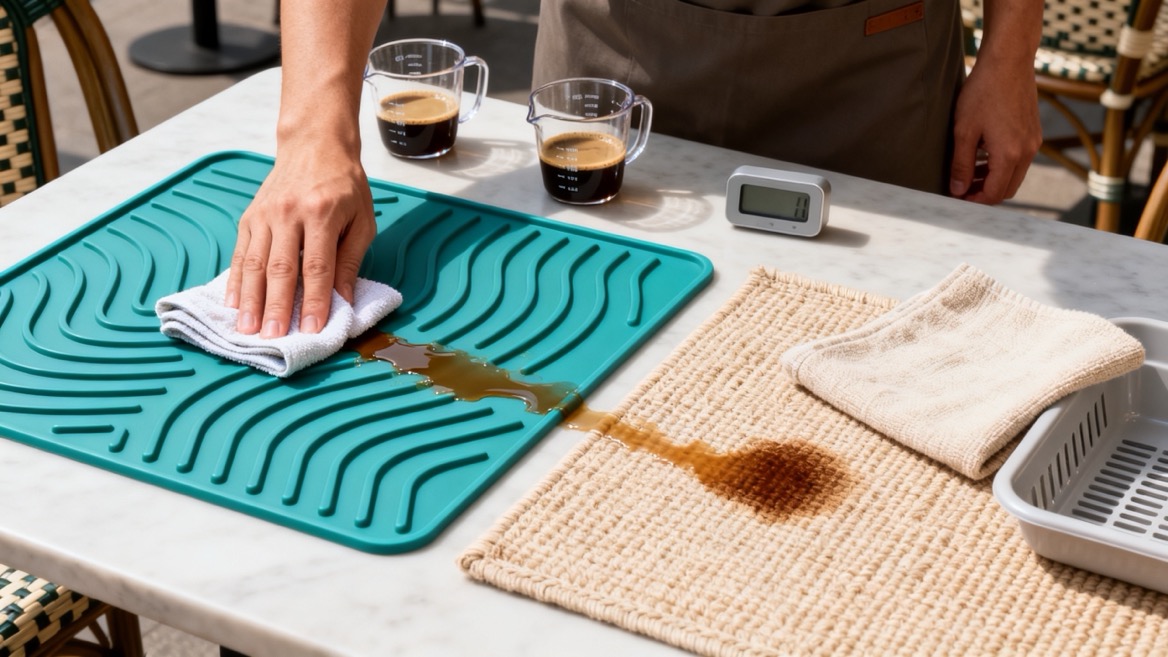
Purchase price is only one part of cost. A cheaper mat may become more expensive if it requires frequent replacement or an inconvenient cleaning process.
A useful purchasing calculation is:
Cost per usable service = total purchasing, cleaning, handling, and replacement costs ÷ completed service uses.
For example, consider a hypothetical patio using 100 mats, each serving four parties per day across 90 operating days. That represents 36,000 mat-service uses—not 36,000 independently verified cleaning cycles.
If one cleaning process requires five additional seconds per use, the difference totals 50 labor hours across that hypothetical season. This illustration is not a measured saving for either material; it shows why timed sample trials matter.
Include detergent, laundry charges, drying capacity, spare inventory, inspection time, and discarded units. Avoid claiming a universal percentage saving without comparable operating data.
| Outdoor service setting | Preferred starting point | Main reason |
|---|---|---|
| High-turnover café patio | PVC waterproof mat | Frequent spills and repeat cleaning |
| Promotional beverage event | Custom PVC coaster or mat | Distinctive shapes and molded branding |
| Covered fine-dining terrace | Fabric table mat | Soft texture and coordinated table styling |
| Venue with established linen service | Fabric or PVC after testing | Existing laundering changes the cost calculation |
| Exposed poolside beverage area | Outdoor-qualified PVC candidate | Water exposure makes nonabsorbency useful |
| Permanent outdoor installation | Neither without verification | Weather exposure requires product-specific evidence |
These are starting recommendations, not guarantees. Poolside chemicals, cleaning products, table coatings, and exposure conditions can change the result.
For custom PVC outdoor beverage mats, prioritize function before decorative complexity. A design should remain easy to clean and provide a stable platform for drinkware.
- A level central area sized for the intended glass base.
- Shallow, accessible channels rather than difficult-to-clean crevices.
- Rounded edges and an appropriate overall thickness.
- A backing tested on the intended tabletop finish.
- Branding positioned away from the main glass-contact area.
- Clear cleaning and storage instructions.
For fabric, specify construction with equal care: fiber composition, weave, backing, edge finish, laundering instructions, and any water-repellent treatment. Ask whether appearance and moisture performance have been evaluated after repeated cleaning.
A trustworthy supplier should explain the scope of each document rather than treating every authorization or test report as a universal safety certificate.
Yijia's supplied company profile reports EU RoHS-related compliance, California Proposition 65-related compliance, and Disney FAMA authorization. Buyers should request the current documents and verify the relevant product, facility, applicant, materials, and validity.
RoHS primarily regulates hazardous substances in electrical and electronic equipment. A non-electrical coaster ordinarily falls outside that central scope. Testing against RoHS substance limits may support a buyer's material specification, but it does not establish food-contact suitability.
Proposition 65 concerns exposure to listed chemicals and associated warning obligations. It is not a general product-approval certification. For flexible PVC, ask how relevant substances and intended-use exposures were assessed.
FAMA means Facility and Merchandise Authorization. Disney's documentation describes authorization for specified production arrangements; it is not a blanket product-safety certificate or unrestricted permission to use Disney artwork.
If a mat will contact unpackaged food, request separate documentation appropriate to the destination market and intended use. Neither the PVC label nor a general chemical test establishes that suitability.
Yijia Plastic Products Co., Ltd. combines development, production, and sales of PVC coasters and other soft-PVC gifts. According to the company information supplied for this article, our facilities cover 3,000 square meters and include 10 automated production lines plus advanced dispensing equipment.
Our stated OEM/ODM experience includes projects involving Starbucks, Disney, McDonald's, Pop Mart, and Tencent. These company-provided details describe our background; they do not independently establish endorsement or authorization for a new branded order.
For a new project, our preferred starting point is the brief: intended venue, table finish, beverage types, dimensions, branding, cleaning method, and destination market. These details help turn a promotional item into a practical service accessory.
Choose PVC when repeat spill handling, wipe-clean convenience, and molded customization drive the project. Choose fabric when textile presentation and absorbency justify the laundering workflow.
For either material, sustainability claims need evidence. Compare useful service life, cleaning demands, packaging, replacement frequency, and locally available disposal routes. Neither "reusable" nor "natural fiber" alone establishes the lower overall impact.
Ready to develop a custom outdoor beverage mat? Send Yijia your artwork, target dimensions, order quantity, destination market, and service conditions. Request a sample, proposed material specification, care instructions, and applicable documentation before approving bulk production.
Usually, when the main priorities are frequent spill cleanup and rapid table resets. Fabric may be preferable on covered terraces where presentation matters and a reliable laundering process already exists.
Some coated or laminated constructions can resist water penetration. Ordinary cotton or linen should not be assumed waterproof, and a water-repellent finish does not automatically waterproof seams or the backing.
No—a typical nonabsorbent PVC surface leaves condensation on top. Surface channels or recessed areas can help manage it, while an absorbent fabric collects moisture until its capacity is reached.
Only when the finished product has suitable evidence for the expected conditions. Otherwise, clean and dry the mats, then store them away from prolonged outdoor exposure.
No. A beverage mat beneath a glass is different from a surface intended to touch unpackaged food. Request documentation specific to the intended use and destination market.
Neither is always cheaper. Compare purchase price, cleaning labor, laundering, spare inventory, and replacement rates using your own operating conditions and sample-test results.
- U.S. Food and Drug Administration. *Food Code 2022*, Chapter 4: equipment surfaces, linens, cleaning, and laundering provisions. This is a model code; applicable local requirements should be checked. [Read the full document]. [fda]
- Cotton Incorporated, CottonWorks. *Quality Assurance Basics*. Supports the discussion of cotton's natural absorbency and the importance of textile specifications. [Read the guidance]. [cottonworks]
- Cotton Incorporated, CottonWorks. *TransDRY® Technology*. Explains how treatments and construction alter cotton moisture-management performance; it is not evidence for every fabric table mat. [Read the technical overview]. [cottonworks]
- European Commission. *RoHS Directive*. Explains its electrical and electronic equipment scope and restricted substances. [Read the official overview]. [environment.ec.europa]
- California Office of Environmental Health Hazard Assessment. *Phthalates—Proposition 65 Warnings Website*. Explains listed phthalates, flexible-plastic applications, and exposure-warning obligations. [Read the fact sheet]. [p65warnings.ca]
- The Walt Disney Company. *Facility and Merchandise Authorization Application*. Describes authorization requirements for Disney-branded production. [Read the application guidance]. [thewaltdisneycompany]
- Company information. Yijia's experience, factory size, production equipment, compliance claims, and customer-project history were supplied in the commissioning brief and were not independently verified. Testing steps, purchasing recommendations, and the cost example are editorial analysis, not reported company test results.[yijiabar]


