
Views: 298 Author: Yijia Plastic Publish Time: 2026-10-29 Origin: Site


Content Menu
● PVC Waterproof Mat vs. Rubber Mat: The Essential Differences
● What Does "Resists Repeated Beverage Spills" Actually Mean?
>> Waterproofing Is Only the Starting Point
>> Repeated Exposure Includes Cleaning
● How PVC and Rubber Mats Handle Different Beverage Spills
>> Water, Beer, and Carbonated Drinks
>> Coffee, Tea, Wine, and Colored Mixers
>> Spirits and Alcohol-Based Cleaners
>> Dairy Drinks, Cream Liqueurs, and Oily Residues
● Why Bar Mat Design Can Matter More Than Material
>> Raised Borders Determine Containment
>> Surface Geometry Affects Cleaning
>> Stability Must Be Tested on the Actual Counter
● A Practical Repeated-Spill Test for Procurement Teams
>> Step 1: Establish a Fair Comparison
>> Step 2: Use Representative Beverages
>> Step 3: Repeat the Full Service Cycle
>> Step 4: Set Acceptance Criteria Before Testing
● Cleaning Practices That Support Long-Term Performance
● Compliance Documents: What Buyers Should Actually Verify
>> PVC Formulation and Chemical Testing
>> Food Contact and Brand Authorization
● Yijia's Approach to Custom PVC Bar Mats
● Which Mat Should You Choose?
>> Is a PVC waterproof mat completely stain-proof?
>> Does a rubber bar mat always resist alcohol better?
>> Can I put a PVC bar mat in a dishwasher?
>> Which mat is easier to clean after sugary spills?
>> Does a heavier mat hold more spilled liquid?
>> How often should a commercial bar mat be replaced?
A PVC waterproof mat and a rubber mat can both handle beverage spills, but neither material wins every comparison. For branded bar counters exposed to beer, soda, coffee, and routine wiping, a well-formulated PVC bar mat is a practical option. For demanding chemical exposure or specialized cleaning conditions, a correctly selected rubber compound may be preferable.
The decisive factor is formulation—followed by mat design, cleaning compatibility, and performance after repeated use. "Waterproof" alone does not establish resistance to alcohol, staining, heat, or surface deterioration.
At Yijia Plastic Products Co., Ltd., our manufacturing perspective is straightforward: buyers should compare finished samples under realistic service conditions, not choose by material name alone. This guide explains what matters and how to evaluate it.

Flexible PVC is a thermoplastic material formulated with additives to achieve the required softness and processing characteristics. Rubber describes a broader family that includes natural rubber and synthetic elastomers such as nitrile rubber and EPDM.
This distinction matters because two rubber mats can behave differently around the same beverage or cleaner. Flexible PVC formulations also vary.
| Buying criterion | PVC waterproof mat | Rubber mat |
|---|---|---|
| Water-based spills | Suitable formulations can provide a nonabsorbent barrier | Suitable solid compounds can provide a nonabsorbent barrier |
| Alcohol exposure | Requires formulation-specific verification | Depends on elastomer; some grades offer favorable compatibility |
| Oils and fatty residues | Verify with the finished material | Nitrile is often worth evaluating; EPDM is generally unsuitable for oils |
| Spill containment | Depends on border height and usable reservoir space | Depends on the same design factors |
| Cleaning performance | Depends on texture, geometry, and cleaner compatibility | Depends on compound, texture, and cleaner compatibility |
| Branding | Molded shapes and multicolor designs are practical options | Options depend on compound and manufacturing process |
| Best purchasing evidence | Finished-sample testing and relevant documentation | Finished-sample testing and relevant documentation |
This comparison concerns countertop service mats. Floor mats, foam-backed mats, and absorbent fabric-topped products require different evaluation criteria.
A mat may stop liquid passing through its base while still becoming stained, sticky, swollen, or difficult to clean.
For purchasing purposes, separate five questions:
1. Does liquid penetrate or leak through the mat?
2. Does the material change after exposure?
3. Does visible staining remain after washing?
4. Does the surface retain unpleasant odors?
5. Does the mat remain flat and stable?
A successful waterproof bar mat should meet the requirements that matter for its intended location—not merely survive one splash.
A busy counter creates a cycle: spill, dwell time, wiping, washing, drying, and reuse.
That cycle exposes the mat to both beverages and cleaning chemicals. Material compatibility depends on concentration, temperature, and exposure time. A brief splash of a diluted cocktail is not equivalent to prolonged contact with concentrated alcohol.
For this reason, chemical-resistance charts help shortlist materials, but they cannot establish the service life of a finished bar mat.
For these spills, both a suitable PVC waterproof mat and a suitable solid rubber mat can be viable.
The operational challenge is often residue. Beer and sweetened drinks can leave deposits between raised features, along borders, and underneath the mat.
Choose a design that staff can inspect and brush easily. A complicated surface may look impressive but create additional cleaning work if narrow recesses trap residue.
For routine drink service, practical cleanability can matter more than small differences between material categories.
Liquid resistance and stain resistance are separate properties.
A mat may remain intact while retaining visible discoloration. Color, surface finish, formulation, exposure duration, and cleaning method can all influence the result.
Test the actual beverages served at your venue. Red wine, coffee, and strongly colored mixers are useful candidates when appearance matters.
For branded mats, inspect the logo and surrounding background separately. A stain that is inconspicuous on a dark base may be obvious beside a light-colored logo.
Do not assume that a PVC waterproof mat is resistant to every alcohol concentration.
Published compatibility information distinguishes between flexible PVC and different rubber compounds. Some elastomers show favorable alcohol compatibility, while flexible PVC may carry limitations under particular test conditions.
However, industrial compatibility ratings do not directly predict performance during brief beverage spills.
The sensible approach is to test the finished mat with the actual spirit, dilution, contact time, and cleaner used in service. Avoid substituting "alcohol-resistant" marketing language for specific evidence.
These applications require attention to fats as well as water.
Nitrile rubber is commonly considered for oil exposure. EPDM, despite its suitability for many aqueous environments, generally performs poorly with oils and hydrocarbons.
Flexible PVC also needs formulation-specific evaluation.
For cafés and cocktail bars, include milk-based coffee, cream liqueurs, and any relevant oily ingredients in sample testing. One successful water test cannot represent this mixed exposure.
A waterproof base does not prevent overflow.
Containment depends on border height, internal dimensions, and the volume occupied by raised pins or decorative features. Two mats with identical outside dimensions may hold different amounts of liquid.
Ask suppliers for measured usable spill capacity rather than estimating it from overall size.
Also check how easily staff can lift and empty the mat without spilling collected liquid onto the counter.
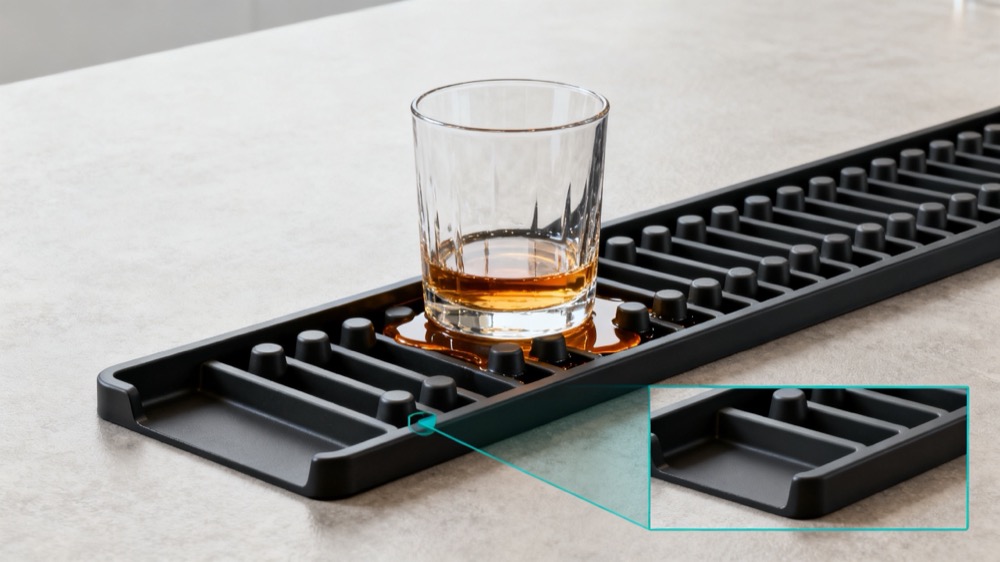
Raised features can support glassware above collected liquid, but their arrangement should remain accessible.
When reviewing a custom bar mat, examine:
- Spaces between pins or ribs.
- Internal corners around lettering.
- The transition between the base and border.
- Recesses that may retain cleaning solution.
- Underside areas where moisture can remain.
A useful design balances presentation, glass support, liquid collection, and brush access.
"Non-slip" is not an unconditional material property.
Performance depends on the mat underside, countertop finish, contamination, moisture, and how force is applied.
Evaluate the sample on the intended surface, both dry and with representative moisture underneath. Check whether it shifts during normal glass placement and wiping.
Do not translate a countertop stability assessment into a claim about pedestrian slip safety.
The following is a proposed buyer screening protocol, not an accredited standard or a claim about Yijia's completed testing.
Compare finished mats with similar dimensions, thickness, and functional geometry wherever possible.
Record:
- Material identification and supplier.
- Initial dry mass and dimensions.
- Flatness and edge condition.
- Surface appearance and odor.
- Logo appearance.
- Intended cleaning instructions.
Photograph each sample under consistent lighting.
Select liquids that reflect actual operations. A useful shortlist includes water, beer, cola, coffee, wine, and the venue's strongest routinely served spirit.
Include the actual cleaning product at its prescribed working dilution.
Apply the same liquid volume and contact time to each sample. Use separate areas or separate samples where necessary to avoid confusing the effects of different liquids.
One practical screening plan is 50 spill–clean–dry cycles, with inspections every 10 cycles.
These numbers are suggested planning values, not an established industry benchmark.
Keep washing method, drying conditions, and inspection timing consistent. Measure samples only after comparable drying or conditioning.
If dishwasher use is required, obtain explicit supplier approval for the proposed cycle before testing.
Agree on what constitutes a failure:
| Check | Example acceptance requirement |
|---|---|
| Leakage | No liquid transfer through an intact base |
| Appearance | No unacceptable permanent staining |
| Surface condition | No cracking, tackiness, or visible deterioration |
| Dimensions | Remain within agreed tolerances |
| Flatness | No edge lift that disrupts service |
| Branding | Logo remains legible and intact |
| Cleanability | Residue can be removed using the approved procedure |
Record results rather than reducing everything to "passed."
A short screening test can identify weaknesses, but it does not justify a multi-year lifespan claim without supporting service data.
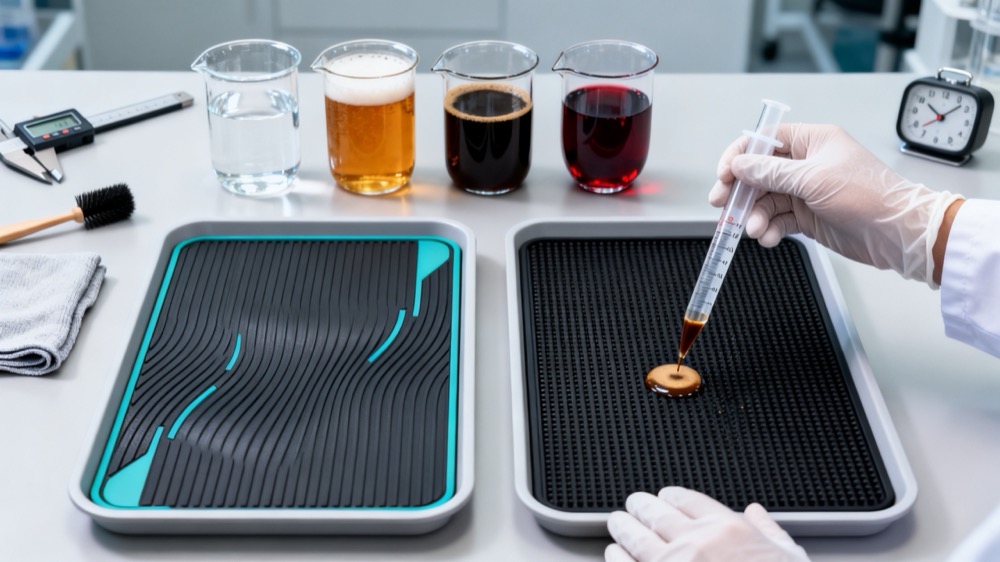
An easy-clean bar mat still requires a consistent routine.
1. Empty collected liquid before it overflows.
2. Remove sticky deposits promptly.
3. Wash using a supplier-approved detergent and method.
4. Brush accessible recesses without damaging the surface.
5. Rinse as required by the cleaning procedure.
6. Dry the mat and counter before replacement.
7. Inspect for damage and persistent residue.
Follow local hygiene requirements and the labels of cleaning or sanitizing products. Cleaning removes soil; sanitizing is a separate process where required.
Do not assume either PVC or rubber is dishwasher-safe. Temperature, detergent chemistry, and cycle duration must be compatible with the specific finished product.
Safety documentation and spill-performance evidence answer different questions.
Ask for reports relevant to the finished product, intended market, and supplied formulation.
California Proposition 65 concerns exposures to listed chemicals and associated warning obligations. It is not a universal product-safety certification.
Likewise, RoHS principally addresses electrical and electronic equipment. A RoHS-related substance test may provide useful information, but it does not by itself prove that a non-electrical bar mat is food-contact compliant.
A test report should identify the tested sample, date, methods, substances, and applicable limits.
A mat used beneath glassware is not automatically approved for direct contact with food.
If direct food contact is intended, specify that requirement before material selection and request documentation appropriate to the destination market and conditions of use.
Brand authorization is another separate issue. Disney-related manufacturing documentation should not be presented as proof of beverage resistance, food-contact suitability, or unrestricted permission to reproduce licensed artwork.
Keep chemical compliance, facility authorization, and functional testing distinct.
Yijia Plastic Products Co., Ltd. combines research and development, production, and sales of PVC bar mats and other soft PVC promotional products.
Our company background includes 18 years of experience, a 3,000-square-meter factory, 10 automated production lines, and advanced dispensing equipment. We provide one-stop OEM/ODM customization.
Our supplied company profile also identifies cooperation experience involving Starbucks, Disney, McDonald's, Pop Mart, and Tencent, together with RoHS-, Proposition 65-, and Disney FAMA-related credentials. Buyers should review the relevant documents and project scope for their own orders.
From our manufacturing perspective, an effective custom mat starts with the operating environment—not just artwork.
A useful project brief includes:
- Beverage types and likely spill duration.
- Counter dimensions and surface finish.
- Required spill capacity.
- Cleaning chemicals and temperatures.
- Logo, colors, and artwork authorization.
- Destination-market documentation.
- Agreed sample acceptance criteria.
This information helps connect visual design with real service requirements.
Choose a PVC waterproof mat when molded branding, custom geometry, and routine beverage service are priorities—and the finished sample passes your cleaning and spill checks.
Consider a specified rubber compound when a particular chemical exposure or operating condition favors that elastomer. Do not purchase an unidentified "rubber mat" for a demanding application.
For repeated beverage spills, there is no evidence-based universal winner. The better product is the one whose formulation, construction, and maintenance requirements match your counter.
To develop a custom PVC bar mat with Yijia, send your artwork, dimensions, beverage list, cleaning method, and target market. Request a sample and agree on a repeated-spill evaluation before approving production.
No. Waterproofing concerns liquid penetration. Staining depends on the beverage, material formulation, surface finish, exposure duration, and cleaning procedure.
No. Rubber includes different elastomers with different compatibility profiles. Compare the specified compound and finished sample under realistic exposure conditions.
Only when the supplier approves the relevant temperature, detergent, and cycle. The same precaution applies to rubber mats.
Neither material wins automatically. Accessible surface features, removable residue, cleaner compatibility, and a consistent cleaning routine determine practical performance.
Not necessarily. Usable capacity depends on internal dimensions, border height, and displacement from raised features—not weight alone.
Use condition-based inspection rather than an unsupported fixed interval. Replace mats that develop cracks, persistent tackiness, disruptive deformation, or residue that approved cleaning cannot remove.
- Rubber Fab. "Chemical Resistance Chart." Supports distinctions between elastomer families and the importance of concentration, temperature, and exposure duration. [View source]. [rubberfab]
- Fernco. "Rubber Chemical Resistance Chart," June 2023 revision. Includes flexible PVC, EPDM, and nitrile ratings; useful for preliminary material screening, not finished-mat performance certification. [View source]. [fernco.co]
- European Chemicals Agency. "Investigation Report on PVC and PVC Additives." Provides background on plasticizers and formulation differences in flexible PVC. [View report]. [europarl.europa]
- California Office of Environmental Health Hazard Assessment. "Phthalates—Proposition 65 Warnings." Explains listed phthalates and warning obligations. [View source]. [p65warnings.ca]
- European Commission. "RoHS Directive." Explains its electrical and electronic equipment scope and restricted substances. [View source]. [environment.ec.europa]


