
Views: 295 Author: Yijia Plastic Publish Time: 2026-10-27 Origin: Site
Content Menu
● PVC Waterproof Mat vs. Silicone Mat: A Quick Comparison
● What Makes a PVC Waterproof Mat Different from a Silicone Mat?
>> Flexible PVC: A Customizable Thermoplastic
>> Silicone: An Elastomer with Broad Temperature Capability
● Which Material Handles Outdoor Café Conditions Better?
>> Hot Cups, Cold Weather, and Table Temperatures
● Waterproofing, Grip, and Spill Control: Design Matters
>> Waterproof Does Not Mean the Table Stays Dry
>> Non-Slip Performance Must Be Checked on Your Tables
● Cleaning, Hygiene, and Food-Contact Requirements
>> Choose a Surface Your Staff Can Clean Consistently
>> Food Safety Requires More Than a Material Label
● Custom Branding: Where PVC Bar Mats Can Add Value
● A Practical Sample-Test Plan Before Bulk Ordering
>> Step 1: Establish Comparable Samples
>> Step 2: Run a Seven-Day Café Trial
>> Step 3: Set Acceptance Criteria Before Ordering
● Compare Cost per Service Day, Not Just Purchase Price
● What Yijia Brings to a Custom PVC Mat Project
● Final Recommendation: Match the Mat to the Café
>> Is a PVC waterproof mat suitable for outdoor café tables?
>> Is silicone always better than PVC outdoors?
>> Can either material damage a café table?
>> Are silicone mats automatically food-safe?
>> Can PVC and silicone mats go in a dishwasher?
>> Which material is better for a custom café logo?
A PVC waterproof mat is often the better choice for branded outdoor café tables in sheltered settings, while a silicone mat generally offers stronger resistance to temperature extremes and weather exposure. Neither material wins every comparison. The right choice depends on sunlight, cleaning routines, table surfaces, branding requirements, and replacement costs.
At Yijia Plastic Products Co., Ltd., our perspective comes from 18 years of developing and manufacturing PVC soft-plastic gifts, including custom PVC bar mats. For café buyers, we recommend evaluating the finished product—not simply choosing a material name.
This guide compares both options and explains how to select a mat that balances performance, presentation, and practical operating costs.

This comparison concerns flexible, reusable tabletop mats—not absorbent fabric placemats, stone drying mats, or rigid PVC table covers.
| Buying factor | PVC waterproof mat | Silicone mat |
|---|---|---|
| Best-fit application | Branded tables and sheltered café terraces | More exposed settings and temperature-sensitive applications |
| Water protection | Non-absorbent body; edges and underside still matter | Non-absorbent body; edges and underside still matter |
| Sunlight exposure | Requires an appropriate formulation and product-specific validation | Generally offers strong weathering resistance |
| Temperature tolerance | More limited; verify the finished mat's rating | Generally wider; verify the finished mat's rating |
| Custom branding | Well suited to molded, multicolor designs | Also customizable through molding and other processes |
| Cleaning | Follow validated washing instructions | Follow validated washing instructions |
| Food contact | Requires application-specific documentation | Requires application-specific documentation |
| Purchase price | Often competitive for promotional projects | May carry a premium; compare equivalent quotations |
| Main purchasing risk | Assuming every flexible PVC mat is outdoor-rated | Assuming every silicone mat is food-safe or dishwasher-safe |
These are selection guidelines, not universal product specifications. Formulation, thickness, surface geometry, and manufacturing quality can change the outcome.
PVC stands for polyvinyl chloride. Flexible PVC formulations use additives to achieve the softness and handling characteristics required for products such as bar mats and promotional gifts.
For outdoor café tables, PVC's commercial appeal is its combination of customizable appearance and practical spill management.
Molded designs can incorporate:
- Raised logos and lettering.
- Contrasting color sections.
- Defined borders.
- Textured drink-resting areas.
- Shapes matched to a brand campaign.
However, the formulation matters. Two visually similar PVC mats may respond differently to sunlight, heat, cleaning chemicals, and repeated flexing.
Silicone elastomers generally offer strong thermal stability and resistance to weather, ultraviolet exposure, and ozone.
That makes silicone worth considering for cafés with demanding temperature conditions or prolonged outdoor exposure.
However, "silicone" describes a material family, not a complete performance guarantee. Pigments, fillers, curing systems, thickness, and surface design still influence the finished mat.
Our purchasing recommendation is straightforward: compare documented products rather than assuming all PVC or all silicone behaves identically.
For an uncovered terrace, silicone generally has the advantage in weathering resistance.
Flexible PVC can also be suitable outdoors when appropriately formulated. It should not be rejected automatically, but outdoor suitability needs evidence specific to the proposed product.
Ask the supplier:
1. Is this formulation intended for outdoor use?
2. What weathering evaluation supports that claim?
3. Were the actual production colors tested?
4. What changes in appearance or flexibility are acceptable?
5. What warranty exclusions apply?
Avoid accepting a vague "UV-proof" claim. A material can remain usable while its color, surface finish, or logo contrast changes.
For a shaded café terrace where staff bring mats inside after service, a properly specified PVC waterproof mat may offer a sensible balance of appearance and cost.
Silicone generally accommodates a wider temperature range than flexible PVC.
However, raw-material temperature figures should not be treated as finished-product guarantees. A mat's decoration, backing, or other components may have different limits.
Ask for the rated operating temperature of the complete mat.
Also distinguish between:
- A drinking cup resting briefly on the surface.
- Repeated contact with hot serving vessels.
- Storage on a sun-heated table.
- Dishwasher exposure.
- Contact with cookware.
A café table mat is not automatically a trivet. Neither material should be used under hot pans without an explicit rating for that application.
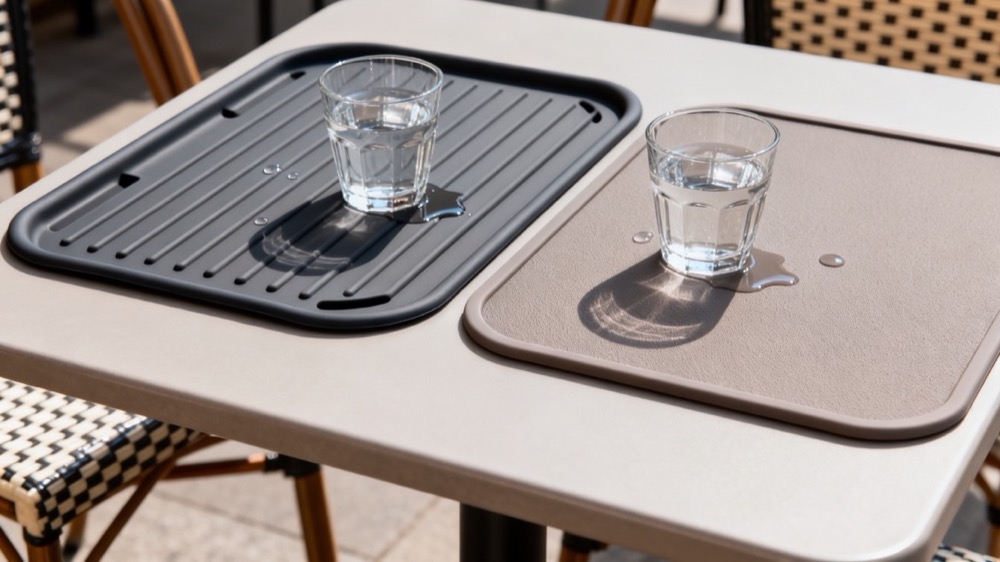
Both materials can provide a non-absorbent barrier. Neither automatically prevents water from reaching the table.
Rain can enter beneath an edge. Condensation can collect underneath. A raised border can contain small spills but may also retain water until staff empty it.
When assessing an outdoor table mat, examine:
- Border height and continuity.
- Surface channels or recessed areas.
- Flatness across the whole mat.
- Underside texture.
- Ease of lifting and drying.
The practical question is not simply whether water penetrates the material. It is whether the complete design manages water effectively during service.
Do not choose a winner based on material alone.
Grip depends on the combination of mat texture, table finish, moisture, contamination, and contact area. Glass, coated metal, sealed wood, and laminate should each be evaluated separately.
During sample review, test both interfaces:
- Does the mat slide across the table?
- Does a cup slide across the mat?
A stable mat with an unsuitable top texture can still create an inconvenient drinking surface. Likewise, a grippy upper surface does not compensate for a sliding underside.
A visually attractive mat can become inconvenient if its grooves are difficult to wash.
Raised patterns and detailed logos should be balanced against cleaning access. Ask staff to clean a sample after exposure to coffee, milk, syrup, and the café's usual condiments.
Evaluate:
- Residue remaining around lettering.
- Time needed for washing and rinsing.
- Drying time under normal storage conditions.
- Odor after cleaning.
- Changes after repeated washing.
Use only cleaning methods the supplier has validated. Silicone is not automatically dishwasher-safe, and PVC should not automatically be treated as unsuitable for every machine-washing process.
The correct answer depends on the finished product and the washing conditions.
A mat used beneath cups has a different intended use from one used for direct contact with pastries or uncovered food.
For silicone rubber articles intended for repeated food contact in the United States, 21 CFR 177.2600 may be relevant. Compliance depends on the applicable composition, extraction, and use requirements—not simply the word "silicone."
For either material, request documentation covering:
- The finished article or a clearly representative formulation.
- Intended food-contact conditions.
- Relevant destination-market requirements.
- Test dates and sample identification.
- Colorants and other components where applicable.
Do not treat a general material certificate as proof that every customized version meets the same requirements.
For cafés, a tabletop mat can serve two roles: managing drinks and reinforcing the brand.
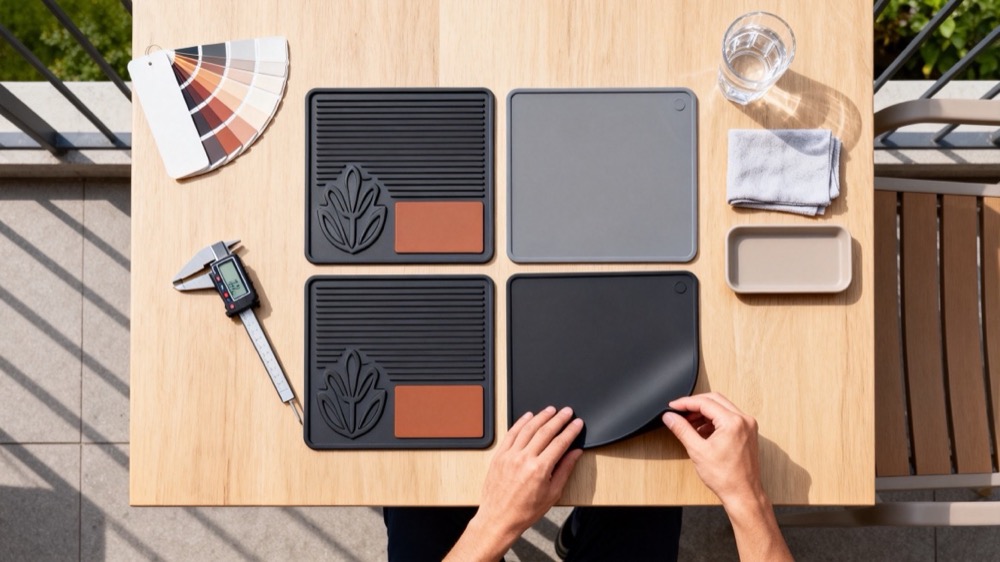
A custom PVC bar mat is worth considering when the project emphasizes molded artwork, contrasting colors, and a tactile logo.
From our manufacturing perspective, the best design is not necessarily the most complicated. It is the one that remains recognizable, sits flat, and cleans easily.
Before approving artwork, review:
1. Logo legibility at actual size.
2. Contrast against the main mat color.
3. Placement beneath cups and serving items.
4. Border and groove cleanability.
5. Consistency between approved samples and production.
Silicone can also support custom branding. Compare physical samples rather than assuming either material always delivers better visual quality.
For multi-location café projects, repeatability matters as much as the first sample's appearance.
A small operational trial can reveal problems that a specification sheet misses.
The following is a proposed buyer evaluation—not a published laboratory standard or a claim about measured product performance.
Request samples with similar dimensions, thickness, and intended use.
Record the formulation reference, color, surface design, cleaning instructions, and supplier's claimed operating limits.
Comparing a thick premium silicone mat against a thin promotional PVC mat will not isolate the effect of material.
Use the samples under representative service conditions and keep a simple daily log.
| Check | Suggested evaluation |
|---|---|
| Flatness | Photograph corners and edges on the same table |
| Grip | Compare dry and damp conditions using the same cup |
| Spill management | Apply equal measured quantities of water |
| Cleaning | Use the café's normal approved washing routine |
| Appearance | Photograph under consistent lighting |
| Staff experience | Record cleaning difficulty and handling comments |
This trial assesses short-term suitability. It does not establish multi-year outdoor life.
Agree on acceptable flatness, dimensions, logo appearance, cleaning behavior, and documentation before approving bulk production.
Keep an approved reference sample.
For larger projects, request relevant laboratory evaluation in addition to the operational trial. Neither a brief field trial nor a generic material brochure should support an unsupported lifespan guarantee.
A lower unit price does not necessarily mean a lower operating cost.
Consider acquisition, freight, cleaning labor, replacements, and the number of days each mat remains presentable.
A useful purchasing calculation is:
Cost per service day=(Purchase, delivery, cleaning, and replacement costs)/Usable service days
Use your own trial results and quotations rather than assumed replacement intervals.
For a seasonal promotion, visual impact and purchase price may dominate. For a permanent exposed terrace, weather resistance and replacement frequency may matter more.
Avoid unsupported environmental shortcuts, too. Neither PVC nor silicone should automatically be called biodegradable, universally recyclable, or environmentally superior. Ask about actual local collection routes and evaluate durability within your operating model.
Yijia Plastic Products Co., Ltd. combines research and development, production, and sales of PVC soft-plastic gifts.
Our company background includes:
- 18 years of manufacturing experience.
- A 3,000-square-meter factory.
- Ten automated production lines.
- Multiple advanced dispensing machines.
- One-stop OEM/ODM customization.
- Project experience involving Starbucks, Disney, McDonald's, Pop Mart, and Tencent.
These company-provided credentials describe our background; they do not replace product-specific testing or imply endorsement by the named brands.
The same distinction applies to compliance documentation. RoHS concerns restricted substances in electrical and electronic equipment; a related substance test does not establish a non-electrical mat's food-contact suitability. California Proposition 65 concerns chemical-exposure warnings, not blanket product approval. Disney FAMA concerns authorization for facilities producing Disney-branded merchandise, not general material-safety certification.
Ask for current documents and confirm their scope against your actual order.
Choose a PVC waterproof mat when your priority is custom branding for sheltered outdoor tables, supported by suitable formulation, cleaning instructions, and sample approval.
Choose a silicone mat when wider temperature capability and weathering resistance carry greater weight, provided the finished product meets your operational requirements.
For a tailored PVC solution, contact Yijia with your table dimensions, artwork, order quantity, destination market, sunlight exposure, and cleaning routine. Request a sample and a product-specific specification before committing to bulk production.
Yes, when its formulation and construction suit the exposure. Shaded, managed terraces may be appropriate applications. Request product-specific evidence for prolonged sunlight or demanding weather conditions.
No. Silicone generally has advantages in weathering and temperature resistance, but branding, cleaning, purchase cost, and the actual exposure conditions may make PVC a better commercial fit.
Do not assume universal compatibility. Test the finished mat on the actual table coating, particularly under heat and moisture, and check for staining, sticking, surface changes, or trapped water.
No. Food-contact suitability depends on the finished formulation, intended conditions of use, and applicable requirements. Ask for relevant documentation rather than relying on a generic material description.
Only when the supplier confirms that the finished product tolerates the proposed temperature, detergent, and washing cycle. Otherwise, follow the validated manual-cleaning instructions.
Both can be customized. PVC is a strong option for molded multicolor promotional designs. Evaluate actual samples for legibility, detail, cleaning access, and production consistency.
1. [Timco Rubber — "PVC vs. Silicone: Which Is Better?"]
Industry comparison covering temperature capability, weathering, and formulation-dependent material selection. Its general material figures are not treated here as finished-mat specifications. [timcorubber]
Primary regulatory text addressing eligible rubber compositions and requirements for specified repeated food-contact uses. [ecfr]
3. [U.S. Food and Drug Administration — Inventory of Food Contact Substances Listed in 21 CFR]
Explains that authorization depends on substance identity, intended use, and conditions of use. [hfpappexternal.fda]
4. [European Commission — RoHS Directive]
Explains the directive's electrical and electronic equipment scope and restrictions on ten hazardous substances. [environment.ec.europa]
5. [California Department of Justice — Proposition 65 Frequently Asked Questions]
Explains chemical-exposure warning requirements and distinguishes warnings from regulatory determinations that a product is safe or unsafe. [oag.ca]
6. [The Walt Disney Company — Facility and Merchandise Authorization Application and Instructions]
Describes facility authorization requirements for producing or handling Disney-branded products. [thewaltdisneycompany]


