
Views: 224 Author: Yijia Plastic Publish Time: 2026-09-26 Origin: Site
Content Menu
● PVC vs. Silicone at a Glance
● What Job Must the Mat Perform?
● How Do the Materials Compare?
>> Wine spills, staining, and cleaning
>> Grip, drainage, and stemware stability
>> Heat, washing, and useful life
>> Which one looks more premium?
● Three Checks That Improve the Decision
>> 1. Separate serving from drying
>> 2. Run a seven-service sample trial
>> 3. Compare cost per usable service
>> Match documents to the intended use
>> Specify a custom mat before tooling
>> The verdict
>> Is a PVC wine glass drip mat suitable for a bar?
>> Is silicone always easier to clean than PVC?
>> Can either mat air-dry sanitized wine glasses?
>> Will red wine stain a light-colored mat?
>> Which material is better for hot washing?
>> Is a custom PVC mat always cheaper than silicone?
>> Does Disney FAMA certify a mat for food contact?
A PVC wine glass drip mat can give a premium wine bar a distinctive branded surface while catching the spills that come with service. A silicone drip mat may be the stronger choice when the bar's washing routine involves repeated heat. Neither material wins in every setting. The decision depends on whether the mat will sit at a guest-facing pour station, support clean glassware as it dries, or attempt to do both.
The most useful comparison is between finished products, not material names alone. A shallow PVC design may be quicker to clean than a deeply ribbed silicone one. A carefully specified silicone mat may hold its shape better through a demanding hot-wash routine. Before ordering, define the mat's job and test samples under the conditions your staff will actually encounter.

| Buying criterion | PVC wine glass drip mat | Silicone drip mat |
|---|---|---|
| Guest-facing branding | A strong option for molded relief, colored areas, and prominent logos | Can also be colored and customized; graphic methods vary by supplier |
| Routine wine spills | Suitable when the formulation and surface design match the task | Suitable when the surface design and cleaning method match the task |
| Repeated heat | Confirm the finished product’s washing limits | Generally offers greater material-level heat tolerance; confirm finished-product limits |
| Cleaning effort | Depends heavily on groove depth, finish, and approved cleaner | Depends heavily on groove depth, finish, and approved cleaner |
| Glass stability | Test the actual glass foot on the wet mat | Test the actual glass foot on the wet mat |
| Best procurement test | Artwork quality, spill control, cleaning, and price at volume | Heat tolerance, cleaning, stability, and price at volume |
For a visible, cold-service station, a well-designed custom PVC mat may be the better fit. If repeated hot washing is central to the brief, give silicone closer consideration. In either case, approve a physical sample before placing a bulk order.
A serving mat catches drops after a pour, protects the counter, and gives staff a defined place to set a bottle or glass. A glass-draining surface has a different purpose: it must support cleaned glassware while water escapes and air circulates.
That distinction matters because "wine glass drip mat" can describe either product. A decorative mat should not be assumed to function as an appropriate drain board for sanitized glasses. If your bar expects one mat to serve both roles, evaluate its drainage geometry and the entire glassware-washing workflow—not just its appearance.
Start the purchase brief with a location and a task:
- Guest-facing pour station: Prioritize appearance, glass stability, spill containment, and fast wipe-downs.
- Back-bar drying station: Prioritize the approved cleaning workflow, drainage, airflow, and access for washing.
- Mixed-use station: Check whether staff can keep clean glassware separate from surfaces used to catch service spills.
A striking logo will not solve a poorly planned drying process. Equally, an efficient draining surface may not give a premium bar the presentation it wants in a guest's line of sight.
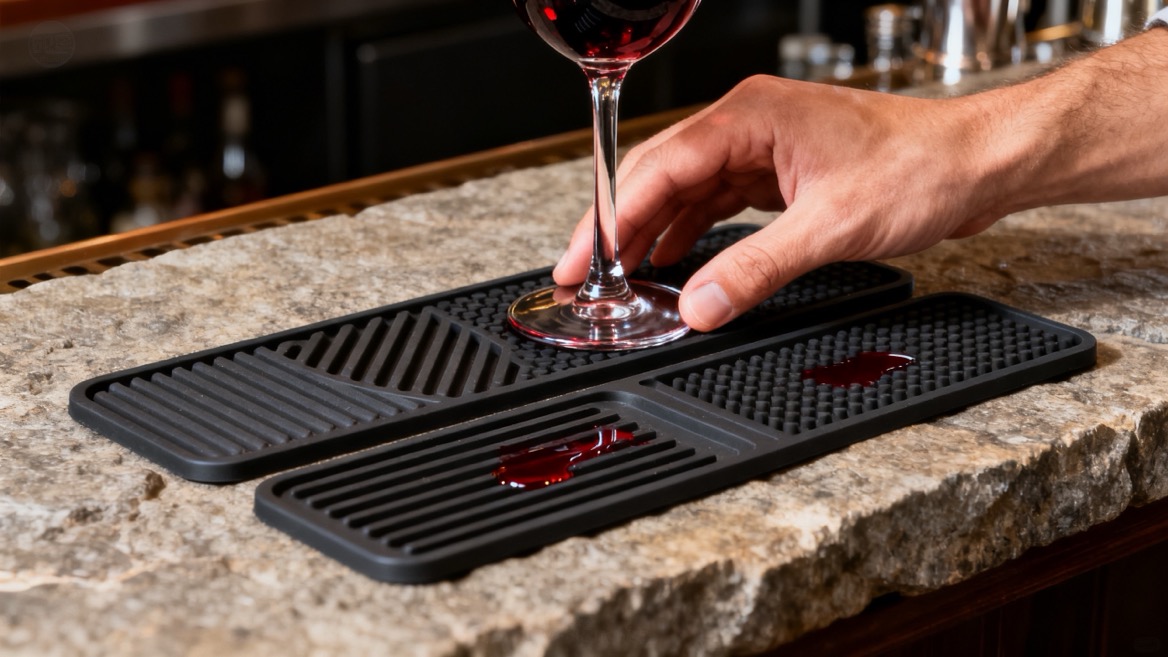
Red wine can leave visible residue on either type of mat. How readily it comes off depends on the finished color, texture, formulation, length of exposure, and cleaning method. A dark surface may hide a mark without being any cleaner; a pale surface may reveal residue sooner.
The buying question is therefore specific: Can staff remove a dried spill from this exact mat with the cleaner they are permitted to use, without damaging its color or artwork? Ask for production-representative samples. Test them with red wine, then inspect the grooves, raised graphics, and underside after cleaning.
Flexible PVC is formulated with additives that influence softness and other properties. Some plasticizers can migrate under particular conditions, making formulation and finished-item evidence important. That does not mean all PVC mats behave alike. Silicone also varies by grade, and a graphic, coating, or adhesive can have different cleaning limits from the silicone beneath it.
Neither material should be declared the winner for grip without testing the finished design. Underside texture, counter material, surface moisture, and the shape of the glass foot all affect stability.
Raised ribs can lift a glass base above pooled liquid. If they are too tall or too widely spaced, however, a narrow wine-glass foot may rock. Deep channels can hold more spills but can also be slower to empty and scrub. A border that retains wine effectively may create a problem if staff tip the mat toward themselves when clearing it.
Test each sample on the intended stone, wood, or stainless-steel counter. Use your actual stemware. Place and lift a filled glass as staff would during service; check for sliding, rocking, splashing, and edges that catch the stem or foot. Repeat when the mat is wet.
Silicone rubber generally tolerates a wider temperature range than flexible PVC. That advantage becomes relevant if mats regularly face a hot-wash process or sit near warm equipment. It is not permission to put every silicone mat through any dishwasher cycle: the finished article's pigments, graphics, and other components may set a lower limit.
Request written washing instructions for the specific product, regardless of material. Confirm the cleaner, temperature, exposure time, rinse method, and drying method. Then inspect the sample after repeated cleaning for edge curl, cracking, tears, tackiness, fading, and retained odor.
Avoid promises such as "lasts twice as long." Service life depends on the design and treatment the mat receives. A short venue trial is more useful than an unsupported material-wide estimate.
Premium presentation is a design result, not a polymer property. A restrained silicone mat can look elegant; a precisely finished PVC mat can look distinctive and intentional. Either can look inexpensive if its color clashes with the bar, its grooves retain visible residue, or its logo dominates the counter.
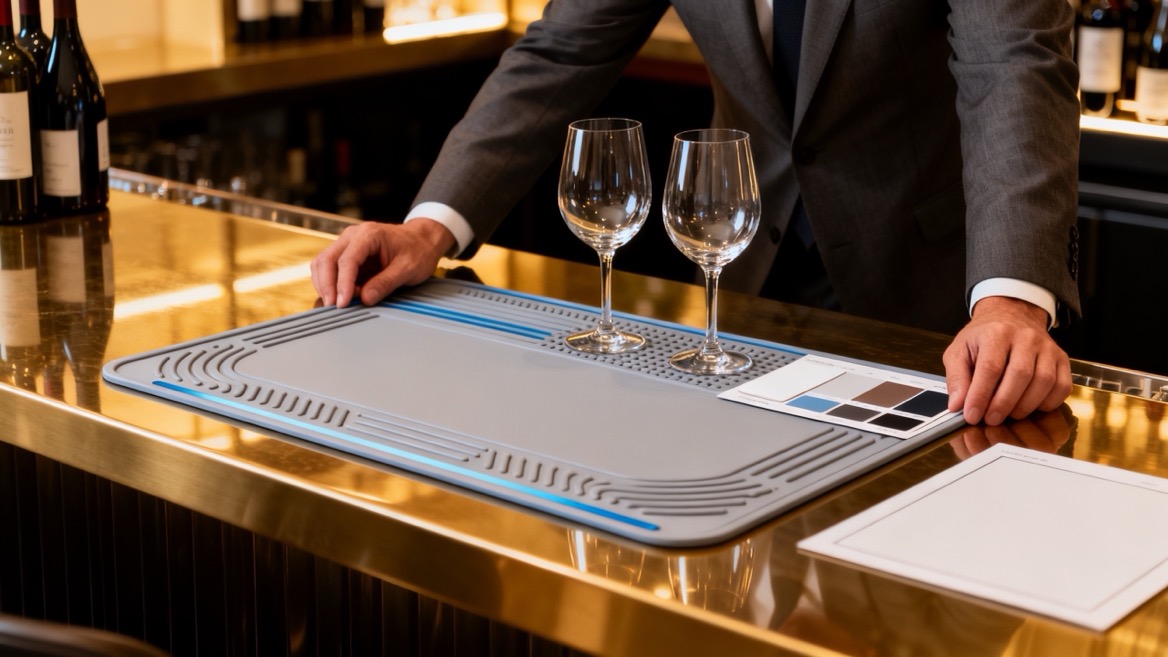
View samples from a seated guest's position. Ask whether the branding remains visible once bottles and tools are in place. Check the color under the bar's real lighting rather than approving it only on a screen. Consider whether the mat complements wine labels and glassware instead of competing with them.
For custom work, request a physical proof showing logo placement, relief, color, and usable glass-setting area. PVC can be an effective choice for molded branding, while silicone also supports customization through processes that should be confirmed with its supplier. Judge the outcome from samples, not assumptions about either material.
Ask staff where a glass goes immediately after it has been cleaned and sanitized. If the answer is "onto the branded display mat," stop and examine that practice. A mat intended to catch wine during service is not automatically suitable as the surface on which clean glasses air-dry.
Draw a simple station map before selecting a material. Mark the routes for used glasses, washed glasses, bottles, and guest-ready stemware. This often reveals whether you need one mat, two different surfaces, or a change in placement rather than a different polymer.
A photograph shows the mat at its best. A service trial shows how it behaves after spills, movement, and cleaning. Test PVC and silicone samples with the same glassware, counter, wine, and approved cleaning routine.
1. Photograph both clean samples under the venue's lighting.
2. During each service, note glass movement, pooled liquid, and hard-to-reach residue.
3. At close, have staff clean the mats according to the proposed instructions.
4. After seven services, compare color, odor, surface feel, edge shape, and cleaning effort.
This is a suggested buying protocol, not a published performance benchmark. Set pass criteria beforehand: no unacceptable rocking, no persistent tackiness, manageable cleaning effort, and legible branding after the final wash. Add requirements specific to your operation.
The lowest unit quote is not always the least expensive choice for a working bar. Compare like-for-like quotations with the same dimensions, thickness, color count, artwork coverage, packaging, and order quantity. Include tooling, delivery, replacements, and cleaning effort in your internal assessment.
A practical measure is total landed purchase and replacement cost divided by the number of usable service shifts you observe or reasonably project. Track cleaning labor separately so that a time-consuming design does not appear cheap simply because its purchase price is low.
No universal PVC-versus-silicone cost-per-service figure can answer this for your venue. Quotes and a controlled sample trial can.
For a mat used beneath glasses to catch drips, request a finished-item specification, relevant test reports, cleaning instructions, and a traceable approved sample. If food or drink will intentionally contact the mat, state that in the brief and request food-contact evidence applicable to the destination market. The words "PVC" and "silicone" alone establish neither suitability nor compliance.
Check that every report identifies the relevant product, formulation or material, test scope, and date. A result for raw resin—or for another customer's differently colored product—should not be presented as proof for your finished custom mat.
Compliance terms also need careful handling. EU RoHS primarily addresses electrical and electronic equipment; a standalone, non-electrical drip mat is not automatically within its scope. California Proposition 65 concerns warnings about certain chemical exposures, not a general product-safety certification. Disney FAMA concerns authorization for Disney-branded production at a facility; it does not certify a mat for food contact.
If licensed artwork is proposed, confirm the customer's right to use it and obtain the authorization relevant to that project. Previous work involving a well-known brand is not permission to reproduce its marks for a new order.
Begin with function. Give the supplier the counter dimensions, glass-foot diameter, desired placement of bottles and glasses, and the way staff will remove collected liquid. Ask for channels that hold everyday drips without creating recesses too narrow to clean.
Then define the visual standard: base color, artwork colors, logo position, relief height, and acceptable color variation. Approve the physical sample under actual bar lighting. Check that it lies flat, works on the intended countertop, and arrives in packaging that protects its shape and finish.
Finally, put the cleaning routine in writing. List the proposed cleaner, wash temperature, rinse method, and drying method. Ask the manufacturer to confirm compatibility with the complete decorated mat. If the routine and material do not match, change the specification before production rather than asking staff to work around a finished purchase.
Yijia Plastic Products Co., Ltd. specializes in custom PVC products, including coasters, and offers OEM/ODM services. According to the company information supplied for this article, it has 18 years of experience, a 3,000-square-meter factory, ten automated production lines, and multiple dispensing machines. The company also reports experience working with Starbucks, Disney, McDonald's, Pop Mart, and Tencent. These are company-provided background claims, not independent test results for a proposed wine-bar mat.
For a premium bar project, turn that manufacturing background into verifiable deliverables: an application-specific PVC proposal, artwork proof, physical prototype, product-matched test documents, and approved cleaning guidance. Ask to see current, relevant records when a licensed design or a particular compliance claim is part of the order.
Yijia's stated specialty is PVC. This comparison does not assume it manufactures silicone mats. If your cleaning requirements point toward silicone, request a sample from a qualified silicone supplier and assess it against the same brief.
Choose a custom PVC wine glass drip mat when its primary job is guest-facing spill control, distinctive branding matters, and the finished sample passes your stability and cleaning trial. Choose a silicone drip mat when verified heat or washing demands favor it—provided its design, documentation, and sample also pass. Neither should stand in for an appropriate glassware drain board without reviewing the complete sanitation workflow.
Planning a branded wine-bar station? Send Yijia your counter dimensions, artwork, estimated order quantity, destination market, and cleaning procedure. Request a product-matched PVC prototype and supporting documentation before approving production. If hot washing is a deciding factor, compare that prototype with a silicone sample under the same conditions.
It can be suitable for catching drips beneath glasses when the finished product meets the bar's functional and cleaning requirements. Do not assume a spill-catching mat is approved for intentional food contact. Specify that use separately if it is required.
No. Open, accessible grooves may be quicker to clean than deep, crowded ones, regardless of material. Test the finished designs with the cleaner and routine your staff will use.
Only if the product and setup provide appropriate drainage and air circulation within the bar's applicable washing procedure. A decorative serving mat is not automatically an appropriate drain board.
It may. The result depends on the finish, pigments, formulation, spill dwell time, and cleaning method. Test a production-representative sample before approving a pale color.
Silicone generally offers greater material-level heat tolerance. Still, obtain the finished mat's written temperature and cleaning limits: its graphics or other components may have different limits.
No. Tooling, artwork, dimensions, order volume, freight, replacement frequency, and cleaning effort all affect the result. Compare equivalent quotes and expected cost per usable service.
No. FAMA relates to authorization for Disney-branded production at a facility. Intended food-contact use calls for separate, product-specific evidence.
The operational guidance and material distinctions above draw on the following sources. Yijia's capabilities and customer-history statements come solely from the company background supplied for this article and should be verified against current company records before publication.
- Shin-Etsu Chemical, [*Characteristic Properties of Silicone Rubber Compounds*]. Technical discussion of silicone rubber's heat, chemical, and mechanical properties; performance varies by formulation. [shinetsusilicone-global]
- WACKER Chemie, [*Solid and Liquid Silicone Rubber: Material and Processing Guidelines*]. Grade-dependent properties, processing methods, and considerations for sensitive applications. [wacker]
- SpecialChem, [*Plasticizers: How to Select the Right Grade for Plastics?*]. Flexible PVC formulations and factors affecting plasticizer migration. [specialchem]
- ServSafe, [*Going Straw-free? Review These Glassware Cleaning Guidelines*]. Glassware washing, sanitizing, and air-drying guidance. [servsafe]
- European Commission, [*Food Contact Materials*]. EU requirements for materials intended to contact food. [food.ec.europa]
- European Commission, [*RoHS Directive*]. Scope and purpose of restrictions concerning electrical and electronic equipment. [environment.ec.europa]
- California Office of Environmental Health Hazard Assessment, [*About Proposition 65*]. Explanation of the law's exposure-warning requirements. [oehha.ca]
- The Walt Disney Company, [*Facility and Merchandise Authorization Application Instructions*]. Explanation of facility authorization for Disney-branded production. [thewaltdisneycompany]


