
Views: 294 Author: Yijia Plastic Publish Time: 2026-10-31 Origin: Site
Content Menu
● Soft PVC Coaster vs. Cork Coaster: Quick Comparison
● How Soft PVC and Cork Coasters Handle Moisture
>> Soft PVC Coasters: Water Resistance Without Absorption
>> Cork Coasters: Water-Repellent, but Not Completely Waterproof
● Cleaning and Hygiene in Busy Restaurants
>> Which Coaster Is Easier to Clean?
>> Material Choice Does Not Replace a Cleaning Procedure
● Grip, Glass Stability, and Table Protection
>> Test Wet Grip Rather Than Trusting Material Labels
>> Hot Drinks Require a Separate Assessment
● Durability, Branding, and Guest Experience
>> Soft PVC Coasters for Detailed Restaurant Branding
>> Cork Coasters for a Natural Visual Identity
● Sustainability: Compare the Finished Product and Disposal Route
● A Practical Seven-Day Restaurant Coaster Trial
>> Step 1: Establish a Baseline
>> Step 2: Reproduce Real Service Conditions
>> Step 3: Apply Your Intended Cleaning Routine
>> Step 4: Inspect After Repeated Cycles
● Compare Cost per Use, Not Just Purchase Price
● Supplier Documentation: What Restaurant Buyers Should Verify
>> Separate Material Testing from Product Approval
>> Yijia's Manufacturing Background
● Which Coaster Should Your Restaurant Choose?
>> 1. Are soft PVC coasters better for condensation?
>> 2. Do cork coasters absorb water immediately?
>> 3. Can restaurant PVC coasters go in a dishwasher?
>> 4. Are cork coasters naturally antibacterial?
>> 5. Which material lasts longer in a wet restaurant?
>> 6. What should I request before placing a custom coaster order?
A soft PVC coaster is generally the stronger choice for moisture-prone restaurant environments where repeated spills, wet glassware, and frequent cleaning define daily service. A cork coaster remains attractive for venues that prioritize natural texture and manageable, lower-intensity moisture exposure. The right decision depends on how each finished coaster handles water, cleaning, and your restaurant's workflow—not simply its material name.
At Yijia Plastic Products Co., Ltd., we approach this comparison as a manufacturer with 18 years of experience in soft PVC gifts. Our perspective favors practical product design, but cork deserves a fair assessment. Below, we compare both materials and explain how restaurant buyers can test samples before committing to an order.

For busy dining rooms, bars, and iced-drink counters, cleanability should carry more weight than appearance alone.
| Buying factor | Soft PVC coaster | Cork coaster |
|---|---|---|
| Moisture behavior | Generally resists water absorption; liquid remains on the surface | Naturally water-repellent, but can absorb moisture over time |
| Spill management | Recessed designs can collect small amounts of condensation | Performance depends on surface, density, coating, and construction |
| Routine cleaning | Often suitable for washing when the formulation permits | Cleaning instructions vary; prolonged soaking may be unsuitable |
| Drying | Surface water must be removed before stacking | Absorbed moisture can extend drying requirements |
| Branding | Supports molded shapes, colors, and raised details | Offers a natural appearance with printed or engraved decoration |
| Main design risk | Deep details can trap residue | Coatings, binders, and exposed edges may affect durability |
| Best-fit setting | Frequent wet service with controlled cleaning procedures | Natural-style venues with lighter moisture exposure |
These are selection guidelines, not universal performance guarantees. Compare production-representative samples rather than assuming every PVC or cork coaster behaves alike.
A soft PVC coaster generally acts as a barrier rather than an absorbent pad. Condensation stays on its upper surface until staff wipe it away or it evaporates.
This distinction matters. Water resistance does not mean automatic spill containment. A flat coaster can allow water to escape around the edge, while a shallow recess and modest raised rim can help retain it.
For custom restaurant coasters, we recommend evaluating:
- Usable space inside the rim.
- Capacity for condensation without overflow.
- Flatness beneath the glass.
- Accessibility of grooves during cleaning.
A visually impressive design is not necessarily the easiest design to maintain.
Cork should not be described as a sponge. Its cellular structure and suberin-rich cell walls contribute to natural water repellency.
However, research shows that cork can absorb water and change dimensions during immersion. Humidity also affects its moisture content. In one laboratory study, samples held at 20°C for 30 days reached approximately 4.3%, 6.0%, and 9.0% moisture content at relative humidities of 45%, 65%, and 85%, respectively.
Those figures describe particular laboratory samples—not restaurant coaster failure rates.
Commercial cork coasters may be solid cork, agglomerated cork, coated cork, or layered composites. Their binders, finishes, and exposed edges can materially change moisture performance.
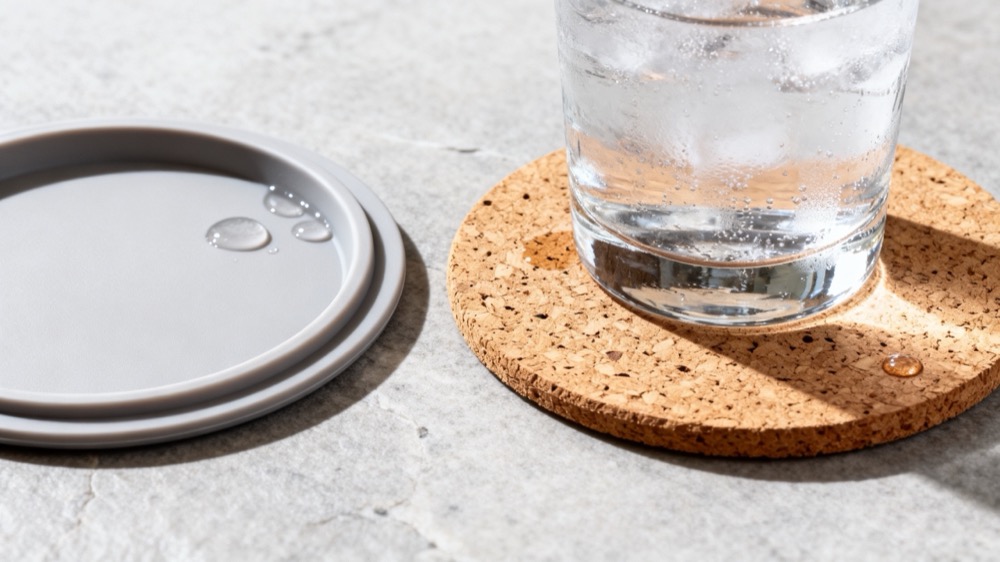
A simple, smooth soft PVC coaster is often the more practical option for frequent wet cleaning. Nevertheless, detergent compatibility and cleaning temperature depend on the finished formulation, decoration, and construction.
Do not assume every PVC coaster tolerates dishwashers, concentrated sanitizers, or repeated high-temperature washing.
Cork requires equally specific guidance. A sealed surface may simplify wiping, but scratches and exposed edges can behave differently from the protected face.
Ask both suppliers for written cleaning instructions covering:
1. Approved detergents.
2. Maximum cleaning temperature.
3. Permitted chemical concentrations and contact times.
4. Rinsing and drying requirements.
5. Signs that indicate replacement is necessary.
The FDA Food Code emphasizes easily cleanable surfaces and preventing residue accumulation on nonfood-contact equipment surfaces. These principles provide useful purchasing criteria, although a coaster's precise regulatory treatment depends on its use and local requirements.
Neither material is automatically hygienic.
A PVC coaster with sticky residue trapped beneath raised lettering can perform poorly in service. A cork coaster stacked while damp also creates an avoidable maintenance problem.
Cork has demonstrated antibacterial activity in laboratory research, with results differing between bacterial species. That does not establish that every finished cork coaster is self-sanitizing or suitable for reuse without cleaning.
Soft PVC's flexibility allows manufacturers to develop textured bases and cushioned contact surfaces. Cork also offers a compressible surface that can help accommodate minor irregularities.
However, actual grip depends on more than material:
- Table finish and cleanliness.
- Water beneath the coaster.
- Glass weight and base geometry.
- Surface texture.
- Coaster thickness and flatness.
Test both options on the tables your restaurant actually uses. Performance on dry laminate may not predict performance on wet polished stone.
Also check whether the coaster lifts with the glass. This can interrupt service regardless of which material you choose.
A coaster intended for iced beverages should not automatically be approved for very hot cups or heated serving vessels.
Cork's insulating structure can be useful beneath hot drinkware. Flexible PVC's temperature tolerance varies with its formulation.
Request a finished-product temperature specification. Neither material should be treated as a trivet for cookware without appropriate validation.
Custom soft PVC coasters support distinctive shapes, multiple colors, and molded logos. These features suit restaurant chains, promotional campaigns, and themed hospitality concepts.
From our manufacturing perspective, the key is balancing recognition with maintenance.
We recommend shallow relief, open cleaning channels, and a stable glass-contact area. Deep lettering and narrow decorative recesses may create unnecessary cleaning work.
Approve a physical sample rather than relying only on a digital rendering. Check color, dimensions, flexibility, odor, and flatness.
Cork offers a warm, tactile appearance that may suit cafés, wine bars, and restaurants built around natural materials.
Its visual appeal is a genuine purchasing consideration, but decoration still needs testing. Printed logos, coatings, and laminated layers can wear differently from the cork beneath them.
For either material, inspect samples after cleaning—not just when they first arrive. Guest-facing quality depends on how the coaster looks and feels throughout service.
Cork's plant-based origin is relevant, but it does not make every cork coaster equally sustainable. Agglomerated products may include binders, while printing, coatings, and backing materials can affect end-of-life options.
Soft PVC is a synthetic plastic. Buyers should not describe a PVC coaster as biodegradable, universally recyclable, or environmentally preferable without supporting evidence.
A more useful comparison asks:
- How long will the coaster remain serviceable?
- What materials, binders, and coatings does it contain?
- How much cleaning does it require?
- Is a practical local collection or recovery route available?
- Will the restaurant actually use that route?
Without comparable product-level evidence, neither material should receive an unconditional environmental victory.
Instead of relying on broad claims, run a small operational trial. The following is a proposed purchasing method, not a standardized certification test.
Select an equal number of each coaster. Record dimensions, dry weight, appearance, and initial flatness.
Photograph the top, underside, and edges. Include the actual glassware and table surfaces in the test.
Use chilled glasses, representative drinks, and normal service intervals. Include condensation and occasional spills without creating an unrealistic continuous-soaking test.
Record:
- Water escaping beyond the coaster.
- Sliding or glass instability.
- Visible staining.
- Coasters lifting with glasses.
- Moisture remaining underneath.
Use only cleaning methods approved by the supplier. Keep detergent concentration, temperature, and drying conditions consistent.
Measure hands-on cleaning time and drying time separately. Staff labor and drying capacity are different operational constraints.
Check for curling, cracking, swelling, tackiness, fading, loose particles, or persistent odor.
Set acceptance criteria before reviewing the results. This prevents an attractive sample from receiving special treatment despite poor service performance.
Seven days cannot prove a multi-year lifespan. It can reveal obvious mismatches between the product and your restaurant's workflow.
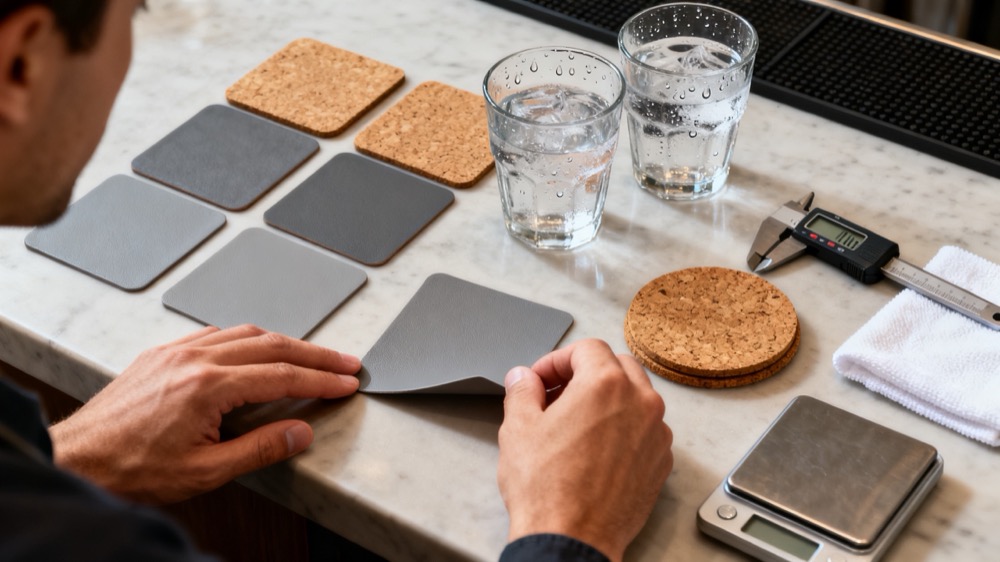
A low unit price does not necessarily produce the lowest operating cost.
For procurement purposes, use:
Cost per use = purchase cost + cleaning cost + replacement cost + disposal cost, divided by total usable service cycles.
Apply this consistently to both materials and avoid double-counting replacements.
A durable coaster can still become expensive if staff must spend extra time cleaning intricate details. Conversely, an inexpensive cork coaster may be suitable where moisture exposure is light and replacement is planned.
Do not accept a claimed lifespan without understanding the test conditions. Ask whether the evidence reflects your cleaning chemicals, drinkware, and service frequency.
Ask for reports that identify the tested product, material, colors, laboratory, date, and applicable requirements. A report for another formulation is not proof for your finished order.
Three distinctions are particularly important:
- RoHS primarily concerns electrical and electronic equipment. Testing coaster materials against its substance limits does not automatically establish that an ordinary coaster falls within its legal scope.
- California Proposition 65 concerns exposure warnings. It is not a universal product-safety certification.
- Disney FAMA means Facility and Merchandise Authorization. It is not a food-contact or coaster-performance certificate.
If direct food contact is intended, specify that use separately and request the relevant market-specific assessment.
Yijia Plastic Products Co., Ltd. combines research, development, production, and sales of PVC coasters and other soft PVC gifts.
Our company-provided profile includes:
- 18 years of manufacturing experience.
- A 3,000-square-meter factory.
- Ten automated production lines and advanced dispensing equipment.
- One-stop OEM/ODM customization.
- Reported project experience involving Starbucks, Disney, McDonald's, Pop Mart, and Tencent.
The profile also reports RoHS-related, Proposition 65-related, and Disney FAMA credentials. Buyers should verify the current documents and their precise scope. These statements are manufacturer-supplied, not independently verified here, and do not establish brand endorsement.
Choose a soft PVC coaster when frequent wet service, repeat cleaning, and detailed customization are your main priorities—provided the finished sample passes your operational trial.
Choose a cork coaster when natural appearance is central to the venue and moisture exposure remains compatible with the product's construction and maintenance instructions.
For a custom restaurant coaster project, send Yijia your glass-base dimensions, table material, beverage types, cleaning procedure, target market, quantity, and artwork. Request a production-representative sample and supporting documentation before approving bulk production.
They are generally better suited to resisting water absorption. However, containing condensation requires appropriate dimensions and surface geometry. A flat PVC coaster can still allow water to reach the table.
Not necessarily. Cork is naturally water-repellent, and absorption can be slow. Finished-coaster performance depends on density, exposed structure, binders, coatings, and exposure conditions.
Only when the supplier explicitly validates that cleaning method. Heat, detergents, and repeated washing can affect the material or decoration. Otherwise, follow the approved manual-cleaning procedure.
Laboratory research has found antibacterial activity in tested cork samples. This does not prove every commercial cork coaster provides equivalent protection, and it does not replace cleaning.
There is no universal lifespan. Soft PVC is often the more practical starting point for repeated wet service, but construction and maintenance determine actual results. Compare samples under identical conditions.
Request a representative sample, dimensional specifications, cleaning instructions, relevant test reports, color approval, and agreed acceptance criteria. Confirm that documentation applies to the formulation and decoration you will receive.
1. U.S. Food and Drug Administration. *Food Code 2022*. Sections addressing nonfood-contact surface materials, cleanability, and cleaning frequency provide the operational hygiene framework used here. [fda]
2. Rosa, M. E., and Fortes, M. A. *Water Absorption by Cork*. *Wood and Fiber Science*. Experimental research on water uptake, dimensional changes, and immersion behavior; not a finished-coaster service-life study. [wfs.swst]
3. *Surface and Dynamic Viscoelastic Properties of Cork*. *BioResources*, 14(1), beginning at page 607. Source for the controlled-humidity moisture-content figures and discussion of cork's surface properties. [bioresources.cnr.ncsu]
4. Gonçalves, F., et al. *Evaluation of Antimicrobial Properties of Cork*. PubMed record, PMID: 26635416. Source for the discussion of species-dependent laboratory antibacterial findings. [pubmed.ncbi.nlm.nih]
5. European Commission. *RoHS Directive*. Official explanation of the directive's electrical and electronic equipment scope and restricted substances. [environment.ec.europa]
6. California Office of Environmental Health Hazard Assessment. *Frequently Asked Questions for Businesses—Proposition 65*. Official guidance on exposure assessment and warning responsibilities. [p65warnings.ca]
7. The Walt Disney Company. *International Labor Standards Program Manual*. Official explanation of Facility and Merchandise Authorization and its role in Disney-branded production. [impact.disney]


