
Views: 220 Author: Yijia Plastic Publish Time: 2026-09-15 Origin: Site
Content Menu
● Quick Answer: Soft PVC Wins for Grip When Properly Designed
● Soft PVC Coaster vs. Hard Plastic Coaster at a Glance
● Why Grip Matters on a Glass Table
● The Material Science Behind Better Coaster Grip
>> Why Soft PVC Creates Better Surface Contact
>> Why Texture Matters More Than Material Alone
● Soft PVC Coaster Advantages on Glass Tables
>> 1. Flexible Material Reduces Unwanted Movement
>> 2. Better Compatibility With Anti-Slip Patterns
>> 3. Strong Branding Potential Without Sacrificing Function
>> 4. More Forgiving During Everyday Use
>> 5. Strong Resistance to Cracking
● Hard Plastic Coaster Advantages and Limitations
>> When Hard Plastic Can Be a Good Choice
>> The Main Grip Challenges of Hard Plastic
● Real-World Test: How to Compare Coaster Grip Before Mass Production
>> A Practical Glass Table Grip Test
● Design Factors That Improve Soft PVC Coaster Grip
>> Choose a Balanced Thickness
>> Add an Engineered Underside
● Moisture Management: The Overlooked Coaster Issue
>> Recommended Moisture-Control Features
● How Businesses Should Choose Between Soft PVC and Hard Plastic
● Manufacturing Insight: Why Sample Development Matters
● Compliance Considerations for Custom PVC Coasters
● Final Verdict: Which Coaster Offers Better Grip?
● Create a Better Custom PVC Coaster
>> 1. Do soft PVC coasters scratch glass tables?
>> 2. Are soft PVC coasters waterproof?
>> 3. Can a hard plastic coaster be made non-slip?
>> 4. What is the best underside texture for a PVC coaster?
>> 5. Will a raised 3D logo make a PVC coaster unstable?
>> 6. Which coaster is better for coffee shops: soft PVC or hard plastic?
>> 7. Can PVC coasters be customized in irregular shapes?
>> 8. What information should I provide for a custom PVC coaster quotation?
For smooth, polished, or tempered glass tables, a soft PVC coaster will usually provide better real-world grip than a standard hard plastic coaster. Its flexible surface can conform more closely to tiny irregularities in the tabletop, while a well-designed textured underside increases resistance to sliding.
However, material alone does not determine performance. The final grip of a coaster depends on its surface texture, underside geometry, thickness, hardness, flatness, moisture-management design, and the weight of the drinkware. A poorly designed soft PVC coaster can still slide, while a hard plastic coaster with a rubberized base may perform very well.
For buyers developing branded drinkware accessories, café merchandise, promotional gifts, character products, or retail-ready tabletop items, the most reliable answer is clear: choose a custom soft PVC coaster with a matte or textured anti-slip bottom, a stable cup-support area, and controlled material formulation.
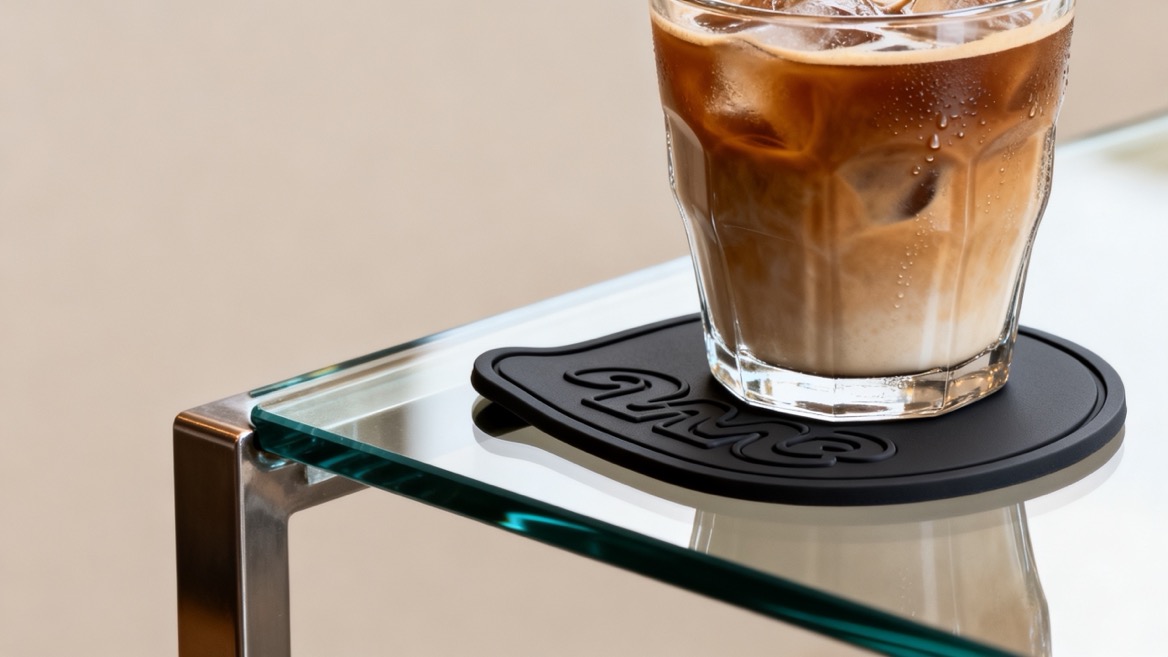
A soft PVC coaster generally offers better grip on glass tables because the material is flexible, slightly compliant, and able to create more contact with a smooth table surface.
Hard plastic coasters, by comparison, are usually more rigid. Their contact with glass is limited to the flat areas of the base. If the underside is glossy, polished, warped, or wet, it may slide more easily across a glass tabletop.
The practical difference is especially noticeable in environments such as:
- Coffee shops with glass-top tables
- Hotel lounges and restaurants
- Offices with modern glass desks
- Bars with high-gloss tabletops
- Retail gift sets and licensed promotional collections
- Homes with tempered-glass dining tables
- Events where guests move drinks frequently
For a branded coaster, grip is not just a functional feature. It affects the customer's perception of product quality. A coaster that stays in place feels more premium, safer, and more thoughtfully engineered.
| Comparison Factor | Soft PVC Coaster | Hard Plastic Coaster |
|---|---|---|
| Grip on dry glass tables | Usually high with a textured underside | Often moderate unless fitted with anti-slip pads |
| Grip on slightly wet glass tables | Generally better when designed with texture or raised contact zones | Can become slippery if the base is smooth |
| Flexibility | Flexible and resilient | Rigid or semi-rigid |
| Conformity to surface micro-texture | Better conformity | Limited conformity |
| Resistance to cracking | Strong resistance to cracking under normal use | Can crack, chip, or become brittle depending on resin |
| Water resistance | Excellent | Excellent |
| Condensation absorption | Low; water remains on the surface | Low; water remains on the surface |
| Custom shapes | Excellent for complex outlines and irregular silhouettes | Better for simple geometric forms |
| 2D and 3D logo effects | Excellent | Usually more limited or more expensive |
| Visual texture options | High | Moderate |
| Weight | Generally lightweight | Lightweight to medium |
| Cleaning | Easy to wipe clean | Easy to wipe clean |
| Premium tactile feel | Soft, dimensional, tactile | Smooth, rigid, often more conventional |
| Best use case | Promotional gifts, branded merchandise, cafés, character IP products | Simple utility coasters, rigid sets, low-detail designs |
Bottom line: A soft PVC coaster is usually the stronger option for a glass table when anti-slip performance and custom branding are priorities. A hard plastic coaster may be suitable when rigidity, a highly polished appearance, or a minimal flat design matters more than tactile grip.
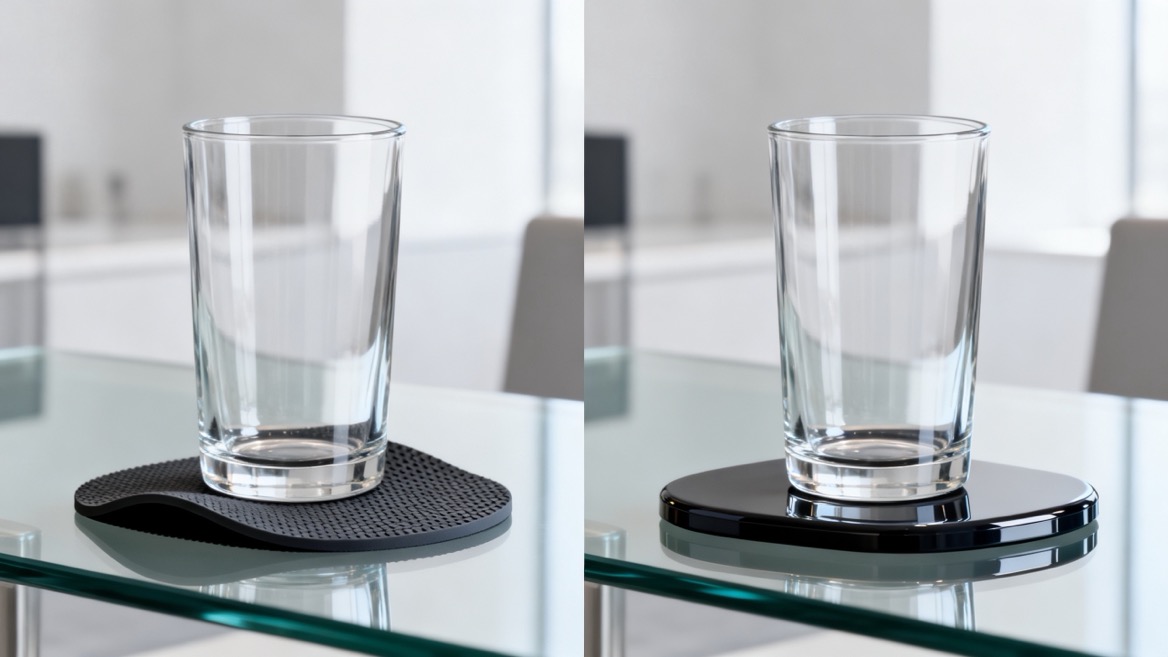
A glass table looks clean and premium, but it is one of the more demanding coaster surfaces. It is smooth, non-porous, and often highly polished. These characteristics reduce natural resistance between the coaster and tabletop.
When someone lifts a glass, pulls it closer, or adjusts it with one hand, the coaster can move with the drink. This creates several common problems:
- The coaster slides away from the intended position
- A drink shifts suddenly and may spill
- Condensation spreads across the tabletop
- The coaster makes a scraping sound
- A lightweight coaster sticks to the bottom of a cold glass
- A branded item feels cheap or poorly designed
- The table surface receives repeated friction from hard coaster edges
For business buyers, this issue can become more significant at scale. A café, hotel, restaurant, event organizer, or promotional-gift buyer may distribute hundreds or thousands of coasters. If the product slides too easily, the user experience becomes part of the brand experience.
A coaster is a small product, but it has a highly visible job: it should keep the drink stable, protect the table, and display the brand without creating annoyance.
Grip is related to friction. In simple terms, friction is the force that resists sliding when two surfaces touch.
The basic relationship is often represented as:
F=μN
Where:
- F is the resisting friction force
- μ is the coefficient of friction
- N is the normal force, or the downward force created by the coaster and drink
For a coaster on a glass tabletop, the goal is to increase practical resistance to lateral movement. Designers can improve grip by increasing contact quality, creating texture, selecting an appropriate material hardness, and preventing liquid from forming a slippery layer under the coaster.
Soft PVC is flexible rather than completely rigid. When placed on a glass tabletop, it can adapt more easily to microscopic surface variation, dust particles, tiny uneven areas, or subtle changes in the table coating.
This creates a broader and more stable contact interface.
A hard plastic coaster often remains flat only at selected contact points. On an extremely smooth surface, a glossy rigid base may glide more easily because it cannot adapt to surface texture in the same way.
Elastic materials have been studied for their friction behavior on textured glass surfaces, demonstrating that the interaction between material flexibility and surface texture can affect sliding resistance.
A smooth soft PVC coaster may still slide. The best grip comes from combining flexible PVC with intelligent underside design.
Useful anti-slip features include:
- Fine matte texture to reduce smooth-on-smooth sliding
- Small raised dots or ribs to create controlled contact points
- A recessed center with a textured outer ring
- Radial grooves that help channel condensation
- A grid or crosshatch pattern on the underside
- Slightly thicker outer edges for stable table contact
- Micro-texture that improves resistance without trapping excessive dirt
A matte or textured PVC surface is commonly used to enhance grip and reduce surface sliding.
For custom projects, the underside should not be treated as an afterthought. It is one of the most important functional design areas of the coaster.
A professionally designed soft PVC coaster offers several grip-related advantages.
Soft PVC has enough flexibility to sit more naturally against a smooth tabletop. Instead of behaving like a rigid plate, it can create a more forgiving contact layer between the glass table and coaster.
This is valuable for:
- Lightweight coasters
- Complex custom shapes
- Character-shaped promotional products
- Irregular logo outlines
- Coasters with raised decorative borders
- Tabletop gifts used in cafés or offices
The flexibility also helps the coaster remain functional when it is handled repeatedly, packed for shipping, or used in changing indoor temperatures.
Soft PVC works especially well with molded texture. Manufacturers can create detailed underside patterns during production rather than adding a separate anti-slip component later.
For example, a custom PVC coaster may include:
- A matte bottom surface
- Small raised circles around the outer edge
- A recessed logo panel
- Drainage channels for condensation
- A smooth but stable cup-resting zone
- A textured perimeter that contacts the table
This approach combines branding and performance in one product structure.
Soft PVC is highly suitable for vivid color matching, 2D logos, raised 3D details, character silhouettes, and multi-layer designs. It allows a brand to create something more memorable than a flat printed circle.
This matters for licensed merchandise, food-and-beverage campaigns, entertainment promotions, retail gift packs, and collectible accessories.
A coaster can use different PVC colors to separate logo elements, create raised outlines, and deliver a tactile brand experience. At the same time, its underside can remain optimized for stability.
Hard plastic may produce a sharper edge-to-table contact. Soft PVC feels gentler when set down, moved, or stacked. It is less likely to create an unpleasant hard-plastic sound on a glass table.
This improves the perceived quality of the product, particularly in hospitality settings where customers interact with cups, bottles, and glasses continuously.
Soft PVC is more resilient than many brittle rigid plastics. It is less likely to crack when dropped or flexed during normal use.
This makes it suitable for:
- Long-term promotional campaigns
- Coffee-shop merchandise
- Corporate gifts
- Travel retail products
- Children's character merchandise
- High-volume event giveaways
- International bulk shipments
Hard plastic coasters are not automatically poor products. They can be a sensible option when the intended use and visual direction favor rigidity.
Typical materials may include PP, PS, ABS, acrylic, or other rigid plastic formulations. Each has different properties, but most share the same basic limitation on glass tables: a hard, smooth base can slide unless designers add a friction-enhancing feature.
A hard plastic coaster may work well when buyers need:
- A very thin and rigid profile
- A glossy finish
- A highly uniform flat surface
- A minimalist premium look
- A print-focused design with limited molded detail
- A rigid display product
- A low-cost simple coaster for short-term use
For example, a rigid promotional coaster with a laminated printed surface may be appropriate for an indoor event where it will be distributed briefly and placed on non-glass tables.
On glass surfaces, a basic hard plastic coaster may have several disadvantages:
- Its smooth underside can slide easily
- It may shift when a guest reaches for a drink
- It can make a scraping sound on a glass tabletop
- It can feel less stable when condensation is present
- It may need extra silicone, rubber, cork, or foam feet
- It may crack if dropped, depending on the material
- It is less suitable for highly dimensional logo relief
Hard plastic does not necessarily fail on glass. But it often requires an additional design feature, such as non-slip pads, a rubber base, or a textured lower surface, to achieve comparable stability.
The most reliable way to determine whether a soft PVC coaster or hard plastic coaster performs better is to test the actual production sample.
Do not make a final purchasing decision based only on material descriptions, digital renderings, or product photographs.
Use this simple process with pre-production samples:
1. Prepare a clean glass tabletop or tempered-glass panel.
2. Test at least three coaster samples of each design.
3. Place an empty glass, a half-filled glass, and a cold drink with condensation on the coaster.
4. Push the drink gently from the side using consistent hand pressure.
5. Observe whether the coaster stays on the table, slides with the drink, or sticks to the cup.
6. Repeat the test with a dry underside and a lightly damp underside.
7. Test the coaster after 50 to 100 wipe cycles to see whether texture and grip remain consistent.
8. Record results for sliding distance, coaster movement, drink stability, water retention, and visual wear.
A better anti-slip coaster should show the following characteristics:
- It remains in place when the glass is moved slightly
- It does not easily stick to the base of a cold cup
- It keeps the drink centered
- It does not curl or warp after use
- It does not become excessively slippery when damp
- It stays flat after shipping and storage
- Its branding remains clear after repeated wiping
- Its edges feel smooth and comfortable
For a large order, ask the manufacturer to provide production-level samples rather than only hand-made samples. The actual material hardness, molding accuracy, color filling, and underside texture can change during mass production.
The right soft PVC formula is important, but construction details are equally important.
For many custom drink coasters, a thickness of approximately 3 mm to 5 mm can provide a useful balance between flexibility, durability, and a substantial feel.
A coaster that is too thin may curl or feel lightweight. A coaster that is too thick may become unnecessarily heavy, costly, or visually bulky.
The ideal thickness depends on:
- Coaster diameter or overall size
- Shape complexity
- Raised logo depth
- Intended drinkware weight
- Packaging format
- Target retail position
- Required shipping weight
A highly raised logo may look attractive, but it should not create an unstable surface for a glass.
The central drink-contact area should be sufficiently flat and wide. A narrow glass, wine glass, or bottle base needs stable support.
A practical design approach is:
- Use raised graphics around the perimeter
- Keep the center surface flatter
- Add a shallow recessed ring for the glass base
- Avoid sharp decorative peaks beneath the drink
- Confirm usable cup diameter during sample approval
Custom PVC coasters are commonly valued for flexible shapes, water resistance, and dimensional design, but raised details should be managed carefully so they do not reduce drink stability.
For the strongest result on glass tables, consider one of these underside specifications:
| Underside Design | Grip Performance | Best Application |
|---|---|---|
| Smooth glossy PVC | Low | Decorative coasters with minimal movement |
| Fine matte PVC | Moderate to high | General office, home, and café use |
| Raised micro-dot texture | High | Glass, lacquered, polished, or metal tables |
| Crosshatch or grid pattern | High | Promotional and hospitality products |
| Textured outer ring | High | Round coasters requiring a clean central base |
| Rubberized or silicone insert | Very high | Premium anti-slip applications |
| Foam backing | Moderate | Short-term promotional use, not ideal for heavy moisture |
For most branded PVC coaster programs, a matte base plus micro-texture provides an excellent combination of grip, manufacturability, appearance, and cost control.
Grip is only one part of glass-table protection. Condensation matters too.
Both soft PVC and hard plastic are generally water-resistant rather than absorbent. They act as a barrier between the drink and table, but they do not soak up water in the way cork, paper, fabric, or ceramic stone may do.
This means condensation can collect:
- On top of the coaster
- Around the base of the glass
- Under the glass if the drink is very cold
- Along raised decorative details
- Around the coaster edge if the surface overflows
A soft PVC coaster can manage moisture more effectively when it includes molded channels, a raised rim, or a shallow recessed center. These features help keep water from spilling onto the table immediately.
For cold drinks, iced coffee, beer glasses, and bottled beverages, consider:
- A 1 mm to 2 mm raised outer rim
- Shallow internal drainage grooves
- A slightly recessed central drink zone
- Textured channels that reduce water pooling
- A wide enough coaster diameter to catch condensation
- A non-slip underside that maintains stability when moisture is present
For standard drinkware, the coaster should extend beyond the glass base. A larger usable surface helps contain drips and prevents the drink from sitting too close to the edge.
The best material is tied to the product's commercial purpose.
| Buyer Priority | Recommended Choice | Why |
|---|---|---|
| Strong grip on glass tables | Soft PVC with textured underside | Flexible material and molded anti-slip texture improve stability |
| Licensed character merchandise | Soft PVC | Supports complex outlines, bright colors, and raised visual details |
| Premium café merchandise | Soft PVC with recessed cup area | Durable, tactile, washable, and brand-friendly |
| Simple flat promotional coaster | Hard plastic or soft PVC | Choice depends on budget, finish, and grip requirement |
| High-gloss minimalist tabletop accessory | Hard plastic with rubber feet | Keeps the rigid visual effect while improving stability |
| Corporate gift set | Soft PVC | Offers strong logo visibility and everyday usefulness |
| Outdoor events | Soft PVC | Resists moisture and is less likely to crack |
| Highly rigid retail display piece | Hard plastic | Provides a firm, structured form |
For many OEM and ODM projects, soft PVC is the more versatile platform. It can be engineered to achieve both decorative branding and functional table grip.
After working with branded gift and promotional-product projects, one lesson remains consistent: small product details determine whether a coaster becomes a useful daily item or an unused giveaway.
The difference may be as simple as:
- Changing a glossy underside to matte
- Adding a 0.5 mm raised anti-slip pattern
- Increasing the coaster thickness slightly
- Widening the flat cup-support area
- Adjusting PVC hardness
- Revising the logo placement
- Adding a shallow moisture-catching rim
These changes are relatively minor during the design stage. After mass production begins, however, they can become expensive to revise.
A professional development process should include:
1. Artwork review and structural evaluation
2. Material and hardness selection
3. Confirmation of coaster dimensions
4. Selection of top and bottom textures
5. Prototype or pre-production sample creation
6. Grip testing on actual table surfaces
7. Color and logo approval
8. Packaging review
9. Final production confirmation
10. Quality inspection before shipment
For brands that need reliable quality across repeat orders, this process is far more valuable than selecting a coaster based only on the lowest unit price.
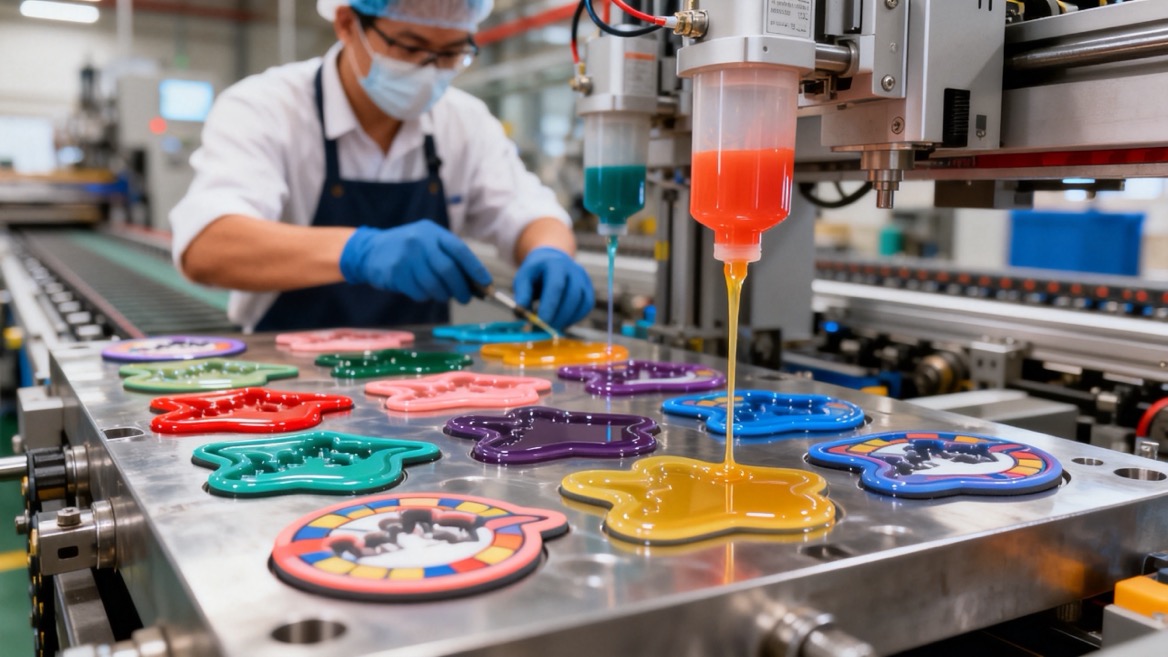
For international sales, material compliance should be addressed early in the product-development process.
PVC is a broad material category. Its final chemical profile depends on the formulation, plasticizers, pigments, additives, ink systems, and manufacturing controls used for the specific product.
California Proposition 65 does not ban products automatically. Instead, it focuses on whether exposure to listed chemicals may require a warning, making documentation, material disclosure, and suitable testing important for applicable products.
For soft PVC coaster sourcing, buyers should discuss:
- EU RoHS requirements
- California Proposition 65 requirements
- Phthalate-control requirements
- Heavy-metal restrictions
- Product-specific testing needs
- Packaging material requirements
- Documentation for retail or licensed programs
- Third-party laboratory testing where required
A supplier with established compliance experience can help buyers align the material formula and test scope with the destination market and the intended product category.
For most glass-table applications, a soft PVC coaster offers better grip than a standard hard plastic coaster.
Its flexible structure, tactile finish, and compatibility with molded anti-slip patterns make it the more reliable option for reducing coaster movement on smooth surfaces.
However, the strongest result does not come from choosing "soft PVC" alone. It comes from specifying the right design:
- Soft PVC material with controlled hardness
- Fine matte or micro-textured underside
- Stable flat or recessed drink-support area
- Raised rim or channels for condensation
- Sufficient thickness to prevent curling
- Appropriate coaster size for the intended drinkware
- Verified sample testing on glass tables
A hard plastic coaster can still work when paired with a rubber or silicone base. But if your project requires strong logo presentation, custom shapes, long-term durability, and dependable grip on smooth glass surfaces, soft PVC is usually the more practical and brand-effective solution.
If you are developing a branded coaster for a café chain, restaurant, beverage campaign, promotional event, gift set, character collection, or retail program, focus on performance before mass production.
Choose a custom soft PVC coaster that combines anti-slip texture, stable cup support, moisture-control features, vivid branding, and market-appropriate material compliance.
Yijia Plastic Products Co., Ltd. provides one-stop OEM and ODM support for custom PVC coasters and other soft PVC gift products. With 18 years of manufacturing experience, a 3,000-square-meter factory, 10 automated production lines, advanced dispensing equipment, and experience supporting recognized global brands, the team can help develop coaster designs that are both visually distinctive and practical for real-world use.
Share your artwork, target dimensions, intended market, preferred packaging, and performance requirements to begin a custom sample evaluation.
A properly manufactured soft PVC coaster is unlikely to scratch a glass table under normal use. The coaster should have smooth edges, a clean molded underside, and no embedded hard particles. Keeping both the table and coaster clean is still important because dust or grit trapped underneath any coaster can create abrasion.
Yes. Soft PVC coasters are generally water-resistant and easy to wipe clean. They do not absorb condensation like cork or fabric. For cold drinks, a raised rim or recessed center can help contain water on the coaster surface.
Yes. A hard plastic coaster can achieve strong grip when it includes rubber feet, silicone pads, cork backing, foam backing, or a textured underside. Without these features, a smooth hard plastic base may slide on glass or other polished tabletops.
For general use on glass tables, a fine matte finish combined with micro-dots, a crosshatch pattern, or a textured outer ring is usually effective. The final choice should be verified through physical sample testing because coaster weight, table finish, humidity, and drinkware type can affect performance.
It can if the raised design is placed directly beneath the glass base or if the details are too tall and uneven. A better approach is to keep a stable central cup area while placing raised branding around the edge, in a border, or in a shallow recessed layout.
Soft PVC is usually better for coffee-shop merchandise and branded tabletop use because it is durable, washable, visually customizable, and easier to engineer with anti-slip texture. Hard plastic may be suitable for rigid, minimalist designs, especially when enhanced with non-slip backing.
Yes. Soft PVC is highly suitable for custom silhouettes, including logos, mascots, food shapes, animals, characters, product icons, and other irregular outlines. This makes it especially useful for brand promotions, licensed merchandise, and gift programs.
Provide your artwork, quantity, target size, thickness preference, number of colors, 2D or 3D design requirement, desired finish, packaging needs, delivery country, intended table surface, and any compliance or test requirements. If grip on glass tables is important, specify that you need a textured anti-slip underside.
1. [Friction behaviors of elastic materials sliding on textured glass surfaces]
2. [Friction Coefficients for Common Materials and Surfaces]
3. [California Proposition 65 Compliance Guide for Manufacturers]
4. [Four Steps to Avoid Application of California Proposition 65 to Soft Plastic Products]
5. [Custom PVC Coasters: Materials, Uses and Bulk Ordering Guide]
6. [PVC Material Coaster: Material Grades, Properties and Design Considerations]


