
Views: 299 Author: Yijia Plastic Publish Time: 2026-11-03 Origin: Site
Content Menu
● Soft PVC Coaster vs. Wooden Coaster: Maintenance at a Glance
● Why Soft PVC Coasters Usually Need Less Maintenance
>> Moisture Does Not Trigger Wood-Like Swelling
>> There Is No Wood Finish to Reapply
>> Molded Branding Can Simplify Appearance Maintenance
● When Wooden Coasters Remain a Practical Choice
>> A Suitable Finish Can Narrow the Maintenance Gap
>> Natural Presentation May Justify Additional Care
● How to Clean Soft PVC Coasters and Wooden Coasters
>> A Practical Soft PVC Coaster Cleaning Routine
>> A Practical Wooden Coaster Cleaning Routine
>> Cleaning Is Not the Same as Disinfecting
● Hidden Design Details That Change Cleaning Workload
>> Deep Grooves Can Cancel Part of PVC's Advantage
>> Water Resistance Does Not Mean Water Absorption
>> Backings and Table Surfaces Need Testing Together
● A Seven-Day Commercial Coaster Trial Before Bulk Ordering
>> Days 1–2: Establish Comparable Conditions
>> Days 3–6: Record Real Operational Differences
>> Day 7: Compare Results Against Acceptance Criteria
● How to Compare the Real Maintenance Cost
● What Commercial Buyers Should Ask a Coaster Manufacturer
● How Yijia Supports Custom PVC Coaster Projects
● Final Recommendation: Choose for Your Actual Service Conditions
● FAQ
>> 1. Are soft PVC coasters easier to clean than wooden coasters?
>> 2. Can soft PVC coasters go in a commercial dishwasher?
>> 3. Do all wooden coasters need regular oiling?
>> 4. Can either material stain?
>> 5. Are soft PVC coasters suitable for hot drinks?
>> 6. Which coaster lasts longer in commercial use?
A soft PVC coaster generally requires less maintenance than a wooden coaster in busy cafés, bars, hotels, and restaurants. In a soft PVC coaster vs. wooden coaster comparison, the main difference is how each material handles repeated moisture exposure: soft PVC typically supports a straightforward wash-and-dry routine, while wood requires more attention to its finish, edges, and drying conditions.
However, material alone does not determine performance. A deeply recessed PVC design can trap residue, while a well-sealed wooden coaster can remain practical in controlled settings. From our manufacturing perspective at Yijia Plastic Products Co., Ltd., the best choice depends on cleaning workload, product construction, and the customer experience you want to create.

For commercial buyers, maintenance means more than removing a coffee stain. It includes drying, inspection, storage, surface restoration, and replacement.
The following comparison describes typical products—not guaranteed results for every formulation, wood species, or coating.
| Maintenance factor | Soft PVC coaster | Wooden coaster |
|---|---|---|
| Routine cleaning | Mild detergent, gentle washing, and drying | Damp wiping and prompt drying; follow finish instructions |
| Moisture exposure | Generally tolerates repeated surface wetting well | Performance depends heavily on sealing and construction |
| Stain removal | Usually straightforward, but pigments and residue can persist | Unsealed areas may absorb liquids and discolor |
| Surface restoration | No wood-style oiling or refinishing | Some finishes require periodic renewal |
| Cleaning challenges | Deep grooves, textured backs, printed decoration | Exposed grain, damaged coatings, engraved recesses |
| Heat limitations | Formulation-specific; not automatically dishwasher-safe | Finish, adhesive, and wood construction determine limits |
| Retirement signs | Tackiness, distortion, cracking, or damaged decoration | Splintering, cracks, warping, or coating failure |
| Strongest commercial fit | Frequent beverage service and repeated cleaning | Premium presentation with controlled handling |
The practical advantage usually belongs to soft PVC when rapid turnover and consistent cleaning matter most. Wood becomes more attractive when natural appearance justifies additional care.
Wood exchanges moisture with its surroundings. Changes in moisture content can cause dimensional movement, and finishes reduce moisture exposure rather than making wood permanently impermeable.
Soft PVC does not have wood's moisture-responsive grain structure. For a suitably formulated, intact coaster, repeated contact with condensation generally creates less concern about swelling or grain movement.
That distinction matters wherever iced drinks remain on tables for extended periods. Staff can focus on removing liquid and residue instead of protecting exposed wood fibers.
However, water resistance does not eliminate the need to clean and dry the coaster's underside.
Soft PVC coasters do not require wood-style oiling, waxing, or resealing.
Wooden coaster care depends on the finish:
- Oiled surfaces may need renewal according to the supplier's instructions.
- Film-forming coatings need inspection for wear, peeling, or cracking.
- Unfinished wood requires particular caution around prolonged wetting.
- Laminated products also depend on edge sealing and adhesive durability.
Not every wooden coaster needs frequent refinishing. Nevertheless, its protective surface introduces another condition for staff to monitor.
Branding method affects how a coaster ages.
With molded, colored PVC details, the design does not depend entirely on a surface-printed image. Surface printing can still be suitable, but buyers should request cleaning-compatibility and abrasion evidence for the actual decoration.
For wood, laser engraving avoids an ink layer, yet deep engraved areas may collect residue. Printed or coated wooden designs require their own durability checks.
The useful question is not simply "Will the logo last?" It is "Will the logo remain presentable after our cleaning routine?"
A well-made, fully sealed wooden coaster can perform satisfactorily in commercial service. It should not be judged as though it were an unfinished wood slice.
Examine the top, underside, edges, and engraved areas. Weak coverage at one edge can undermine otherwise good protection.
Ask which coating was used and whether it tolerates your cleaning products. "Sealed wood" is not a complete maintenance specification.
Wood may suit boutique hotels, tasting rooms, executive lounges, and restaurants built around natural materials.
In these environments, the visual experience can outweigh the convenience of a simpler cleaning routine. Moderate turnover and careful staff handling may also reduce the practical maintenance burden.
Our view is straightforward: choose wood deliberately for its presentation, rather than assuming every coaster material needs identical care.
Neither material has a universal environmental advantage based on maintenance alone. Such comparisons also require information about sourcing, production, service life, transport, and disposal.
Use the manufacturer's instructions as the starting point. For a product approved for gentle hand washing:
1. Remove loose debris and empty collected liquid.
2. Wash with mild detergent and lukewarm water.
3. Clean recessed details with a soft brush if needed.
4. Rinse away detergent and loosened residue.
5. Dry both sides completely before stacking.
6. Inspect for damage, surface changes, or remaining stains.
Avoid treating dishwasher use, boiling water, strong solvents, or concentrated cleaners as universally acceptable.
Flexible PVC performance varies by formulation. A cleaning method suitable for one product may damage another.
For wooden products, follow the instructions for the specific finish:
1. Wipe spills promptly.
2. Clean with a lightly dampened cloth and an approved cleaner.
3. Avoid immersion unless the supplier explicitly permits it.
4. Dry the face, edges, and underside.
5. Store with airflow rather than stacking damp pieces.
6. Inspect for coating damage, cracks, and rough areas.
Apply maintenance oil or another finish only when specified. Adding an unsuitable treatment can change appearance, drying behavior, or cleaning compatibility.
Removing visible residue does not establish that a coaster has been disinfected.
Where disinfection is required, select a product labeled for the relevant surface and follow its dilution and wet-contact-time instructions. Confirm compatibility with the coaster manufacturer.
A material that withstands a quick wipe may not withstand prolonged chemical exposure. Commercial operators should also follow applicable local requirements and their venue's hygiene procedures.
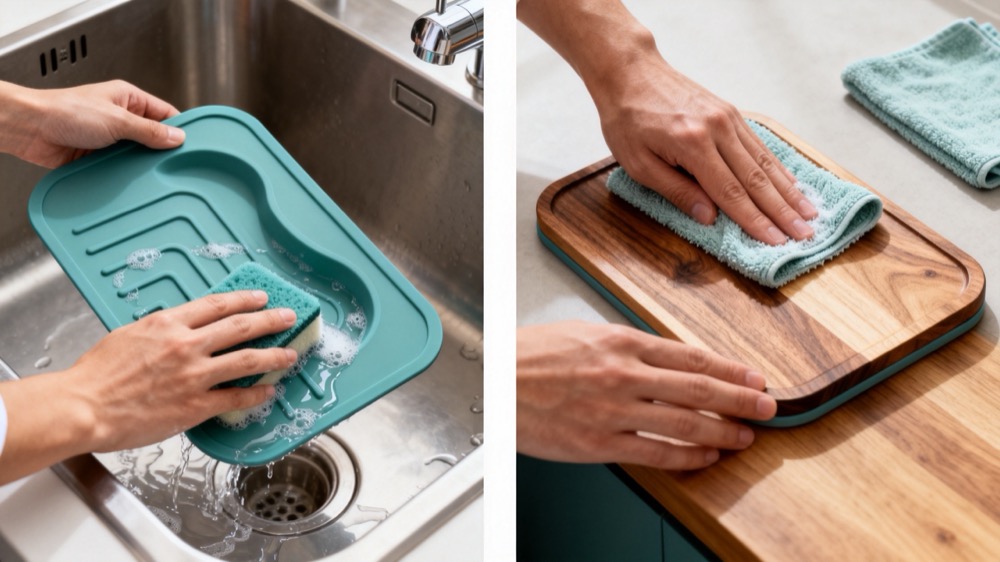
Raised logos and recessed channels create visual depth, but they also create places for syrup, milk, and debris to collect.
For high-turnover beverage service, we recommend evaluating:
- Shallow, accessible decorative details.
- Smooth transitions between raised and recessed areas.
- Drainable channels without narrow dead ends.
- An underside that staff can inspect easily.
A simpler coaster may outperform a more elaborate design when measured by cleaning effort.
Soft PVC generally holds condensation on its surface rather than absorbing it like an absorbent coaster.
A shallow rim can help contain liquid, but staff still need to empty and clean it. Excessive pooling can wet the glass base or spill when the coaster moves.
Unsealed wood may absorb moisture, but that is not automatically an advantage: absorption can also contribute to discoloration and dimensional change.
Test the complete glass-and-coaster combination, not just a flat material sample.
Felt, cork, adhesives, and printed backings can create separate maintenance issues on either material.
Check whether the backing retains moisture, detaches during cleaning, or leaves residue. Test the coaster on your actual tabletop finish, especially under warm or damp conditions.
A product is only as maintenance-friendly as its least durable component.
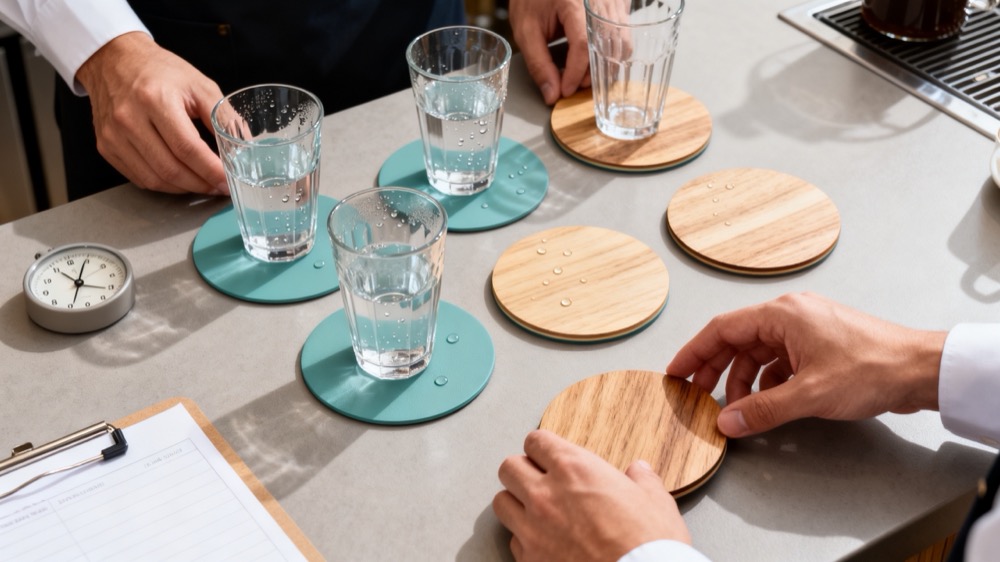
Rather than relying on an unsupported lifespan claim, run a small comparison under your own service conditions.
The following is a proposed purchasing protocol, not a published industry standard.
Select samples of both materials with similar dimensions. Record their construction, finish, decoration, and care instructions.
Use the same drink types, exposure periods, and approved cleaning procedures. Photograph each sample under consistent lighting.
Track:
- Active cleaning time per batch.
- Drying time before storage.
- Residue remaining in grooves or engraving.
- Visible staining after cleaning.
- Changes in flatness, texture, or decoration.
- Marks or residue on the tabletop.
Include the drinks your venue actually serves, such as iced coffee, sweetened beverages, or milk-based drinks.
Set acceptance criteria before evaluating the results. Examples include no visible coating damage, no persistent tackiness, and satisfactory removal of beverage residue.
A short trial cannot predict years of service. It can, however, reveal cleaning incompatibilities and workflow problems before a large order.
Purchase price alone can hide the cost of repeated handling.
A useful model is:
Monthly maintenance cost = cleaning labor + cleaning materials + finish upkeep + replacement expense.
Consider an illustrative scenario:
- A venue cleans 200 coasters daily.
- One option requires five additional seconds of active handling per coaster.
- Across 30 days, that difference equals approximately 8.3 labor hours.
- At an assumed labor cost of $15 per hour, the difference is approximately $125 monthly.
These are hypothetical inputs, not measured PVC-versus-wood results.
Replace them with your own trial data. Also measure batch cleaning carefully: a procedure that adds five seconds to an entire batch is very different from one that adds five seconds to every coaster.
Drying space and unavailable inventory matter too, even when they do not require continuous staff attention.
A useful specification should answer practical questions before production begins:
- Which cleaners and concentrations have been evaluated?
- Is hand washing required, or has dishwasher suitability been verified?
- What temperature limits apply to the finished product?
- Does testing cover the decoration and backing?
- Which defects require replacement?
- Can the supplier provide batch-relevant material documentation?
- Will repeat orders use the approved formulation and construction?
Avoid using unrelated documentation as proof of cleaning performance. Chemical-compliance reports, manufacturing authorizations, and maintenance tests answer different questions.
At Yijia Plastic Products Co., Ltd., our company background includes 18 years of experience in developing, manufacturing, and supplying soft PVC gifts.
Our stated facilities include a 3,000-square-meter factory, 10 automated production lines, and advanced dispensing equipment, supported by one-stop OEM/ODM customization.
Our stated project experience includes work involving Starbucks, Disney, McDonald's, Pop Mart, and Tencent. Buyers should request relevant supporting documentation and confirm any permissions before using customer names or logos publicly.
For procurement, request applicable EU RoHS and California Proposition 65 documentation, together with relevant Disney FAMA authorization records. Do not treat these different documents as interchangeable product-safety or hygiene certifications.
For a custom PVC coaster, we recommend approving cleanability, decoration durability, and tabletop compatibility alongside color and artwork.
Soft PVC is generally the lower-maintenance choice for repeated beverage spills, frequent washing, and fast table turnover.
Wood remains a credible option when its appearance supports the venue's positioning and staff can maintain the specified finish.
For your next order, send Yijia your artwork, coaster dimensions, beverage types, tabletop material, and cleaning products. Request an OEM/ODM sample and a written care specification, then validate both before approving bulk production.
Generally, yes. They usually avoid wood-related finish upkeep and moisture movement. However, deep grooves, unsuitable cleaners, and vulnerable decoration can increase cleaning effort.
Not automatically. Request verification for the finished product under the machine's actual temperature, detergent, and cycle conditions.
No. Care depends on the finish. Some oiled products need renewal, while coated products require inspection and finish-specific maintenance.
Yes. Beverage pigments, oils, surface damage, and delayed cleaning can affect appearance. Test likely spills on production-representative samples.
They may be suitable beneath beverage cups when specified for that use. Confirm the finished product's temperature limits; do not assume suitability for cookware or direct high heat.
There is no universal lifespan. Formulation, wood construction, finish quality, cleaning chemicals, and handling all affect replacement frequency.
1. British Plastics Federation. "Polyvinyl Chloride PVC." Background on PVC formulations, additives, durability, and chemical resistance; not coaster-specific performance testing. [bpf.co]
2. British Plastics Federation. "Materials for Rotational Moulding," section on plasticised PVC. Explains that flexibility, impact behavior, and temperature performance vary by grade. [bpf.co]
3. USDA Forest Service, Forest Products Laboratory. *Wood Handbook: Wood as an Engineering Material*, General Technical Report FPL-GTR-113. Relevant chapters cover moisture-related dimensional changes and wood finishing. [fpl.fs.usda]
4. USDA Forest Service, Forest Products Laboratory. *Chronicle of 65 Years of Wood Finishing Research at the Forest Products Laboratory*, FPL-GTR-60. Background on finishes, moisture exclusion, and finish deterioration. [fpl.fs.usda]
5. Centers for Disease Control and Prevention. "When and How to Clean and Disinfect a Facility," March 18, 2025. Guidance on cleaning, surface-compatible disinfectants, and contact time; not a coaster-specific approval. [cdc]


