
Views: 218 Author: Yijia Plastic Publish Time: 2026-10-26 Origin: Site
Content Menu
● Why Source PVC Beer Coasters from China?
>> A substantial manufacturing and export ecosystem
>> Regional choices support different sourcing priorities
● Selection Criteria: How This Shortlist Was Built
● Top 10 PVC Beer Coaster Manufacturers in China
>> 1. Yijia Plastic Products Co., Ltd.
>>> A candidate for development-led customization and smaller-brand programs
>> 2. Dongguan JIAN Plastic & Metal Products Ltd.
>>> A candidate for coordinated promotional-merchandise programs
>> 3. Jin Sheu Enterprise Co., Ltd.
>>> A Taiwan-based supplier with mainland China manufacturing
>> 4. Dongguan Ever Star Bar Supplier
>>> A candidate for barware-focused purchasing
>> 5. TALMUD
>>> A candidate for souvenir and multi-material coaster collections
>> 6. Guangzhou Hongli Plastic Industrial Co., Ltd.
>>> A candidate for soft-PVC gifts and accessory combinations
>> 7. HUASAN
>>> A candidate for design-intensive promotional products
>> 8. Ningbo Beilun Keren Toy Crafts Co., Ltd.
>>> A Zhejiang alternative for custom PVC craft products
>> 9. Fuzhou Xingchun Soft-PVC Premium Co., Ltd.
>>> A candidate for broader soft-PVC merchandise programs
>> 10. YC Badges (Zhongshan) Limited
>>> A candidate for compact promotional-product assortments
● Supplier Comparison: Capacity, MOQ, and Compliance Evidence
● Technical Buyer's Guide: Specify the Product Before Comparing Prices
>> Define material and performance requirements precisely
>> Distinguish genuine compliance requirements from marketing badges
● Common Purchasing Pitfalls—and How to Avoid Them
>> Comparing quotations built on different specifications
>> Accepting a report that does not match the order
>> Approving appearance without testing function
● Insider Pitfall Guide: Freeze the Construction, Not Just the Artwork
● Factory Verification, Sampling, and Logistics
>> Verify the business before paying a deposit
>> Use a staged approval process
>> Plan shipment around the finished packaging
● Conclusion: Choose a Supplier That Can Control Repeat Orders
● FAQs
>> 1. How can I verify whether a factory's ISO certificate has expired or been suspended?
>> 2. Can one chemical test report cover every color and backing option?
>> 3. Does a "RoHS-compliant PVC coaster" automatically satisfy EU import requirements?
>> 4. Does Disney FAMA prove the factory can legally make any character-branded coaster?
>> 5. What should we do if the approved sample passes but bulk goods differ?
A reliable PVC Beer Coaster manufacturer should offer more than an attractive sample and a competitive quotation. For breweries, beverage distributors, hospitality groups, and promotional-product importers, the real purchasing challenge is finding a supplier that can reproduce the approved design, control material consistency, document compliance, and deliver repeat orders predictably.
China offers a broad sourcing base for these requirements. Its promotional-product manufacturers include specialist soft-PVC factories, diversified gift manufacturers, and barware suppliers. Dongguan and neighboring Guangdong manufacturing centers feature prominently in this shortlist, alongside suppliers in Fujian and Zhejiang. Their published product ranges demonstrate the availability of custom molding, branded merchandise production, and coordinated packaging services.
However, "top" needs a clear definition. This guide presents ten candidates for procurement evaluation—not an audited ranking by production volume or market share. It compares publicly available company information, identifies gaps requiring verification, and explains how buyers can turn a supplier shortlist into a dependable purchasing decision.

China's General Administration of Customs reported plastic-product exports of approximately US$104.61 billion in 2025, down 1.3% from 2024. The figures were published in January 2026 and provide recent official context for China's plastics export infrastructure. They cover plastic products broadly, not PVC beer coasters specifically; they should not be presented as the size of the coaster market.
For coaster procurement, the more relevant advantage is the breadth of available manufacturing services. Companies in this guide advertise combinations of soft-PVC molding, custom shapes, embossed or debossed logos, packaging development, and related promotional merchandise. This allows buyers to source a standalone coaster or coordinate it with keychains, bar mats, bottle openers, and other branded products.
The supplier profiles reveal three practical sourcing locations:
- Guangdong: Dongguan, Guangzhou, and Shenzhen offer several candidates for custom soft-PVC gifts and coordinated promotional-product programs.
- Fujian: Fuzhou suppliers provide additional options for soft-PVC promotional merchandise.
- Zhejiang: Ningbo offers alternatives for buyers seeking PVC craft and souvenir manufacturers outside Guangdong.
Location alone does not prove quality. Use regional concentration to plan factory visits and compare suppliers efficiently, then evaluate each actual production site.
The shortlist prioritizes product relevance and the availability of identifiable supplier information. It does not imply that every company has passed a factory audit or laboratory assessment.
Professional buyers should evaluate each candidate against six dimensions:
| Evaluation dimension | Evidence to request | Why it matters |
|---|---|---|
| Product relevance | Recent soft-PVC coaster samples and production records | General plastics experience does not establish coaster expertise |
| Development capability | Artwork review, mold drawings, sample revisions, material options | Determines whether customization extends beyond adding a logo |
| Quality control | Incoming-material checks, in-process inspection, final inspection records | Helps control variation between samples and bulk production |
| Compliance documentation | Relevant laboratory reports and verifiable management-system certificates | Connects marketing claims to the actual product and factory |
| Delivery reliability | Production schedule, available capacity, subcontracting disclosure | Shows whether the supplier can support the required ship date |
| Commercial flexibility | Written MOQ, tooling terms, packaging options, reorder arrangements | Helps evaluate total purchasing cost and long-term suitability |
Public information is uneven. Where a company does not publish a verifiable monthly output, product-specific MOQ, or relevant certification, this guide says so rather than inventing a figure.
"Main markets" also require caution: most suppliers do not disclose audited sales by destination. The profiles distinguish published market positioning from market information that still needs confirmation.
Location: Dongguan, Guangdong
Established: 2009, according to the company website
Market positioning: International brands, importers, distributors, and promotional-gift companies.
Yijia specializes in custom soft-PVC gifts and integrates product development, manufacturing, and sales. Its published product range includes PVC beer coasters, bar mats, luggage tags, keychains, and other promotional items. The website describes customization covering shape, dimensions, branding, and flat or textured finishes.
According to information supplied by Yijia for this article, the company operates a 3,000 m² factory with ten automated production lines and multiple dispensing machines. These are useful facility indicators, but they are not equivalent to independently verified monthly coaster output.
For small and medium-sized brands, Yijia is worth evaluating where the project requires close design communication, sample revisions, and coordinated production rather than a standard catalog purchase. Its product-development positioning makes artwork review and mold-related support particularly relevant topics for the initial quotation discussion.
Yijia also reports RoHS-related testing, California Proposition 65 compliance support, Disney FAMA authorization, and experience with projects involving Starbucks, Disney, McDonald's, Pop Mart, and Tencent. These are company-supplied statements, not independently verified endorsements. Buyers should request current supporting documents and clarify whether brand-related work was direct or conducted through an authorized intermediary.
OEM/ODM scope to discuss:
- Custom coaster shapes, colors, thicknesses, and surface relief.
- Mold development and sample adjustment.
- Matching PVC bar mats and promotional gifts.
- Private-label packaging and repeat-order specifications.
Procurement checkpoint: The website states both "founded in 2009" and "18 years of expertise." Confirm the incorporation date and whether the experience figure includes predecessor operations before repeating it in formal supplier documentation.
Location: Dongguan, Guangdong
Established: The business traces its manufacturing history to Taiwan in 1984; this should not be treated as the incorporation date of the current Dongguan entity.
Market positioning: Overseas buyers of customized promotional products.
JIAN publishes a dedicated PVC coaster offering with customized colors, dimensions, thicknesses, shapes, and logo designs. Its listed decoration options include embossed or debossed color-filled designs and printing.
Its broader portfolio covers metal gifts, embroidered products, lanyards, silicone items, and PVC merchandise. That breadth makes it relevant for importers combining beer coasters with campaign merchandise rather than buying coasters alone. The company also states that its sales office and factory share a Dongguan location.
OEM/ODM scope: Custom PVC coasters and coordinated promotional-product development.
Main-market limitation: The reviewed pages establish overseas positioning but do not provide a reliable geographic sales breakdown.
Procurement checkpoint: Request the actual coaster production location, product-specific capacity, MOQ, and applicable test reports. Do not interpret company-wide staffing as dedicated coaster capacity.
Manufacturing location: Dongguan and other China facilities
Established: Jin Sheu's milestone page identifies 1991 as the company's establishment, with manufacturing roots dating to 1984 and its first China metal factory established in 1994.
Market positioning: Worldwide promotional-product buyers.
Jin Sheu publishes soft-PVC drink coasters intended for restaurants, pubs, exhibitions, and branded promotions. Its product page states an MOQ of 100 pieces per design, although buyers should reconfirm this against the final artwork and packaging requirements.
The company describes China factories and Hong Kong logistics support, making it relevant for buyers who value export coordination and consolidated promotional-product sourcing. It is included here because of its mainland manufacturing operations, not because it is headquartered in mainland China.
OEM/ODM scope: Custom coaster artwork, colors, shapes, packaging, and coordinated promotional merchandise.
Compliance signal: Jin Sheu states that it provides annual raw-material test reports for soft-PVC and other product categories. These reports should still be checked against the proposed coaster formulation and current order.
Procurement checkpoint: Establish which facility will make the coasters and whether a current report covers the exact materials and colors specified.
Location: Dongguan, Guangdong
Established: The website states "since 1993"; verify the current legal entity's registration separately.
Market positioning: International beverage and hospitality customers.
Ever Star publishes PVC coasters, custom bar coasters, and PVC bar mats. Its barware focus makes it relevant for breweries and hospitality buyers looking to coordinate several branded items within one purchasing program.
The company advertises a 10,000 m² plant. This is a company-stated facility figure, not a verified measure of coaster production capacity.
OEM/ODM scope: Branded coasters, bar mats, and related bar-supply projects.
Main-market limitation: International positioning is visible, but destination-level sales shares are not disclosed in the reviewed material.
Procurement checkpoint: Clarify which items are made in-house and which are sourced. For a multi-item barware order, obtain separate specifications, inspection requirements, and production schedules for each product.
Location: China; confirm the production address for the selected SKU
Established: Its coaster page describes operations since 2005.
Market positioning: Museums, souvenir businesses, themed merchandise buyers, and online sellers.
TALMUD publishes a broad coaster portfolio spanning soft PVC and other materials. Its souvenir-coaster page specifically includes rubber and soft-PVC options alongside cork/MDF, ceramic, metal, and other constructions.
This breadth may suit buyers assembling destination-themed collections or comparing materials within one product range. It is less useful as proof of specialist PVC production unless the supplier identifies the exact manufacturing process and factory.
OEM/ODM scope: Themed artwork, customized dimensions, product collections, and packaging.
MOQ signal: TALMUD advertises "no MOQ" on its general coaster page. Buyers should not assume this applies to a new custom PVC mold; request written confirmation for the actual design.
Procurement checkpoint: Confirm whether the quoted product is molded soft PVC rather than silicone, printed rubber, or another coaster construction.
Location: Huadu District, Guangzhou, Guangdong
Established: 2003, according to its supplier profile
Market positioning: Domestic and overseas customers; no reliable country-level breakdown is published in the reviewed profile.
Hongli's profile lists soft-PVC products including keychains, magnets, luggage-related accessories, and cup pads. It also describes a new-product development department and customized product work.
Its relevance lies in combining a beer-coaster project with other soft-PVC merchandise. Buyers should request recent coaster examples because a broad gift portfolio does not demonstrate current capability for a particular coaster design.
OEM/ODM scope: Custom soft-PVC gifts, cup pads, logos, and related accessories.
Procurement checkpoint: Match the Chinese business license, quotation, bank beneficiary, and factory address. Similar English company names make legal-entity verification especially important.
Location: Shenzhen, Guangdong
Established: 2011, according to the company website
Market positioning: Custom promotional-product buyers; geographic market shares are not publicly established in the reviewed page.
HUASAN describes a 2,000 m² factory with more than 100 employees and lists coasters among its custom PVC products. Its stated service sequence includes design, mold making, prototyping, production, and packaging.
Its portfolio also includes figurines, refrigerator magnets, and other character-driven merchandise. This makes it worth evaluating for a coaster project that uses an unusual silhouette or belongs to a larger branded collection.
OEM/ODM scope: Custom molding, artwork development, samples, promotional merchandise, and packaging.
Procurement checkpoint: Request functional coaster samples—not only decorative gift samples—and agree on flatness, stable glass placement, and surface-detail requirements before tooling approval.
Location: Ningbo, Zhejiang
Established: 1997, according to its published company profile
Market positioning: Worldwide customers; destination shares are not disclosed.
Keren's profile lists soft-PVC handicrafts including coasters, keychains, magnets, luggage tags, and other promotional gifts. It states that customized orders can be completed to customer specifications.
The company offers an alternative geographic sourcing option for buyers comparing Guangdong factories with Zhejiang suppliers. Its product breadth also makes it relevant to souvenir collections and mixed promotional-gift orders.
OEM/ODM scope: Customer-designed coasters and coordinated soft-PVC promotional items.
Procurement checkpoint: Obtain current factory evidence, recent production samples, and up-to-date compliance documentation. A long-established supplier profile should not substitute for present-day operational verification.
Location: Fuzhou, Fujian
Established: 2003, according to its supplier profile
Market positioning: Promotional-product customers; an audited destination breakdown was not identified.
Xingchun's profile lists coasters, luggage tags, keychains, photo frames, and other soft-PVC merchandise. It also reports an 18,000 m² plant and 800 employees. These are published supplier claims and should be reconfirmed because directory information can become outdated.
The product range makes it relevant for buyers comparing dedicated PVC gift suppliers rather than general barware distributors.
OEM/ODM scope: Customized soft-PVC coasters and coordinated promotional merchandise.
Procurement checkpoint: Confirm the exact contracting entity and current production address. Do not transfer the export history, certifications, or factory statistics of a similarly named business to this entity without documentary evidence.
Location: Zhongshan, Guangdong
Established: 2012, according to its marketplace company profile
Market positioning: B2B promotional-product sourcing; principal destination markets require confirmation.
YC Badges' published profile lists PVC coasters, PVC keychains, luggage tags, refrigerator magnets, and logo patches. Its product mix makes it relevant for distributors seeking matching promotional items from a single supplier.
However, the available evidence is less detailed than for several other companies in this guide. Its inclusion should be treated as a starting point for qualification rather than confirmation of production scale.
OEM/ODM scope to verify: Customized PVC coaster artwork, matching accessories, packaging, and sample development.
Procurement checkpoint: Confirm manufacturer-versus-intermediary status, production address, tooling ownership, and material traceability before paying a production deposit.
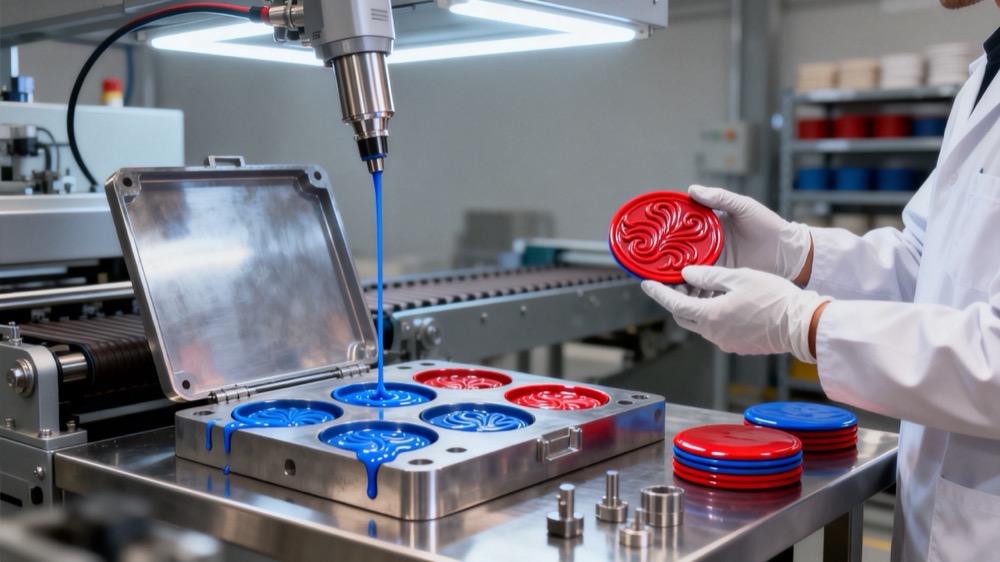
Facility size and staffing are capacity indicators—not verified monthly output. Likewise, "not verified" does not mean a supplier lacks compliance documentation; it means this review did not establish it.
| Supplier | Published capacity indicator | PVC coaster MOQ | Compliance evidence and verification needs |
|---|---|---|---|
| Yijia | Company-supplied: 3,000 m²; 10 automated lines | Project-specific quotation required | Reports RoHS-related testing, Proposition 65 support, and Disney FAMA; request current documents |
| JIAN | Broad manufacturing operation; dedicated coaster output not disclosed | Confirm by design | Product-specific reports and current certificates require verification |
| Jin Sheu | Multiple China factories; coaster-specific output not disclosed | Published: 100 pieces/design; reconfirm | States annual raw-material reporting; verify formulation coverage |
| Ever Star | Company states 10,000 m² plant | Confirm by design | Relevant current reports not established in reviewed pages |
| TALMUD | General coaster page advertises five production lines | General "no MOQ" claim; custom PVC applicability unconfirmed | Request PVC-specific documentation |
| Hongli | Factory identified; current output not disclosed | Confirm by design | Profile mentions testing generally, without sufficient specific evidence |
| HUASAN | Company states 2,000 m² and 100+ employees | Confirm by design | Request relevant current reports |
| Keren | Current output not disclosed | Confirm by design | Request current factory and product documentation |
| Xingchun | Profile states 18,000 m² and 800 employees; reconfirm | Confirm by design | Request current entity-specific documentation |
| YC Badges | Current capacity not established | Confirm by design | Request factory evidence and relevant reports |
For a meaningful capacity comparison, send every supplier the same artwork, dimensions, thickness, color count, packaging specification, order quantity, and delivery window.
Avoid specifications limited to "eco-friendly PVC," "premium rubber," or "export quality." These descriptions do not create a measurable acceptance standard.
Instead, ask the supplier to confirm:
- Soft PVC as the intended material, without unapproved substitution.
- The agreed formulation and any restrictions on recycled content.
- Finished dimensions, thickness, weight, and tolerances.
- A measurable hardness requirement where relevant.
- Required color references and approved production samples.
- Logo process: molded relief, debossing, printing, or a combination.
- Flatness, edge quality, and stable support for the intended glassware.
- Cleaning conditions and any claimed temperature limits.
- Packaging materials and permitted stacking arrangements.
Several suppliers publish options for custom dimensions, thicknesses, molded relief, and printing. The purchasing specification should identify exactly which combination is being ordered.
A conventional non-electrical coaster should not automatically be treated as a CE-marked product. European Commission guidance states that CE marking applies only where relevant legislation specifically requires it; it must not be placed on products outside that scope. A supplier offering a "CE certificate" should identify the applicable legislation and product classification.
RoHS principally addresses electrical and electronic equipment. A RoHS-related material test can provide useful information about selected restricted substances, but it does not by itself establish that a conventional PVC coaster meets every applicable EU requirement.
For soft-PVC articles, assess relevant REACH restrictions with a qualified laboratory. The European Commission identifies a restriction on DEHP, BBP, DBP, and DIBP at concentrations equal to or above 0.1% by weight, individually or in combination, in plasticized material, subject to the regulation's scope and conditions.
California Proposition 65 is an exposure-warning framework, not a universal product-certification scheme. Whether a warning is required depends on relevant exposure and applicable exemptions—not simply whether a supplier displays a "Prop 65" logo.
Disney FAMA is different again: it concerns authorization of a facility for relevant Disney-branded work. It is not a general chemical-safety certificate and does not authorize unrelated buyers to reproduce Disney intellectual property.
A low quotation may reflect a thinner coaster, simpler relief, different packaging, or excluded mold charges rather than greater manufacturing efficiency.
Require an itemized quotation covering:
1. Unit price against the approved specification.
2. Tooling and sample charges.
3. Packaging and carton requirements.
4. Testing and inspection costs.
5. Freight terms and named delivery location.
6. Reorder conditions and tooling storage.
Evaluate landed cost and rejection risk, not just the factory unit price.
Ask the laboratory or compliance reviewer to check the report's applicant, sample description, photographs, test date, methods, and tested substances.
The essential question is not "Does this factory have a report?" It is "Does this evidence adequately cover the formulation, components, and intended market of this order?"
For beer-service applications, proposed acceptance checks should include:
- Placement under the intended glass sizes.
- Stability on representative tables and counters.
- Resistance to the agreed cleaning process.
- Visual inspection after repeated wet-and-dry use.
- Packaging trials for deformation or surface transfer.
- Comparison of bulk goods with the approved reference sample.
These should be agreed as project-specific tests rather than presented as universal industry standards.
A procurement safeguard that deserves more attention is approving the hidden construction as carefully as the visible logo.
Ask the supplier to document:
- Whether the decorative face and backing use the same formulation.
- Whether different colors use different material preparations.
- Which layers or components were represented in testing.
- Whether unapproved material substitutions are prohibited.
- What changes trigger a new sample approval or laboratory review.
This matters because an attractive top surface does not establish the composition of the entire finished article. The EU phthalate restriction's reference to plasticized material reinforces why component and formulation coverage deserve scrutiny rather than relying solely on a generic finished-product description.
A practical control is to retain approved samples with the buyer, factory, and inspection provider, together with the drawing, agreed weight range, material specification, and packaging standard. Require written change notification before any formulation, backing, pigment, or production-site change.
This is a risk-control recommendation—not an allegation that any supplier listed here uses inferior material.
Request the Chinese business license and reconcile it with the contract, invoice, payment beneficiary, and production address.
Then conduct a live factory review or independent audit focused on the actual proposed workflow: material preparation, dispensing or molding, curing, finishing, inspection, and packing. Ask the supplier to disclose subcontracted processes explicitly.
A disciplined sequence is:
1. Review the drawing and manufacturing feasibility.
2. Approve material and compliance requirements.
3. Produce a tooling or development sample.
4. Correct appearance and functional issues.
5. Approve a pre-production reference sample.
6. Complete agreed testing and inspection.
7. Release shipment against documented acceptance criteria.
Do not let a delivery deadline eliminate the pre-production approval stage.
Request actual carton dimensions, gross weight, quantity per carton, and packaging photographs before finalizing freight.
Ask the forwarder or customs broker to confirm product classification, current duties, documentation, and destination requirements. Do not assume that a tariff code copied from a different coaster material is appropriate.
For delivery-sensitive launches, request a schedule separating sample approval, material procurement, production, inspection, dispatch, and transport. This makes delays easier to identify before they become missed campaign dates.
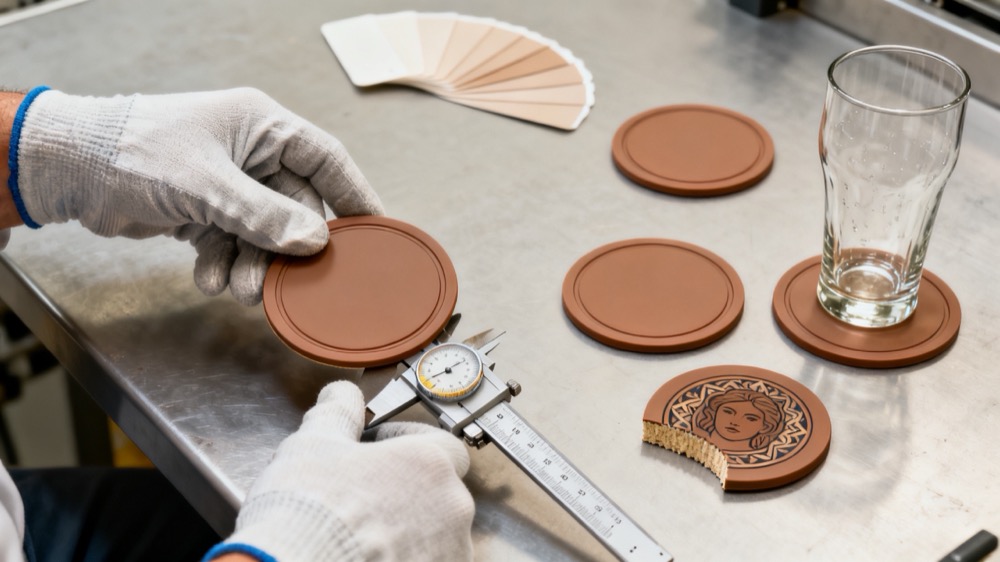
The ten companies above offer different starting points: specialist soft-PVC development, broad promotional-product sourcing, barware coordination, and regional manufacturing alternatives.
Yijia is a relevant first candidate for buyers seeking custom PVC coasters alongside related soft-PVC gifts, particularly where development involvement and coordinated customization matter. Its published product scope supports that positioning, while its company-supplied capacity and compliance claims should be verified during qualification.
Before requesting final prices, prepare one complete specification package and send it to several suitable suppliers. Compare their technical questions, documentation quality, sample accuracy, and willingness to accept written production controls.
To discuss a project with Yijia Plastic Products Co., Ltd., submit your artwork, target dimensions, order quantity, destination market, packaging needs, and required delivery date. Request a written proposal covering tooling, sample approval, relevant testing, production scheduling, and repeat-order controls.
Search the exact company name or certificate number through IAF CertSearch. Review the status, scope, location, issuing certification body, and accreditation information—not just the printed expiry date. The database supports checking active, suspended, withdrawn, and expired status.
If the record cannot be resolved, contact the issuing certification body through independently verified contact details before drawing a conclusion.
Do not assume so. Ask the laboratory to determine whether the proposed sample set adequately represents all relevant formulations, pigments, layers, and components.
For EU-bound products, this is particularly important where restrictions apply to plasticized material rather than merely to the appearance or average composition of the assembled coaster.
No. RoHS addresses hazardous-substance restrictions in electrical and electronic equipment. A conventional coaster requires its own applicable-product assessment; a RoHS material report is not a blanket EU market-access certificate.
Likewise, CE marking should not be requested or applied automatically when the product is not covered by legislation requiring it.
No. Disney's documentation requires facility authorization for relevant Disney-branded production, but that does not replace the buyer's licensing rights or project-specific permissions. Ask for both the applicable facility authorization and the necessary intellectual-property authorization chain.
For other licensed characters, obtain the corresponding rights-holder documentation rather than assuming Disney-related authorization applies.
The purchase contract should define the response before production begins:
- An independent inspection against the approved sample and specification.
- Shipment hold pending investigation.
- Retesting where the difference may affect compliance.
- Written corrective action and agreed rework or replacement.
- Responsibility for testing, replacement freight, and disposal where applicable.
Photographs alone cannot resolve a formulation dispute. Preserve traceable samples and use an appropriate laboratory when composition or restricted substances are in question.
- General Administration of Customs of China — "China's Major Exports by Quantity and Value, Dec 2025," published January 8, 2026; includes the 2025 plastic-products export figures. [english.customs.gov]
- European Commission, Your Europe — CE marking applicability and manufacturer responsibilities. [europa]
- European Commission — RoHS Directive scope and restricted substances. [environment.ec.europa]
- European Commission — REACH restrictions, including the four-phthalate restriction. [single-market-economy.ec.europa]
- California OEHHA — Businesses and Proposition 65. [oehha.ca]
- IAF CertSearch — Accredited management-system certificate verification. [iafcertsearch]
- The Walt Disney Company — Facility and Merchandise Authorization application and authorization requirements. [thewaltdisneycompany]


