
Views: 228 Author: Yijia Plastic Publish Time: 2026-11-02 Origin: Site
Content Menu
● Why Source PVC Soft Rubber Mats from China?
● How We Selected These Manufacturers
● Top 10 PVC Soft Rubber Mat Manufacturers in China
>> 1. Yijia Plastic Products Co., Ltd.
>> 2. KKS Enterprises Co., Ltd.
>> 4. China MJM Bar Mats Factory
>> 5. Dongguan Tongtianxia Rubber Co., Ltd.
>> 6. Dongguan Dain Crafts & Gifts Co., Ltd.
>> 7. Dongguan Weikai Plastic Products Co., Ltd.
>> 8. Dongguan Maibarr Arts & Crafts Co., Ltd.
>> 9. Letto Signs Carpet Co., Ltd.
>> 10. Dongguan Luxiang Plastic Products Co., Ltd.
● Manufacturer Comparison: Capacity, MOQ, and Compliance
● Technical Buying Guide: Specify the Product Before Comparing Prices
>> Clarify What "PVC Soft Rubber" Means
>> Assess the Finished Mat, Not Only Its Appearance
>> Understand What Compliance Documents Actually Establish
● An Overlooked Sourcing Trap: The Sample Does Not Define Every Layer
● How to Qualify a Factory and Manage the First Order
>> Step 1: Verify the Contracting Entity
>> Step 2: Use a Controlled Sampling Process
>> Step 3: Agree Inspection and Delivery Terms
>> Step 4: Calculate the Landed Cost
>> 1. How Can I Verify Whether a Manufacturer's ISO Certificate Has Expired?
>> 2. Can One Chemical Test Report Cover Every Color and Repeat Order?
>> 3. Does a PVC Bar Mat Need CE Marking or RoHS Certification?
>> 4. How Can Buyers Compare Capacity When Factories Report Different Metrics?
>> 5. How Can a Buyer Reduce the Risk of Unauthorized Brand Use?
Choosing a PVC soft rubber mat manufacturer involves more than comparing prices and approving a colorful sample. For professional buyers, the real challenge is finding a supplier that can repeat the same material quality, logo detail, chemical compliance, and delivery performance across successive orders.
China offers a substantial supplier base for custom PVC bar mats, promotional counter mats, branded coasters, and related soft-PVC gifts. Its manufacturing advantages include established plastics-processing regions and a broad selection of factories serving hospitality, beverage, promotional merchandise, and retail programs.
However, supplier claims require careful interpretation. A large factory does not automatically offer available capacity. A familiar customer logo does not prove an ongoing commercial relationship. A test report does not necessarily cover every color or formulation.
This guide compares ten manufacturers and supplier candidates, explains what their public information supports, and identifies what buyers should verify before committing to a long-term partnership.

China's plastics industry provides useful context for buyers, although broad industry figures should not be confused with the size of the PVC bar mat market.
A 2025 industry economic review published through the China Plastics Piping Association website reports Chinese plastic-product exports of approximately US$104.61 billion, down 1.3% year on year, citing incomplete General Administration of Customs statistics. It also identifies Guangdong and Zhejiang as the two largest provincial producers in its industry production dataset.
These figures cover a wide range of plastic products. They are not a market-size estimate for PVC soft rubber mats.
For procurement teams, the practical relevance is regional concentration:
- Guangdong offers a visible concentration of soft-PVC gift and promotional-product suppliers, including several Dongguan factories profiled below.
- Foshan has suppliers specializing in branded bar mats and hospitality merchandise.
- Zhejiang provides additional sourcing options through barware and promotional-product businesses.
The manufacturers in this shortlist illustrate those regional strengths, with Dongguan, Foshan, and Hangzhou represented.
The purchasing advantage is choice. Buyers can compare a dedicated soft-PVC gift factory with a broader mat producer or barware specialist instead of assuming that every supplier operates the same business model.
The selection focuses on product relevance and information transparency rather than promotional language.
| Evaluation area | Evidence considered | What buyers should verify |
|---|---|---|
| Product specialization | Public listings for PVC bar mats or related soft-PVC products | Whether the quoted product is actually manufactured at the proposed site |
| Company history | Published establishment dates and operating history | Business-license details and legal-entity continuity |
| Development capability | Custom sizes, molded logos, tooling, and related product ranges | In-house design responsibility and revision procedures |
| Manufacturing resources | Published factory area, equipment, or production infrastructure | Available capacity for the actual order |
| Quality management | Public quality-control descriptions | Inspection records, traceability, and corrective-action procedures |
| Compliance | Published reports, credentials, or compliance claims | Current documents matching the product and intended market |
| Commercial suitability | Customization scope and any published MOQ | Written terms for each design, color, and packaging configuration |
No factory visits, sample testing, or independent production audits were performed for this article.
Where public information is incomplete, the missing detail is identified rather than replaced with an estimated figure. "Not publicly verified" does not mean that a supplier lacks a capability or credential.
Location: Dongguan, Guangdong
Established: 2009, according to its website
Market coverage: Global brands, importers, distributors, and promotional-gift companies; country-level sales shares are not disclosed.
Yijia combines product development, manufacturing, and sales for custom soft-PVC gifts. Its website describes a 3,000-square-meter factory with ten automated production lines, two automatic color-mixing machines, and fifty automatic 18-color dispensing machines. The company also promotes 18 years of experience, although buyers should reconcile that description with its published 2009 founding date.
Its product range includes PVC bar mats, coasters, luggage tags, refrigerator magnets, keychains, and other branded merchandise. For small and medium-sized brands, this breadth makes Yijia a relevant candidate when one project includes several coordinated promotional products rather than a single mat design.
The company's potential value lies in integrated customization: artwork development, color confirmation, sampling, production, packaging, and shipping coordination. Its website advertises samples in two to three days, which buyers should confirm against tooling complexity and artwork readiness.
Yijia reports RoHS- and California Proposition 65-related compliance credentials, Disney FAMA authorization, and cooperation experience involving Starbucks, Disney, McDonald's, Pop Mart, and Tencent. These are company-reported statements, not independent endorsements established by this article.
Procurement fit: A candidate for value-conscious brands seeking coordinated OEM/ODM development and a direct factory relationship. Evaluate communication efficiency through an actual quotation and sampling project rather than assuming response quality from equipment counts.
Location: Hangzhou, Zhejiang
Established: 2001
Market coverage: B2B barware customers, including breweries, bars, and restaurants; a verified country breakdown is not published on the reviewed product page.
KKS publishes a dedicated custom PVC bar mat range and describes a 4,000-square-meter production facility with approximately 200 employees. Its catalog includes different dimensions and material options, making it relevant for buyers comparing molded PVC products with other bar-runner constructions.
Customization covers size, material, color, pattern, and logo. A published listing gives an MOQ of 100 pieces, but this should be treated as a product-level starting point rather than a universal condition.
Procurement fit: Hospitality and beverage-merchandise programs requiring custom mats within a wider barware sourcing project.
Verification priority: Confirm which material, dimensions, tooling conditions, and packaging are included in the quoted MOQ.
Location: Shunde, Foshan, Guangdong
Established: Manufacturing activity reported since 2001
Main markets: North America, Europe, Japan, Australia, Southeast Asia, and other international markets.
Promors states that it manufactures custom bar mats from its Shunde factory. Its published OEM/ODM scope includes size, thickness, color, logo placement, and packaging.
The company offers a relevant comparison point for hospitality buyers because its public positioning specifically addresses bars, restaurants, hotels, and beverage-service businesses.
Procurement fit: Export-oriented branded bar mats for hospitality and promotional use.
Verification priority: Obtain an unambiguous material specification. Product descriptions can use "rubber," "PVC," and other material names loosely; the purchase contract should identify the actual construction rather than rely on a category label.
Location: Foshan, Guangdong
Established: 1999, according to its supplier profile
Market coverage: A reliable regional sales breakdown was not identified in the reviewed profile.
MJM's public profile focuses on PVC bar mats, bar runners, and illuminated bar mats. It describes a product-development history involving molded PVC, fabric-backed constructions, and LED versions.
That specialization makes the company a relevant candidate for buyers sourcing beverage-promotion merchandise with more unusual construction requirements.
Procurement fit: Customized bar runners and promotional projects that may require alternatives to conventional molded PVC.
Verification priority: Separate ordinary non-electrical mats from illuminated products. Electrical features change the compliance review and should not be covered by the same generic documentation package.
Location: Dongguan, Guangdong
Established: 2007
Market coverage: Public trade information identifies North America among its export destinations; current market shares are not verified.
Tongtianxia's supplier information describes approximately 15,000 square meters of facilities. Public listings include custom PVC bar mats, while trade-directory information also describes natural-foam-rubber operations and a PVC bar mat factory.
Its relevance is the opportunity to compare multiple mat constructions through one supplier candidate.
Procurement fit: Buyers assessing molded PVC alongside rubber-based products for different campaign budgets or applications.
Verification priority: Confirm the exact manufacturing site and process used for the quoted mat. Total company floor area is not a dedicated PVC bar mat capacity figure.
Location: Dongguan, Guangdong
Established: 2001
Market coverage: International promotional and retail customers; verified regional revenue shares are not disclosed.
Dain's public supplier profile describes an operation that developed from mold-making into broader promotional-gift manufacturing. Its portfolio includes soft-PVC and silicone products, bar mats, mouse pads, luggage tags, magnets, and metal gifts.
The same profile reports design, molding, assembly, and printing capabilities, supported by a Dongguan facility and a Hengyang branch plant.
Procurement fit: Multi-product promotional programs where buyers want coordinated artwork and development across different merchandise categories.
Verification priority: Identify which site performs tooling, molding, finishing, and final inspection, and determine whether any stages are subcontracted.
Location: Dongguan, Guangdong
Established: 2019
Market coverage: An independently verified regional breakdown was not available in the reviewed profile.
Weikai's supplier profile lists PVC bar mats and silicone bar mats among its products. The profile reports an employee range of 11–50 people, providing a scale indicator but not a production-capacity commitment.
It is a relevant candidate for buyers exploring a smaller supplier organization with product-category alignment.
Procurement fit: Custom mat projects where direct communication and willingness to support the specific design matter more than headline factory size.
Verification priority: Request recent examples of comparable production, a current machine list, and a realistic production schedule.
Location: Dongguan, Guangdong
Established: Operating history reported from 2001; another field on the same profile lists 2016
Market coverage: International promotional-product customers; country-level sales data is not established.
Maibarr's public profile describes PVC bar mats, placemats, non-slip mats, coasters, luggage tags, and other promotional gifts. It also lists automatic PVC dispensing machines alongside silicone, injection-molding, and die-casting equipment.
The company therefore merits consideration for coordinated gift programs involving several materials.
Procurement fit: OEM/ODM promotional merchandise spanning PVC, silicone, and related components.
Verification priority: Resolve the conflicting establishment dates before publication or supplier approval. They may reflect different legal or operating histories, but that explanation should come from documentation, not assumption.
Location: China; confirm the contracting factory address during qualification
Established: Early 1990s, according to its product page
Market coverage: International mat customers; verified sales shares are not disclosed.
Letto Signs lists customized PVC/silicone bar mats within a much broader mat portfolio. Its product page reports 45,000 square meters of workshop and warehouse space, more than 300 equipment sets, and annual output capacity of 20 million square meters.
Those figures apply to its wider mat operation. They should not be represented as dedicated molded-PVC bar mat capacity.
Procurement fit: Buyers sourcing bar mats together with floor, advertising, outdoor, or other mat categories.
Verification priority: Ask for the equipment, monthly output, and inspection resources specifically assigned to the proposed molded product.
Location: Dongguan, Guangdong
Established: 2010 in directory records; another supplier profile reports factory activity from 2009
Reported markets: Public profiles identify destinations including North America, Europe, Japan, and Australia, but current sales proportions are not verified.
Luxiang's published product range includes PVC bar mats, PVC cup mats, silicone gifts, and luggage-related promotional items. Multiple directory records identify 2010 as its establishment year, while another profile describes factory activity beginning in 2009.
The company is relevant to buyers looking for related bar-accessory and promotional products from a single sourcing contact.
Procurement fit: Customized PVC mats and coordinated gift assortments.
Verification priority: Reconcile the legal-entity history and confirm the actual manufacturing site. Do not interpret an online "one-piece minimum" listing as proof that fully customized production is available at that quantity.
The table below distinguishes published indicators from verified order commitments. Factory area, staffing, and total equipment counts are not directly comparable measures of mat output.
| Manufacturer | Published capacity indicator | Published MOQ | Certification or compliance position |
|---|---|---|---|
| Yijia | 3,000 m²; 10 automated lines; dispensing equipment | Project quotation required | Company reports RoHS/Proposition 65-related credentials and Disney FAMA; verify scope and current documents. |
| KKS | 4,000 m²; approximately 200 employees | 100 pieces on a reviewed listing | Current product-specific documentation not verified. |
| Promors | Shunde manufacturing operation; output not disclosed | Not verified | Request destination-specific reports. |
| MJM | Specialized bar-mat product history; output not disclosed | Not verified | Assess ordinary and illuminated products separately. |
| Tongtianxia | Approximately 15,000 m² reported | Not verified | Request reports for the actual PVC formulation. |
| Dain | Dongguan and Hengyang production infrastructure reported | Not verified | Public quality-system descriptions require documentary confirmation. |
| Weikai | 11–50 employees reported | Not verified | Current credentials not verified. |
| Maibarr | Automatic PVC dispensing and other machinery reported | Not verified | Current credentials not verified. |
| Letto Signs | 45,000 m²; 300+ equipment sets; broad mat capacity | Not verified | Do not assume reports cover every mat construction. |
| Luxiang | Multiple public supplier profiles; dedicated output unverified | Custom-production MOQ not verified | Obtain current reports rather than relying on listing labels. |
For a useful capacity comparison, send every shortlisted supplier the same specification and request weekly output, allocated machine time, production location, and dispatch date.
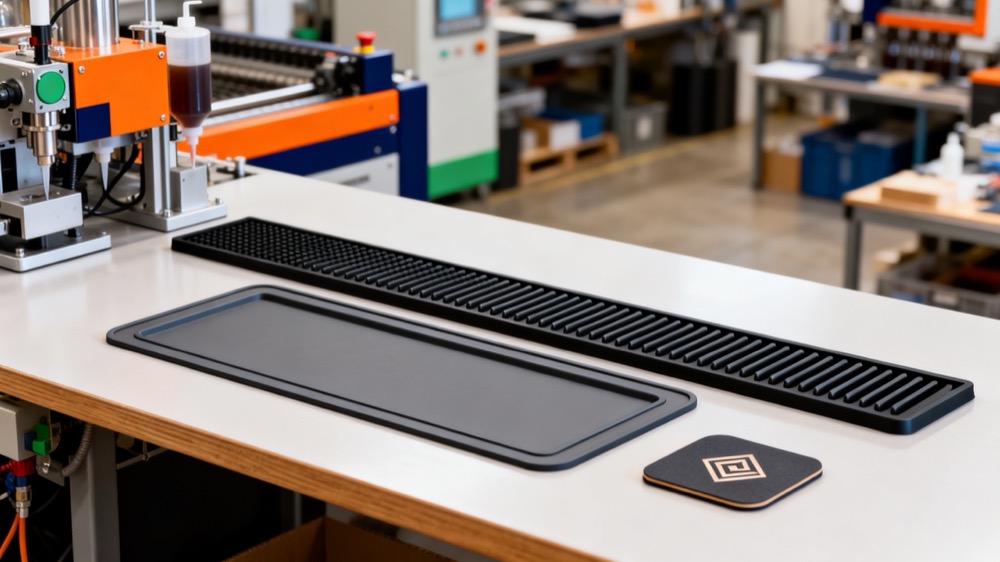
The terminology itself can create purchasing errors. Reviewed supplier catalogs place PVC, silicone, nitrile rubber, and other constructions within related bar-mat categories.
Therefore, specify the actual material in the quotation and contract. Do not accept "rubber-like," "eco material," or "premium soft rubber" as a complete material description.
For an initial request for quotation, define:
- Intended use: glass drainage, branded counter display, coffee station, or promotional giveaway.
- Material and restrictions on recycled content.
- Overall dimensions, backing thickness, and total height.
- Product weight and agreed tolerance.
- Hardness target and test method.
- Logo relief, color references, and artwork limits.
- Cleaning conditions and exposure expectations.
- Packaging, carton limits, and destination market.
Treat these as project specifications to agree with the factory, not universal industry limits.
A useful approval plan should examine:
1. Flatness after unpacking and conditioning.
2. Logo clarity, edge definition, and color separation.
3. Consistency of raised drainage features.
4. Performance on the intended wet and dry counter surface.
5. Response to the buyer's actual cleaning chemicals.
6. Color transfer or surface marking under intended use.
7. Packaging effects after simulated storage and transport.
Agree pass/fail criteria before production. "Same as sample" is much stronger when the approved sample is supported by measurable specifications.
RoHS primarily regulates hazardous substances in electrical and electronic equipment. A voluntary RoHS-related materials report may provide useful information, but it is not a complete compliance assessment for an ordinary non-electrical PVC bar mat.
Likewise, CE marking is not a general quality badge. It applies only where relevant legislation requires it, and it must not be applied where no applicable requirement exists.
California Proposition 65 concerns warnings about exposures to listed chemicals. It is not a universal government-issued product certification. A supplier's "Proposition 65 passed" statement needs clarification about the tested substances, intended exposure, assessment basis, and warning decision.
For each destination, ask a competent laboratory or compliance specialist to establish the applicable assessment scope. Avoid assuming that one report covers all markets and uses.
One practical risk deserves more attention than generic advice about "cheap materials": a buyer may approve the visible logo and surface while leaving the backing formulation, weight, hardness, and color compounds undefined.
This is a risk-control scenario, not an allegation against any manufacturer in this list.
A purchase order that defines only dimensions and artwork leaves room for disagreement over what constitutes an equivalent product. The safer approach is traceability:
- Seal and identify the approved reference sample.
- Record its weight, dimensions, hardness, and construction.
- Document the material and color-compound references.
- Require written approval before formulation or subcontractor changes.
- Link inspection and laboratory samples to identifiable production lots.
- Select verification samples from actual production, not only supplier-prepared presentation samples.
Do not use weight alone as proof of material quality. Use it as one screening parameter alongside the agreed specification and appropriate testing.
The broader concern is supported by the 2025 industry review, which identifies reduced raw-material standards and simplified processes among the risks associated with price-driven competition. It does not identify the companies in this article as engaging in those practices.
Request the business license, legal company name, factory address, and payment-beneficiary details. Explain any differences between the exporter, manufacturer, and payment recipient before sending a deposit.
A live video tour can support initial screening, but a significant or sensitive order may justify an independent site audit.
Separate artwork approval from production approval:
1. Approve dimensions and artwork.
2. Confirm tooling ownership and revision charges.
3. Review a physical sample.
4. Test the agreed performance and compliance requirements.
5. Approve packaging.
6. Authorize production against a dated specification.
Ask whether the sample uses the intended production formulation, equipment, and finishing process.
Define inspection timing, sampling method, defect categories, and remedies for nonconformity. Require written approval for production-site changes or subcontracting.
For delivery planning, distinguish sample completion, production completion, inspection release, dispatch, and arrival. These are separate milestones.
Compare more than the factory price. Include tooling, testing, inspection, packaging, freight, insurance, duties, brokerage, and destination handling.
Ask a customs broker to confirm classification for the actual product construction and destination. Do not assume that a supplier's generic customs description determines the correct treatment.
Confirm whether mats ship flat or rolled, and approve the packing method through a realistic storage-and-transit trial.
The right PVC soft rubber mat manufacturer is the one that can document and repeat the agreed product—not simply offer the lowest quotation.
This shortlist provides different sourcing routes: integrated soft-PVC gift development, barware-focused supply, specialized promotional mats, and broader mat-manufacturing operations. Missing information should become a qualification question rather than an assumed strength or weakness.
Yijia is a relevant first candidate for brands seeking coordinated OEM/ODM support across PVC bar mats and related promotional gifts. Its published equipment base and customization scope provide a starting point for evaluation; the next step is to test that fit through a detailed quotation, physical sample, and document review.
Send Yijia your artwork, dimensions, target quantity, destination market, cleaning conditions, and packaging requirements. Request a written development proposal covering tooling, materials, sample timing, testing, inspection, and production scheduling before approving the first order.
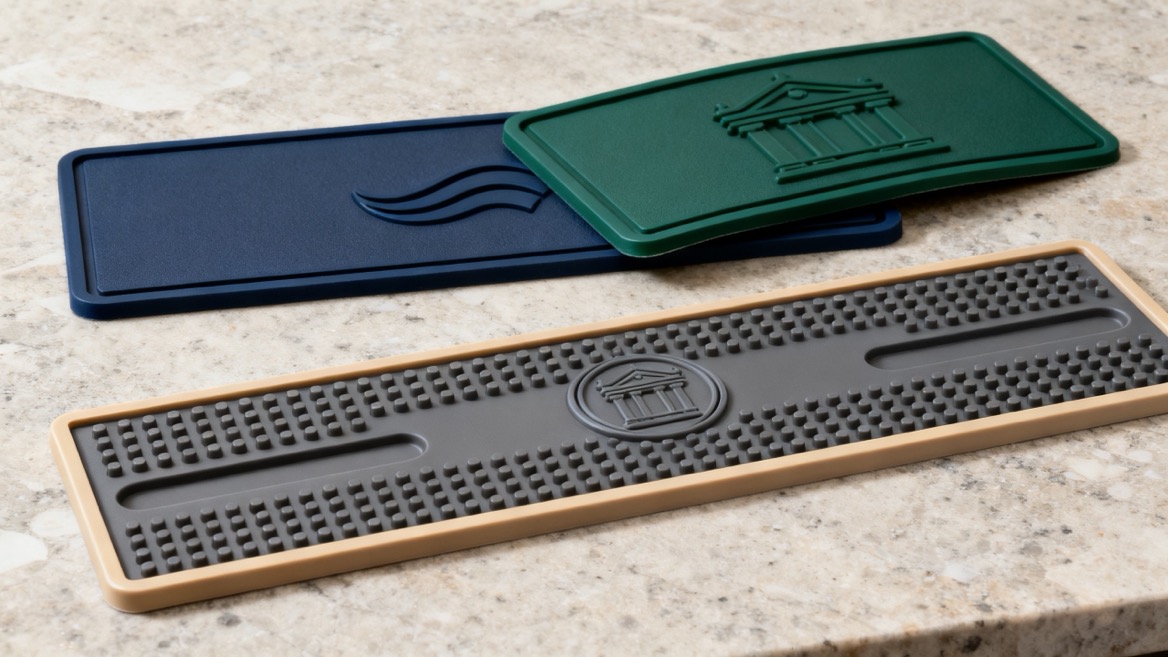
Search the certificate number or company name in IAF CertSearch, then compare the legal entity, site, standard, scope, issuer, and current status.
The platform supports checks for active, suspended, withdrawn, and expired certificates. If the record cannot be resolved, seek confirmation directly from the issuing certification body rather than accepting a PDF at face value.
Also check scope: certification covering a sales office is not the same as certification covering the proposed manufacturing site.
Do not assume so. Ask the laboratory to establish a justified sampling strategy for the actual materials, colors, and construction.
The report should identify the submitted sample clearly enough to connect it with the ordered product. Agree when formulation changes, new pigments, new suppliers, or production-site changes trigger reassessment.
Avoid accepting a generic resin report as the only evidence for a finished, multicolor mat.
An ordinary non-electrical bar mat should not be treated as requiring CE marking simply because it is sold in Europe. CE obligations depend on applicable legislation, while RoHS primarily addresses electrical and electronic equipment.
An illuminated mat needs a separate review because its electrical functions can change the regulatory analysis. Establish the product classification before requesting certificates.
Ask for an order-specific production plan.
A 15,000-square-meter factory, a ten-line operation, and a supplier reporting millions of square meters of annual mat production may be describing fundamentally different product mixes.
Use one common specification and ask each supplier for allocated equipment, weekly finished output, current production commitments, inspection capacity, and recovery arrangements if a machine fails.
Do not convert factory area into assumed monthly pieces.
Require written rules covering artwork confidentiality, mold access, subcontractor access, surplus goods, rejected products, and portfolio photography.
Ask suppliers to substantiate claimed brand-project experience through legally shareable evidence, while respecting confidentiality obligations.
A recognizable logo in a catalog is not enough to establish current authorization. Buyers must also ensure they have the right to commission the branded product themselves.
- China Plastics Piping Association, published April 17, 2026. Includes industry production analysis and export figures attributed to the General Administration of Customs. [ppia-china]
- China Plastics Processing Industry Association: industry information and statistical updates. [cppia.com]
- European Commission: RoHS Directive scope and restricted substances. [environment.ec.europa]
- European Commission: CE-marking principles and limitations. [single-market-economy.ec.europa]
- Your Europe: product-specific CE-marking requirements. [europa]
- California OEHHA: Proposition 65 business resources and exposure-warning responsibilities. [p65warnings.ca]
- IAF CertSearch: accredited certificate verification and status checks. [iafcertsearch]
- Yijia: company history, factory equipment, product range, and customization services. [yijiabar]
- KKS: custom PVC bar mat specifications, factory information, and published MOQ. [chinabarproducts]
- Promors: company history, markets, and OEM/ODM scope. [promors]
- MJM: company profile and bar-mat development history. [made-in-china]
- Tongtianxia: factory profile and product information. [m.made-in-china]
- Dain: company history, production infrastructure, and product range. [sourceready]
- Weikai: company profile and listed mat categories. [weikaigifts.en.alibaba]
- Maibarr: product range, equipment, and conflicting establishment-date fields. [maibarr.goldsupplier]
- Letto Signs: bar-mat specifications and broader factory-capacity claims. [logomat-lettosigns]
- Luxiang: product range, establishment records, and supplier profiles. [dgluxiang.en.alibaba]


