
Views: 243 Author: Yijia Plastic Publish Time: 2026-10-11 Origin: Site
Content Menu
● Why Coffee Shops Use Bar Mats Behind the Counter
>> 1. They Contain Small Spills Before They Spread
>> 2. They Help Keep Cups and Tools Steadier
>> 3. They Provide a Buffer Between Tools and Worktops
>> 4. They Make Workstations Easier to Understand
>> 5. They Add Branding Without Occupying Extra Space
● Where Should Coffee Shops Place Bar Mats?
● PVC Bar Mats for Coffee Shops: What Buyers Should Evaluate
>> Evaluate the Surface Geometry
>> Check Edges, Flatness, and Handling
>> Verify Heat and Cleaning Compatibility
● How to Clean Coffee Bar Mats Behind the Counter
>> A Practical Cleaning Routine
>> Keep Clean Storage Separate From Spill Collection
● A Five-Day Trial Before Ordering Custom Coffee Bar Mats
>> Days 1–2: Record the Existing Workflow
>> Days 3–4: Introduce the Sample
● What Compliance Documents Do Coffee Bar Mat Buyers Need?
>> California Proposition 65 Assessment
● Custom Coffee Bar Mats From Yijia Plastic Products Co., Ltd.
>> Are bar mats necessary in every coffee shop?
>> Can a bar mat replace an espresso machine drip tray?
>> Can coffee shops put hot pitchers on PVC bar mats?
>> Are PVC bar mats dishwasher-safe?
>> Can bar mats be used to dry clean glasses?
>> What should I prioritize when ordering custom bar mats?
>> How often should a coffee bar mat be replaced?
Coffee shops use bar mats behind the counter to contain small spills, provide a steadier surface for drink preparation, protect worktops, and organize busy service areas. A well-designed coffee bar mat helps manage the everyday mix of water, espresso, milk, and syrup without forcing baristas to interrupt every task for a full countertop wipe-down.
From our manufacturing perspective at Yijia Plastic Products Co., Ltd., the most useful mat is not simply the one with the biggest logo. It is the one that fits the workstation, cleans easily, and supports the way staff actually work.
The principle is simple: functionality comes first. Branding adds value when the underlying product performs reliably.

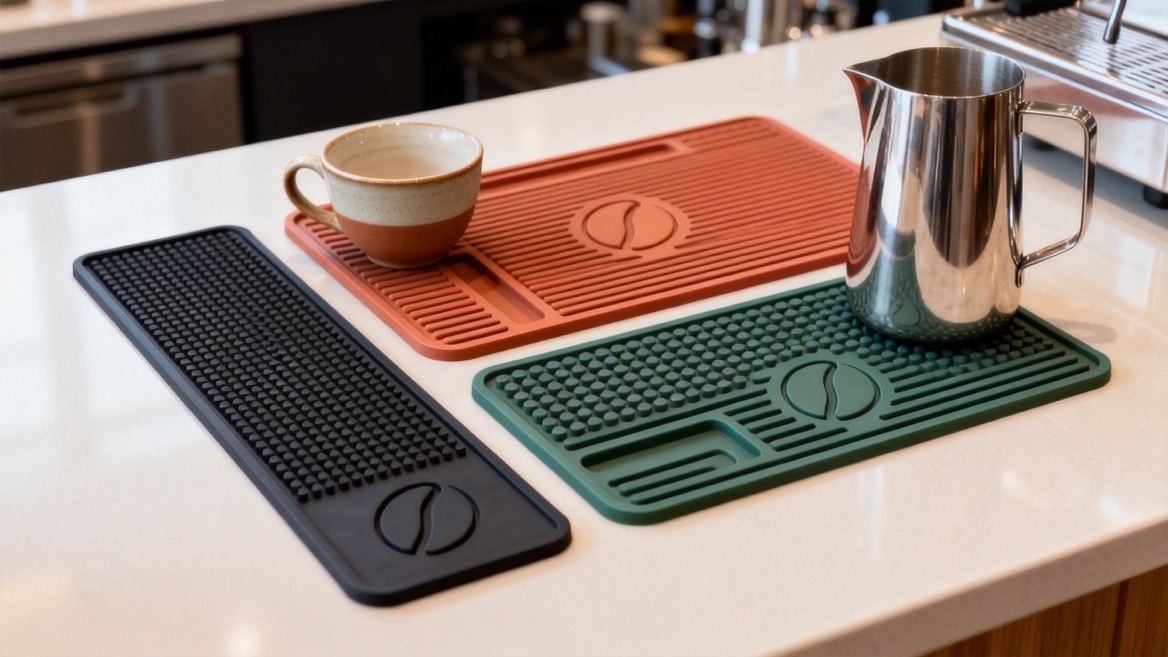
A coffee bar mat is a removable countertop accessory used in beverage preparation or service areas. Many designs feature raised nubs or ribs, recessed spaces for liquid collection, and a perimeter edge.
Unlike an absorbent towel, a typical molded PVC bar mat holds small amounts of liquid within its surface rather than soaking them into fabric. Staff can lift the mat, empty collected liquid, and wash it separately from the counter.
Coffee shops commonly place bar mats:
- Beside espresso machines for beverage assembly.
- Under syrup bottles and cold-drink preparation tools.
- At designated pitcher or utensil resting areas.
- Near pickup points where drips frequently collect.
A bar mat is not the same as a dedicated espresso tamping mat. The latter supports portafilter handling and tamping pressure. Some products combine functions, but buyers should verify suitability rather than assume every coffee counter mat can do both.
Behind a café counter, small spills are routine. A pitcher may drip after steaming. Syrup can run down a bottle. Ice melts during cold-drink preparation.
A raised-edge mat can contain some of this liquid within a defined area, provided its capacity is not exceeded. This reduces the immediate spread of drips across the workstation.
Containment is not drainage. Unless a mat has a specific drainage arrangement, collected liquid stays inside it until someone empties it. Overflowing mats defeat the purpose and require prompt attention.
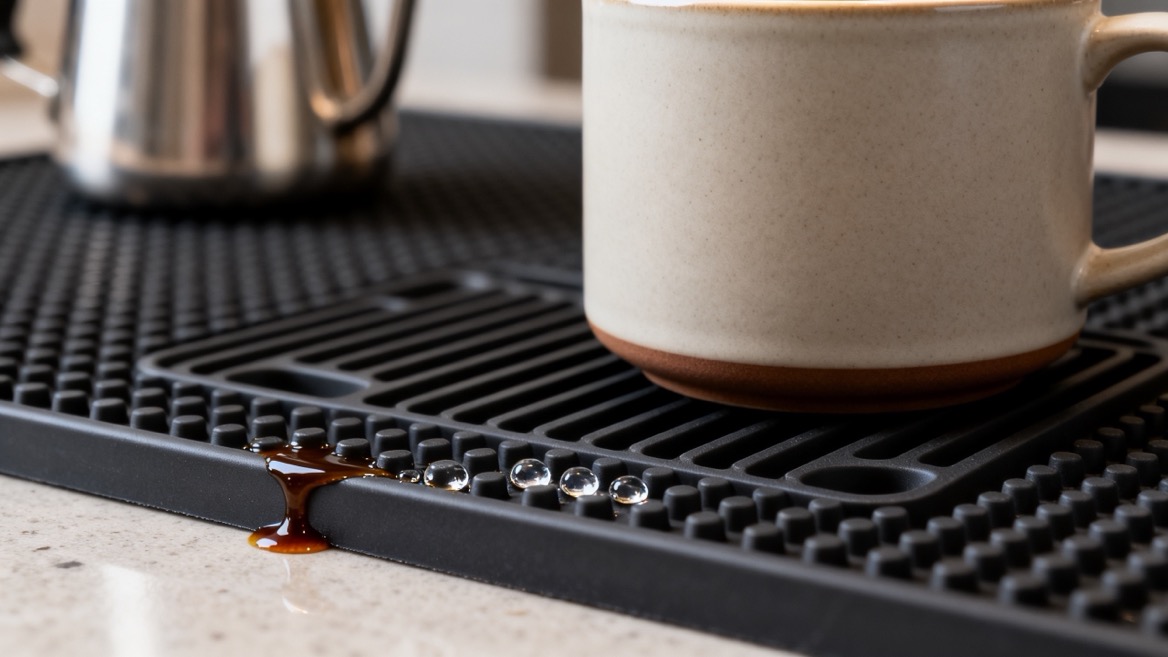
A suitable mat can provide more grip than a smooth, wet countertop. That may help cups, pitchers, and accessories stay in position during routine preparation.
However, grip depends on the complete setup:
- Mat material and surface texture.
- Countertop condition.
- Moisture beneath the mat.
- Cup shape and base diameter.
- Whether the mat lies flat.
I would assess stability with the café's actual cups rather than approve a sample based on appearance alone. A tall takeaway cup and a wide ceramic mug can behave differently on the same raised pattern.
Repeated placement of pitchers, cups, and accessories can create noise and wear. A flexible mat introduces a buffer between those objects and the counter.
This can be useful at frequently used landing areas. It does not make the worktop scratch-proof, and trapped grit beneath a mat can still cause damage.
Lift the mat regularly and clean both surfaces. Protection depends on maintenance, not merely on having a mat in place.
A defined mat area can signal where particular tasks belong.
For example, one mat may identify the syrup station, while another marks the drink-finishing area. This creates a simple visual boundary without rebuilding the counter.
For managers, the benefit is clearer station organization. For staff, it is an easier-to-follow workspace. Any improvement in speed should be measured in the actual café rather than promised as a universal percentage.
Custom bar mats can incorporate a café logo, brand colors, or a short message into an accessory the business already needs.
Customer-facing placement may make that branding visible during ordering or collection. Staff-facing placement can create a consistent appearance across multiple stores.
The design should remain restrained. Oversized lettering and intricate relief can compete with usable space or make cleaning less convenient.
Placement matters as much as material. Covering every available surface is rarely the most practical approach.
Start by identifying where liquids repeatedly accumulate and where staff regularly put down wet tools.
| Counter area | Potential benefit | Placement precaution |
|---|---|---|
| Drink-finishing station | Contains routine preparation drips | Leave a stable area for tall cups |
| Syrup station | Collects bottle drips | Clean sticky residue promptly |
| Pitcher resting area | Defines a wet-tool landing zone | Keep separate from clean utensil storage |
| Customer pickup counter | Helps manage occasional beverage drips | Check cup stability and customer reach |
| Espresso tamping station | May protect the worktop | Use a product designed for tamping |
| Equipment area | May organize adjacent workspace | Do not block ventilation, drains, or servicing access |
Avoid positioning a mat where its edge interferes with equipment or catches during normal movements. Check the workstation with staff present before finalizing dimensions.
PVC bar mats offer opportunities for custom shapes, molded graphics, and coordinated colors. Nevertheless, the material name alone does not establish quality.
Two visually similar mats may differ in flexibility, odor, flatness, cleanability, and resistance to the café's cleaning routine.
Raised features should support the intended cups and tools while leaving accessible spaces for washing.
Very fine decorative channels may look attractive but can make residue removal more difficult. For a syrup-heavy station, straightforward surface geometry may be more useful than elaborate artwork.
Inspect whether the sample sits flat on the intended countertop. Look for uneven edges, loose decorative sections, or areas that trap debris.
Also check whether staff can lift and empty it without excessive bending or spilling. A large mat may cover more space but be harder to carry to the washing area.
Do not assume that all PVC bar mats tolerate dishwashers, boiling water, steam exposure, or strong cleaning chemicals.
Ask for product-specific instructions covering:
- Permitted washing methods.
- Maximum service and cleaning temperatures.
- Compatible detergents and sanitizers.
- Any dishwasher restrictions.
- Expected use around hot equipment.
Choose according to documented performance, not broad claims such as "commercial grade."
A bar mat can support an orderly workstation, but it is not inherently hygienic. Milk, syrup, and beverage residue still need to be removed.
The appropriate cleaning frequency depends on use, contamination, and local requirements. A closing-time wash alone may be insufficient at a busy milk or syrup station.
1. Remove cups, bottles, and tools from the mat.
2. Empty collected liquid before it overflows.
3. Wash with a compatible detergent, cleaning between raised features.
4. Rinse thoroughly to remove loosened residue and detergent.
5. Apply an appropriate sanitizing step when required for the intended use, following product instructions.
6. Allow adequate draining and air drying.
7. Clean the countertop beneath the mat before replacing it.
Replace mats that develop cracks, persistent residue, damaged edges, or other defects that prevent effective cleaning.
A mat used to collect beverage spills should not automatically become a drying surface for cleaned utensils.
If the intended use involves food contact or contact with drinking rims, request documentation suitable for that application. A generic chemical test report does not establish every form of food-contact suitability.
The operating rule is straightforward: define what the mat is for, then maintain it accordingly.
A short workstation trial provides more useful purchasing evidence than a visual approval alone.
The following is a suggested evaluation method, not a reported customer case study.
Observe one representative station during comparable service periods.
Record:
- Where spills occur.
- How often staff wipe the counter.
- Which cups or tools move unexpectedly.
- How long cleanup takes.
- Whether staff reach across one another.
Keep the observations simple enough to repeat consistently.
Place a sample in the proposed position without changing unrelated parts of the workflow.
Check whether it contains routine drips, supports the actual drinkware, and remains flat throughout service. Ask staff whether it helps or creates an obstruction.
Include a full cleaning cycle. A mat that performs well during service but is awkward to wash may not suit the operation.
Compare observations and staff feedback.
Approve the design only after checking both service performance and maintenance. Adjust dimensions, surface layout, or placement before committing to a larger order.
This approach also helps multi-location operators avoid copying a design that works in one store but does not fit another counter layout.
Procurement teams should separate material testing, legal obligations, and manufacturing authorization. These documents answer different questions.
RoHS principally concerns electrical and electronic equipment. A standalone bar mat generally falls outside that product scope.
Testing a mat's materials against RoHS substance limits may still support a buyer's restricted-substance specification. It should not be presented as a universal café-use or food-contact approval.
California Proposition 65 concerns exposures to listed chemicals and associated warning requirements. It is not a blanket product-safety certification.
Ask what substances were evaluated, which product the report covers, and how the results relate to the intended market and use.
Disney FAMA means Facility and Merchandise Authorization. It relates to authorization for facilities involved in producing Disney-branded merchandise.
It does not replace product-specific chemical testing, food-contact assessment, or cleaning-performance verification.
For any document, check the product identification, issuing organization, date, scope, and connection to the material being ordered.
At Yijia Plastic Products Co., Ltd., we bring 18 years of experience in developing, manufacturing, and supplying PVC soft promotional products, including PVC bar mats.
Our 3,000-square-meter factory has 10 automated production lines and multiple advanced dispensing machines. We provide one-stop OEM/ODM customization for international customers.
Our company background includes cooperation experience with Starbucks, Disney, McDonald's, Pop Mart, and Tencent. These relationships describe our broader project experience; they should not be interpreted as endorsements of a particular coffee bar mat.
For purchasing teams, our manufacturing capabilities create a starting point for discussing custom dimensions, molded branding, color matching, and production requirements.
Send us your counter dimensions, logo artwork, intended application, order quantity, destination market, and cleaning method. Request a sample and the relevant supporting documentation before approving bulk production.
No. Their usefulness depends on the workstation. They are worth evaluating where repeated drips, wet tools, or unclear preparation zones create problems.
No. An adjacent countertop mat does not replace the machine's designed drip tray or drainage system. Keep those components accessible and maintain them according to the equipment instructions.
Only within the specific product's documented temperature limits. Confirm suitability with the supplier and assess the actual contact conditions before routine use.
Not automatically. Dishwasher suitability depends on the formulation and construction. Follow the product's written cleaning instructions.
Only when the product and cleaning arrangement are appropriate for that purpose. Keep clean-glass drying separate from mats collecting milk, syrup, or other service spills.
Prioritize fit, cup stability, cleanability, material documentation, and sample performance. Finalize decorative details after the functional requirements are clear.
There is no universal replacement interval. Inspect regularly and replace it when damage, deformation, or persistent residue prevents reliable use or effective cleaning.
1. U.S. Food and Drug Administration — [Food Code 2022]. Authoritative model guidance for retail food establishments; supports the discussion of equipment hygiene and the need to follow applicable local requirements. [fda]
2. International Association for Food Protection — ["Cleaning: A Retail and Foodservice Perspective"]. Explains Food Code provisions concerning cleanable nonfood-contact surfaces and preventing residue accumulation. [foodprotection]
3. University of Minnesota Extension — ["Sanitizing Equipment and Food Contact Surfaces"]. Supports the distinction between cleaning and sanitizing and the importance of an appropriate sanitation routine. [extension.umn]
4. California Office of Environmental Health Hazard Assessment — [Proposition 65]. Official explanation of the law's listed-chemical and exposure-warning framework; supports distinguishing legal requirements from a blanket safety certification. [oehha.ca]
5. California Department of Toxic Substances Control — [Restrictions on the Use of Certain Hazardous Substances in Electronic Devices]. Explains the electrical/electronic equipment context of RoHS restrictions. [dtsc.ca]
6. The Walt Disney Company — [Facility and Merchandise Authorization Application Instructions]. Defines FAMA and its relationship to facility authorization for Disney-branded production. Current authorization status should be checked separately. [thewaltdisneycompany]


