
Views: 263 Author: Yijia Plastic Publish Time: 2026-09-27 Origin: Site
Content Menu
● Why Craft Breweries Use Custom Bar Mats
>> They help contain routine drips
>> They give glassware a defined landing area
>> They put the brewery's identity at the point of service
● How to Design Brewery Bar Mats for Real Service
>> Measure the working area first
>> Match the design to the use case
● PVC Bar Mats: Strengths and Trade-Offs
● A Practical Custom Bar Mat Ordering Process
>> Questions to put in the purchase specification
● How Taprooms Can Evaluate a Mat After Launch
● Cleaning and Care in a Busy Taproom
● Working With an OEM/ODM Manufacturer
● The Bottom Line for Breweries
>> Are custom bar mats worth buying for a small taproom?
>> What information should I send for a custom PVC bar mat quote?
>> Do PVC bar mats absorb spilled beer?
>> Can I put a custom PVC bar mat in a dishwasher?
>> Is a RoHS report the same as bar-mat certification?
>> What does Disney FAMA mean for a manufacturer?
A craft brewery can spend months refining a beer and still lose a guest's attention at a cluttered, sticky counter. Custom bar mats help taprooms manage everyday drips while turning a working surface into a visible part of the brewery's identity. The best brewery bar mats are not merely logo merchandise. They fit the way staff pour, clean, and serve—and give guests one more reason to remember where they had a good experience.
That practical role matters in a competitive market. U.S. craft brewer volume sales declined 4% in 2025, according to the Brewers Association. Its midyear 2026 report estimated a further 4% decline in craft volume during the first half of 2026, even as taprooms performed better by volume change than other brewery types. A branded mat will not reverse those trends on its own. It can, however, make a small, busy service area more functional and more distinctive.

A taproom counter serves several purposes at once. It is a pouring station, a pickup point, a place for conversation, and sometimes the closest view a guest gets of the brewery's visual identity. A mat has to earn its space in all four roles.
Freshly rinsed glasses, crowded tasting flights, and fast pours can leave water or beer on the counter. A textured mat with a raised edge can hold minor spills in a defined area, depending on its design. Staff can then lift and clean it rather than continually wiping liquid from a broad section of the bar.
Containment is not absorption. A PVC mat collects liquid on or between its surface features; it does not soak up a spill like a towel. It also does not replace a properly designed drip tray beneath a draught faucet.
A mat makes it easier to designate where staff set clean glasses, finished pours, or tasting samples. Surface texture may help keep glassware steadier during ordinary service, but buyers should test a sample with their actual glass shapes and counter material. No mat makes a wet service area slip-proof.
A guest may miss a wall graphic while ordering but look directly at the counter while receiving a beer. A well-designed mat places the brewery name, mark, or visual motif in that moment. Its value comes from repeated, natural visibility—not from adding as much artwork as the surface can hold.
For breweries supplying other venues, branded bar mats can also extend a consistent visual identity to partner bars. Their placement should suit the venue's service layout and its rules for branded materials.
A useful buying decision starts with realistic expectations. A custom mat is a service accessory, not a complete cleanliness or marketing strategy.
It cannot make an unclean counter hygienic, eliminate the need for staff to address spills, or guarantee more visits or sales. It should not obstruct drainage, interfere with a glass rinser, or sit where liquid can collect unnoticed beneath it. If the surface is difficult to lift, rinse, and dry, an attractive design may become a nuisance during closing.
This distinction is especially important when comparing promotional claims. Ask how a mat behaves with beer, water, and the cleaning products your team actually uses. Request evidence for material or chemical claims that apply to the finished product. Avoid treating a general statement about "compliance" as proof that every color, formulation, and production batch meets the same requirement.
The most effective design begins with the station, not the artwork file. A striking mat that crowds a faucet or hides grime will not serve the team for long.
Record the available counter length and depth. Note faucet positions, drip trays, rinsers, payment devices, and where staff normally place glasses. Leave enough room to lift the mat without moving equipment or knocking into active work areas.
If a long counter has several distinct functions, consider separate mats rather than one uninterrupted piece. A smaller mat at a pickup point may be easier to remove during service. A longer runner may suit a row of taps, provided it does not cover an access point or drainage area.
A brewery logo may look crisp on a screen but lose detail when translated into raised PVC. Favor a clear silhouette, strong contrast, and lettering that remains legible at the proposed size. Keep critical information away from edges likely to be hidden by equipment or glasses.
Before approving a mold, ask for an artwork proof that shows the actual dimensions, color boundaries, raised details, and logo placement. If the design includes fine lines or small type, request a physical sample. Viewing it across a real bar is more informative than enlarging a digital proof.
A permanent taproom station, a festival booth, and a promotional shipment have different priorities. Permanent stations need easy cleaning and dependable fit. Event mats may need to pack and move conveniently. Mats supplied to partner venues need branding that is recognizable even when surrounded by other equipment.
| Use case | Design priority | Question to ask before ordering |
|---|---|---|
| Taproom pouring station | Fit, drainage, and easy removal | Can staff lift and clean it during a busy shift? |
| Guest pickup counter | Clear, visible branding | Is the logo readable behind a glass? |
| Beer festival booth | Portability and quick setup | Will it lie flat on the event counter? |
| Partner bar | Durable, recognizable identity | Does it suit the venue’s available space? |
| Limited-release promotion | Distinctive artwork | Can the detail be reproduced clearly? |
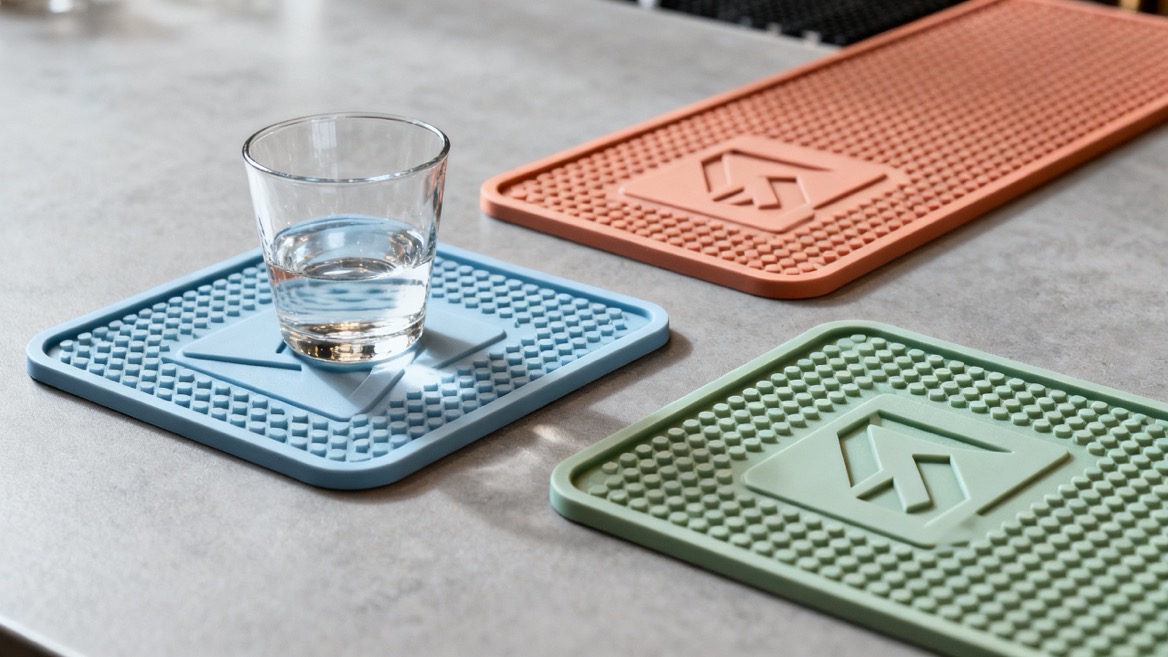
Custom PVC bar mats are a practical option when a brewery wants molded texture, flexible shapes, and multicolor raised artwork. They can accommodate a recognizable logo or other brand elements without relying on a printed sheet alone. A supplier should still show what its particular process can reproduce consistently.
Material choice is a trade-off, not a universal ranking. PVC formulations vary. Buyers should examine flexibility, odor, color consistency, surface feel, and the ease of cleaning a physical sample. If staff use hot equipment, strong chemicals, or a machine-washing process, ask the supplier to confirm that the proposed mat and cleaning method are compatible. Do not assume a PVC mat can go through a commercial dishwasher.
The same caution applies to environmental and chemical claims. The EU RoHS Directive primarily addresses hazardous substances in electrical and electronic equipment; it is not a blanket product certification for an ordinary, non-electrical bar mat. California Proposition 65 concerns warnings about certain chemical exposures, not a general "safe product" seal. For a particular order, request the relevant test report, product identification, and scope before making claims to customers.
A good specification reduces costly misunderstandings between the taproom, designer, and manufacturer. It also gives the production team a clear basis for preparing a sample.
1. Define placement. Identify whether each mat will sit under taps, at a pickup point, at an event booth, or in a partner venue.
2. Record dimensions. Measure usable space and mark equipment, drainage areas, and edges that must remain clear.
3. Prepare artwork. Supply a vector logo where possible, along with brand colors and any minimum text that must remain readable.
4. Specify service conditions. Describe expected spills, cleaning products, cleaning frequency, and whether the mat must be moved or stored regularly.
5. Review a proof and sample. Check dimensions, logo legibility, raised features, flatness, odor, and how the mat feels on the intended counter.
6. Confirm order details. Agree on quantity, packaging, approved sample, production schedule, inspection criteria, and shipping requirements in writing.
Do not skip the sample because the digital image looks convincing. A bartender should handle the proposed mat with wet hands, set the usual glassware on it, and remove it for cleaning. Those small tests can reveal problems long before a full order arrives.
Ask which details are molded, how colors will be matched, and whether the finished size has a production tolerance. Confirm how the supplier handles a rejected sample or a discrepancy between the approved sample and bulk goods. If mats will be shipped to multiple venues, specify how each location's quantity will be packed and labeled.
For branded intellectual property, make sure your team has permission to use every logo or character in the artwork. A manufacturer's production capability is not a substitute for a buyer's rights to reproduce a third party's design.
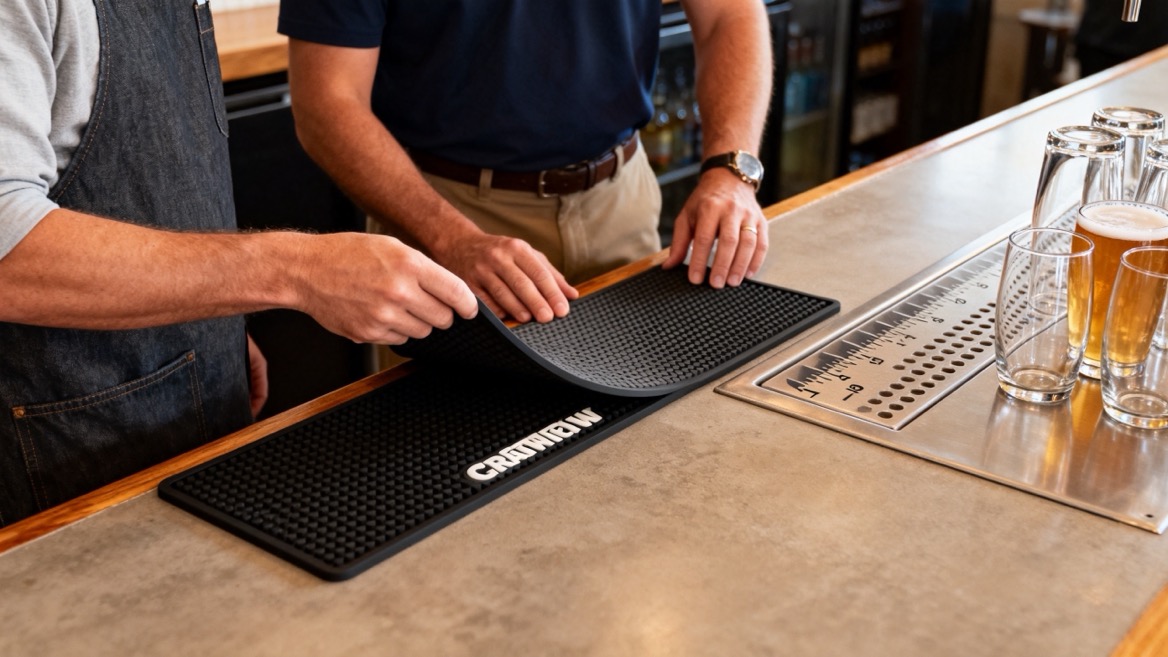
A brewery does not need an elaborate study to learn whether its new mats work. A short service trial gives more useful feedback than assumptions about promotional return.
Place the sample at its intended station for several normal shifts. Ask staff whether it stays in place, interferes with pouring, and is easy to lift at closing. Check whether liquid remains trapped beneath it. Look at the artwork from the guest side of the counter, including when glasses are on the mat.
Then make a simple keep-or-change decision:
- Keep the layout if staff can use and clean it easily and guests can see the main brand element.
- Adjust the size if it blocks equipment or leaves too little working space.
- Simplify the artwork if small text disappears at normal viewing distance.
- Reconsider the material or texture if the proposed cleaning routine proves unsuitable.
This is an operational assessment, not a claim that the mat has increased revenue. If a brewery wants to measure a promotional effect, it needs a separate method and a meaningful comparison—not an assumed return based on logo exposure.
At the end of service, remove loose debris, clean the mat using the manufacturer's instructions, rinse when appropriate, and allow it to dry before storage or reuse. Clean the counter beneath it as well. Address visible spills during service rather than waiting for the closing routine.
Follow the venue's applicable food-service procedures and the directions for any cleaning or sanitizing product. A general surface-cleaning guide is not a substitute for local requirements or the mat maker's material-specific instructions. Check the mat regularly for damage, persistent odors, or areas that are difficult to clean.
This routine also protects presentation. A logo covered by residue does not communicate care, however distinctive the artwork was when it left the factory.
A custom bar mat order is easier to manage when one team can discuss both design and production. Yijia Plastic Products Co., Ltd. describes itself as a manufacturer with 18 years of experience in PVC soft-gel products, integrating research and development, production, and sales. According to the company information supplied for this article, it operates a 3,000-square-meter factory with 10 automated production lines and multiple dispensing machines, and offers one-stop OEM/ODM customization.
Yijia also reports project experience with Starbucks, Disney, McDonald's, Pop Mart, and Tencent. Those names describe the company's stated collaboration history; they are not presented here as bar-mat endorsements, customer reviews, or proof of results for breweries. Any public use of client names or logos should be checked against the company's permissions.
The company reports documentation relating to RoHS, California Proposition 65, and Disney FAMA. Buyers should request current, order-relevant records and confirm what each document covers. In particular, Disney's FAMA is a facility-and-merchandise authorization tied to specified production arrangements, not a general product-quality certificate or blanket permission to manufacture Disney-branded goods.
For a brewery buyer, the most useful first conversation is concrete: send the counter measurements, artwork, intended quantity, target market, and service conditions. Then ask Yijia which production approach it recommends and what can be verified with a sample before the order proceeds.
Custom bar mats are popular because they combine a modest but useful service function with a highly visible place for brewery branding. Their success depends on fit, readable artwork, realistic material expectations, and a cleaning routine the team will actually follow.
Planning mats for a taproom, event, or partner-bar program? Send Yijia Plastic Products Co., Ltd. your counter dimensions, logo artwork, estimated quantity, and intended use. Request a design proof, a physical sample, and the product-specific documentation you need before approving production.
They can be, if they solve a real counter-layout need and the mat is visible to guests. Start with the busiest station rather than ordering for every surface. Test a sample during ordinary service before deciding on a larger quantity.
Provide the desired dimensions, quantity, artwork, number of colors, intended placement, target market, packaging needs, and delivery destination. Describe how the mat will be cleaned. These details make a quotation and sample review more useful.
No. PVC mats generally collect or contain minor liquid on their surface, depending on their texture and edge design. Staff still need to empty and clean them. They do not replace towels, drainage equipment, or spill-response procedures.
Do not assume so. Ask the manufacturer for instructions specific to the proposed formulation and construction. If machine washing is essential to your operation, state that requirement before selecting a material or approving a sample.
No. EU RoHS rules principally apply to electrical and electronic equipment. A test report may provide information about substances in a tested sample, but its scope must be checked. It should not be described as proof that an ordinary bar mat is universally "RoHS certified."
FAMA concerns authorization for Disney-branded production under specified arrangements. It is not a universal factory certification or permission for unrelated customers to use Disney artwork. Ask the manufacturer for the current documents relevant to your proposed project.
- Brewers Association, [*National Beer Sales & Production Data*]. Source for 2025 U.S. craft beer sales and brewery-count figures. [brewersassociation]
- Matt Gacioch, Brewers Association, [*2026 Midyear Report: Pressure Persists as Signs of Stability Emerge*], July 22, 2026. Source for first-half 2026 industry estimates and the comparison among brewery types. [brewersassociation]
- Bart Watson and Matt Gacioch, Brewers Association, [*Green Shoots: Where Craft Beer Goes From Here*], June 2, 2026. Industry analysis of hospitality-focused breweries and differentiation; it does not establish a causal sales benefit from bar mats. [brewersassociation]
- European Commission, [*Restriction of Hazardous Substances in Electrical and Electronic Equipment (RoHS)*]. Source for the directive's scope and restricted substances. [environment.ec.europa]
- California Office of Environmental Health Hazard Assessment, [*About Proposition 65*]. Source for the law's warning requirements and purpose. [oehha.ca]
- The Walt Disney Company, [*Facility and Merchandise Authorization Application Instructions*]. Source for the meaning and project-specific nature of FAMA authorization. [thewaltdisneycompany]
- U.S. Centers for Disease Control and Prevention, [*When and How to Clean and Disinfect a Facility*]. General background on cleaning surfaces and following product directions; not a bar-specific regulatory standard. [cdc]


